Species · Birds
Nubian Nightjar Caprimulgus nubicus
The scientific name of the Nubian Nightjar is Caprimulgus nubicus. It is a species of bird in the family Caprimulgidae (nightjar), order Caprimulgiformes. The name dates from 1823.
- Scientific name
- Caprimulgus nubicus M. H. K. Lichtenstein, 1823
- Common name
- Nubian Nightjar
- Genus
- Caprimulgus
- Family
- Caprimulgidae (Nightjar)
- Order
- Caprimulgiformes
- Class
- Aves
- Red List category
- LC Least Concern
- Environment
- terrestrial
- Recorded in
- 10 countries
- Name status
- accepted in the Catalogue of Life

Overview
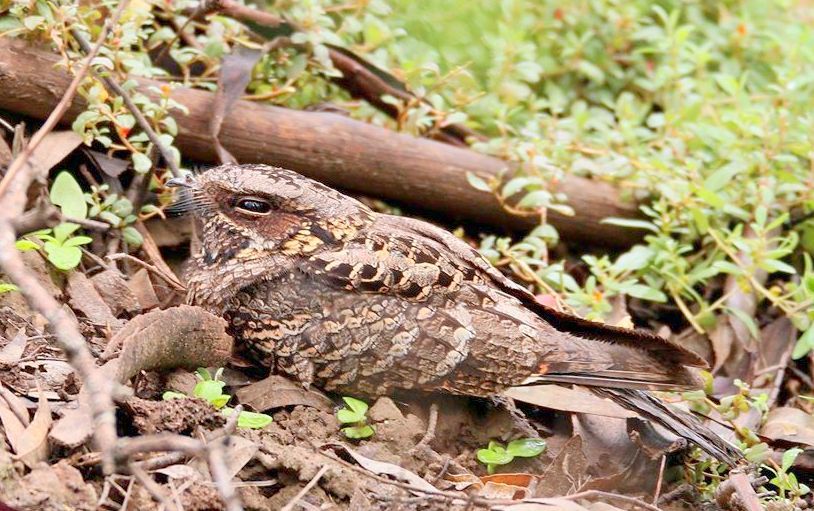
Caprimulgus nubicus occurs in salt marsh habitats. It has large eyes, a large beak, and a red-brown band across its neck.
Written 26 November 2026 from the sources listed below. Each statement was checked against the passage it cites; statements that could not be supported were removed.
Appearance
The Nubian Nightjar has large eyes and a large beak that assist its nocturnal hunting. It has a red-brown band across its neck.[1][2]
The white spots on its wings are positioned no farther from the wing tips than those of other nightjar species. It measures 20–22 cm in length.[3][4]
Habitat
The Nubian Nightjar occurs in salt marsh habitats. It is recorded in Djibouti, Egypt, Eritrea, Ethiopia, Israel, Kenya, Oman, Saudi Arabia, Somalia, Sudan, and Yemen.[5][6]
Behaviour
The Nubian Nightjar is nocturnal.[7]
Reproduction and life cycle
The Nubian Nightjar nests directly on the ground. Its nests occur in clusters containing one to three nests.[8][9]
The species is hypothesized to favor nesting sites near agricultural areas because they provide greater access to food.[10]
Similar species
The Nubian Nightjar resembles the Moorish nightjar but is smaller, has a shorter tail, and has blunter wings.[11]
Classification of the Nubian Nightjar
| Kingdom | Animalia |
|---|---|
| Phylum | Chordata |
| Subphylum | Vertebrata |
| Infraphylum | Gnathostomata |
| Parvphylum | Osteichthyes |
| Megaclass | Tetrapoda |
| Class | Aves (Bird) |
| Order | Caprimulgiformes (Nightjar) |
| Family | Caprimulgidae (Nightjar) |
| Genus | Caprimulgus (Nightjars) |
| Species | Caprimulgus nubicus M. H. K. Lichtenstein, 1823 |
Where the Nubian Nightjar is found
Checklists and occurrence records place Caprimulgus nubicus in 10 countries across Africa. GBIF holds 846 georeferenced records of it.
Countries
- Djibouti 56
- Ethiopia 15
- Israel 408
- Jordan 35
- Kenya 88
- Oman 6
- Saudi Arabia 146
- Somalia 49
- Sudan 13
- Yemen 30
Regions and cities with the most records
- Southern District, Israel 356
- Safi, Jordan 327
- Jazan Region, Saudi Arabia 81
- Abū ‘Arīsh, Saudi Arabia 47
- West Bank, Palestinian Territory 27
- Mecca Region, Saudi Arabia 26
- Jericho, Palestinian Territory 25
- Ma‘ale Adummim, Palestinian Territory 25
- Ḑamad, Saudi Arabia 25
- Taita Taveta, Kenya 19
- Şabyā, Saudi Arabia 18
- Karak, Jordan 17
- Thuwal, Saudi Arabia 17
- Al ‘Ayzarīyah, Palestinian Territory 16
- Bet She’an, Israel 14
- Northern District, Israel 14
- Afula, Israel 11
- Balbala, Djibouti 11
- Djibouti, Djibouti 11
- Janīn, Palestinian Territory 11
- Aqaba, Jordan 10
- Naẕerat ‘Illit, Israel 10
- Arta, Djibouti 9
- Samburu County, Kenya 9
- Āfar, Ethiopia 9
- Al Hudaydah, Yemen 8
- Al Yāmūn, Palestinian Territory 8
- Isiolo County, Kenya 8
- Yāfā, Israel 8
- Nazareth, Israel 7
- Kitui County, Kenya 6
- Maale Iron, Israel 6
- Qabāţīyah, Palestinian Territory 6
- Dhofar, Oman 5
- Laḩij, Yemen 5
- Metahāra, Ethiopia 5
Range as the checklists state it
Europe & Northern Asia (excluding China)
Africa
A number beside a place is its count of GBIF occurrence records. A place without a number comes from a checklist alone. Records show where a species has been observed or collected, which can include escapes and vagrants.
Common names
English
- Nubian Nightjar
- NUNI
Names in 30 other languages
- Breton
- Adren-Nubia
- Catalan
- enganyapastors núbic
- Croatian
- nubijski leganj
- Czech
- lelek núbijský
- Danish
- Nubisk Natravn
- Dutch
- nubische nachtzwaluw
- Esperanto
- Nubia kaprimulgo
- Estonian
- nuubia öösorr
- Finnish
- nuubiankehrääjä
- French
- Engoulevent de Nubie
- German
- Bajuda-Ziegenmelker, Bajudanachtschwalbe, Bajudaziegenmelker, Nubiennachtschwalbe, Nubischer Ziegenmelker
- Hebrew
- תחמס נובי
- Hungarian
- núbiai lappantyú
- Icelandic
- Nýfari
- Irish
- Tuirne núbiach
- Italian
- Succiacapre della Nubia
- Japanese
- サバクヨタカ
- Latvian
- Nūbijas vakarlēpis
- Lithuanian
- Nubinis lėlys
- Northern Sami
- Nubiačahran
- Norwegian Bokmål
- nubianattravn
- Polish
- lelek pustynny
- Portuguese
- Noitibó-da-núbia, notibó-núbio
- Russian
- Нубийский козодой
- Slovak
- lelek pustatinný
- Slovenian
- nubijska podhujka
- Spanish
- chotacabras nubio
- Swedish
- nubisk nattskärra
- Ukrainian
- дрімлюга нубійський
- Welsh
- troellwr Nwbia
Synonyms
One other scientific name has been used for this species and is now treated as a synonym of Caprimulgus nubicus.
- Caprimulgus nubicus nubicus Lichtenstein, MHC, 1823
Subspecies and varieties
- Caprimulgus nubicus jonesi subspecies
- Caprimulgus nubicus nubicus subspecies
- Caprimulgus nubicus tamaricis subspecies
- Caprimulgus nubicus torridus subspecies
Related species
-
 Pennant-winged NightjarCaprimulgus vexillarius
-
 European NightjarCaprimulgus europaeus
-
 Standard-winged NightjarCaprimulgus longipennis
-
 Egyptian NightjarCaprimulgus aegyptius
-
 Nechisar NightjarCaprimulgus solala
-
 Fiery-necked NightjarCaprimulgus pectoralis
-
 Indian NightjarCaprimulgus asiaticus
-
 Large-tailed NightjarCaprimulgus macrurus
Compare
Questions and answers
What is the scientific name of the Nubian Nightjar?
The scientific name of the Nubian Nightjar is Caprimulgus nubicus. Written with its author, the full name is Caprimulgus nubicus M. H. K. Lichtenstein, 1823.
Which family does the Nubian Nightjar belong to?
Caprimulgus nubicus belongs to the family Caprimulgidae, in the order Caprimulgiformes and the class Aves.
Where is the Nubian Nightjar found?
Checklists and occurrence records place Caprimulgus nubicus in 10 countries, including Israel, Saudi Arabia, Kenya, Djibouti, Somalia and Jordan.
What is the conservation status of the Nubian Nightjar?
The IUCN Red List category recorded for Caprimulgus nubicus is Least Concern (LC).
What other names does the Nubian Nightjar have?
Caprimulgus nubicus is also known in English as NUNI.
Sources
Passages the profile rests on
- The Nubian nightjar has large eyes and a large beak that assist its nocturnal hunting. Source passage: “It is a nocturnal species, known for its large eyes and beak, which help it hunt at night.” — English Wikipedia
- The Nubian nightjar has a red-brown band across its neck. Source passage: “Another characteristic feature is a red-brown band over the neck.” — English Wikipedia
- The white spots on the Nubian nightjar's wings are positioned no farther from the wing tips than those of other nightjar species. Source passage: “The white wing spots are not further away from the wing tips than other types of nightjars.” — English Wikipedia
- The Nubian nightjar measures 20–22 cm in length. Source passage: “The Nubian nightjar is 20–22 cm (7.9–8.7 in) long.” — English Wikipedia
- The Nubian nightjar occurs in salt marsh habitats. Source passage: “It is found in salt marshes of Djibouti, Egypt, Eritrea, Ethiopia, Israel, Kenya, Oman, Saudi Arabia, Somalia, Sudan, and Yemen.” — English Wikipedia
- The Nubian nightjar is recorded in Djibouti, Egypt, Eritrea, Ethiopia, Israel, Kenya, Oman, Saudi Arabia, Somalia, Sudan, and Yemen. Source passage: “It is found in salt marshes of Djibouti, Egypt, Eritrea, Ethiopia, Israel, Kenya, Oman, Saudi Arabia, Somalia, Sudan, and Yemen.” — English Wikipedia
- The Nubian nightjar is nocturnal. Source passage: “It is a nocturnal species, known for its large eyes and beak, which help it hunt at night.” — English Wikipedia
- The Nubian nightjar nests directly on the ground. Source passage: “Like other nightjars, the Nubian nightjar nests on the ground.” — English Wikipedia
- The Nubian nightjar's nests occur in clusters containing one to three nests. Source passage: “Its nests are clustered in small groups of 1 to 3.” — English Wikipedia
- The Nubian nightjar is hypothesized to favor nesting sites near agricultural areas because they provide greater access to food. Source passage: “It is hypothesized to prefer to nest near agricultural areas for greater access to food.” — English Wikipedia
- The Nubian nightjar resembles the Moorish nightjar but is smaller, has a shorter tail, and has blunter wings. Source passage: “The bird resembles the Moorish nightjar, but is smaller, has a shorter tail and blunt wings compared to the Moorish nightjar.” — English Wikipedia
Data
- Catalogue of Life, 2026-10-16 XR cc by
- Global Biodiversity Information Facility CC BY 4.0
- Wikidata CC0
- GeoNames CC BY 4.0
- Wikimedia Commons per image; credit shown with each image
- Within the Catalogue of Life, this name comes from The Integrated Taxonomic Information System cc0
References
- Gill, Frank, & and Minturn Wright. (2006). Birds of the World: Recommended English Names.
This species in other databases
- Catalogue of Life QSPM
- Wikidata Q1269353
- iNaturalist 19420
- WoRMS urn:lsid:marinespecies.org:taxname:212732
- Avibase nubnig1
Page built on 27 November 2026. See how the catalog is made and all sources and licences.
Cite this page
ScientificNames.org. (2026). Caprimulgus nubicus (Nubian Nightjar). Retrieved November 27, 2026, from https://scientificnames.org/species/caprimulgus-nubicus
“Caprimulgus nubicus (Nubian Nightjar).” ScientificNames.org, 2026, scientificnames.org/species/caprimulgus-nubicus. Accessed 27 Nov. 2026.
ScientificNames.org. “Caprimulgus nubicus (Nubian Nightjar).” Accessed November 27, 2026. https://scientificnames.org/species/caprimulgus-nubicus.
@misc{scientificnames_caprimulgus_nubicus_nubian_nightjar,
  author = {{ScientificNames.org}},
  title = {Caprimulgus nubicus (Nubian Nightjar)},
  year = {2026},
  url = {https://scientificnames.org/species/caprimulgus-nubicus},
  note = {Accessed 2026-11-27}
}