Species · Birds
Palau Nightjar Caprimulgus phalaena
The scientific name of the Palau Nightjar is Caprimulgus phalaena. It is a species of bird in the family Caprimulgidae (nightjar), order Caprimulgiformes. The name dates from 1872.
- Scientific name
- Caprimulgus phalaena Hartlaub & Finsch, 1872
- Common name
- Palau Nightjar
- Genus
- Caprimulgus
- Family
- Caprimulgidae (Nightjar)
- Order
- Caprimulgiformes
- Class
- Aves
- Red List category
- LC Least Concern
- Recorded in
- 1 country
- Name status
- accepted in the Catalogue of Life
Overview
The Palau Nightjar (Caprimulgus phalaena) is a bird in the family Caprimulgidae, order Caprimulgiformes and class Aves. The species is endemic to Palau and occurs on Arakabesan, Babelthuap, Koror and Peleliu. It has greyish-brown plumage, white patches on each side of its throat and white tips on its outer tail and wings.
Written 26 November 2026 from the sources listed below. Each statement was checked against the passage it cites; statements that could not be supported were removed.
Habitat
The Palau Nightjar is endemic to Palau. It occurs on four islands: Arakabesan, Babelthuap, Koror and Peleliu.[1][2]
Appearance
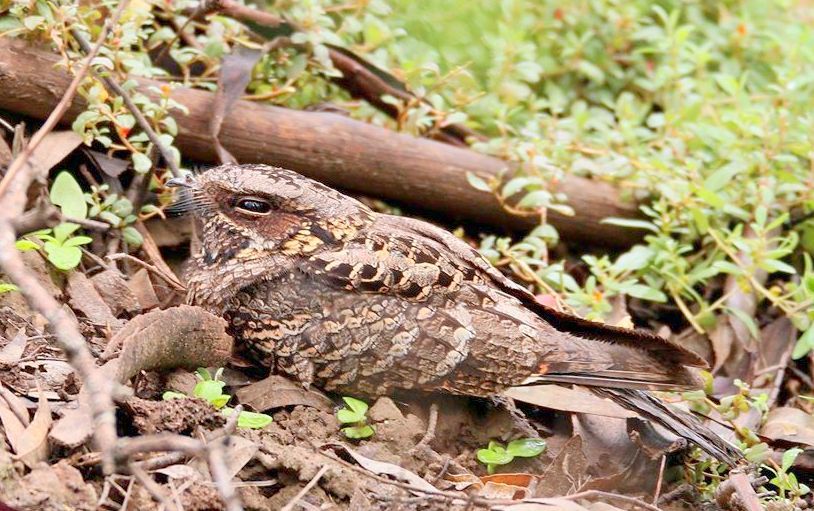
The Palau Nightjar has greyish-brown plumage and is sexually dimorphic. Its forehead, crown and nape are greyish-brown, while its mantle, back, rump and uppertail-coverts have brown speckling.[3][4][5]
The species has an indistinct pale or tawny-buff collar around its hindneck and a large white patch on each side of its throat. Its chin, belly and flanks are buff-brown.[6][7][8]
The bill is brownish or blackish, and the legs are brownish. Females resemble males but often have a stronger rufous tinge.[9][10]
Immature birds resemble females, while juveniles resemble immature birds but have paler plumage. The chick has not been described.[11][12][13]
The species is described as small and greyish-brown, with a chestnut neck, back and central tail. Its outer tail and wings have white tips visible in flight.[14][15]
The IUCN factsheet describes the Palau Nightjar as a fairly small, brown nightjar with chestnut-brown coloration.[16]
Diet
The Palau Nightjar feeds on moths, crickets and beetles.[17]
Behaviour
The Palau Nightjar is crepuscular. It is frequently observed on leaf litter on the ground or on branches.[18][19]
The species frequently perches on roads and tracks at night.[20]
The species produces a call resembling that of the grey nightjar. Its call consists of up to 14 or more loud tok notes, delivered at a slower rate than the grey nightjar.[21][22][23]
Reproduction and life cycle
The reported breeding season extends from April through August. The species does not construct a nest and lays its eggs directly on bare ground or leaf litter.[24][25][26]
Clutches contain one or two eggs.[27]
Conservation
The Palau Nightjar is classified as Least Concern by the IUCN. Its population is stable, with an estimated 1,000 to 2,499 individuals.[28][29][30]
Similar species
The Palau Nightjar was formerly considered conspecific with the jungle nightjar and the grey nightjar. Caprimulgus phalaena was previously grouped with Caprimulgus indicus and Caprimulgus jotaka under the name Caprimulgus indicus.[31][32]
Classification of the Palau Nightjar
| Kingdom | Animalia |
|---|---|
| Phylum | Chordata |
| Subphylum | Vertebrata |
| Infraphylum | Gnathostomata |
| Parvphylum | Osteichthyes |
| Megaclass | Tetrapoda |
| Class | Aves (Bird) |
| Order | Caprimulgiformes (Nightjar) |
| Family | Caprimulgidae (Nightjar) |
| Genus | Caprimulgus (Nightjars) |
| Species | Caprimulgus phalaena Hartlaub & Finsch, 1872 |
Where the Palau Nightjar is found
Checklists and occurrence records place Caprimulgus phalaena in 1 country across Oceania. GBIF holds 225 georeferenced records of it.
Countries
Regions and cities with the most records
- Ngerulmud, Palau 146
- Airai, Palau 130
- Koror, Palau 58
- Peleliu, Palau 7
- Ngardmau, Palau 5
- Ngeremlengui, Palau 5
- Ngaraard, Palau 4
Range as the checklists state it
Oceania
A number beside a place is its count of GBIF occurrence records. A place without a number comes from a checklist alone. Records show where a species has been observed or collected, which can include escapes and vagrants.
Common names
English
- Palau Nightjar
Names in 21 other languages
- Catalan
- enganyapastors de les illes Palau
- Chinese
- 帕劳夜鹰, 帛琉夜鷹
- Croatian
- palauski leganj
- Danish
- Palaunatravn
- Dutch
- Palaunachtzwaluw
- Esperanto
- palaŭa kaprimulgo
- French
- Engoulevent de Palau, Engoulevent des Palau
- German
- Palaunachtschwalbe
- Japanese
- パラオヨタカ
- Lithuanian
- Palaujinis lėlys
- Norwegian
- palaunattravn
- Polish
- lelek koralowy
- Portuguese
- noitibó-de-palau
- Russian
- Палауский козодой
- Serbian
- Leganj sa ostrva Palau
- Slovak
- lelek palauský
- Spanish
- Chotacabras de Palaos
- Swedish
- palaunattskärra
- Turkish
- Palau Çobanaldatanı
- Ukrainian
- дрімлюга палауський
- pau
- Chebacheb
Synonyms
2 other scientific names have been used for this species and are now treated as synonyms of Caprimulgus phalaena.
- Caprimulgus indicus phalaena Hartlaub & Finsch, 1872
- Caprimulgus jotaka phalaena Finsch, FHO; Hartlaub, KJG, 1872
Related species
-
 Pennant-winged NightjarCaprimulgus vexillarius
-
 European NightjarCaprimulgus europaeus
-
 Standard-winged NightjarCaprimulgus longipennis
-
 Egyptian NightjarCaprimulgus aegyptius
-
 Nechisar NightjarCaprimulgus solala
-
 Fiery-necked NightjarCaprimulgus pectoralis
-
 Indian NightjarCaprimulgus asiaticus
-
 Large-tailed NightjarCaprimulgus macrurus
Compare
Questions and answers
What is the scientific name of the Palau Nightjar?
The scientific name of the Palau Nightjar is Caprimulgus phalaena. Written with its author, the full name is Caprimulgus phalaena Hartlaub & Finsch, 1872.
Which family does the Palau Nightjar belong to?
Caprimulgus phalaena belongs to the family Caprimulgidae, in the order Caprimulgiformes and the class Aves.
Where is the Palau Nightjar found?
Checklists and occurrence records place Caprimulgus phalaena in 1 country: Palau.
What is the conservation status of the Palau Nightjar?
The IUCN Red List category recorded for Caprimulgus phalaena is Least Concern (LC).
What is a Nightjar diet?
The Palau Nightjar feeds on moths, crickets and beetles.[17]
Sources
Passages the profile rests on
- The Palau nightjar is endemic to Palau. Source passage: “The Palau nightjar (Caprimulgus phalaena) is a species of nightjar endemic to Palau.” — English Wikipedia
- The species occurs on four Palauan islands: Arakabesan, Babelthuap, Koror and Peleliu. Source passage: “This species is found only in four islands in Palau- Arakabesan, Babelthuap, Koror and Peleliu.” — English Wikipedia
- The Palau nightjar has greyish-brown plumage and is sexually dimorphic. Source passage: “It is a large, greyish-brown nightjar, 28-32 cm in length, and it is sexually dimorphic.” — English Wikipedia
- The forehead, crown and nape are greyish-brown. Source passage: “The forehead, crown and nape of this species is greyish-brown” — English Wikipedia
- The mantle, back, rump and uppertail-coverts have brown speckling. Source passage: “the mantle, back, rump and uppertail-coverts are speckled brown.” — English Wikipedia
- The species has an indistinct pale or tawny-buff collar around its hindneck. Source passage: “There is an indistinct pale or tawny buff collar around the hindneck.” — English Wikipedia
- The species has a large white patch on each side of its throat. Source passage: “There is a large-white patch in each side of the throat” — English Wikipedia
- The chin, belly and flanks are buff-brown. Source passage: “the chin, belly and flanks are buff-brown.” — English Wikipedia
- The bill is brownish or blackish, while the legs are brownish. Source passage: “The bill is brownish or blackish and the legs are brownish.” — English Wikipedia
- Females resemble males but often have a stronger rufous tinge. Source passage: “The female is similar to the male but is often more heavily tinged rufous.” — English Wikipedia
- Immature birds resemble females. Source passage: “The immature is similar to the female.” — English Wikipedia
- Juveniles resemble immature birds but have paler plumage. Source passage: “The juvenile is similar to the immature but paler.” — English Wikipedia
- The chick has not been described. Source passage: “The chick has not been described.” — English Wikipedia
- The species is described as small and greyish-brown, with a chestnut neck, back and central tail. Source passage: “A small grayish-brown nightjar with a chestnut neck, back, and central tail.” — ebird.org
- The species has white tips on its outer tail and wings that are visible in flight. Source passage: “white tips to outer tail and wings in flight.” — ebird.org
- The IUCN factsheet describes the species as a fairly small, brown nightjar with chestnut-brown coloration. Source passage: “A fairly small, brown nightjar with chestnut-brown on” — iucnredlist.org
- The species feeds on moths, crickets and beetles. Source passage: “Its diet consists of moths, crickets and beetles.” — English Wikipedia
- The species is crepuscular. Source passage: “Like most nightjars it is crepuscular” — English Wikipedia
- The species is frequently observed on leaf litter on the ground or on branches. Source passage: “is frequently spotted on leaf litter on the ground or on branches.” — English Wikipedia
- The species frequently perches on roads and tracks at night. Source passage: “It frequently sits on roads and tracks at night.” — English Wikipedia
- The species produces a call resembling that of the grey nightjar. Source passage: “It makes a call similar to that of the grey nightjar” — English Wikipedia
- Its call consists of up to 14 or more loud tok notes. Source passage: “a series of up to 14 or more loud tok tok tok” — English Wikipedia
- The species delivers its tok call at a slower rate than the grey nightjar. Source passage: “although it is delivered at a slower rate.” — English Wikipedia
- The reported breeding season extends from April through August. Source passage: “The breeding season has been reported to be from April to August.” — English Wikipedia
- The species does not construct a nest. Source passage: “This species does not make a nest” — English Wikipedia
- The species lays its eggs directly on bare ground or leaf litter. Source passage: “it lays its eggs on bare ground or on leaf litter.” — English Wikipedia
- Clutches contain one or two eggs. Source passage: “The clutch size is 1 to 2 eggs.” — English Wikipedia
- The Palau nightjar is classified as Least Concern by the IUCN. Source passage: “It is considered as Least-concern by the IUCN” — English Wikipedia
- The species has a stable population. Source passage: “with a stable population of 1,000 to 2,499 individuals.” — English Wikipedia
- The estimated population is between 1,000 and 2,499 individuals. Source passage: “1,000 to 2,499 individuals.” — English Wikipedia
- The species was formerly considered conspecific with the jungle nightjar and the grey nightjar. Source passage: “This species was formerly considered to be conspecific with the jungle nightjar and the grey nightjar.” — English Wikipedia
- Caprimulgus phalaena was previously grouped with Caprimulgus indicus and Caprimulgus jotaka under the name Caprimulgus indicus. Source passage: “Caprimulgus indicus, C. jotaka and C. phalaena (del Hoyo and Collar 2014) were previously lumped as C. indicus following Sibley and Monroe (1990, 1993).” — datazone.birdlife.org
Data
- Catalogue of Life, 2026-10-16 XR cc by
- Global Biodiversity Information Facility CC BY 4.0
- Wikidata CC0
- GeoNames CC BY 4.0
- Within the Catalogue of Life, this name comes from The Integrated Taxonomic Information System cc0
References
- Hartlaub, G., and O. Finsch. (1872). On a fourth Collection of Birds from the Pelew and Mackenzie Islands. Proceedings of the Zoological Society of London, Vol. 40, No. 6. where the name was published
This species in other databases
Page built on 29 November 2026. See how the catalog is made and all sources and licences.
Cite this page
ScientificNames.org. (2026). Caprimulgus phalaena (Palau Nightjar). Retrieved November 29, 2026, from https://scientificnames.org/species/caprimulgus-phalaena
“Caprimulgus phalaena (Palau Nightjar).” ScientificNames.org, 2026, scientificnames.org/species/caprimulgus-phalaena. Accessed 29 Nov. 2026.
ScientificNames.org. “Caprimulgus phalaena (Palau Nightjar).” Accessed November 29, 2026. https://scientificnames.org/species/caprimulgus-phalaena.
@misc{scientificnames_caprimulgus_phalaena_palau_nightjar,
  author = {{ScientificNames.org}},
  title = {Caprimulgus phalaena (Palau Nightjar)},
  year = {2026},
  url = {https://scientificnames.org/species/caprimulgus-phalaena},
  note = {Accessed 2026-11-29}
}