Species · Birds
Rufous-cheeked Nightjar Caprimulgus rufigena
The scientific name of the Rufous-cheeked Nightjar is Caprimulgus rufigena. It is a species of bird in the family Caprimulgidae (nightjar), order Caprimulgiformes. The name dates from 1845.
- Scientific name
- Caprimulgus rufigena A. Smith, 1845
- Common name
- Rufous-cheeked Nightjar
- Genus
- Caprimulgus
- Family
- Caprimulgidae (Nightjar)
- Order
- Caprimulgiformes
- Class
- Aves
- Red List category
- LC Least Concern
- Recorded in
- 14 countries
- Name status
- accepted in the Catalogue of Life

Overview
Caprimulgus rufigena occurs throughout the year in Southern Africa and occupies woodland, savanna, shrubland, and semi-desert habitats. It has a dark brown body with rufous-coloured spots, and males and females have different markings on their primary feathers and tail corners.
Written 26 November 2026 from the sources listed below. Each statement was checked against the passage it cites; statements that could not be supported were removed.
Similar species
The Rufous-cheeked Nightjar resembles the Fiery-necked Nightjar in general appearance but is paler.[1][2]
Appearance
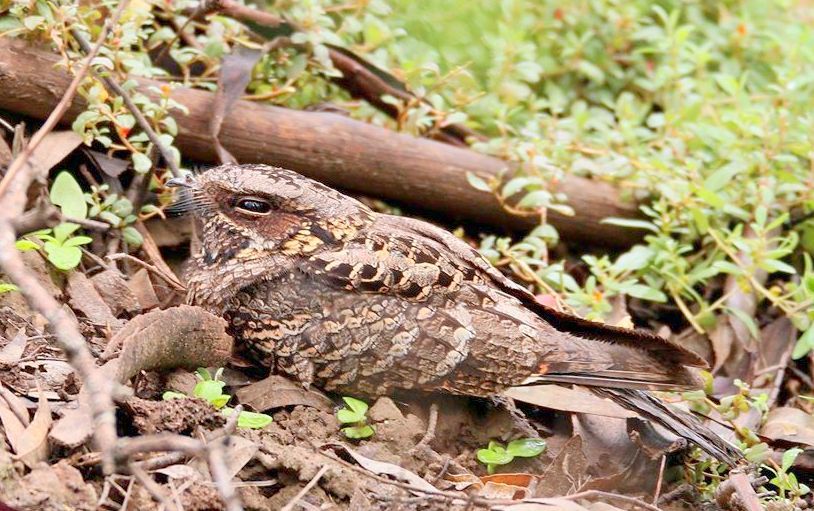
The Rufous-cheeked Nightjar has a dark brown body decorated with rufous-coloured spots and a relatively indistinct rufous-coloured collar. It has a short, slightly curved black beak.[3][4]
Males have white markings on their primary feathers and tail corners, while females have buff markings in these areas.[5][6]
Its plumage provides camouflage against the substrate of its preferred habitat. Juveniles have down feathers with a disruptive counter-shading pattern.[7][8]
The species measures approximately 23–24 cm in height. Males weigh between 48 and 65 g, while females weigh between 46 and 66 g.[9][10][11]
Habitat
The Rufous-cheeked Nightjar inhabits miombo woodland, wooded savanna, woodland edges and clearings. It also occupies semi-arid acacia shrubland and semi-desert habitats.[12][13]
For breeding and nesting, the species prefers dry areas and avoids moist habitats, rivers, lakes, and valleys. Outside wooded habitats, it prefers bare ground, particularly recently burned areas.[14][15]
Diet
Beetles are the primary food of the Rufous-cheeked Nightjar. It also consumes moths, grasshoppers, and other flying insects.[16][17]
Behaviour
The Rufous-cheeked Nightjar is nocturnal and primarily hunts during dusk and the early night. It has also been observed hunting in moonlight and at dawn.[18][19]
The species uses its large eyes to locate prey in darkness but cannot see in complete darkness. It frequently leaves its territories to hunt in different habitats.[20][21]
The Rufous-cheeked Nightjar can drink water while flying over open woodlands and waterholes. It also hunts near roads where insects gather around street lights.[22][23]
The species commonly perches close to the ground while watching for prey. After spotting prey, it can leap towards it, capture it, and return to its original perch.[24][25]
The species produces two main flight calls, described as an upbeat repeated call and a harsh repeated call. Its territorial churring call can reach a rate of 37.5 notes per second.[26][27]
When another male enters its territory, a Rufous-cheeked Nightjar responds with an oaring call. When a female enters its territory, a male responds with a purring song.[28][29]
Reproduction and life cycle
Rufous-cheeked Nightjars form monogamous breeding pairs. The usual breeding period extends from September through November.[30][31]
Both parents participate in nest protection, with males attending at night and females during the day. A typical clutch contains two eggs, although single-egg clutches have also been recorded.[32][33]
Egg incubation lasts approximately 15–17 days. The eggs are generally pale pinkish-cream and glossy, with an average size of 27.17 × 20.09 mm and an average mass of 5.86 g.[34][35][36][37]
The species does not construct conventional nests but lays its eggs in shallow grooves on the ground. It uses quartzite blocks as landmarks to locate its nesting sites.[38][39]
Uses
Caprimulgus rufigena damarensis occurs in western Angola, Namibia, Botswana, and northwestern South Africa. Caprimulgus rufigena rufigena occurs in southwestern Zambia, Zimbabwe, and central, eastern, and southern South Africa.[40][41]
Classification of the Rufous-cheeked Nightjar
| Kingdom | Animalia |
|---|---|
| Phylum | Chordata |
| Subphylum | Vertebrata |
| Infraphylum | Gnathostomata |
| Parvphylum | Osteichthyes |
| Megaclass | Tetrapoda |
| Class | Aves (Bird) |
| Order | Caprimulgiformes (Nightjar) |
| Family | Caprimulgidae (Nightjar) |
| Genus | Caprimulgus (Nightjars) |
| Species | Caprimulgus rufigena A. Smith, 1845 |
Where the Rufous-cheeked Nightjar is found
Checklists and occurrence records place Caprimulgus rufigena in 14 countries across Africa. GBIF holds 10,262 georeferenced records of it.
Countries
- Angola 69
- Botswana 387
- Cameroon 3
- Democratic Republic of the Congo 14
- Ethiopia 26
- Kenya 50
- Mozambique 3
- Namibia 1,501
- Nigeria 10
- Republic of the Congo 6
- South Africa 7,900
- Uganda 3
- Zambia 48
- Zimbabwe 242
Regions and cities with the most records
- Northern Cape, South Africa 1,807
- Limpopo, South Africa 1,500
- North West, South Africa 1,343
- Gauteng, South Africa 1,107
- Western Cape, South Africa 823
- Free State, South Africa 646
- Oshikoto Region, Namibia 314
- Mpumalanga, South Africa 307
- Kunene Region, Namibia 283
- Krugersdorp, South Africa 260
- Bagale, South Africa 230
- Modimolle, South Africa 220
- Kimberley, South Africa 219
- Oshana Region, Namibia 217
- Kgalagadi, Botswana 203
- Beaufort West, South Africa 184
- Centurion, South Africa 182
- Pretoria, South Africa 177
- Roodepoort, South Africa 166
- Midstream, South Africa 165
- Thembisa, South Africa 165
- Randburg, South Africa 162
- Khomas Region, Namibia 153
- Randfontein, South Africa 146
- Hammanskraal, South Africa 135
- Matabeleland North, Zimbabwe 135
- Eastern Cape, South Africa 134
- Midrand, South Africa 126
- Mookgophong, South Africa 126
- Hartbeestfontein-A, South Africa 123
- North-West, Botswana 122
- Otjozondjupa Region, Namibia 119
- Bela Bela, South Africa 107
- Bloemfontein, South Africa 105
- Verena, South Africa 97
- Johannesburg, South Africa 90
1 more country has a few records outside this range
These countries hold a few records of Caprimulgus rufigena but lie outside the range the checklists give for it. Such records are often zoo or garden specimens, museum material or vagrants, so the species is not counted as occurring there.
Range as the checklists state it
Africa
A number beside a place is its count of GBIF occurrence records. A place without a number comes from a checklist alone. Records show where a species has been observed or collected, which can include escapes and vagrants.
Common names
English
- Rufous-cheeked Nightjar
- RCNI
Names in 28 other languages
- Afrikaans
- Rooiwangnaguil
- Catalan
- enganyapastors de galtes rogenques
- Chinese
- 棕頰夜鷹, 棕颊夜鹰
- Croatian
- zlatnopjegavi leganj
- Czech
- lelek rezavolící
- Danish
- Rødkindet Natravn
- Dutch
- Roodwangnachtzwaluw
- Esperanto
- rufavanga kaprimulgo
- Estonian
- lõuna-öösorr
- Finnish
- rusoposkikehrääjä
- French
- Engoulevent à joues rousses
- German
- Rostwangen-Nachtschwalbe, Rostwangennachtschwalbe
- Hungarian
- namíbiai lappantyú
- Italian
- Succiacapre guancerossicce
- Japanese
- ホオアカヨタカ
- Lithuanian
- rusvaskruostis lėlys
- Norwegian
- rustkinnattravn
- Norwegian Bokmål
- Rødkinnnattravn
- Polish
- lelek akacjowy
- Portuguese
- noitibó-de-faces-ruivas
- Russian
- Рыжещёкий козодой
- Serbian
- Riđoliki leganj
- Slovak
- lelek hrdzavolíci
- Spanish
- Chotacabras carirrojo
- Swedish
- rödkindad nattskärra
- Turkish
- Kızıl Yanaklı Çobanaldatan
- Ukrainian
- дрімлюга акацієвий
- Welsh
- troellwr bochgoch
Synonyms
One other scientific name has been used for this species and is now treated as a synonym of Caprimulgus rufigena.
- Nyctictypus rufigena
Subspecies and varieties
- Caprimulgus rufigena damarensis subspecies
- Caprimulgus rufigena rufigena subspecies
Related species
-
 Pennant-winged NightjarCaprimulgus vexillarius
-
 European NightjarCaprimulgus europaeus
-
 Standard-winged NightjarCaprimulgus longipennis
-
 Egyptian NightjarCaprimulgus aegyptius
-
 Nechisar NightjarCaprimulgus solala
-
 Fiery-necked NightjarCaprimulgus pectoralis
-
 Indian NightjarCaprimulgus asiaticus
-
 Large-tailed NightjarCaprimulgus macrurus
Compare
Questions and answers
What is the scientific name of the Rufous-cheeked Nightjar?
The scientific name of the Rufous-cheeked Nightjar is Caprimulgus rufigena. Written with its author, the full name is Caprimulgus rufigena A. Smith, 1845.
Which family does the Rufous-cheeked Nightjar belong to?
Caprimulgus rufigena belongs to the family Caprimulgidae, in the order Caprimulgiformes and the class Aves.
Where is the Rufous-cheeked Nightjar found?
Checklists and occurrence records place Caprimulgus rufigena in 14 countries, including South Africa, Namibia, Botswana, Zimbabwe, Angola and Kenya.
What is the conservation status of the Rufous-cheeked Nightjar?
The IUCN Red List category recorded for Caprimulgus rufigena is Least Concern (LC).
What other names does the Rufous-cheeked Nightjar have?
Caprimulgus rufigena is also known in English as RCNI.
Sources
Passages the profile rests on
- The Rufous-cheeked Nightjar resembles the Fiery-necked Nightjar in general appearance. Source passage: “Similar to that of the fiery-necked nightjar” — English Wikipedia
- The Rufous-cheeked Nightjar is paler than the Fiery-necked Nightjar. Source passage: “Paler than the fiery-necked nightjar” — English Wikipedia
- The Rufous-cheeked Nightjar has a dark brown body decorated with rufous-coloured spots and a relatively indistinct rufous-coloured collar. Source passage: “the rufous-necked nightjar has a dark brown body decorated with rufous-coloured spots and a less distinct rufous-coloured collar.” — English Wikipedia
- The species has a short, slightly curved black beak. Source passage: “it has a short, slightly curved black beak.” — English Wikipedia
- Male Rufous-cheeked Nightjars have white markings on their primary feathers and tail corners. Source passage: “A male has white marks on the primaries and the tail corner” — English Wikipedia
- Female Rufous-cheeked Nightjars have buff markings on their primary feathers and tail corners. Source passage: “while in females it is buff.” — English Wikipedia
- The species' plumage provides camouflage against the substrate of its preferred habitat. Source passage: “Its colours allow it to camouflage perfectly with the substrate of its preferred habitat.” — English Wikipedia
- Juvenile Rufous-cheeked Nightjars have down feathers with a disruptive counter-shading pattern. Source passage: “Juvenile down feathers give the young a disrupting counter-shading pattern” — English Wikipedia
- The Rufous-cheeked Nightjar measures approximately 23–24 cm in height. Source passage: “the rufous-cheeked nightjar is 23–24 cm tall” — English Wikipedia
- Male Rufous-cheeked Nightjars weigh between 48 and 65 g. Source passage: “a male weighing 48-65g” — English Wikipedia
- Female Rufous-cheeked Nightjars weigh between 46 and 66 g. Source passage: “a female weighing 46-66g” — English Wikipedia
- The species inhabits miombo woodland, wooded savanna, and woodland edges and clearings. Source passage: “It can usually be found in wooded habitats such as the miombo woodland, wooded savanna, and woodland edges and clearings.” — English Wikipedia
- The Rufous-cheeked Nightjar also occupies semi-arid acacia shrubland and semi-desert habitats. Source passage: “It can also be found in more open habitats such as the semi-arid acacia shrubland and semi-deserts.” — English Wikipedia
- For breeding and nesting, the species prefers dry areas and avoids moist habitats, rivers, lakes, and valleys. Source passage: “For breeding and nesting they prefer dryer areas and avoid rivers, lakes, valleys, as well as moist areas.” — English Wikipedia
- When nesting outside wooded habitats, the species prefers bare ground, particularly recently burned areas. Source passage: “when they nest outside wooded areas, they prefer bare areas often those that have been recently burned down.” — English Wikipedia
- Beetles are the primary food of the Rufous-cheeked Nightjar. Source passage: “They primarily eat beetles” — English Wikipedia
- The species also consumes moths, grasshoppers, and other flying insects. Source passage: “but also eat moths, grasshoppers and other flying insects.” — English Wikipedia
- The Rufous-cheeked Nightjar is nocturnal and primarily hunts during dusk and the early night. Source passage: “The rufous-cheeked nightjar primarily hunts at dusk and early night” — English Wikipedia
- The species has also been observed hunting in moonlight and at dawn. Source passage: “but has also been seen to hunt in the moonlight and at dawn.” — English Wikipedia
- The species uses its large eyes to locate prey in darkness but cannot see in complete darkness. Source passage: “their large eyes which are well-equipped to see in the dark, however they cannot see in complete darkness.” — English Wikipedia
- Rufous-cheeked Nightjars frequently leave their territories to hunt in different habitats. Source passage: “Nightjars frequently leave their territory while hunting, and even travel to different habitats.” — English Wikipedia
- The species can drink water while flying over open woodlands and waterholes. Source passage: “It in open woodlands and waterholes where it can drink water while flying” — English Wikipedia
- The species also hunts near roads where insects gather around street lights. Source passage: “they also hunt by roads where insects gather because they are attracted to street lights.” — English Wikipedia
- Rufous-cheeked Nightjars commonly perch close to the ground while watching for prey. Source passage: “They primarily perch low to the ground to watch their prey” — English Wikipedia
- After spotting prey, the bird can leap towards it, capture it, and return to its original perch. Source passage: “once spotted they will leap towards it, snatch it, and land back on the same spot they started.” — English Wikipedia
- The species produces two main flight calls, described as an upbeat repeated call and a harsh repeated call. Source passage: “One is an upbeat "Q! Q! Q! Q!" and the other is a harsh "oar! oar! oar!"” — English Wikipedia
- The territorial churring call can reach a rate of 37.5 notes per second. Source passage: “the nightjar starts churring at 31 and 32–37.5 notes/second” — English Wikipedia
- When another male enters its territory, a Rufous-cheeked Nightjar responds with an oaring call. Source passage: “A male will be met with oaring similar to that of the flight call” — English Wikipedia
- When a female enters its territory, a male Rufous-cheeked Nightjar responds with a purring song. Source passage: “while a female will be sung a song that sounds like purring.” — English Wikipedia
- Rufous-cheeked Nightjars form monogamous breeding pairs. Source passage: “Rufous-cheeked nightjars are a monogamous species” — English Wikipedia
- The usual breeding period extends from September through November. Source passage: “The breeding period usually takes place from September to November.” — English Wikipedia
- Both parents participate in nest protection, with males attending at night and females during the day. Source passage: “both partners watch over the nest with the male watching the nest at night and the female during the day.” — English Wikipedia
- A typical clutch contains two eggs, although single-egg clutches have also been recorded. Source passage: “The rufous-cheeked nightjar usually lays two eggs per clutch with an incubation period of 15–17 days, however they have been seen to lay only one egg.” — English Wikipedia
- Egg incubation lasts approximately 15–17 days. Source passage: “with an incubation period of 15–17 days” — English Wikipedia
- The eggs are generally pale pinkish-cream and glossy. Source passage: “The eggs are glossy and are usually a pale pinkish-cream colour.” — English Wikipedia
- The eggs measure an average of 27.17 × 20.09 mm. Source passage: “The eggs are on average 27.17 x 20.09 mm” — English Wikipedia
- The eggs have an average mass of 5.86 g. Source passage: “and weigh on average 5.86g.” — English Wikipedia
- The species does not construct conventional nests but lays its eggs in shallow grooves on the ground. Source passage: “Rufous-cheeked nightjars do not make nests, they simply make small grooves on the floor of their chosen spot and lay their eggs in there.” — English Wikipedia
- Rufous-cheeked Nightjars use quartzite blocks as landmarks to locate their nesting sites. Source passage: “the rufous-cheeked nightjar uses quartzite blocks as landmarks to lead them to their nest.” — English Wikipedia
- The subspecies Caprimulgus rufigena damarensis occurs in western Angola, Namibia, Botswana, and northwestern South Africa. Source passage: “C. r. damarensis Strickland, 1853 – west Angola, Namibia, Botswana and northwest South Africa” — English Wikipedia
- The subspecies Caprimulgus rufigena rufigena occurs in southwestern Zambia, Zimbabwe, and central, eastern, and southern South Africa. Source passage: “C. r. rufigena Smith, A, 1845 – southwest Zambia, Zimbabwe and central, east, south South Africa” — English Wikipedia
Data
- Catalogue of Life, 2026-10-16 XR cc by
- Global Biodiversity Information Facility CC BY 4.0
- Wikidata CC0
- GeoNames CC BY 4.0
- Wikimedia Commons per image; credit shown with each image
- Within the Catalogue of Life, this name comes from The Integrated Taxonomic Information System cc0
References
- Gill, Frank, & and Minturn Wright. (2006). Birds of the World: Recommended English Names.
This species in other databases
Page built on 29 November 2026. See how the catalog is made and all sources and licences.
Cite this page
ScientificNames.org. (2026). Caprimulgus rufigena (Rufous-cheeked Nightjar). Retrieved November 29, 2026, from https://scientificnames.org/species/caprimulgus-rufigena
“Caprimulgus rufigena (Rufous-cheeked Nightjar).” ScientificNames.org, 2026, scientificnames.org/species/caprimulgus-rufigena. Accessed 29 Nov. 2026.
ScientificNames.org. “Caprimulgus rufigena (Rufous-cheeked Nightjar).” Accessed November 29, 2026. https://scientificnames.org/species/caprimulgus-rufigena.
@misc{scientificnames_caprimulgus_rufigena_rufous_cheeked_nightjar,
  author = {{ScientificNames.org}},
  title = {Caprimulgus rufigena (Rufous-cheeked Nightjar)},
  year = {2026},
  url = {https://scientificnames.org/species/caprimulgus-rufigena},
  note = {Accessed 2026-11-29}
}