Species · Birds · Extinct
Bonin Grosbeak Carpodacus ferreorostris
The scientific name of the Bonin Grosbeak is Carpodacus ferreorostris. It is an extinct species of bird in the family Fringillidae (finch), order Passeriformes. The name dates from 1829.
- Scientific name
- Carpodacus ferreorostris (Vigors, 1829)
- Common name
- Bonin Grosbeak
- Genus
- Carpodacus
- Family
- Fringillidae (Finch)
- Order
- Passeriformes
- Class
- Aves
- Red List category
- EX Extinct
- Name status
- accepted in the Catalogue of Life

Overview
The Bonin Grosbeak was a finch classified among birds commonly called grosbeaks. The species was recorded only on Chichi-jima in the Ogasawara Islands. It was retiring but not shy and fed on fruits and buds, primarily collecting food from the ground or low shrubs.
Written 26 November 2026 from the sources listed below. Each statement was checked against the passage it cites; statements that could not be supported were removed.
Appearance
The Bonin Grosbeak was a finch classified among birds commonly called grosbeaks. Contemporary illustrations show considerable differences, particularly among males.[1][2]
It remains uncertain whether the illustrated differences reflect seasonal variation or the existence of multiple subspecies or species.[3]
Habitat
The Bonin Grosbeak was recorded only on Chichi-jima in the Ogasawara Islands. Chichi-jima proper was the only locality where it was observed.[4][5]
Diet
The Bonin Grosbeak fed on fruits and buds.[6]
Behaviour
The Bonin Grosbeak was retiring but not shy. It was usually encountered alone or in pairs.[7][8]
It primarily collected food from the ground or low shrubs and was rarely observed perching in trees. It was apparently rather phlegmatic and somewhat reluctant to fly.[9][10][11]
Only one type of vocalization was described. It was a soft, pure, high-pitched note that could be short or prolonged and was produced either singly or in short series.[12][13][14]
Conservation
The Bonin Grosbeak is classified as extinct. It was most recently assessed for the IUCN Red List in 2023.[15][16]
Settlement of the Bonin Islands began in 1830. The species could not be found by naturalist William Stimpson during the 1854 Rodgers-Ringgold expedition to Chichi-jima.[17][18]
Rats, feral goats, sheep, dogs and cats were present on Chichi-jima in 1854, alongside pigs already present in 1828. The Bonin Grosbeak probably became extinct soon after 1830 because of habitat destruction and predation by introduced mammals.[19][20]
Similar species
Although classified among birds commonly called grosbeaks, the Bonin Grosbeak was not closely related to grosbeaks in the strict taxonomic sense.[1][21]
Many authorities classify the species in Carpodacus, although some assign it to the separate genus Chaunoproctus.[22]
A genetic analysis published in 2013 identified the Bonin Grosbeak as a relatively basal member of its group, more derived than the common rosefinch. Its estimated divergence from other members of its group was approximately 12.5 million years ago.[23][24]
Classification of the Bonin Grosbeak
| Kingdom | Animalia |
|---|---|
| Phylum | Chordata |
| Subphylum | Vertebrata |
| Infraphylum | Gnathostomata |
| Parvphylum | Osteichthyes |
| Megaclass | Tetrapoda |
| Class | Aves (Bird) |
| Order | Passeriformes (Passerine) |
| Family | Fringillidae (Finch) |
| Genus | Carpodacus (Rosefinch) |
| Species | Carpodacus ferreorostris (Vigors, 1829) |
Where the Bonin Grosbeak is found
Checklists place Carpodacus ferreorostris in Asia.
Range as the checklists state it
Southern Asia
A number beside a place is its count of GBIF occurrence records. A place without a number comes from a checklist alone. Records show where a species has been observed or collected, which can include escapes and vagrants.
Common names
English
- Bonin Grosbeak
- Bonin Islands Grosbeak
Names in 25 other languages
- Chinese
- 笠原腊嘴雀, 笠原臘嘴雀
- Croatian
- boninska rujnica
- Czech
- hýl boninský
- Danish
- Boninfinke
- Dutch
- Bonindikbek
- Esperanto
- bonina fringo
- Estonian
- bonini leevike
- Finnish
- bonininnokkavarpunen, boninnokkavarpunen
- French
- Roselin des Bonin
- German
- Bonin-Kernbeißer, Boningimpel, Boninkernbeißer
- Hungarian
- Bonin-szigeteki meggyvágó
- Italian
- Beccogrosso delle Bonin
- Japanese
- オガサワラマシコ
- Latvian
- Boninas dižknābis
- Lithuanian
- Bonino salos svilikas
- Norwegian
- boninfink
- Polish
- łuskówka
- Portuguese
- bico-grande-das-bonim, bico-grande-das-ilhas-bonin, pintarroxo-das-bonin
- Russian
- Бонинский дубонос, Дубоносовая чечевица
- Serbian
- Rumenka iz Bonina
- Slovak
- červenák mašiko
- Spanish
- Camachuelo de las Bonin, Carpodaco de Bonin
- Swedish
- boninrosenfink
- Turkish
- Bonin Kocabaşı
- Ukrainian
- чечевиця бонінська
Synonyms
4 other scientific names have been used for this species and are now treated as synonyms of Carpodacus ferreorostris.
- Chaunoproctus ferreirostris Vigors, NA, 1829
- Chaunoproctus ferreorostris (Vigors, 1829)
- Coccothraustes ferreorostris Vigors, NA, 1829
- Fringilla papa Kittlitz, FH, 1830
Related species
-
 Common RosefinchCarpodacus erythrinus
-
 Sinai RosefinchCarpodacus synoicus
-
 Pallas's RosefinchCarpodacus roseus
-
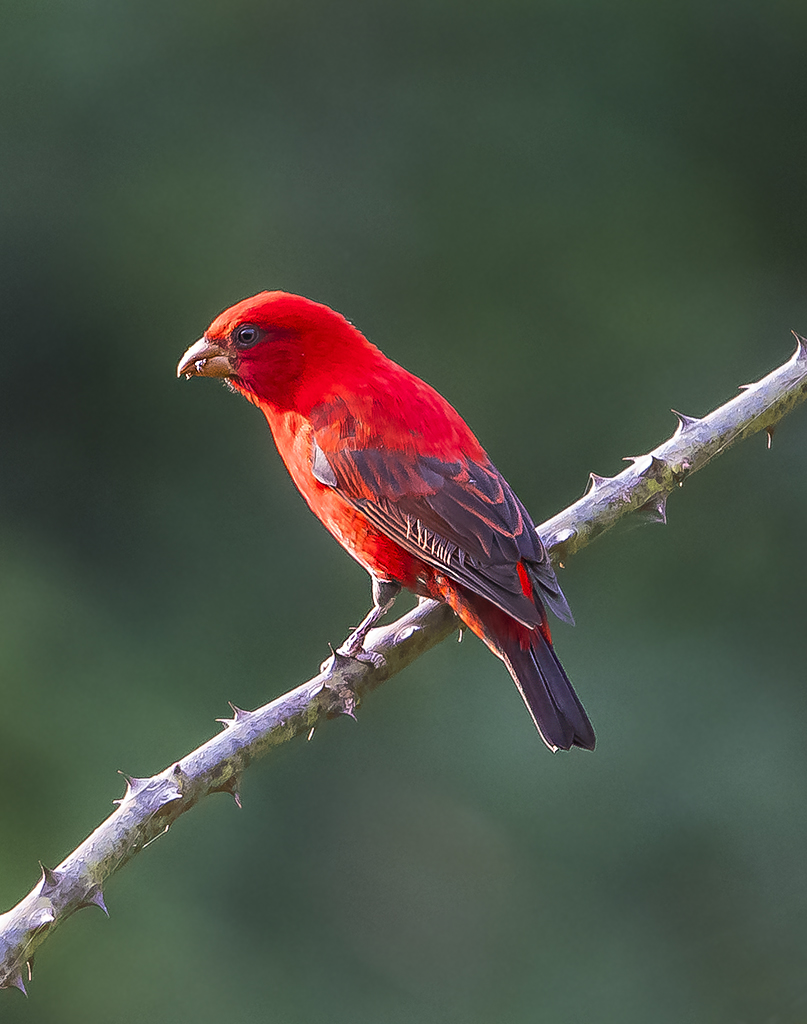 Scarlet FinchCarpodacus sipahi
-
 Siberian Long-tailed RosefinchCarpodacus sibiricus
-
 Great RosefinchCarpodacus rubicilla
-
 Pink-browed RosefinchCarpodacus rodochroa
-
 Taiwan RosefinchCarpodacus formosanus
Compare
Questions and answers
What is the scientific name of the Bonin Grosbeak?
The scientific name of the Bonin Grosbeak is Carpodacus ferreorostris. Written with its author, the full name is Carpodacus ferreorostris (Vigors, 1829).
Which family does the Bonin Grosbeak belong to?
Carpodacus ferreorostris belongs to the family Fringillidae, in the order Passeriformes and the class Aves.
What is the conservation status of the Bonin Grosbeak?
The IUCN Red List category recorded for Carpodacus ferreorostris is Extinct (EX).
What other names does the Bonin Grosbeak have?
Carpodacus ferreorostris is also known in English as Bonin Islands Grosbeak.
Sources
Passages the profile rests on
- The Bonin Grosbeak was a finch classified among birds commonly called grosbeaks. Source passage: “The Bonin grosbeak or Bonin Islands grosbeak (Carpodacus ferreorostris) is an extinct finch.” — English Wikipedia
- Contemporary illustrations of the species show considerable differences, particularly among males. Source passage: “Contemporary illustrations show considerable differences, especially in males.” — English Wikipedia
- It remains uncertain whether the differences shown in illustrations reflect seasonal variation or the existence of multiple subspecies or species. Source passage: “Whether these are due to seasonal variation or whether several subspecies or even species existed could only be determined by a thorough review of the available material.” — English Wikipedia
- The Bonin Grosbeak was recorded only on Chichi-jima in the Ogasawara Islands. Source passage: “It was found only on Chichi-jima in the Ogasawara Islands.” — English Wikipedia
- Chichi-jima proper was the only locality where the species was observed. Source passage: “Chichi-jima proper is the only place, however, where the bird was observed.” — English Wikipedia
- The Bonin Grosbeak fed on fruits and buds. Source passage: “It fed on fruits and buds” — English Wikipedia
- The Bonin Grosbeak was retiring but not shy. Source passage: “It was a retiring although not shy bird” — English Wikipedia
- The species was usually encountered alone or in pairs. Source passage: “was usually found singly or in pairs.” — English Wikipedia
- The species primarily collected its food from the ground or low shrubs. Source passage: “which were primarily picked up from the ground or low shrubs” — English Wikipedia
- The Bonin Grosbeak was rarely observed perching in trees. Source passage: “it rarely was observed to perch in trees” — English Wikipedia
- The species was apparently rather phlegmatic and somewhat reluctant to fly. Source passage: “being apparently rather phlegmatic and somewhat reluctant to fly.” — English Wikipedia
- Only one type of vocalization was described for the Bonin Grosbeak. Source passage: “Only one kind of vocalization has been described:” — English Wikipedia
- Its recorded vocalization was a soft, pure, high-pitched note that could be short or prolonged. Source passage: “a soft, pure and high note, sometimes short, sometimes drawn out;” — English Wikipedia
- The species produced its vocalization either singly or in short series. Source passage: “sometimes given singly, sometimes in a short series.” — English Wikipedia
- The Bonin Grosbeak is classified as extinct. Source passage: “Carpodacus ferreorostris is an Extinct taxon” — datazone.birdlife.org
- The species was most recently assessed for the IUCN Red List in 2023. Source passage: “Bonin Grosbeak Carpodacus ferreorostris has most recently been assessed for The IUCN Red List of Threatened Species in 2023.” — iucnredlist.org
- Settlement of the Bonin Islands began in 1830. Source passage: “settlement was begun in 1830.” — English Wikipedia
- The species could not be found by naturalist William Stimpson during the 1854 Rodgers-Ringgold expedition to Chichi-jima. Source passage: “When the Rodgers-Ringgold North Pacific Exploring and Surveying Expedition called at Chichi-jima in 1854, naturalist William Stimpson could not find the birds.” — English Wikipedia
- Rats, feral goats, sheep, dogs and cats were present on Chichi-jima in 1854, alongside pigs already present in 1828. Source passage: “What he did find, however, were rats and feral goats, sheep, dogs and cats, in addition to the pigs that were already present in 1828” — English Wikipedia
- The Bonin Grosbeak probably became extinct soon after 1830 because of habitat destruction and predation by introduced mammals. Source passage: “Just like the Bonin thrush, the Bonin grosbeak probably succumbed soon after 1830 to habitat destruction and predation by the introduced mammals.” — English Wikipedia
- The Bonin Grosbeak was not closely related to grosbeaks in the strict taxonomic sense. Source passage: “it is not closely related to the grosbeaks sensu stricto.” — English Wikipedia
- The species is classified in Carpodacus by many authorities, although some authorities assign it to the separate genus Chaunoproctus. Source passage: “Many authorities place the species in the genus Carpodacus, but some place it in its own genus, Chaunoproctus.” — English Wikipedia
- A genetic analysis published in 2013 identified the Bonin Grosbeak as a relatively basal member of its group, more derived than the common rosefinch. Source passage: “A 2013 genetic analysis found it to be a relatively basal member of the group, more derived than the common rosefinch” — English Wikipedia
- The estimated divergence time of the Bonin Grosbeak from other members of its group was approximately 12.5 million years ago. Source passage: “with an estimated divergence time from other members of the group around 12.5 million years ago.” — English Wikipedia
Data
- Catalogue of Life, 2026-10-16 XR cc by
- Wikidata CC0
- Wikimedia Commons per image; credit shown with each image
- Within the Catalogue of Life, this name comes from The Integrated Taxonomic Information System cc0
This species in other databases
Page built on 29 November 2026. See how the catalog is made and all sources and licences.
Cite this page
ScientificNames.org. (2026). Carpodacus ferreorostris (Bonin Grosbeak). Retrieved November 29, 2026, from https://scientificnames.org/species/carpodacus-ferreorostris
“Carpodacus ferreorostris (Bonin Grosbeak).” ScientificNames.org, 2026, scientificnames.org/species/carpodacus-ferreorostris. Accessed 29 Nov. 2026.
ScientificNames.org. “Carpodacus ferreorostris (Bonin Grosbeak).” Accessed November 29, 2026. https://scientificnames.org/species/carpodacus-ferreorostris.
@misc{scientificnames_carpodacus_ferreorostris_bonin_grosbeak,
  author = {{ScientificNames.org}},
  title = {Carpodacus ferreorostris (Bonin Grosbeak)},
  year = {2026},
  url = {https://scientificnames.org/species/carpodacus-ferreorostris},
  note = {Accessed 2026-11-29}
}