Species · Fishes
Caspian Lamprey Caspiomyzon wagneri
The scientific name of the Caspian Lamprey is Caspiomyzon wagneri. It is a species of fish in the family Petromyzontidae (lamprey), order Petromyzontiformes. The name dates from 1870.
- Scientific name
- Caspiomyzon wagneri (Kessler, 1870)
- Common name
- Caspian Lamprey
- Genus
- Caspiomyzon
- Family
- Petromyzontidae (Lamprey)
- Order
- Petromyzontiformes
- Class
- Petromyzonti
- Red List category
- LC Least Concern
- Environment
- brackish, freshwater
- Recorded in
- 4 countries
- Name status
- accepted in the Catalogue of Life

Overview
Caspiomyzon wagneri inhabits the Caspian Sea and its associated river systems. It is a non-parasitic anadromous lamprey that feeds on animal carcasses.
Written 26 November 2026 from the sources listed below. Each statement was checked against the passage it cites; statements that could not be supported were removed.
Appearance
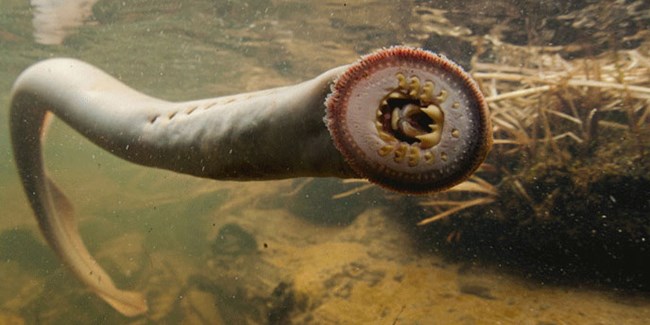
The Caspian Lamprey has a slender, eel-like body with silvery-grey coloration. It lacks jaws and has a circular oral disc surrounding its mouth, which contains several radiating rows of small, backward-facing teeth.[1][2][3][4]
It has a single nostril near its eyes and seven visible gill openings immediately behind its head. It lacks gill covers, scales, and paired fins.[5][6][7]
The species has two elongated dorsal fins, with the rear fin nearly adjoining its small tail fin.[8]
The Caspian Lamprey typically grows to approximately 40 cm in length. The longest recorded specimen measured 55 cm and weighed 206 g.[9][10][11]
Habitat
The Caspian Lamprey inhabits the Caspian Sea and its associated river systems. It occurs in the northern, western, and southern watersheds of the Caspian Sea.[12][13][14]
The species spends its feeding stage in the sea before migrating upstream into rivers.[15]
Its river destinations include the Volga, Ural, Terek, and Kura rivers. Southern Caspian Sea migration destinations include the Shirud, Talar, Babolrud, Gorganrud, Tajan, Haraz, Sardabrud, Aras, Tonekabon, Polrud, Sefidrud, and Shafarud rivers, as well as Anzali Lagoon.[16][17]
Diet
The Caspian Lamprey is a non-parasitic species that feeds on animal carcasses. It is classified as a scavenger among anadromous lampreys.[18][19]
Behaviour
The Caspian Lamprey is an anadromous fish that migrates from the sea into rivers. Adults migrate through the Volga, Sura, and other rivers to reach spawning grounds.[20][21]
When upstream migration starts, the species stops growing and begins sexual maturation.[22]
Reproduction and life cycle
Morphological changes occur during spawning migration, and some are associated with the sex of the fish.[23]
Conservation
The Caspian Lamprey is listed as vulnerable in Europe and Iran. It was historically considered near threatened in the southern Caspian Sea basin.[24][25]
The species is threatened by river pollution, dam construction, and restricted and declining distribution. Dams and construction projects have disrupted its migratory routes and restricted access to spawning grounds.[26][27]
Drought-induced drying of streams is identified as a major recent threat. Populations have stabilized following a decline and are increasing in some parts of the species' range.[28][29]
Uses
Annual harvests from the lower Volga reached 15–30 million Caspian lampreys in the early twentieth century.[30]
Classification of the Caspian Lamprey
| Kingdom | Animalia |
|---|---|
| Phylum | Chordata |
| Subphylum | Vertebrata |
| Infraphylum | Agnatha |
| Superclass | Cyclostomi |
| Class | Petromyzonti |
| Order | Petromyzontiformes (Lamprey) |
| Family | Petromyzontidae (Lamprey) |
| Subfamily | Petromyzontinae |
| Genus | Caspiomyzon |
| Species | Caspiomyzon wagneri (Kessler, 1870) |
Where the Caspian Lamprey is found
Checklists and occurrence records place Caspiomyzon wagneri in 4 countries. GBIF holds 51 georeferenced records of it.
Countries
Regions and cities with the most records
- Gilan Province, Iran 10
- Astrakhan Oblast, Russia 8
- Astrakhan, Russia 6
- Reẕvānshahr, Iran 6
- Yevlakh, Azerbaijan 6
- Bandar-e Anzalī, Iran 4
- Khomām, Iran 3
A number beside a place is its count of GBIF occurrence records. A place without a number comes from a checklist alone. Records show where a species has been observed or collected, which can include escapes and vagrants.
Common names
English
- Caspian Lamprey
- Volga Lamprey
Names in 9 other languages
- Arabic
- جلكى قزوينية
- Czech
- mihule kaspická
- Finnish
- kaspiannahkiainen
- French
- lamproie caspienne
- German
- Kaspineunauge
- Hungarian
- Kaszpi-tengeri ingola
- Persian
- Mar Mahi
- Russian
- Волжская минога, Каспийская минога
- Spanish
- lamprea del Caspio
Synonyms
3 other scientific names have been used for this species and are now treated as synonyms of Caspiomyzon wagneri.
- Agnathomyzon caspicus Gratzianov, 1907
- Agnathomyzon wagneri (Kessler, 1870)
- Petromyzon wagneri Kessler, 1870
Related species
- Epirus Brook LampreyCaspiomyzon graecus
- Greek Brook LampreyCaspiomyzon hellenicus
-
 Sea LampreyPetromyzon marinus
-
 European River LampreyLampetra fluviatilis
-
 Pacific LampreyEntosphenus tridentatus
-
 Brook LampreyLampetra planeri
-
 Arctic LampreyLethenteron camtschaticum
-
 Ukrainian Brook LampreyEudontomyzon mariae
Compare
Questions and answers
What is the scientific name of the Caspian Lamprey?
The scientific name of the Caspian Lamprey is Caspiomyzon wagneri. Written with its author, the full name is Caspiomyzon wagneri (Kessler, 1870).
Which family does the Caspian Lamprey belong to?
Caspiomyzon wagneri belongs to the family Petromyzontidae, in the order Petromyzontiformes and the class Petromyzonti.
Where is the Caspian Lamprey found?
Checklists and occurrence records place Caspiomyzon wagneri in 4 countries: Iran, Russia, Turkmenistan and Azerbaijan.
What is the conservation status of the Caspian Lamprey?
The IUCN Red List category recorded for Caspiomyzon wagneri is Least Concern (LC).
What other names does the Caspian Lamprey have?
Caspiomyzon wagneri is also known in English as Volga Lamprey.
Are lampreys still eaten?
The Caspian Lamprey was historically harvested for human consumption.[31]
Sources
Passages the profile rests on
- The Caspian lamprey has a slender, eel-like body. Source passage: “The Caspian lamprey is a slim-bodied, eel-like fish” — English Wikipedia
- The Caspian lamprey has a silvery-grey coloration. Source passage: “The Caspian lamprey is a silvery-grey colour.” — English Wikipedia
- The species lacks jaws and has a circular oral disc surrounding its mouth. Source passage: “Like other lampreys, it has no jaws, but it has a round oral disc surrounding the mouth.” — English Wikipedia
- Its oral disc contains several radiating rows of small, backward-facing teeth. Source passage: “Inside this it has several radiating rows of tiny, backward-facing teeth.” — English Wikipedia
- The Caspian lamprey has a single nostril located near its eyes. Source passage: “There is a single nostril near the eyes.” — English Wikipedia
- The species has seven visible gill openings immediately behind its head and lacks gill covers. Source passage: “There are no gill covers and the seven gill openings are visible just behind the head.” — English Wikipedia
- The Caspian lamprey lacks scales and paired fins. Source passage: “The fish has no scales or paired fins” — English Wikipedia
- The species possesses two elongated dorsal fins, with the rear fin nearly adjoining its small tail fin. Source passage: “but has two elongated dorsal fins, the hindmost of which nearly joins onto the small tail fin.” — English Wikipedia
- The Caspian lamprey typically grows to approximately 40 cm in length. Source passage: “grows to a length of about 40 cm (16 in).” — English Wikipedia
- The longest recorded specimen measured 55 cm in length. Source passage: “The longest recorded specimen was 55 cm (22 in) long” — English Wikipedia
- The longest recorded specimen weighed 206 g. Source passage: “weighed 206 g (7.3 oz).” — English Wikipedia
- The Caspian lamprey inhabits the Caspian Sea and its associated river systems. Source passage: “The Caspian lamprey is endemic to the Caspian Sea and related river system in its northern, western, and southern watersheds” — pmc.ncbi.nlm.nih.gov
- The Caspian lamprey is native to the Caspian Sea. Source passage: “native to the Caspian Sea” — English Wikipedia
- The species occurs in the northern, western, and southern watersheds of the Caspian Sea. Source passage: “in its northern, western, and southern watersheds” — pmc.ncbi.nlm.nih.gov
- The species spends its feeding stage in the sea before migrating upstream into rivers. Source passage: “This species migrate up- stream from the sea where they spend the feeding stage” — pmc.ncbi.nlm.nih.gov
- The species migrates into the Volga, Ural, Terek, and Kura rivers. Source passage: “migrates to the Volga, Ural, Terek, and Kura rivers” — pmc.ncbi.nlm.nih.gov
- Southern Caspian Sea migration destinations include the Shirud, Talar, Babolrud, Gorganrud, Tajan, Haraz, Sardabrud, Aras, Tonekabon, Polrud, Sefidrud, and Shafarud rivers, as well as Anzali Lagoon. Source passage: “Shirud, Talar, Babolrud, Gorganrud, Tajan, Haraz, Sardabrud, Aras, Tonekabon, Polrud, Sefidrud, and Shafarud rivers and the Anzali Lagoon” — pmc.ncbi.nlm.nih.gov
- The Caspian lamprey is a non-parasitic species that feeds on animal carcasses. Source passage: “This species is a non-parasitic lamprey that feeds on animal carcasses.” — English Wikipedia
- The Caspian lamprey is classified as a scavenger among anadromous lampreys. Source passage: “scavenger (Caspian lamprey, Caspiomyzon wagneri)” — repository.library.noaa.gov
- The Caspian lamprey is an anadromous fish that migrates from the sea into rivers. Source passage: “The Caspian lamprey is an anadromous fish” — English Wikipedia
- Adults migrate through the Volga, Sura, and other rivers to reach spawning grounds. Source passage: “migrates up the Volga, Sura, and other rivers to spawn.” — English Wikipedia
- The species stops growing and begins sexual maturation when its upstream migration starts. Source passage: “when migration starts, lampreys stop growing and begin to mature sexually” — pmc.ncbi.nlm.nih.gov
- Morphological changes occur during spawning migration, and some are associated with the sex of the fish. Source passage: “During the spawning migration, the lamprey undergoes certain morphological changes, some of which have been linked to the sex of the fish” — pmc.ncbi.nlm.nih.gov
- The Caspian lamprey is listed as vulnerable in Europe and Iran. Source passage: “The Caspian lamprey is listed as vulnerable generally in Europe (Renaud 1997) and in Iran” — pmc.ncbi.nlm.nih.gov
- The Caspian lamprey was historically considered near threatened in the southern Caspian Sea basin. Source passage: “consider this species to be near threat- ened in the southern Caspian Sea basin” — pmc.ncbi.nlm.nih.gov
- The species is threatened by river pollution, dam construction, and restricted and declining distribution. Source passage: “because it migrates into rivers which are polluted and dammed and because of its restricted and declining distribution” — pmc.ncbi.nlm.nih.gov
- Dams and construction projects have disrupted the species' migratory routes and restricted its access to spawning grounds. Source passage: “its migratory routes have been disrupted by dams and construction projects and it can no longer reach its spawning grounds.” — English Wikipedia
- Drought-induced drying of streams is identified as a major recent threat to the species. Source passage: “The chief threat more recently has been the drying up of these streams caused by drought.” — English Wikipedia
- Caspian lamprey populations have stabilized following a decline and are increasing in some parts of their range. Source passage: “populations have stabilised after this decline, and are even increasing in part of its range.” — English Wikipedia
- Annual harvests from the lower Volga reached 15–30 million Caspian lampreys in the early twentieth century. Source passage: “In the early 1900s, 15 to 30 million fish were harvested annually from the lower Volga.” — English Wikipedia
- The species was subsequently harvested for human consumption. Source passage: “and later for human consumption.” — English Wikipedia
Data
- Catalogue of Life, 2026-10-16 XR cc by
- Global Biodiversity Information Facility CC BY 4.0
- Wikidata CC0
- GeoNames CC BY 4.0
- Wikimedia Commons per image; credit shown with each image
- Within the Catalogue of Life, this name comes from World Register of Marine Species cc by
This species in other databases
- Catalogue of Life 69D4C
- Wikidata Q636761
- iNaturalist 96839
- WoRMS urn:lsid:marinespecies.org:taxname:280039
- ITIS 159732
Page built on 28 November 2026. See how the catalog is made and all sources and licences.
Cite this page
ScientificNames.org. (2026). Caspiomyzon wagneri (Caspian Lamprey). Retrieved November 28, 2026, from https://scientificnames.org/species/caspiomyzon-wagneri
“Caspiomyzon wagneri (Caspian Lamprey).” ScientificNames.org, 2026, scientificnames.org/species/caspiomyzon-wagneri. Accessed 28 Nov. 2026.
ScientificNames.org. “Caspiomyzon wagneri (Caspian Lamprey).” Accessed November 28, 2026. https://scientificnames.org/species/caspiomyzon-wagneri.
@misc{scientificnames_caspiomyzon_wagneri_caspian_lamprey,
  author = {{ScientificNames.org}},
  title = {Caspiomyzon wagneri (Caspian Lamprey)},
  year = {2026},
  url = {https://scientificnames.org/species/caspiomyzon-wagneri},
  note = {Accessed 2026-11-28}
}