Species · Flowering plants
Cautleya spicata
Cautleya spicata has no English name on record in the checklists used here. It is a species of flowering plant in the family Zingiberaceae (ginger family), order Zingiberales.
- Scientific name
- Cautleya spicata (Sm.) Baker
- Genus
- Cautleya
- Family
- Zingiberaceae (Ginger Family)
- Order
- Zingiberales
- Class
- Liliopsida
- Red List category
- LC Least Concern
- Recorded in
- 5 countries
- Name status
- accepted in the Catalogue of Life

Overview
The species occurs across the Himalayas and extends into Yunnan, China.
Written 27 November 2026 from the sources listed below. Each statement was checked against the passage it cites; statements that could not be supported were removed.
Appearance
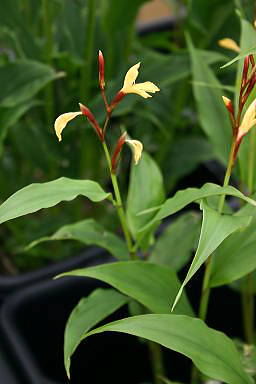
The plant has pseudostems formed by tightly wrapped leaf bases or sheaths, which grow 30–60 cm tall. Each plant bears 4–7 leaves, with leaf stalks measuring 1.5–2 cm long and leaf blades measuring 12–30 cm long and 1.6–4 cm wide.[1][2][3][4][5]
Its inflorescence is a dense spike measuring approximately 7–12 cm long. Each flower has a red bract surrounding its sepals and a tubular calyx measuring 1.5–2.5 cm long.[6][7][8]
The three petals are fused at the base into a tube, whose three terminal lobes measure 2–2.5 cm long. Each flower has three petal-like staminodes inside its petals, and the two lateral staminodes are upright and approximately the same size as the central petal lobe.[9][10][11][12]
The labellum measures approximately 2.5 cm long, bends downwards and is divided into two at the tip. The single stamen has a two-pronged spur at the base of the anther.[13][14][15]
The ripe seed capsule is red and splits open to expose black seeds. The seeds have a white aril.[16][17]
The cultivar 'Crug Canary' can reach 1 m in height and has red stems, deep red bracts and orange-yellow flowers. The cultivar 'Arun Flame' has dense flower spikes and purplish-red leaf undersides, while 'Lutea' produces predominantly yellow flowers.[18][19][20]
Plants grown under collection number CC 3676 are shorter than the other described cultivars.[21]
Reproduction and life cycle
The inflorescence appears in July in the species' native habitat.[22]
Conservation
The species tolerates frost down to approximately −10 °C.[23]
Uses
The species is cultivated as an ornamental garden plant and can also be grown in containers.[24][25]
Habitat
Cultivated plants require moisture-retentive, humus-rich soil and protection from full sun.[26]
Diet
Cautleya spicata is recorded as a plant food item in a comparative study of Assamese macaques and rhesus macaques.[27]
Classification of Cautleya spicata
| Kingdom | Plantae |
|---|---|
| Subkingdom | Pteridobiotina |
| Phylum | Tracheophyta |
| Class | Liliopsida |
| Order | Zingiberales |
| Family | Zingiberaceae (Ginger Family) |
| Genus | Cautleya (Hardy Ginger) |
| Species | Cautleya spicata (Sm.) Baker |
Where Cautleya spicata is found
Checklists and occurrence records place Cautleya spicata in 5 countries across Asia. GBIF holds 166 georeferenced records of it.
Countries
Regions and cities with the most records
1 more country has a few records outside this range
These countries hold a few records of Cautleya spicata but lie outside the range the checklists give for it. Such records are often zoo or garden specimens, museum material or vagrants, so the species is not counted as occurring there.
A number beside a place is its count of GBIF occurrence records. A place without a number comes from a checklist alone. Records show where a species has been observed or collected, which can include escapes and vagrants.
Common names
Names in 3 other languages
- Chinese
- 红苞距药姜, 红苞距藥薑
- Finnish
- isohimalajaninkivääri
- Russian
- Каутлея колосовидная
Synonyms
4 other scientific names have been used for this species and are now treated as synonyms of Cautleya spicata.
- Cautleya petiolata Baker
- Cautleya robusta Baker
- Roscoea petiolata Royle ex Hook.fil.
- Roscoea spicata Sm.
Related species
-
 Cautleya gracilis
-
 GingerZingiber officinale
-
 Shampoo GingerZingiber zerumbet
-
 Grains of ParadiseAframomum melegueta
-
 CardamomElettaria cardamomum
-
 Torch GingerEtlingera elatior
-
 Greater GalangalAlpinia galanga
-
 Black CardamomAmomum subulatum
Compare
Questions and answers
When does Cautleya spicata flower?
Its inflorescence appears in July in its native habitat.[22]
How tall does Cautleya spicata grow?
Its pseudostems grow 30–60 cm tall. The cultivar 'Crug Canary' can reach 1 m in height.[2][18]
Where does Cautleya spicata occur?
It occurs across the Himalayas and extends into Yunnan, China.[28]
Can Cautleya spicata tolerate frost?
It tolerates frost down to approximately −10 °C.[23]
Can Cautleya spicata be grown in containers?
Yes. The species can be cultivated in containers.[25]
Sources
Passages the profile rests on
- The plant has pseudostems formed by tightly wrapped leaf bases or sheaths. Source passage: “What appear to be stems in Cautleya species are actually "pseudostems" formed by the tightly wrapped bases or sheaths of the leaves.” — English Wikipedia
- Its pseudostems grow 30–60 cm tall. Source passage: “In Cautleya spicata, the pseudostems are 30–60 cm (12–24 in) tall.” — English Wikipedia
- Each plant bears 4–7 leaves. Source passage: “There are 4–7 leaves” — English Wikipedia
- Its leaf stalks measure 1.5–2 cm in length. Source passage: “a stalk (petiole) 1.5–2 cm (0.6–0.8 in) long” — English Wikipedia
- Its leaf blades are 12–30 cm long and 1.6–4 cm wide. Source passage: “The leaf blades are 12–30 cm (5–12 in) long by 1.6–4 cm (0.6–1.6 in) wide.” — English Wikipedia
- Its inflorescence is a dense spike measuring approximately 7–12 cm long. Source passage: “takes the form of a dense spike about 7–12 cm (3–5 in) long.” — English Wikipedia
- Each flower has a red bract surrounding its sepals. Source passage: “A red bract surrounds the sepals” — English Wikipedia
- Its tubular calyx measures 1.5–2.5 cm long. Source passage: “The calyx is shorter than the bract, being 1.5–2.5 cm (0.6–1.0 in) long.” — English Wikipedia
- Its three petals are fused at the base into a tube. Source passage: “Inside the calyx, the three petals are fused at the base to form a tube” — English Wikipedia
- The three lobes at the ends of the petal tube measure 2–2.5 cm long. Source passage: “At the end of the tube the petals form three lobes, 2–2.5 cm (0.8–1.0 in) long.” — English Wikipedia
- Each flower has three petal-like staminodes inside its petals. Source passage: “Inside the petals are three petal-like structures (staminodes).” — English Wikipedia
- The flower's two lateral staminodes are upright and approximately the same size as its central petal lobe. Source passage: “The two side staminodes are upright, more-or-less the same size as the central petal lobe.” — English Wikipedia
- Its labellum measures approximately 2.5 cm long. Source passage: “The lip or labellum is about 2.5 cm (1.0 in) long” — English Wikipedia
- Its labellum bends downwards and is divided into two at the tip. Source passage: “bent downwards and divided into two at the tip.” — English Wikipedia
- Its single stamen has a two-pronged spur at the base of the anther. Source passage: “The single stamen has a two-pronged "spur" at base of the anther” — English Wikipedia
- Its ripe seed capsule is red and splits open to expose black seeds. Source passage: “The seed capsule is red when ripe, splitting to reveal the black seeds” — English Wikipedia
- Its seeds have a white aril. Source passage: “the black seeds which have a white aril.” — English Wikipedia
- The cultivar 'Crug Canary' can reach 1 m in height and has red stems, deep red bracts, and orange-yellow flowers. Source passage: “'Crug Canary' is up to 1 m (3 ft) tall, with red stems, deep red bracts and orange-yellow flowers.” — English Wikipedia
- The cultivar 'Arun Flame' has dense flower spikes and purplish-red leaf undersides. Source passage: “'Arun Flame' is similar height, with denser flower spikes; the undersides of the leaves have a purplish-red tinge.” — English Wikipedia
- The cultivar 'Lutea' produces predominantly yellow flowers. Source passage: “'Lutea' bears largely yellow flowers.” — English Wikipedia
- Plants grown under collection number CC 3676 are shorter than the other described cultivars. Source passage: “Plants grown under the collection number CC 3676 are shorter, with dark orange flowers.” — English Wikipedia
- Its inflorescence appears in July in its native habitat. Source passage: “The inflorescence appears in July in the native habitat of the species” — English Wikipedia
- The species tolerates frost down to approximately −10 °C. Source passage: “It is hardy to −10 °C (14 °F)” — English Wikipedia
- The species is cultivated as an ornamental garden plant. Source passage: “Cautleya spicata is cultivated as an ornamental garden plant.” — English Wikipedia
- The species can be cultivated in containers. Source passage: “It may also be grown in a container” — English Wikipedia
- Cultivated plants require moisture-retentive, humus-rich soil and protection from full sun. Source passage: “It requires a moisture-retentive, humus-rich soil, out of the full sun.” — English Wikipedia
- Cautleya spicata is recorded as a plant food item in a comparative study of Assamese macaques and rhesus macaques. Source passage: “Cautleya spicata, +, +, +, 3, 23, 0.5, Herb, Leaf, stem, flower, bark.” — pmc.ncbi.nlm.nih.gov
- The species occurs across the Himalayas and extends into Yunnan, China. Source passage: “It is found in the Himalayas through to China (Yunnan).” — English Wikipedia
- The genus name Cautleya commemorates Proby Cautley, who was responsible for extensive irrigation works in India. Source passage: “The genus name honours Proby Cautley, who was responsible for extensive irrigation works in India under the British Raj.” — English Wikipedia
- The specific epithet spicata means spiky. Source passage: “The specific epithet, spicata, means "spiky".” — English Wikipedia
- The species was first described in 1822 under the name Roscoea spicata. Source passage: “Cautleya spicata was first described by James Edward Smith in 1822 as a Roscoea, R. spicata.” — English Wikipedia
- The species was transferred to the genus Cautleya in 1890. Source passage: “It was transferred to Cautleya by John Gilbert Baker in 1890.” — English Wikipedia
Data
- Catalogue of Life, 2026-10-16 XR cc by
- Global Biodiversity Information Facility CC BY 4.0
- Wikidata CC0
- GeoNames CC BY 4.0
- Wikimedia Commons per image; credit shown with each image
- Within the Catalogue of Life, this name comes from The World Checklist of Vascular Plants (WCVP) cc by
References
- J.D.Hooker, Fl. Brit. India 6: 209 (1890) where the name was published
This species in other databases
- Catalogue of Life RXPM
- Wikidata Q15246135
- iNaturalist 602623
- World Flora Online wfo-0000353044
- GRIN 494501
Page built on 27 November 2026. See how the catalog is made and all sources and licences.
Cite this page
ScientificNames.org. (2026). Cautleya spicata. Retrieved November 27, 2026, from https://scientificnames.org/species/cautleya-spicata
“Cautleya spicata.” ScientificNames.org, 2026, scientificnames.org/species/cautleya-spicata. Accessed 27 Nov. 2026.
ScientificNames.org. “Cautleya spicata.” Accessed November 27, 2026. https://scientificnames.org/species/cautleya-spicata.
@misc{scientificnames_cautleya_spicata,
  author = {{ScientificNames.org}},
  title = {Cautleya spicata},
  year = {2026},
  url = {https://scientificnames.org/species/cautleya-spicata},
  note = {Accessed 2026-11-27}
}