Species · Mammals
Guinea Pig Cavia porcellus
The scientific name of the Guinea Pig is Cavia porcellus. It is a species of mammal in the family Caviidae (maras), order Rodentia. The name dates from 1758.
- Scientific name
- Cavia porcellus (Linnaeus, 1758)
- Common name
- Guinea Pig
- Genus
- Cavia
- Family
- Caviidae (Maras)
- Order
- Rodentia
- Class
- Mammalia
- Recorded in
- 10 countries
- Name status
- accepted in the Catalogue of Life

Overview
The Guinea pig is a domesticated species raised as a pet, meat animal, laboratory subject, and for ceremonial purposes. It is distributed globally as a pet and livestock animal. It has no tail, and most individuals have four front teeth that grow continuously.
Written 24 November 2026 from the sources listed below. Each statement was checked against the passage it cites; statements that could not be supported were removed.
Uses
Guinea pigs are raised as pets, meat animals, laboratory subjects, and for ceremonial purposes. Their meat is consumed in Peru, Bolivia, Colombia, and Ecuador, as well as in various sub-Saharan African countries.[1][2][3]
In 2022, Peru produced 13,400 tonnes of guinea pig meat, while Bolivia produced 5,300 tonnes. Guinea pigs have also been used in medical research as models for studying human medical conditions.[4][5][6]
Similar species
The montane guinea pig (Cavia tschudii) is considered the most likely wild ancestor of the domestic Guinea pig.[7]
Appearance
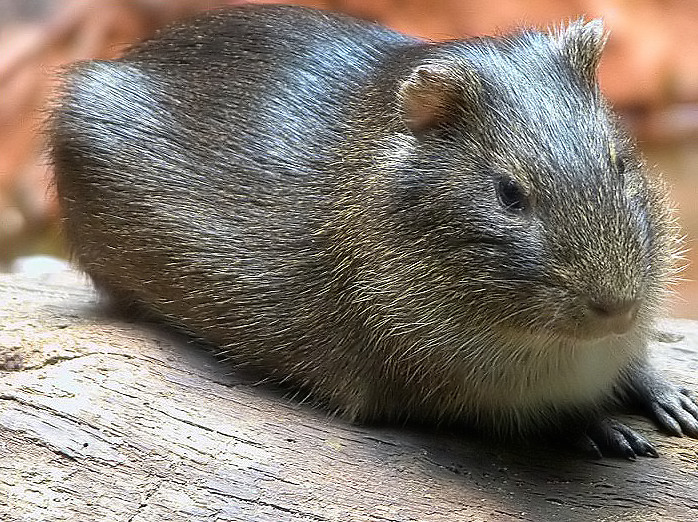
Domestic Guinea pigs have fur of varying lengths, textures, and colors depending on their breed. They have no tails, and most have four front teeth that grow continuously.[8][9][10]
Adult domestic Guinea pigs typically measure between 20 and 25 cm in length and generally weigh between 700 and 1,100 grams. Some livestock breeds can reach 3 kg when fully grown.[11][12][13]
Male Guinea pigs are generally larger than females.[14]
Habitat
The domesticated species does not live naturally in the wild. Domestic Guinea pigs are maintained globally as pets and animals raised for meat.[15][16]
Diet
Domestic Guinea pigs are adapted to eating herbs and grasses from mountain meadows. Common foods include lettuce, cabbage, grasses, barley, and Timothy hay.[17][18]
They may also be fed pellets made from compressed alfalfa or barley. At the Smithsonian National Zoo, their diet includes root vegetables, leafy greens, hay, and nutritionally complete pellets.[19][20]
Corn, barley, wheat bran, soybean meal, pigeon pea, and Leucaena leaf meal are used in guinea pig feed manufacturing. Small-scale production traditionally uses forage and household kitchen or crop waste as feed.[21][22]
Behaviour
Domestic Guinea pigs are social animals that generally prefer close contact with other individuals. They are most active around dawn and dusk.[23][24]
A solitary Guinea pig may respond to perceived danger by remaining completely motionless, while groups may scatter in different directions when threatened. Guinea pigs communicate using six main vocalizations.[25][26][27]
Guinea pigs may huddle together for warmth and protection. Male Guinea pigs establish social hierarchies involving access to food and mates.[28][29]
Reproduction and life cycle
Female Guinea pigs typically experience estrus three to four times annually, with each period lasting 16 days. Males reach sexual maturity between 56 and 70 days of age, while females reach sexual maturity at approximately 67 days.[30][31][32]
Females typically give birth to three or four offspring per litter. Young Guinea pigs are generally weaned at approximately two to three weeks of age, and females provide relatively little parental care.[33][34][35]
Conservation
Domestic Guinea pigs are not considered threatened or endangered.[36]
Classification of the Guinea Pig
| Kingdom | Animalia |
|---|---|
| Phylum | Chordata |
| Subphylum | Vertebrata |
| Infraphylum | Gnathostomata |
| Parvphylum | Osteichthyes |
| Megaclass | Tetrapoda |
| Class | Mammalia (Mammal) |
| Subclass | Theria |
| Infraclass | Eutheria |
| Order | Rodentia (Rodent) |
| Suborder | Hystricomorpha |
| Infraorder | Hystricognathi (Hystricognath Rodents) |
| Family | Caviidae (Maras) |
| Subfamily | Caviinae (Cavies) |
| Genus | Cavia (Cavy) |
| Species | Cavia porcellus (Linnaeus, 1758) |
Where the Guinea Pig is found
Checklists and occurrence records place Cavia porcellus in 10 countries across South America. GBIF holds 540 georeferenced records of it.
Countries
- Argentina 19
- Bolivia 92
- Brazil 28
- Chile 14
- Colombia 300
- Ecuador 12
- Paraguay 5
- Peru 41
- Uruguay 4
- Venezuela 25
Regions and cities with the most records
- Bogota D.C., Colombia 158
- Bogotá, Colombia 143
- Funza, Colombia 142
- Mosquera, Colombia 142
- Madrid, Colombia 125
- Chía, Colombia 108
- Cajicá, Colombia 62
- Soacha, Colombia 62
- Beni Department, Bolivia 49
- Cundinamarca, Colombia 22
- Monagas, Venezuela 16
- Meta Department, Colombia 14
- Buenos Aires, Argentina 12
- Santa Cruz Department, Bolivia 11
- Boyacá, Colombia 9
- La Paz Department, Bolivia 8
- Vichada Department, Colombia 7
- Ibarra, Ecuador 6
- Imbabura, Ecuador 6
- Antioquia, Colombia 5
- La Paz, Bolivia 5
- Breña, Peru 4
- Ciudad Juárez, Mexico 4
- Jesus Maria, Peru 4
- Lima, Peru 4
- Lima Province, Peru 4
- San Francisco De Borja, Peru 4
- San Isidro, Peru 4
- Santa Anita - Los Ficus, Peru 4
- Biobio, Chile 3
- Callao, Peru 3
- Chiguayante, Chile 3
- Concepción, Chile 3
- Hualpén, Chile 3
- Penco, Chile 3
- San Pedro de la Paz, Chile 3
15 more countries have a few records outside this range
These countries hold a few records of Cavia porcellus but lie outside the range the checklists give for it. Such records are often zoo or garden specimens, museum material or vagrants, so the species is not counted as occurring there.
Range as the checklists state it
South America
A number beside a place is its count of GBIF occurrence records. A place without a number comes from a checklist alone. Records show where a species has been observed or collected, which can include escapes and vagrants.
Common names
English
- Guinea Pig
- Cavy
- Domestic Guinea Pig
- Domesticated Guinea Pig
Names in 57 other languages
- Arabic
- خنزير غينيا, خنزير غينيا المستأنس, كابياء خنزيرية
- Armenian
- Ծովախոզուկ
- Azerbaijani
- Dəniz donuzcuğu
- Basque
- Akuri
- Belarusian
- Марская свінка
- Breton
- Razh-Porquinho-da-Índia
- Bulgarian
- Морско свинче
- Burmese
- ပူး
- Catalan
- Conill porquí
- Chinese
- 天竺鼠, 豚鼠
- Croatian
- Zamorac
- Czech
- Morče domácí
- Dutch
- Cavia, Guinees Biggetje, Huiscavia
- Esperanto
- Kobajo
- Estonian
- Merisiga
- Finnish
- marsu
- French
- Cochon d'Inde
- Georgian
- ზღვის გოჭი
- German
- Hausmeerschweinchen
- Hebrew
- שרקן
- Hungarian
- Tengerimalac
- Icelandic
- Naggrís
- Italian
- Cavia domestica, Porcellino d'India
- Japanese
- テンジクネズミ, モルモット
- Korean
- 기니피그
- Latvian
- Jūrascūciņa
- Lithuanian
- Jūrų kiaulytė
- Malay
- Tikus Belanda
- Malayalam
- ഗിനി പന്നി
- Norwegian Bokmål
- Tammarsvin, marsvin
- Persian
- خوکچه هندی
- Polish
- Kawia domowa, świnka morska
- Portuguese
- Cobaia, Coelho-da-índia, Porquinho-da-Índia, Sauiá-cobaia
- Romanian
- Cobai
- Russian
- Морская свинка
- Scottish Gaelic
- Gearra-mhuc
- Serbian
- Морско прасе
- Slovak
- Morča domáce
- Slovenian
- Morski prašiček
- Spanish
- Acure, Cobaya, Conejillo de Indias, Curiel, Curí (generalizado), Cuy, Cuyo
- Tagalog
- Konehilyo
- Thai
- หนูตะเภา
- Turkish
- Kobay
- Ukrainian
- Кавія свійська, Морська свинка
- Vietnamese
- Lợn Guinea
- Welsh
- Mochyn cwta
- ang
- Rætswīn
- arg
- Conillet d'Indias
- fry
- Bargemot, Kavia
- glv
- Muc rangagh
- hbs
- Morsko prase
- ido
- Kobayo
- ldn
- humazhomid
- lim
- Hoescavia
- pam
- Dagis sungsung
- que
- Kuy, Wasi quwi
- vls
- Spaansche ratte
Synonyms
One other scientific name has been used for this species and is now treated as a synonym of Cavia porcellus.
- Mus porcellus Linnaeus, 1758
Related species
-
 Montane Guinea PigCavia tschudii
-
 Brazilian Guinea PigCavia aperea
-
 Greater Guinea PigCavia magna
-
 Santa Catarina's Guinea PigCavia intermedia
-
 Shiny Guinea PigCavia fulgida
- Sacha Guinea PigCavia patzelti
-
 CapybaraHydrochoerus hydrochaeris
-
 Patagonian MaraDolichotis patagonum
Compare
Questions and answers
What is the scientific name of the Guinea Pig?
The scientific name of the Guinea Pig is Cavia porcellus. Written with its author, the full name is Cavia porcellus (Linnaeus, 1758).
Which family does the Guinea Pig belong to?
Cavia porcellus belongs to the family Caviidae, in the order Rodentia and the class Mammalia.
Where is the Guinea Pig found?
Checklists and occurrence records place Cavia porcellus in 10 countries, including Colombia, Bolivia, Peru, Brazil, Venezuela and Argentina.
What other names does the Guinea Pig have?
Cavia porcellus is also known in English as Cavy, Domestic Guinea Pig and Domesticated Guinea Pig.
Sources
Passages the profile rests on
- Domestic guinea pigs are raised as pets, meat animals, laboratory subjects, and for ceremonial purposes. Source passage: “Guinea pigs have been raised by humans as a meat source, as pets, as laboratory test subjects, and for ceremonial use.” — English Wikipedia
- Guinea pig meat is consumed in Peru, Bolivia, Colombia, and Ecuador. Source passage: “notably in the Andean region (Peru, Bolivia, Colombia, and Ecuador).” — pmc.ncbi.nlm.nih.gov
- Guinea pigs have also been consumed in various sub-Saharan African countries. Source passage: “To a lesser extent, the consumption of guinea pig meat has also been common in the different countries of sub-Saharan Africa for several decades” — pmc.ncbi.nlm.nih.gov
- Peru produced 13,400 tonnes of guinea pig meat in 2022. Source passage: “In 2022, the production of guinea pig meat was 13,400 and 5300 t in Peru and Bolivia, respectively” — pmc.ncbi.nlm.nih.gov
- Bolivia produced 5,300 tonnes of guinea pig meat in 2022. Source passage: “the production of guinea pig meat was 13,400 and 5300 t in Peru and Bolivia, respectively” — pmc.ncbi.nlm.nih.gov
- Guinea pigs have been used in medical research as models for studying human medical conditions. Source passage: “they are still used in research, primarily as models to study human medical conditions.” — English Wikipedia
- The montane guinea pig (Cavia tschudii) is considered the most likely wild ancestor of the domestic guinea pig. Source passage: “is most likely derived from the Andean montane guinea pig (Cavia tschudii)” — nationalzoo.si.edu
- Domestic guinea pigs have fur in varying lengths, textures, and colors depending on their breed. Source passage: “The length, texture and color of their fur varies by breed.” — nationalzoo.si.edu
- Domestic guinea pigs have no tails. Source passage: “Guinea pigs have no tails.” — nationalzoo.si.edu
- Most domestic guinea pigs have four front teeth that grow continuously. Source passage: “They have four front teeth and small back teeth. Their front teeth grow continuously” — English Wikipedia
- Adult domestic guinea pigs typically measure between 20 and 25 cm in length. Source passage: “measure between 20 and 25 cm (8 and 10 in) in length.” — English Wikipedia
- Domestic guinea pigs generally weigh between 700 and 1,100 grams. Source passage: “weigh between 25 and 39 ounces (700 and 1,100 grams).” — nationalzoo.si.edu
- Some livestock breeds can reach a weight of 3 kg when fully grown. Source passage: “Some livestock breeds weigh 3 kg (6.6 lb) when full grown.” — English Wikipedia
- Male guinea pigs are generally larger than females. Source passage: “Male guinea pigs tend to be larger than females.” — nationalzoo.si.edu
- The domesticated species does not live naturally in the wild. Source passage: “The domesticated guinea pig (Cavia porcellus) does not live in the wild” — nationalzoo.si.edu
- Domestic guinea pigs are maintained globally as pets and animals raised for meat. Source passage: “are now globally distributed as pets and for their meat.” — nationalzoo.si.edu
- Domestic guinea pigs are adapted to eating herbs and grasses from mountain meadows. Source passage: “Guinea pigs are adapted to a diet of the herbs and grasses of montane (or mountain) meadows.” — nationalzoo.si.edu
- Common foods provided to domestic guinea pigs include lettuce, cabbage, grasses, barley, and Timothy hay. Source passage: “As pets, they are commonly fed lettuce, cabbage, grasses, barley and Timothy hay.” — nationalzoo.si.edu
- Domestic guinea pigs may be fed pellets made from compressed alfalfa or barley. Source passage: “They are also fed pellets that are made of compressed plant material (usually alfalfa or barley).” — nationalzoo.si.edu
- Domestic guinea pigs at the Smithsonian National Zoo receive root vegetables, leafy greens, hay, and nutritionally complete pellets. Source passage: “At the Smithsonian’s National Zoo, guinea pigs eat a variety of root vegetables, leafy greens, hay, and nutritionally complete pellets.” — nationalzoo.si.edu
- Corn, barley, wheat bran, soybean meal, pigeon pea, and Leucaena leaf meal are feedstuffs used in guinea pig feed manufacturing. Source passage: “Six test diets were obtained by replacing the corresponding basal mixture with 40% corn, 50% barley, 45% wheat bran, 35% soybean meal, 30% pigeon pea, or 30% Leucaena leaf meal.” — pmc.ncbi.nlm.nih.gov
- Small-scale guinea pig production traditionally uses forage and household kitchen or crop waste as feed. Source passage: “Traditionally, guinea pig breeding has been performed in small-scale production units, with forage and domestic kitchen or crop waste” — pmc.ncbi.nlm.nih.gov
- Domestic guinea pigs are social animals that generally prefer close contact with other individuals. Source passage: “They often huddle for warmth and protection, and prefer to be in close contact with other individuals.” — nationalzoo.si.edu
- Domestic guinea pigs are most active around dawn and dusk. Source passage: “These rodents are crepuscular, meaning they are active during dusk and dawn.” — nationalzoo.si.edu
- A solitary guinea pig may respond to perceived danger by remaining completely motionless. Source passage: “During this response, the guinea pig becomes completely immobile until the threat has passed.” — nationalzoo.si.edu
- Groups of domestic guinea pigs may scatter in different directions when threatened. Source passage: “The scatter response involves a group of guinea pigs. When the group perceives a threat, they scatter and split up to confuse a predator.” — nationalzoo.si.edu
- Domestic guinea pigs communicate using six main vocalizations. Source passage: “Guinea pigs produce six main vocalizations: chutts, squeaks, whines, whistles, purrs and chirps.” — nationalzoo.si.edu
- Guinea pigs may huddle together for warmth and protection. Source passage: “They often huddle for warmth and protection” — nationalzoo.si.edu
- Male guinea pigs establish social hierarchies involving access to food and mates. Source passage: “Males form social hierarchies over food and mates, typically resulting in an alpha male within the group.” — nationalzoo.si.edu
- Female guinea pigs typically experience estrus three to four times annually, with each period lasting 16 days. Source passage: “Sows are typically in estrus three to four times per year, and estrus lasts 16 days.” — nationalzoo.si.edu
- Male guinea pigs reach sexual maturity between 56 and 70 days of age. Source passage: “Boars become sexually mature between 56 and 70 days old” — nationalzoo.si.edu
- Female guinea pigs reach sexual maturity at approximately 67 days of age. Source passage: “sows are sexually mature around 67 days old.” — nationalzoo.si.edu
- Female guinea pigs typically give birth to three or four offspring per litter. Source passage: “Guinea pigs give birth to three or four pups per litter” — nationalzoo.si.edu
- Young guinea pigs are generally weaned at approximately two to three weeks of age. Source passage: “which wean in approximately two to three weeks.” — nationalzoo.si.edu
- Female guinea pigs provide relatively little parental care to their offspring. Source passage: “and provide little care for their pups” — nationalzoo.si.edu
- Domestic guinea pigs are not considered threatened or endangered. Source passage: “they are domesticated and are not threatened or endangered.” — nationalzoo.si.edu
Data
- Catalogue of Life, 2026-10-16 XR cc by
- Global Biodiversity Information Facility CC BY 4.0
- Wikidata CC0
- GeoNames CC BY 4.0
- Wikimedia Commons per image; credit shown with each image
- Within the Catalogue of Life, this name comes from The Integrated Taxonomic Information System cc0
References
- Syst. Nat., 10th ed. vol.1 p.59 where the name was published
- Wilson, Don E., and DeeAnn M. Reeder, eds. (1993). Mammal Species of the World: A Taxonomic and Geographic Reference, 2nd Ed., 3rd Printing.
- International Commission on Zoological Nomenclature. (2003). OPINION 2027 (Case 3010): Usage of 17 specific names based on wild species which are pre-dated by or contemporary with those based on domestic animals (Lepidoptera, Osteichthyes, Mammalia): conserved. Bulletin of Zoological Nomenclature, Vol. 60, Part 1.
- Woods, Charles A., and C. William Kilpatrick / Wilson, Don E., and DeeAnn M. Reeder, eds. (2005). Infraorder Hystricognathi Brandt, 1855. Mammal Species of the World: A Taxonomic and Geographic Reference, 3rd Ed., Vol. 2.
- Patton, James L., Ulyses F. J. Pardiñas, and Guillermo D’Elía, eds. (2015). Mammals of South America, Vol. 2: Rodents.
This species in other databases
Page built on 24 November 2026. See how the catalog is made and all sources and licences.
Cite this page
ScientificNames.org. (2026). Cavia porcellus (Guinea Pig). Retrieved November 24, 2026, from https://scientificnames.org/species/cavia-porcellus
“Cavia porcellus (Guinea Pig).” ScientificNames.org, 2026, scientificnames.org/species/cavia-porcellus. Accessed 24 Nov. 2026.
ScientificNames.org. “Cavia porcellus (Guinea Pig).” Accessed November 24, 2026. https://scientificnames.org/species/cavia-porcellus.
@misc{scientificnames_cavia_porcellus_guinea_pig,
  author = {{ScientificNames.org}},
  title = {Cavia porcellus (Guinea Pig)},
  year = {2026},
  url = {https://scientificnames.org/species/cavia-porcellus},
  note = {Accessed 2026-11-24}
}