Species · Flowering plants
Asian Bittersweet Celastrus orbiculatus
The scientific name of the Asian Bittersweet is Celastrus orbiculatus. It is a species of flowering plant in the family Celastraceae (staff-tree family), order Celastrales.
- Scientific name
- Celastrus orbiculatus Thunb.
- Common name
- Asian Bittersweet
- Genus
- Celastrus
- Family
- Celastraceae (Staff-tree Family)
- Order
- Celastrales
- Class
- Magnoliopsida
- Recorded in
- 11 countries
- Name status
- accepted in the Catalogue of Life
Overview
Celastrus orbiculatus is native to China, Japan, and Korea.
Written 26 November 2026 from the sources listed below. Each statement was checked against the passage it cites; statements that could not be supported were removed.
Appearance
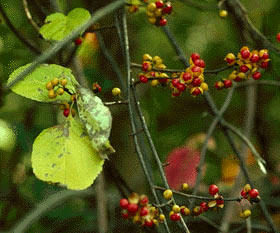
Asian bittersweet is a deciduous woody vine with thin, spindly stems bearing silver to reddish-brown bark. Young growth is bright green, while mature stems develop light brown bark with a cracked, net-like texture.[1][2]
Its vines generally measure between 1 and 4 cm in diameter, although undisturbed vines can exceed 10 cm in diameter. Individual vines can reach 60 feet in length and diameters exceeding 10 inches.[3][4][5][6]
Its leaves are round, glossy, toothed along their margins, and alternately arranged on the vines. They measure approximately 2–12 cm in length, with lower leaves distinctly round and upper leaves often elongated and football-shaped.[7][8][9]
Its leaves turn vivid yellow in late summer.[10]
Its flowers are small and green. Female flowers are yellow-green and grow in clusters of two or three from leaf axils.[11][12]
Its flowers are also described as small, white-green, star-shaped, and arranged in clusters emerging from leaf axils.[13]
Its fruits develop yellow or orange skin that splits to expose a bright red center. The fruit remains attached to the stems throughout winter.[14][15]
Its roots are orange in color. Its vines have smooth stems without tendrils, barbs, or aerial rootlets.[16][17]
Habitat
Asian bittersweet prefers mesic woodland habitats. It grows in grasslands, woodlands, marsh edges, and roadsides.[18][19]
It thrives in moist areas and disturbed sites with exposed mineral soil. It can also grow in soil conditions including sand dunes and bogs.[20][21]
It can establish in clay, sandy, loamy, and rocky soils, as well as soils with high organic matter. It grows in acidic, neutral, and alkaline soil conditions.[22][23]
The species prefers full sunlight but tolerates dense shade during its early growth.[24]
Behaviour
Its climbing vines can strangle host trees or break their branches through accumulated weight. Its dense foliage and climbing stems smother native plants and can strangle their stems and trunks.[25][26]
Its climbing growth can restrict host vegetation's access to sunlight, nutrients, and water.[27]
Reproduction and life cycle
Asian bittersweet has separate male and female plants. It reproduces through seeds and vegetative sprouting from an extensive root system.[28][29]
The plant can produce new shoots from cut stems and roots.[30]
Conservation
Asian bittersweet was introduced into North America in 1879. It has naturalized in eastern North American landscapes, roadsides, and woodlands.[31][32]
In the United States, its documented range extends from Louisiana north to Maine and west to the Rocky Mountains. The species is considered invasive in eastern North America.[33][34]
It is classified as a Pennsylvania noxious weed and cannot be sold, propagated, or intentionally planted in the state. It is also included on the European Union's list of invasive alien species of Union concern.[35][36]
Uses
Asian bittersweet is cultivated as an ornamental plant. Its stems and fruits are used in decorative arrangements and wreaths.[37][38]
Its durable vines are used as weaving material for baskets. Its fibrous inner bark can be used to produce strong cordage.[39][40]
Similar species
Asian bittersweet closely resembles the North American species Celastrus scandens. The two species hybridize where their ranges overlap.[41][42]
Classification of the Asian Bittersweet
| Kingdom | Plantae |
|---|---|
| Subkingdom | Pteridobiotina |
| Phylum | Tracheophyta |
| Class | Magnoliopsida |
| Order | Celastrales |
| Family | Celastraceae (Staff-tree Family) |
| Subfamily | Celastroideae |
| Tribe | Celastreae |
| Genus | Celastrus (Bittersweet) |
| Species | Celastrus orbiculatus Thunb. |
Where the Asian Bittersweet is found
Checklists and occurrence records place Celastrus orbiculatus in 11 countries across Asia, Europe, North America and Oceania. GBIF holds 51,192 georeferenced records of it.
Countries where it is native or its origin is not stated
Countries where it has been introduced
Regions and cities with the most records
- Massachusetts, United States 7,504
- New York, United States 7,439
- Pennsylvania, United States 3,524
- New Jersey, United States 3,196
- Manhattan, United States 2,513
- Maryland, United States 2,497
- Newton, United States 2,480
- Cliffside Park, United States 2,470
- Chestnut Hill, United States 2,464
- Brighton, United States 2,434
- Brookline, United States 2,395
- The Bronx, United States 2,392
- Allston, United States 2,370
- Mission Hill, United States 2,366
- North Bergen, United States 2,349
- Fort Lee, United States 2,341
- Back Bay, United States 2,339
- Watertown, United States 2,339
- West New York, United States 2,333
- Waltham, United States 2,324
- Roxbury Crossing, United States 2,318
- Virginia, United States 2,282
- Belmont, United States 2,280
- Palisades Park, United States 2,275
- Needham, United States 2,273
- Roslindale, United States 2,270
- Cambridge, United States 2,245
- Boston, United States 2,234
- Union City, United States 2,224
- West Roxbury, United States 2,205
- Dorchester, United States 2,200
- Arlington, United States 2,181
- Somerville, United States 2,180
- Secaucus, United States 2,146
- Lexington, United States 2,137
- Mount Vernon, United States 2,135
18 more countries have a few records outside this range
These countries hold a few records of Celastrus orbiculatus but lie outside the range the checklists give for it. Such records are often zoo or garden specimens, museum material or vagrants, so the species is not counted as occurring there.
Range as the checklists state it
Germany [I]; Russian Far East (Upper Amur, Kuril Isl., Primorye, Sakhalin); China (Heilongjiang, Jilin, Liaoning, Neimenggu, Hebei, Shandong, Shaanxi, Henan, Shaanxi, Gansu, Jiangsu, Anhui, Zhejiang, Jiangxi, Hubei, Sichuan); North Korea; South Korea; Japan (Honshu, Shikoku, Kyushu); Thailand; Vietnam; New Zealand [I]; Canada [I] (New Brunswick [I], Ontario [I], Québec [I]); USA [I] (Arkansas [I], Connecticut [I], District of Columbia [I], Delaware [I], Georgia [I], Iowa [I], Illinois [I], Indiana [I], Kentucky [I], Massachusetts [I], Maryland [I], Maine [I], Michigan [I], North Carolina [I], New Hampshire [I], New Jersey [I], New York [I], Ohio [I], Pennsylvania [I], Rhode Island [I], South Carolina [I], Tennessee [I], Virginia [I], Vermont [I], Wisconsin [I], West Virginia [I])
A number beside a place is its count of GBIF occurrence records. A place without a number comes from a checklist alone. Records show where a species has been observed or collected, which can include escapes and vagrants.
Common names
English
- Asian Bittersweet
- Asiatic Bittersweet
- Japanese Bittersweet
- Oriental Staff Vine
- Staff Vine
- Staff-vine
- Climbing Spindleberry
- Oriental Bittersweet
- Round Leaf Bittersweet
- Round-leaved Bittersweet
Names in 22 other languages
- Belarusian
- Дрэвагубца круглалісты
- Chinese
- 南蛇藤
- Czech
- jesenec okrouhlolistý
- Danish
- Træmorder
- Dutch
- Aziatische boomwurger, Zuidoost-Aziatische boomwurger, boomwurger
- Estonian
- ümaralehine tselaster
- Finnish
- japaninkelasköynnös
- French
- bourreau des arbres, célastre asiatique
- German
- Rundblättriger Baumwürger
- Japanese
- tsuru-ume-mo-doki, ツルウメモドキ
- Korean
- 노박덩굴
- Lithuanian
- Apskritalapis smaugikas
- Norwegian Bokmål
- japanfrøbusk
- Polish
- dławisz okrągłolistny
- Russian
- Древогубец круглолистный, Древогубец щётковидный
- Slovak
- bršlenec kruhovitý
- Spanish
- celastro
- Swedish
- japansk träddödare
- Ukrainian
- Деревогубник круглолистий
- Vietnamese
- Dây gối tròn
- Welsh
- Celastrws
- ldn
- ríshoméenanethil
Synonyms
18 other scientific names have been used for this species and are now treated as synonyms of Celastrus orbiculatus.
- Catha articulata (Thunb.) G.Don
- Celastrus articulata hort. ex Koehne
- Celastrus articulatus Thunb.
- Celastrus articulatus var. humilis Matsum.
- Celastrus articulatus var. orbiculata (Thunb.) Wang
- Celastrus articulatus var. papillosus Nakai ex H.Hara
- Celastrus crispulus Regel
- Celastrus insularis Koidz.
- Celastrus jeholensis Nakai
- Celastrus orbiculatus f. aureoarillatus (Honda) Ohwi
- Celastrus orbiculatus f. major Ives
- Celastrus orbiculatus f. major Loes.
- Celastrus orbiculatus f. papillosus (Nakai) H.Hara
- Celastrus orbiculatus var. aureoarillatus Honda
- Celastrus orbiculatus var. orbiculatus
- Celastrus orbiculatus var. papillosus (Nakai) Ohwi
- Celastrus tatarinowii Rupr.
- Ilex leucantha Hassk.
Subspecies and varieties
Related species
-
 Climbing BittersweetCelastrus scandens
-
 CelastrusCelastrus paniculatus
-
 Chinese BittersweetCelastrus hindsii
- White VineCelastrus subspicatus
- Celastrus gemmatus
- Celastrus angulatus
- Celastrus rosthornianus
- Celastrus australis
Compare
Questions and answers
What is the scientific name of the Asian Bittersweet?
The scientific name of the Asian Bittersweet is Celastrus orbiculatus. Written with its author, the full name is Celastrus orbiculatus Thunb..
Which family does the Asian Bittersweet belong to?
Celastrus orbiculatus belongs to the family Celastraceae, in the order Celastrales and the class Magnoliopsida.
Where is the Asian Bittersweet found?
Checklists and occurrence records place Celastrus orbiculatus in 11 countries, including Japan, South Korea, China, North Korea, Vietnam and Taiwan.
What other names does the Asian Bittersweet have?
Celastrus orbiculatus is also known in English as Asiatic Bittersweet, Japanese Bittersweet, Oriental Staff Vine, Staff Vine, Staff-vine and Climbing Spindleberry.
Is Oriental bittersweet good for anything?
Asian bittersweet is cultivated as an ornamental plant. Its durable vines are used for weaving baskets, its fibrous inner bark can produce strong cordage, and its stems and fruits are used in decorative arrangements and wreaths. All parts of the plant are poisonous.[37][39][40][38][43]
What is the invasive vine that kills trees?
Asian bittersweet is an invasive vine that climbs by winding around host tree trunks. Its climbing vines can strangle host trees or break their branches through accumulated weight.[44][25][34]
Sources
Passages the profile rests on
- Celastrus orbiculatus is a deciduous woody vine with thin, spindly stems bearing silver to reddish-brown bark. Source passage: “they are thin, spindly, and have silver to reddish brown bark.” — English Wikipedia
- Its young growth is bright green, while mature stems develop light brown bark with a cracked, net-like texture. Source passage: “Young growth is bright green; larger stems have light brown bark that has a cracked, fish-netted texture.” — extension.psu.edu
- Its vines generally measure between 1 and 4 cm in diameter. Source passage: “They are generally between 1 and 4 cm (0.4 and 1.6 in) in diameter.” — English Wikipedia
- Undisturbed vines can exceed 10 cm in diameter. Source passage: “However, if growth is not disturbed, vines can exceed 10 cm (3.9 in)” — English Wikipedia
- Individual vines can reach 60 feet in length. Source passage: “Single vines can reach 60 feet in length” — extension.psu.edu
- The vines can reach diameters exceeding 10 inches. Source passage: “it puts on yearly growth and can reach diameters of over 10 inches.” — extension.psu.edu
- Its leaves are round, glossy, toothed along their margins, and alternately arranged on the vines. Source passage: “The leaves are round and glossy, 2–12 cm (0.8–4.7 in) long, have toothed margins and grow in alternate patterns along the vines.” — English Wikipedia
- Its leaves measure approximately 2–12 cm in length. Source passage: “The leaves are round and glossy, 2–12 cm (0.8–4.7 in) long” — English Wikipedia
- Lower leaves are distinctly round, while upper leaves are often elongated and football-shaped. Source passage: “Lower leaves are distinctly round, while upper leaves are often football-shaped (elongated).” — extension.psu.edu
- Its leaves turn vivid yellow in late summer. Source passage: “In late summer, the leaves turn vivid yellow” — extension.psu.edu
- Its flowers are small and green. Source passage: “Small green flowers are borne on axillary cymes.” — English Wikipedia
- Its female flowers are yellow-green and grow in clusters of two or three from leaf axils. Source passage: “In late spring, the female yellow-green flowers, each less than ½ inch long, grow from the leaf axils all along the stem in clusters of two or three.” — extension.psu.edu
- Its flowers are small, white-green, star-shaped, and arranged in clusters emerging from leaf axils. Source passage: “they appear in clusters of small (less than 1 inch), white-green star shaped flowers sprouting from the leaf axils.” — madison.ces.ncsu.edu
- Its fruits develop yellow or orange skin that splits to expose a bright red center. Source passage: “In the fall, the yellow skin splits to reveal a bright red center.” — extension.psu.edu
- Its fruit remains attached to the stems throughout winter. Source passage: “The fruit is retained on the stem through winter.” — extension.psu.edu
- Its roots are orange in color. Source passage: “The roots are a distinctive orange color” — extension.unh.edu
- Its vines have smooth stems without tendrils, barbs, or aerial rootlets. Source passage: “The smooth stems do not have tendrils, barbs, or aerial rootlets” — extension.psu.edu
- The species prefers mesic woodland habitats. Source passage: “It prefers mesic woods” — English Wikipedia
- It grows in grasslands, woodlands, marsh edges, and roadsides. Source passage: “Oriental Bittersweet can be found in grasslands, woodlands, marsh edges and along road sides.” — extension.unh.edu
- It thrives in moist areas and disturbed sites with exposed mineral soil. Source passage: “It thrives especially well in moist areas and areas with exposed mineral soil, such as disturbed sites” — extension.psu.edu
- It can grow in soil conditions including sand dunes and bogs. Source passage: “it grows in many soil conditions, including sand dunes and bogs.” — extension.psu.edu
- It can establish in clay, sandy, loamy, and rocky soils, as well as soils with high organic matter. Source passage: “including clay, sandy, loamy, and rocky soils, as well as in high soils that are high in organic matter.” — madison.ces.ncsu.edu
- It can grow in acidic, neutral, and alkaline soil conditions. Source passage: “can live in acidic, neutral, and alkaline ranges of soil pH.” — madison.ces.ncsu.edu
- The species prefers full sunlight but tolerates dense shade during its early growth. Source passage: “While Oriental bittersweet prefers full sun, it tolerates dense shade while young.” — extension.psu.edu
- Its climbing vines can strangle host trees or break their branches through accumulated weight. Source passage: “The encircling vines have been known to strangle the host tree to death or break branches from the excess weight” — English Wikipedia
- Its dense foliage and climbing stems smother native plants and can strangle their stems and trunks. Source passage: “Oriental bittersweet chokes out desirable native plants by smothering them with its dense foliage and strangling stems and trunks.” — extension.psu.edu
- Its climbing growth can restrict host vegetation's access to sunlight, nutrients, and water. Source passage: “restricting its host plant’s access to sunlight, nutrients and water.” — extension.unh.edu
- The species has separate male and female plants. Source passage: “Oriental bittersweet is dioecious; pollen and fruit are borne on separate male and female plants.” — extension.psu.edu
- It reproduces through seeds and vegetative sprouting from an extensive root system. Source passage: “Oriental bittersweet reproduces by seed and vegetatively by sprouting from an extensive root system.” — extension.psu.edu
- The plant can produce new shoots from cut stems and roots. Source passage: “Following cutting, Oriental bittersweet resprouts vigorously from cut stems and roots.” — extension.psu.edu
- It was introduced into North America in 1879. Source passage: “It was introduced into North America in 1879” — English Wikipedia
- It has naturalized in eastern North American landscapes, roadsides, and woodlands. Source passage: “Oriental bittersweet has naturalized to landscapes, roadsides, and woodlands of eastern North America.” — English Wikipedia
- In the United States, its documented range extends from Louisiana north to Maine and west to the Rocky Mountains. Source passage: “In the United States, it can be found as far south as Louisiana, as far north as Maine, and as far west as the Rocky Mountains.” — English Wikipedia
- The species is considered invasive in eastern North America. Source passage: “is considered to be an invasive species in eastern North America.” — English Wikipedia
- It is classified as a Pennsylvania noxious weed and cannot be sold, propagated, or intentionally planted in the state. Source passage: “Oriental bittersweet has been declared a Pennsylvania noxious weed, meaning it can no longer be sold, propagated, or intentionally planted within the state.” — extension.psu.edu
- The species is included on the European Union's list of invasive alien species of Union concern. Source passage: “In the European Union, it is included in the list of invasive alien species of Union concern” — English Wikipedia
- The species is cultivated as an ornamental plant. Source passage: “Celastrus orbiculatus is cultivated as an ornamental plant.” — English Wikipedia
- Its stems and fruits are used in decorative arrangements and wreaths. Source passage: “The plant’s stems and bright fruits are often cut in the fall and used for decoration” — extension.unh.edu
- Its durable vines are used as weaving material for baskets. Source passage: “Its vines, which are durable and tough, are a good source of weaving material for baskets.” — English Wikipedia
- Its fibrous inner bark can be used to produce strong cordage. Source passage: “The fibrous inner bark can be used to make strong cordage.” — English Wikipedia
- Celastrus orbiculatus closely resembles the North American species Celastrus scandens. Source passage: “It closely resembles the native North American species, Celastrus scandens” — English Wikipedia
- Celastrus orbiculatus hybridizes with Celastrus scandens where their ranges overlap. Source passage: “The two species do hybridize where they co-occur.” — extension.psu.edu
- All parts of the plant are poisonous. Source passage: “All parts of the plant are poisonous.” — English Wikipedia
- Its vines climb by winding around the trunks of host trees and can reach heights of 40 feet. Source passage: “the vines twist themselves around the trunk as high as 40 ft (12 m).” — English Wikipedia
Data
- Catalogue of Life, 2026-10-16 XR cc by
- Global Biodiversity Information Facility CC BY 4.0
- Wikidata CC0
- GeoNames CC BY 4.0
- Wikimedia Commons per image; credit shown with each image
- Within the Catalogue of Life, this name comes from Synonymic Checklists of the Vascular Plants of the World cc by
References
- Thunb. Syst. Veg., ed. 14 [J.A.Murray] 237 (1784). where the name was published
This species in other databases
Page built on 26 November 2026. See how the catalog is made and all sources and licences.
Cite this page
ScientificNames.org. (2026). Celastrus orbiculatus (Asian Bittersweet). Retrieved November 26, 2026, from https://scientificnames.org/species/celastrus-orbiculatus
“Celastrus orbiculatus (Asian Bittersweet).” ScientificNames.org, 2026, scientificnames.org/species/celastrus-orbiculatus. Accessed 26 Nov. 2026.
ScientificNames.org. “Celastrus orbiculatus (Asian Bittersweet).” Accessed November 26, 2026. https://scientificnames.org/species/celastrus-orbiculatus.
@misc{scientificnames_celastrus_orbiculatus_asian_bittersweet,
  author = {{ScientificNames.org}},
  title = {Celastrus orbiculatus (Asian Bittersweet)},
  year = {2026},
  url = {https://scientificnames.org/species/celastrus-orbiculatus},
  note = {Accessed 2026-11-26}
}