Species · Flowering plants
Climbing Bittersweet Celastrus scandens
The scientific name of the Climbing Bittersweet is Celastrus scandens. It is a species of flowering plant in the family Celastraceae (staff-tree family), order Celastrales.
- Scientific name
- Celastrus scandens L.
- Common name
- Climbing Bittersweet
- Genus
- Celastrus
- Family
- Celastraceae (Staff-tree Family)
- Order
- Celastrales
- Class
- Magnoliopsida
- Recorded in
- 4 countries
- Name status
- accepted in the Catalogue of Life

Overview
Celastrus scandens commonly grows in woodlands with rich, well-drained soils.
Written 26 November 2026 from the sources listed below. Each statement was checked against the passage it cites; statements that could not be supported were removed.
Appearance
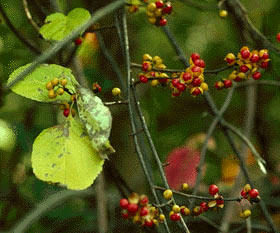
It produces tiny, scentless flowers at the tips of its branches and orange fruits approximately the size of peas.[1][2]
Its woody stems can reach 30 feet (9.1 m) or more in length and measure at least 1 inch (25 mm) in thickness at the base.[3][4]
Habitat
Climbing bittersweet commonly grows in woodlands with rich, well-drained soils.[5]
Behaviour
Its stems twine around other vegetation and can sometimes kill saplings by restricting their further growth.[6][7]
Reproduction and life cycle
Climbing bittersweet produces flowers primarily in June.[8]
Uses
Climbing bittersweet is cultivated as a decorative plant in landscaping. Its fruits are used in seasonal floral arrangements.[9][10]
Its roots were historically used by Native Americans and pioneers to induce vomiting and to treat venereal disease and symptoms of tuberculosis.[11][12][13]
Its fruits are poisonous to humans when ingested.[14]
Similar species
Celastrus orbiculatus is an Asian relative of climbing bittersweet known as Oriental bittersweet.[15]
Classification of the Climbing Bittersweet
| Kingdom | Plantae |
|---|---|
| Subkingdom | Pteridobiotina |
| Phylum | Tracheophyta |
| Class | Magnoliopsida |
| Order | Celastrales |
| Family | Celastraceae (Staff-tree Family) |
| Subfamily | Celastroideae |
| Tribe | Celastreae |
| Genus | Celastrus (Bittersweet) |
| Species | Celastrus scandens L. |
Where the Climbing Bittersweet is found
Checklists and occurrence records place Celastrus scandens in 4 countries across Europe and North America. GBIF holds 11,172 georeferenced records of it.
Countries where it is native or its origin is not stated
Countries where it has been introduced
Regions and cities with the most records
- Ontario, Canada 1,908
- Minnesota, United States 818
- Wisconsin, United States 719
- Pennsylvania, United States 496
- Michigan, United States 389
- Kansas, United States 344
- Quebec, Canada 331
- Illinois, United States 318
- New York, United States 300
- Ohio, United States 283
- Indiana, United States 261
- Missouri, United States 235
- Manitoba, Canada 231
- Nebraska, United States 191
- Ottawa, Canada 172
- Ottawa South, Canada 169
- Gatineau, Canada 149
- Vanier, Canada 147
- New Jersey, United States 145
- Gloucester, Canada 143
- Connecticut, United States 142
- Aylmer, Canada 135
- Vermont, United States 134
- South Dakota, United States 119
- Cartierville, Canada 114
- Laval-des-Rapides, Canada 114
- Kanata, Canada 113
- Mont-Royal, Canada 112
- Nepean, Canada 111
- Laval, Canada 109
- Orléans, Canada 109
- Peterborough, Canada 108
- Bridlewood, Canada 102
- Rosemont–La Petite-Patrie, Canada 100
- Val-des-Arbres, Canada 99
- Saint-Michel, Canada 98
7 more countries have a few records outside this range
These countries hold a few records of Celastrus scandens but lie outside the range the checklists give for it. Such records are often zoo or garden specimens, museum material or vagrants, so the species is not counted as occurring there.
Range as the checklists state it
Germany [I]; Canada (Manitoba, New Brunswick, Ontario, Québec, Saskatchewan); USA (Alabama, Arkansas, Connecticut, District of Columbia, Delaware, Georgia, Iowa, Illinois, Indiana, Kansas, Kentucky, Louisiana, Massachusetts, Maryland, Maine, Michigan, Minnesota, Missouri, Mississippi, Montana, North Carolina, North Dakota, Nebraska, New Hampshire, New Jersey, New York, Ohio, Oklahoma, Pennsylvania, Rhode Island, South Carolina, South Dakota, Tennessee, Texas, Virginia, Vermont, Wisconsin, West Virginia, Wyoming)
A number beside a place is its count of GBIF occurrence records. A place without a number comes from a checklist alone. Records show where a species has been observed or collected, which can include escapes and vagrants.
Common names
English
- Climbing Bittersweet
- Shrubby Bittersweet
- Staffvine
- Waxwork
Names in 3 other languages
- French
- bourreau-des-arbres, célastre grimpant
- Norwegian Bokmål
- slyngfrøbusk
- Swedish
- amerikansk träddödare
Synonyms
3 other scientific names have been used for this species and are now treated as synonyms of Celastrus scandens.
- Celastrus bullatus L.
- Evonymoides scandens (L.) Medik.
- Euonymus scandens (L.) E.H.L.Krause ambiguous synonym
Related species
-
 Asian BittersweetCelastrus orbiculatus
-
 Intellect TreeCelastrus paniculatus
-
 Chinese BittersweetCelastrus hindsii
- White VineCelastrus subspicatus
- Celastrus gemmatus
- Celastrus angulatus
- Celastrus rosthornianus
- Celastrus australis
Compare
Questions and answers
What is the scientific name of the Climbing Bittersweet?
The scientific name of the Climbing Bittersweet is Celastrus scandens. Written with its author, the full name is Celastrus scandens L..
Which family does the Climbing Bittersweet belong to?
Celastrus scandens belongs to the family Celastraceae, in the order Celastrales and the class Magnoliopsida.
Where is the Climbing Bittersweet found?
Checklists and occurrence records place Celastrus scandens in 4 countries, including United States, Canada and Mexico.
What other names does the Climbing Bittersweet have?
Celastrus scandens is also known in English as Shrubby Bittersweet, Staffvine and Waxwork.
Can you eat American bittersweet berries?
No. The fruits of climbing bittersweet are poisonous to humans when ingested.[14]
Is bittersweet good for anything?
Climbing bittersweet is cultivated as a decorative plant in landscaping, and its fruits are used in seasonal floral arrangements. Its roots were historically used to induce vomiting and to treat venereal disease and symptoms of tuberculosis.[11][12][13][9][10]
Where is the best place to plant American bittersweet?
Climbing bittersweet commonly grows in woodlands with rich, well-drained soils.[5]
Sources
Passages the profile rests on
- The species produces tiny, scentless flowers at the tips of its branches. Source passage: “It has tiny, scentless flowers at the tips of the branches.” — English Wikipedia
- The species produces orange fruits approximately the size of peas. Source passage: “It has colorful, orange fruits that are the size of a pea.” — English Wikipedia
- Its woody stems can reach 30 feet (9.1 m) or more in length. Source passage: “30 feet (9.1 m) or longer” — English Wikipedia
- Its stems can measure at least 1 inch (25 mm) in thickness at the base. Source passage: “1 inch (25 mm) or more thick at the base.” — English Wikipedia
- Celastrus scandens commonly grows in woodlands with rich, well-drained soils. Source passage: “commonly found on rich, well-drained soils of woodlands.” — English Wikipedia
- Celastrus scandens has sturdy, perennial, woody stems that twine around other vegetation. Source passage: “It is a sturdy perennial vine that may have twining, woody stems” — English Wikipedia
- Its stems twine around other vegetation and can sometimes kill saplings by restricting their further growth. Source passage: “wind around other vegetation, sometimes killing saplings by restricting further growth.” — English Wikipedia
- Celastrus scandens produces flowers primarily in June. Source passage: “blooms mostly in June” — English Wikipedia
- Celastrus scandens is cultivated as a decorative plant in landscaping. Source passage: “It also sees use as a decorative plant, both in landscaping” — English Wikipedia
- Its fruits are used in seasonal floral arrangements. Source passage: “seasonal floral arrangements.” — English Wikipedia
- The roots of Celastrus scandens were historically used by Native Americans and pioneers to induce vomiting. Source passage: “C. scandens roots were used by Native Americans and pioneers to induce vomiting” — English Wikipedia
- The roots were historically used to treat venereal disease. Source passage: “to treat venereal disease” — English Wikipedia
- The roots were historically used to treat symptoms of tuberculosis. Source passage: “to treat symptoms of tuberculosis.” — English Wikipedia
- The fruits of Celastrus scandens are poisonous to humans when ingested. Source passage: “These fruits are poisonous to humans when ingested” — English Wikipedia
- Celastrus orbiculatus is an Asian relative of Celastrus scandens known as Oriental bittersweet. Source passage: “C. orbiculatus (Oriental bittersweet), from Asia.” — English Wikipedia
Data
- Catalogue of Life, 2026-10-16 XR cc by
- Global Biodiversity Information Facility CC BY 4.0
- Wikidata CC0
- GeoNames CC BY 4.0
- Wikimedia Commons per image; credit shown with each image
- Within the Catalogue of Life, this name comes from Synonymic Checklists of the Vascular Plants of the World cc by
References
- L. (1753). Sp. Pl. [Linnaeus] 1: 196 (1753). where the name was published
This species in other databases
Page built on 27 November 2026. See how the catalog is made and all sources and licences.
Cite this page
ScientificNames.org. (2026). Celastrus scandens (Climbing Bittersweet). Retrieved November 27, 2026, from https://scientificnames.org/species/celastrus-scandens
“Celastrus scandens (Climbing Bittersweet).” ScientificNames.org, 2026, scientificnames.org/species/celastrus-scandens. Accessed 27 Nov. 2026.
ScientificNames.org. “Celastrus scandens (Climbing Bittersweet).” Accessed November 27, 2026. https://scientificnames.org/species/celastrus-scandens.
@misc{scientificnames_celastrus_scandens_climbing_bittersweet,
  author = {{ScientificNames.org}},
  title = {Celastrus scandens (Climbing Bittersweet)},
  year = {2026},
  url = {https://scientificnames.org/species/celastrus-scandens},
  note = {Accessed 2026-11-27}
}