Species · Amphibians
Marco Reyes' Glassfrog Centrolene marcoreyesi
The scientific name of the Marco Reyes' Glassfrog is Centrolene marcoreyesi. It is a species of amphibian in the family Centrolenidae (glass frog), order Anura. The name dates from 2024.
- Scientific name
- Centrolene marcoreyesi Franco-Mena, Székely, Culebras, Batallas-Revelo, Reyes-Puig & Guayasamin, 2024
- Common name
- Marco Reyes' Glassfrog
- Genus
- Centrolene
- Family
- Centrolenidae (Glass Frog)
- Order
- Anura
- Class
- Amphibia
- Name status
- accepted in the Catalogue of Life
Overview
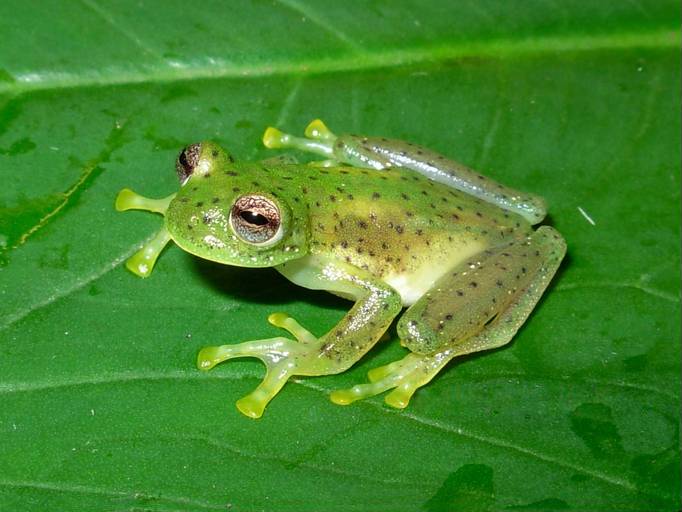
Marco Reyes' Glassfrog (Centrolene marcoreyesi) is an amphibian in the family Centrolenidae. The species is endemic to Ecuador and occurs on the eastern slopes of the Andes in Zamora-Chinchipe Province, at elevations of 1,840–2,190 metres. It has a green body and limbs with whitish spots, and the back third of its underside is translucent.
Written 27 November 2026 from the sources listed below. Each statement was checked against the passage it cites; statements that could not be supported were removed.
Appearance
The body and limbs are green with whitish spots. The dorsal skin has low warts, and the back third of the underside is translucent.[1][2][3]
The fingers and toes are yellowish-green. The snout is rounded and sloping, the lore is slightly concave, and the upper lip is yellowish-white.[4][5][6][7]
The iris is lavender-white with thin brown lines. Adult males have a small, arched humeral spine, and the legs are slender.[8][9][10]
Males measure 24.5–27 millimetres in snout-vent length.[11]
Habitat
Males have been recorded in primary forests, secondary forests and near pastures.[12][13][14]
Individuals have been found on leaves and ferns at night.[15]
Behaviour
The species has been observed on leaves and ferns at night.[16]
The male call consists of a single pulsed note.[17]
Conservation
The describing authors proposed Endangered as a provisional conservation status for the species. Its extent of occurrence is smaller than 100 square kilometres.[18][19]
The species occurs in protected areas, including Podocarpus National Park.[20]
Habitat degradation caused by cattle farming threatens the species. Invasive species, including rainbow trout, are also identified as threats.[21][22]
Similar species
Centrolene marcoreyesi was previously confused with Centrolene buckleyi. It resembles Centrolene buckleyi, Centrolene venezuelensis and Centrolene elisae.[23][24]
Centrolene marcoreyesi may be a sister species of Centrolene sabini.[25]
Classification of the Marco Reyes' Glassfrog
| Kingdom | Animalia |
|---|---|
| Phylum | Chordata |
| Subphylum | Vertebrata |
| Infraphylum | Gnathostomata |
| Parvphylum | Osteichthyes |
| Megaclass | Tetrapoda |
| Class | Amphibia (Amphibians) |
| Order | Anura (Frogs) |
| Family | Centrolenidae (Glass Frog) |
| Subfamily | Centroleninae |
| Genus | Centrolene (Giant Glassfrogs) |
| Species | Centrolene marcoreyesi Franco-Mena, Székely, Culebras, Batallas-Revelo, Reyes-Puig & Guayasamin, 2024 |
Common names
English
- Marco Reyes' Glassfrog
- Marco Reyes’ Glassfrog
Related species
-
 Burrowes' Giant Glass FrogCentrolene ballux
-
 Buckley's GlassfrogCentrolene buckleyi
-
 Centrolene robledoi
- Blue Giant Glass FrogCentrolene azulae
- Boyaca Giant Glass FrogCentrolene petrophilum
-
 Glass FrogCentrolene quindianum
- Medem's GlassfrogCentrolene medemi
- Santander Giant Glass FrogCentrolene acanthidiocephalum
Compare
Questions and answers
What is the scientific name of the Marco Reyes' Glassfrog?
The scientific name of the Marco Reyes' Glassfrog is Centrolene marcoreyesi. Written with its author, the full name is Centrolene marcoreyesi Franco-Mena, Székely, Culebras, Batallas-Revelo, Reyes-Puig & Guayasamin, 2024.
Which family does the Marco Reyes' Glassfrog belong to?
Centrolene marcoreyesi belongs to the family Centrolenidae, in the order Anura and the class Amphibia.
What other names does the Marco Reyes' Glassfrog have?
Centrolene marcoreyesi is also known in English as Marco Reyes’ Glassfrog.
Sources
Passages the profile rests on
- The body and limbs are green with whitish spots. Source passage: “The body and limbs are green with whitish spots.” — English Wikipedia
- The dorsal skin has low warts. Source passage: “The dorsal skin has low warts.” — English Wikipedia
- The back third of the underside is translucent. Source passage: “The back third of the underside is translucent.” — English Wikipedia
- The fingers and toes are yellowish-green. Source passage: “The fingers and toes are yellowish-green.” — English Wikipedia
- The snout is rounded and sloping. Source passage: “The snout is rounded and sloping.” — English Wikipedia
- The lore is slightly concave. Source passage: “The lore is slightly concave.” — English Wikipedia
- The upper lip is yellowish-white. Source passage: “The upper lip is yellowish-white.” — English Wikipedia
- The iris is lavender-white with thin brown lines. Source passage: “The iris is lavender-white, with thin brown lines.” — English Wikipedia
- Adult males have a small, arched humeral spine. Source passage: “Adult males have a small, arched humeral spine.” — English Wikipedia
- The legs are slender. Source passage: “The legs are slender.” — English Wikipedia
- Males measure 24.5–27 millimetres in snout-vent length. Source passage: “The males are 24.5–27 millimetres (0.96–1.06 in) long in snout-vent length.” — English Wikipedia
- Males have been recorded in primary forests. Source passage: “Males have been found in primary and secondary forests, and near pastures.” — English Wikipedia
- Males have been recorded in secondary forests. Source passage: “Males have been found in primary and secondary forests, and near pastures.” — English Wikipedia
- Males have been recorded near pastures. Source passage: “Males have been found in primary and secondary forests, and near pastures.” — English Wikipedia
- Individuals have been found on leaves and ferns at night. Source passage: “Centrolene marcoreyesi has been found on leaves and ferns at night.” — English Wikipedia
- The species has been observed on leaves and ferns at night. Source passage: “Centrolene marcoreyesi has been found on leaves and ferns at night.” — English Wikipedia
- The male call consists of a single pulsed note. Source passage: “The call consists of a single pulsed note.” — English Wikipedia
- The species has an extent of occurrence smaller than 100 square kilometres. Source passage: “Its extent of occurrence is less than 100 square kilometres (39 sq mi).” — English Wikipedia
- The describing authors proposed Endangered as a provisional conservation status for the species. Source passage: “The describing authors proposed a provisional conservation status of Endangered.” — English Wikipedia
- The species occurs in protected areas, including Podocarpus National Park. Source passage: “The species is present in protected areas, including Podocarpus National Park.” — English Wikipedia
- Habitat degradation caused by cattle farming threatens the species. Source passage: “It is threatened by habitat degradation, caused by cattle farming,” — English Wikipedia
- Invasive species, including rainbow trout, are identified as threats to the species. Source passage: “invasive species (including rainbow trout),” — English Wikipedia
- Centrolene marcoreyesi was previously confused with Centrolene buckleyi. Source passage: “Centrolene marcoreyesi was previously confused with Centrolene buckleyi.” — English Wikipedia
- Centrolene marcoreyesi resembles Centrolene buckleyi, Centrolene venezuelensis and Centrolene elisae. Source passage: “Centrolene marcoreyesi is similar to Centrolene buckleyi, Centrolene venezuelensis, and Centrolene elisae.” — English Wikipedia
- Centrolene marcoreyesi may be a sister species of Centrolene sabini. Source passage: “C. marcoreyesi may be a sister species to Centrolene sabini.” — English Wikipedia
Data
- Catalogue of Life, 2026-10-16 XR cc by
- Wikidata CC0
- Within the Catalogue of Life, this name comes from The Integrated Taxonomic Information System cc0
References
- Franco-Mena, Daniela, Ignacio De La Riva, Mateo Vega-Yánez, Luis Amador, Paul Székely, Diego Batallas-Revelo, Diego F. Cisneros-Heredia, Juan P. Reyes Puig, Khristian Venegas-Valencia, Sandra P. Galeano & Juan M. Guayasamin. 2024. Simplifying the Centrolene buckleyi complex (Amphibia: Anura: Centrolenidae): A taxonomic review and description of two new species. PeerJ 12: e17712. where the name was published
This species in other databases
Page built on 28 November 2026. See how the catalog is made and all sources and licences.
Cite this page
ScientificNames.org. (2026). Centrolene marcoreyesi (Marco Reyes' Glassfrog). Retrieved November 28, 2026, from https://scientificnames.org/species/centrolene-marcoreyesi
“Centrolene marcoreyesi (Marco Reyes' Glassfrog).” ScientificNames.org, 2026, scientificnames.org/species/centrolene-marcoreyesi. Accessed 28 Nov. 2026.
ScientificNames.org. “Centrolene marcoreyesi (Marco Reyes' Glassfrog).” Accessed November 28, 2026. https://scientificnames.org/species/centrolene-marcoreyesi.
@misc{scientificnames_centrolene_marcoreyesi_marco_reyes_glassfrog,
  author = {{ScientificNames.org}},
  title = {Centrolene marcoreyesi (Marco Reyes' Glassfrog)},
  year = {2026},
  url = {https://scientificnames.org/species/centrolene-marcoreyesi},
  note = {Accessed 2026-11-28}
}