Species · Mammals
Black Duiker Cephalophus niger
The scientific name of the Black Duiker is Cephalophus niger. It is a species of mammal in the family Bovidae (goats), order Artiodactyla. The name dates from 1846.
- Scientific name
- Cephalophus niger Gray, 1846
- Common name
- Black Duiker
- Genus
- Cephalophus
- Family
- Bovidae (Goats)
- Order
- Artiodactyla
- Class
- Mammalia
- Red List category
- LC Least Concern
- Recorded in
- 7 countries
- Name status
- accepted in the Catalogue of Life

Overview
Cephalophus niger occurs from Guinea to southwestern Nigeria. It has a dark brown to black coat, reddish coloration on parts of the head, and horns in both males and females.
Written 26 November 2026 from the sources listed below. Each statement was checked against the passage it cites; statements that could not be supported were removed.
Appearance
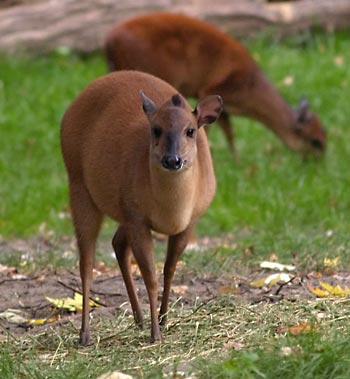
The Black duiker has a heavily built body, short stocky legs, a long body, and a long head. Its coat is dark brown to black, with reddish coloration on the nasal bridge and other parts of the head.[1][2]
It has bare nasal speculums and pointed hooves. Both males and females possess horns.[3][4]
Male horns measure between 7.5 and 17.5 cm, while female horns measure between 2.5 and 3 cm.[5][6]
The body measures between 80 and 90 cm in length, and the tail measures between 12 and 14 cm. The underside of the tail is white.[7][8][9]
The Black duiker has a shoulder height of 45 to 50 cm and weighs between 15 and 20 kg.[10][11]
Habitat
The Black duiker occurs from Guinea to southwestern Nigeria, including Côte d'Ivoire, Ghana, Guinea, Liberia, Nigeria, Sierra Leone, and Togo.[12]
It inhabits rainforests and other forests, including forest edges, bushes, thickets, shrublands, and degraded forests.[13]
Diet
The Black duiker eats a wide variety of foods, with fruits and foliage being its most common foods. Its diet includes flowers, leaves, buds, young shoots, grasses, herbs, berries, and fruits.[14][15]
Its diet also includes insects, termites, ants, snails, and eggs. It may occasionally eat birds.[16][17][15]
Behaviour
The Black duiker is terrestrial and lives alone or in pairs. It is sedentary and territorial.[18][19][20]
It generally occupies a territory of approximately 0.1 hectares. Sources differ on whether it is diurnal or nocturnal and crepuscular.[21][22]
Reproduction and life cycle
The Black duiker does not appear to have a restricted breeding season. Females reach sexual maturity between 9 and 12 months of age, while males reach sexual maturity between 12 and 18 months.[23][24][25]
The gestation period is approximately seven months. Females give birth to one offspring per birth, and a newborn weighs approximately 1 kg.[26][27][28]
Offspring are weaned within five months.[29]
Uses
Humans use Black duikers for their meat and skins.[30]
Conservation
Overhunting threatens the Black duiker despite its reported common occurrence among African duikers. Black duikers are killed annually for their meat and skins.[31][32]
The species is considered rare and endangered in Sierra Leone, Togo, and Nigeria. The IUCN classifies it as lower risk and near threatened.[33][34]
Stricter regulation of the bushmeat trade is identified as a measure that could improve the Black duiker's conservation status.[35]
Classification of the Black Duiker
| Kingdom | Animalia |
|---|---|
| Phylum | Chordata |
| Subphylum | Vertebrata |
| Infraphylum | Gnathostomata |
| Parvphylum | Osteichthyes |
| Megaclass | Tetrapoda |
| Class | Mammalia (Mammal) |
| Subclass | Theria |
| Infraclass | Eutheria |
| Order | Artiodactyla (Artiodactyls) |
| Family | Bovidae (Goats) |
| Subfamily | Antilopinae |
| Tribe | Cephalophini |
| Genus | Cephalophus (Forest Duikers) |
| Species | Cephalophus niger Gray, 1846 |
Where the Black Duiker is found
Checklists and occurrence records place Cephalophus niger in 7 countries across Africa. GBIF holds 253 georeferenced records of it.
Countries
Regions and cities with the most records
- Eastern, Ghana 21
- Sinoe County, Liberia 20
- Montagnes, Ivory Coast 16
- Bas-Sassandra District, Ivory Coast 15
- Kindia, Guinea 15
- Kolenté, Guinea 14
- Nimba, Liberia 13
- Lagunes District, Ivory Coast 8
- Akim Oda, Ghana 6
- Zanzan District, Ivory Coast 6
- Akwatia, Ghana 5
- Asamankese, Ghana 5
- Borgou, Benin 5
- Grand Gedeh County, Liberia 5
- Nzérékoré Region, Guinea 5
- Soubré, Ivory Coast 5
- Zwedru, Liberia 5
- Grand-Lahou, Ivory Coast 4
- Kade, Ghana 4
- Para, Ivory Coast 4
- Petit Grabo, Ivory Coast 4
- River Gee County, Liberia 4
- New Yekepa, Liberia 3
- Sassandra-Marahoue, Ivory Coast 3
- Savanes District, Ivory Coast 3
Range as the checklists state it
Africa
A number beside a place is its count of GBIF occurrence records. A place without a number comes from a checklist alone. Records show where a species has been observed or collected, which can include escapes and vagrants.
Common names
English
- Black Duiker
Names in 2 other languages
- French
- Céphalophe noir
- German
- Schwarzducker
Synonyms
One other scientific name has been used for this species and is now treated as a synonym of Cephalophus niger.
- Antilope pluto
Related species
-
 Red-flanked DuikerCephalophus rufilatus
-
 Bay DuikerCephalophus dorsalis
-
 Yellow-backed DuikerCephalophus silvicultor
-
 Red Forest DuikerCephalophus natalensis
-
 Jentink's DuikerCephalophus jentinki
-
 Abbott's DuikerCephalophus spadix
-
 Black-fronted DuikerCephalophus nigrifrons
-
 Ogilby's DuikerCephalophus ogilbyi
Compare
Questions and answers
What is the scientific name of the Black Duiker?
The scientific name of the Black Duiker is Cephalophus niger. Written with its author, the full name is Cephalophus niger Gray, 1846.
Which family does the Black Duiker belong to?
Cephalophus niger belongs to the family Bovidae, in the order Artiodactyla and the class Mammalia.
Where is the Black Duiker found?
Checklists and occurrence records place Cephalophus niger in 7 countries, including Liberia, Ivory Coast, Ghana, Guinea, Benin and Sierra Leone.
What is the conservation status of the Black Duiker?
The IUCN Red List category recorded for Cephalophus niger is Least Concern (LC).
Can you eat duiker meat?
Humans use Black duikers for their meat.[30]
Sources
Passages the profile rests on
- The black duiker has a heavily built body, short stocky legs, a long body, and a long head. Source passage: “Black Duikers are heavily built: short, stocky legs; long body; long head.” — animaldiversity.org
- The black duiker's coat is dark brown to black, with reddish coloration on the nasal bridge and other parts of the head. Source passage: “They are dark brown to black in color. The bridge of their nose and other parts of their head are more reddish in color.” — animaldiversity.org
- The black duiker has bare nasal speculums and pointed hooves. Source passage: “They have bare nasal speculums and pointed hooves.” — animaldiversity.org
- Both male and female black duikers possess horns. Source passage: “Both sexes have horns.” — animaldiversity.org
- Male black duiker horns measure between 7.5 and 17.5 cm. Source passage: “The male's are between 7.5 and 17.5 cm.” — animaldiversity.org
- Female black duiker horns measure between 2.5 and 3 cm. Source passage: “The female's horns are between 2.5 and 3 cm.” — animaldiversity.org
- The black duiker's body measures between 80 and 90 cm in length. Source passage: “The body is between 80 and 90 cm long.” — animaldiversity.org
- The black duiker's tail measures between 12 and 14 cm long. Source passage: “The tail is between 12 and 14 cm long.” — animaldiversity.org
- The underside of the black duiker's tail is white. Source passage: “The underside of the tail is white.” — animaldiversity.org
- The black duiker has a shoulder height of 45 to 50 cm. Source passage: “The shoulder height is 45 to 50 cm.” — animaldiversity.org
- The black duiker weighs between 15 and 20 kg. Source passage: “And they weigh between 15 and 20 kg.” — animaldiversity.org
- The black duiker occurs from Guinea to southwestern Nigeria, including Côte d'Ivoire, Ghana, Guinea, Liberia, Nigeria, Sierra Leone, and Togo. Source passage: “The Black Duiker ranges from Guinea to Southwestern Nigeria. This area includes the following countries: Côte d'Ivoire, Ghana, Guinea, Liberia, Nigeria, Sierra Leone, and Togo.” — animaldiversity.org
- The black duiker inhabits rainforests and other forests, including forest edges, bushes, thickets, shrublands, and degraded forests. Source passage: “It lives in areas of the rainforest and in in other forests. It can be found on the edges of these forests, in bushes and thickets. It can also be found in shrublands and degraded forests.” — animaldiversity.org
- The black duiker eats a wide variety of foods, with fruits and foliage being its most common foods. Source passage: “Black Duikers eat a wide variety of foods. Fruits and foliage are the most common,” — animaldiversity.org
- Recorded foods of the black duiker include flowers, leaves, buds, young shoots, grasses, herbs, berries, fruits, termites, ants, snails, and eggs. Source passage: “Foods eaten include: flowers, leaves, buds, young shoots, grasses, herbs, berries, fruits, termites, ants, snails and eggs.” — animaldiversity.org
- The black duiker's diet includes insects and eggs. Source passage: “however, their diet also includes everything from insects to eggs.” — animaldiversity.org
- The black duiker may occasionally eat birds. Source passage: “It is possible that they occasionally eat birds, also.” — animaldiversity.org
- The black duiker is a terrestrial animal. Source passage: “C. niger is a terrestrial animal that is found in several different areas of the forest.” — animaldiversity.org
- The black duiker lives alone or in pairs. Source passage: “Cephalophus niger lives alone or in pairs.” — animaldiversity.org
- The black duiker is sedentary and territorial. Source passage: “It is a sedentary and territorial animal.” — animaldiversity.org
- Sources differ on whether the black duiker is diurnal or nocturnal and crepuscular. Source passage: “Some believe that it is diurnal (Kingdon, 1997), while others believe that it is nocturnal and crepuscular (Walther, 1990).” — animaldiversity.org
- The black duiker generally occupies a territory of approximately 0.1 hectares. Source passage: “Its territory is generally about 0.1 hectares.” — animaldiversity.org
- The black duiker does not appear to have a restricted breeding season. Source passage: “There does not seem to be a restricted breeding season in C. niger .” — animaldiversity.org
- Female black duikers reach sexual maturity between 9 and 12 months of age. Source passage: “Females reach sexual maturity between ages 9 and 12 months.” — animaldiversity.org
- Male black duikers reach sexual maturity between 12 and 18 months of age. Source passage: “Males reach sexual maturity between ages 12 and 18 months.” — animaldiversity.org
- The black duiker has a gestation period of approximately seven months. Source passage: “Gestation lasts about 7 months.” — animaldiversity.org
- Female black duikers give birth to one offspring per birth. Source passage: “Only 1 offspring is born per birth;” — animaldiversity.org
- A newborn black duiker weighs approximately 1 kg. Source passage: “and the offspring weighs about 1 kg.” — animaldiversity.org
- Black duiker offspring are weaned within five months. Source passage: “Weaning lasts no longer than 5 months.” — animaldiversity.org
- Humans use black duikers for their meat and skins. Source passage: “Humans use the Black Duiker for its meat and its skin.” — animaldiversity.org
- Overhunting is a threat to the black duiker despite its reported common occurrence among African duikers. Source passage: “C. niger is one of the most common duikers in Africa. Still, it suffers from overhunting.” — animaldiversity.org
- Black duikers are killed annually for their meat and skins. Source passage: “Many are killed each year for meat and skins.” — animaldiversity.org
- The black duiker is considered rare and endangered in Sierra Leone, Togo, and Nigeria. Source passage: “It is considered to be rare and endangered in Sierra Leone, Togo, and Nigeria (Kingdon, 1997).” — animaldiversity.org
- The IUCN classifies the black duiker as lower risk and near threatened. Source passage: “However, the IUCN has it ranked as a lower risk species, that is, near threatened.” — animaldiversity.org
- Stricter regulation of the bushmeat trade is identified as a measure that could improve the black duiker's conservation status. Source passage: “Stricter rules on the bushmeat trade would help the status of this mammal.” — animaldiversity.org
Data
- Catalogue of Life, 2026-10-16 XR cc by
- Global Biodiversity Information Facility CC BY 4.0
- Wikidata CC0
- GeoNames CC BY 4.0
- Wikimedia Commons per image; credit shown with each image
- Within the Catalogue of Life, this name comes from The Integrated Taxonomic Information System cc0
References
- Ann. Mag. Nat. Hist., [ser. 1] vol.18 p.165 where the name was published
- Wilson, Don E., and DeeAnn M. Reeder, eds. (1993). Mammal Species of the World: A Taxonomic and Geographic Reference, 2nd Ed., 3rd Printing.
- Wilson, Don E., and F. Russell Cole. (2000). Common Names of Mammals of the World.
- Wilson, Don E., and DeeAnn M. Reeder, eds. (2005). Mammal Species of the World: A Taxonomic and Geographic Reference, 3rd Ed., Vols. 1 & 2.
- Wilson, D. E., and R. A. Mittermeier, eds. (2011). Handbook of the Mammals of the World, Vol. 2: Hoofed Mammals.
- Burgin, Connor J., Don E. Wilson, Russell A. Mittermeier, Anthony B. Rylands, et al. (2020). Illustrated Checklist of the Mammals of the World. Vol. 2. Eulipotyphla to Carnivora.
This species in other databases
Page built on 27 November 2026. See how the catalog is made and all sources and licences.
Cite this page
ScientificNames.org. (2026). Cephalophus niger (Black Duiker). Retrieved November 27, 2026, from https://scientificnames.org/species/cephalophus-niger
“Cephalophus niger (Black Duiker).” ScientificNames.org, 2026, scientificnames.org/species/cephalophus-niger. Accessed 27 Nov. 2026.
ScientificNames.org. “Cephalophus niger (Black Duiker).” Accessed November 27, 2026. https://scientificnames.org/species/cephalophus-niger.
@misc{scientificnames_cephalophus_niger_black_duiker,
  author = {{ScientificNames.org}},
  title = {Cephalophus niger (Black Duiker)},
  year = {2026},
  url = {https://scientificnames.org/species/cephalophus-niger},
  note = {Accessed 2026-11-27}
}