Species · Mammals
Abbott's Duiker Cephalophus spadix
The scientific name of the Abbott's Duiker is Cephalophus spadix. It is a species of mammal in the family Bovidae (goats), order Artiodactyla. The name dates from 1890.
- Scientific name
- Cephalophus spadix True, 1890
- Common name
- Abbott's Duiker
- Genus
- Cephalophus
- Family
- Bovidae (Goats)
- Order
- Artiodactyla
- Class
- Mammalia
- Red List category
- EN Endangered
- Recorded in
- 1 country
- Name status
- accepted in the Catalogue of Life

Overview
Abbott's Duiker (Cephalophus spadix True, 1890) is a mammal in the family Bovidae and order Artiodactyla. It lives mainly in wet forests and swamps in Tanzania, with principal habitat at elevations between 1,700 and 2,700 metres above sea level. It has a glossy, dark brown coat, a pale grey face and a large red tuft on its forehead.
Written 26 November 2026 from the sources listed below. Each statement was checked against the passage it cites; statements that could not be supported were removed.
Appearance
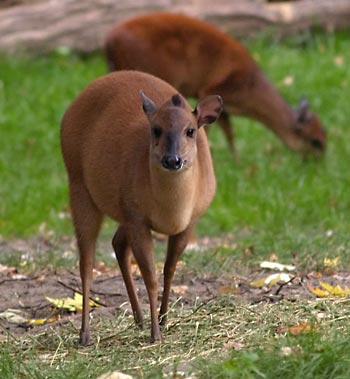
Abbott's Duiker has a glossy, dark brown coat that is lighter on the underside. Its face is pale grey and has a large red tuft on the forehead.[1][2]
Its horns are thin and short, measuring between 8 and 12 cm in length.[3][4]
Adults stand approximately 65 cm tall at the shoulder and weigh approximately 55 kg.[5][6]
Habitat
Abbott's Duiker lives mainly in wet forests and swamps and prefers dense vegetation. Its principal habitat occurs at elevations between 1,700 and 2,700 metres above sea level.[7][8][9]
Individuals sometimes wander to elevations of approximately 4,000 metres. They have been observed feeding in the forest understory and in forest clearings.[10][11]
The species is endemic to Tanzania, with scattered populations in the Eastern Arc Mountains and the Southern Highlands of Tanzania.[12][13][14]
Diet
Abbott's Duiker feeds mainly on fruit and possibly other plant matter. It eats leaves in the forest understory and vegetation in forest clearings.[15][16][17]
Possible food items include fruits, flowers and moss. An individual has been observed carrying a frog in its mouth.[18][19]
Behaviour
Abbott's Duiker is largely nocturnal and spends daytime resting in thickets. It is secretive and alert.[20][21][22]
Individuals form regular pathways through the undergrowth. When threatened, they generally attempt to flee.[23][24]
Individuals have been known to kill pursuing dogs when unable to escape.[25]
Conservation
The global population is estimated to number fewer than 1,500 individuals. There is no captive population of the species.[26][27]
Habitat destruction and poaching threaten Abbott's Duiker.[28][29]
Similar species
Abbott's Duiker may be a subspecies of the yellow-backed duiker.[30]
Classification of the Abbott's Duiker
| Kingdom | Animalia |
|---|---|
| Phylum | Chordata |
| Subphylum | Vertebrata |
| Infraphylum | Gnathostomata |
| Parvphylum | Osteichthyes |
| Megaclass | Tetrapoda |
| Class | Mammalia (Mammal) |
| Subclass | Theria |
| Infraclass | Eutheria |
| Order | Artiodactyla (Artiodactyls) |
| Family | Bovidae (Goats) |
| Subfamily | Antilopinae |
| Tribe | Cephalophini |
| Genus | Cephalophus (Forest Duikers) |
| Species | Cephalophus spadix True, 1890 |
Where the Abbott's Duiker is found
Checklists and occurrence records place Cephalophus spadix in 1 country across Africa. GBIF holds 33 georeferenced records of it.
Countries
Regions and cities with the most records
- Kilimanjaro, Tanzania 7
- Lushoto, Tanzania 4
- Makuyuni, Tanzania 4
- Matui, Tanzania 4
- Mazinde, Tanzania 4
- Tanga, Tanzania 4
Range as the checklists state it
Africa
A number beside a place is its count of GBIF occurrence records. A place without a number comes from a checklist alone. Records show where a species has been observed or collected, which can include escapes and vagrants.
Common names
English
- Abbott's Duiker
- Abbott’s Duiker
- Minde
Names in 16 other languages
- Arabic
- ديكر آبوت
- Chinese
- 坦桑麂羚
- Czech
- chocholatka Abbottova
- Dutch
- Abbotts Duiker
- Finnish
- Abbottinsukeltaja-antilooppi, töyhtöpukkija
- French
- Céphalophe d'Abbott
- German
- Abbott-Ducker, Abbottducker
- Hungarian
- Tanzániai bóbitásantilop
- Japanese
- アボットダイカー
- Korean
- 아보트다이커
- Norwegian Bokmål
- Abbottduiker
- Polish
- Dujker Abbotta, Dujker tanzański
- Portuguese
- Cabrito-de-Abbott
- Russian
- Танзанийский дукер
- Spanish
- Duiker de Abbott, Duiquero de Abbott
- Swedish
- Abbotts dykare
Related species
-
 Red-flanked DuikerCephalophus rufilatus
-
 Bay DuikerCephalophus dorsalis
-
 Yellow-backed DuikerCephalophus silvicultor
-
 Red Forest DuikerCephalophus natalensis
-
 Jentink's DuikerCephalophus jentinki
-
 Black-fronted DuikerCephalophus nigrifrons
-
 Black DuikerCephalophus niger
-
 Ogilby's DuikerCephalophus ogilbyi
Compare
Questions and answers
What is the scientific name of the Abbott's Duiker?
The scientific name of the Abbott's Duiker is Cephalophus spadix. Written with its author, the full name is Cephalophus spadix True, 1890.
Which family does the Abbott's Duiker belong to?
Cephalophus spadix belongs to the family Bovidae, in the order Artiodactyla and the class Mammalia.
Where is the Abbott's Duiker found?
Checklists and occurrence records place Cephalophus spadix in 1 country: Tanzania.
What is the conservation status of the Abbott's Duiker?
The IUCN Red List category recorded for Cephalophus spadix is Endangered (EN).
What other names does the Abbott's Duiker have?
Cephalophus spadix is also known in English as Abbott’s Duiker and Minde.
Sources
Passages the profile rests on
- The species has a glossy, dark brown coat that is lighter on the underside. Source passage: “This duiker has a glossy, dark brown coat which is lighter on the underside.” — English Wikipedia
- Its face is pale grey and has a large red tuft on the forehead. Source passage: “The face is paler and grey in colour, with a large red tuft on the forehead” — English Wikipedia
- Its horns are thin and short. Source passage: “the horns are thin and short (8 to 12 cm (3.1 to 4.7 in)).” — English Wikipedia
- Its horns measure between 8 and 12 cm in length. Source passage: “the horns are thin and short (8 to 12 cm (3.1 to 4.7 in)).” — English Wikipedia
- Adults stand approximately 65 cm tall at the shoulder. Source passage: “Abbott's duikers stand around 65 cm (26 in) tall at the shoulder” — English Wikipedia
- Adults weigh approximately 55 kg. Source passage: “weigh about 55 kg (121 lb).” — English Wikipedia
- The species lives mainly in wet forests and swamps. Source passage: “They live mainly in wet forests and swamps” — English Wikipedia
- Its principal habitat occurs at elevations between 1,700 and 2,700 metres above sea level. Source passage: “between 1,700 and 2,700 m above sea level” — English Wikipedia
- The species prefers dense vegetation. Source passage: “preference for dense vegetation” — English Wikipedia
- Individuals sometimes wander to elevations of approximately 4,000 metres. Source passage: “but can sometimes wander to much higher elevations at 4,000 m.” — English Wikipedia
- It has been observed feeding in the forest understory and in forest clearings. Source passage: “It has been observed feeding on leaves in the forest understory, and on vegetation in forest clearings” — English Wikipedia
- The species is endemic to Tanzania. Source passage: “Abbott's duiker is endemic to Tanzania” — English Wikipedia
- Its distribution includes scattered populations in the Eastern Arc Mountains. Source passage: “in the Eastern Arc Mountains, Mount Kilimanjaro, and Southern Highlands in scattered populations.” — English Wikipedia
- Its distribution includes the Southern Highlands of Tanzania. Source passage: “Southern Highlands in scattered populations.” — English Wikipedia
- The species feeds on leaves in the forest understory. Source passage: “feeding on leaves in the forest understory” — English Wikipedia
- It consumes vegetation in forest clearings. Source passage: “on vegetation in forest clearings” — English Wikipedia
- The species feeds mainly on fruit and possibly other plant matter. Source passage: “They eat mainly fruit and possibly other plant matter.” — English Wikipedia
- Its possible food items include fruits, flowers and moss. Source passage: “may feed on fruits, flowers and moss.” — English Wikipedia
- An individual has been observed carrying a frog in its mouth. Source passage: “An Abbott's duiker has also been seen with a frog in its mouth” — English Wikipedia
- The species is largely nocturnal. Source passage: “largely nocturnal habits” — English Wikipedia
- It spends daytime resting in thickets. Source passage: “spending the days at rest in thickets.” — English Wikipedia
- The species is secretive and alert. Source passage: “The cryptic habits and alertness of Abbott's duiker” — English Wikipedia
- Individuals form regular pathways through the undergrowth. Source passage: “They form regular pathways through the undergrowth” — English Wikipedia
- When threatened, individuals generally attempt to flee. Source passage: “If threatened, they generally try to run” — English Wikipedia
- Individuals have been known to kill pursuing dogs when unable to escape. Source passage: “they have been known to kill pursuing dogs when left with no escape route.” — English Wikipedia
- The global population is estimated to number fewer than 1,500 individuals. Source passage: “Less than 1,500 Abbott's duiker are estimated to be left in the world” — English Wikipedia
- There is no captive population of the species. Source passage: “with no captive population.” — English Wikipedia
- Habitat destruction threatens the species. Source passage: “They are threatened by habitat destruction and poaching.” — English Wikipedia
- Poaching is a threat to the species. Source passage: “They are threatened by habitat destruction and poaching.” — English Wikipedia
- The species may be a subspecies of the yellow-backed duiker. Source passage: “It may be a subspecies of the yellow-backed duiker.” — English Wikipedia
- The species is classified as a mammal in the United States Fish and Wildlife Service document. Source passage: “Kingdom Animalia Location in Taxonomic Tree Genus” — fws.gov
- The scientific name is Cephalophus spadix True, 1890. Source passage: “Scientific Name: Cephalophus spadix True, 1890.” — iucnredlist.org
Data
- Catalogue of Life, 2026-10-16 XR cc by
- Global Biodiversity Information Facility CC BY 4.0
- Wikidata CC0
- GeoNames CC BY 4.0
- Wikimedia Commons per image; credit shown with each image
- Within the Catalogue of Life, this name comes from The Integrated Taxonomic Information System cc0
References
- Proc. U.S. Natl. Mus. vol.13 p.227 where the name was published
- Wilson, Don E., and DeeAnn M. Reeder, eds. (1993). Mammal Species of the World: A Taxonomic and Geographic Reference, 2nd Ed., 3rd Printing.
- Wilson, Don E., and F. Russell Cole. (2000). Common Names of Mammals of the World.
- Wilson, Don E., and DeeAnn M. Reeder, eds. (2005). Mammal Species of the World: A Taxonomic and Geographic Reference, 3rd Ed., Vols. 1 & 2.
- Wilson, D. E., and R. A. Mittermeier, eds. (2011). Handbook of the Mammals of the World, Vol. 2: Hoofed Mammals.
- Burgin, Connor J., Don E. Wilson, Russell A. Mittermeier, Anthony B. Rylands, et al. (2020). Illustrated Checklist of the Mammals of the World. Vol. 2. Eulipotyphla to Carnivora.
This species in other databases
Page built on 29 November 2026. See how the catalog is made and all sources and licences.
Cite this page
ScientificNames.org. (2026). Cephalophus spadix (Abbott's Duiker). Retrieved November 29, 2026, from https://scientificnames.org/species/cephalophus-spadix
“Cephalophus spadix (Abbott's Duiker).” ScientificNames.org, 2026, scientificnames.org/species/cephalophus-spadix. Accessed 29 Nov. 2026.
ScientificNames.org. “Cephalophus spadix (Abbott's Duiker).” Accessed November 29, 2026. https://scientificnames.org/species/cephalophus-spadix.
@misc{scientificnames_cephalophus_spadix_abbotts_duiker,
  author = {{ScientificNames.org}},
  title = {Cephalophus spadix (Abbott's Duiker)},
  year = {2026},
  url = {https://scientificnames.org/species/cephalophus-spadix},
  note = {Accessed 2026-11-29}
}