Species · Spiders and other arachnids
Israeli Desert Huntsman Cerbalus aravaensis
The scientific name of the Israeli Desert Huntsman is Cerbalus aravaensis. It is a species of arachnid in the family Sparassidae (huntsman spider), order Araneae. The name dates from 2007.
- Scientific name
- Cerbalus aravaensis Levy, 2007
- Common name
- Israeli Desert Huntsman
- Genus
- Cerbalus
- Family
- Sparassidae (Huntsman Spider)
- Order
- Araneae
- Class
- Arachnida
- Recorded in
- 2 countries
- Name status
- accepted in the Catalogue of Life

Overview
The Israeli Desert Huntsman is a huntsman spider in the family Sparassidae. It occurs in the southern Arava Valley of Israel and Jordan. It has a leg span of 14 centimeters and is among the largest members of the family Sparassidae in the Middle East.
Written 26 November 2026 from the sources listed below. Each statement was checked against the passage it cites; statements that could not be supported were removed.
Appearance
The Israeli Desert Huntsman is a huntsman spider. Its leg span is 14 centimeters.[1][2]
Adult males have a body length ranging from 1.85 to 2.40 centimeters. Adult females have a body length ranging from 2.20 to 2.65 centimeters.[3][4]
Habitat
The species inhabits sand dunes and partly stable sands along the edges of salt marshes.[5][6]
Behaviour
The species is most active during the hotter summer months.[7]
It constructs underground dens with hinged, trapdoor-like entrances made from sand and silk. It disguises these entrances to protect against predators.[8][9]
Conservation
The Sands of Samar are the last remaining sand dunes in the southern Arava region of Israel and provide habitat for the species. Their area has declined from as much as 7 square kilometers to less than 3 square kilometers.[10][11]
Agricultural rezoning and sand quarrying have contributed to the reduction of the Sands of Samar. Mining projects there are intended to resume in the near future.[12][13]
The future of the species' habitat is uncertain because of planned mining projects. The species is unlikely to survive if the Sands of Samar are destroyed.[14][15]
Classification of the Israeli Desert Huntsman
| Kingdom | Animalia |
|---|---|
| Phylum | Arthropoda |
| Subphylum | Chelicerata |
| Class | Arachnida (Arachnid) |
| Order | Araneae (Spider) |
| Family | Sparassidae (Huntsman Spider) |
| Genus | Cerbalus |
| Species | Cerbalus aravaensis Levy, 2007 |
Origin of the name. Etymology. The specific name refers to the type locality.
Where the Israeli Desert Huntsman is found
Checklists and occurrence records place Cerbalus aravaensis in 2 countries across Asia. GBIF holds 8 georeferenced records of it.
Countries
Regions and cities with the most records
Range as the checklists state it
Israel, Jordan
A number beside a place is its count of GBIF occurrence records. A place without a number comes from a checklist alone. Records show where a species has been observed or collected, which can include escapes and vagrants.
Common names
English
- Israeli Desert Huntsman
Names in 1 other language
- Hebrew
- מברישימון הערבה
Related species
- Cerbalus ergensis
- Cerbalus alegranzaensis
- Cerbalus negebensis
-
 Cerbalus psammodes
- Cerbalus pellitus
- Cerbalus pulcherrimus
- Cerbalus verneaui
-
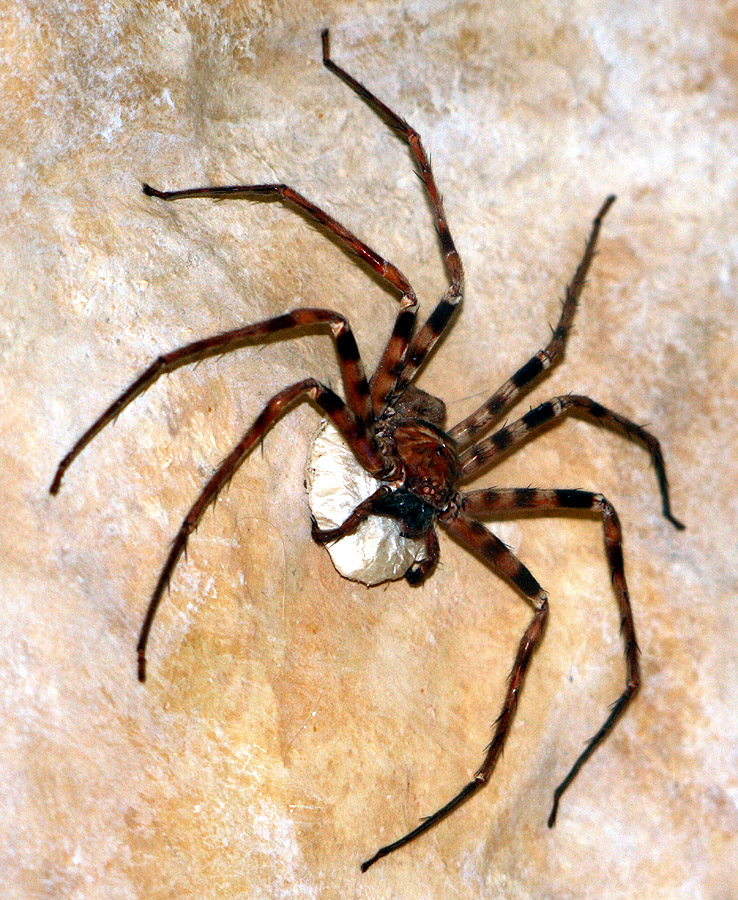 Giant Huntsman SpiderHeteropoda maxima
Compare
Questions and answers
What is the scientific name of the Israeli Desert Huntsman?
The scientific name of the Israeli Desert Huntsman is Cerbalus aravaensis. Written with its author, the full name is Cerbalus aravaensis Levy, 2007.
Which family does the Israeli Desert Huntsman belong to?
Cerbalus aravaensis belongs to the family Sparassidae, in the order Araneae and the class Arachnida.
Where is the Israeli Desert Huntsman found?
Checklists and occurrence records place Cerbalus aravaensis in 2 countries: Israel and Jordan.
What is the name of the Israeli desert huntsman spider?
Its name is the Israeli Desert Huntsman, scientifically named Cerbalus aravaensis Levy, 2007.[16]
Sources
Passages the profile rests on
- The species is a huntsman spider. Source passage: “Cerbalus aravaensis is a huntsman spider found in the southern Arava Valley of Israel and Jordan.” — English Wikipedia
- The species has a leg span of 14 centimeters. Source passage: “The spider has a leg-span of 14 centimeters (5.5 in)” — English Wikipedia
- Adult males have a body length ranging from 1.85 to 2.40 centimeters. Source passage: “Males have a body length of 1.85–2.40 centimeters (0.73–0.94 in)” — English Wikipedia
- Adult females have a body length ranging from 2.20 to 2.65 centimeters. Source passage: “females' body length is 2.20–2.65 centimeters (0.87–1.04 in).” — English Wikipedia
- The species inhabits sand dunes. Source passage: “Cerbalus aravaensis lives in sand dunes,” — English Wikipedia
- The species also inhabits partly stable sands along the edges of salt marshes. Source passage: “and partly stable sands at the edge of salt-marshes.” — English Wikipedia
- The species is most active during the hotter summer months. Source passage: “is most-active in the hotter summer months.” — English Wikipedia
- The species constructs underground dens with hinged, trapdoor-like entrances made from sand and silk. Source passage: “It constructs underground dens with hinged, trap-door-like operculum made of sand and silk,” — English Wikipedia
- The species disguises the entrances to its underground dens to protect against predators. Source passage: “in order to disguise the entrance from predators.” — English Wikipedia
- The Sands of Samar are the last remaining sand dunes in the southern Arava region of Israel and provide habitat for the species. Source passage: “The Sands of Samar, the last remaining sand dunes in the southern Arava region of Israel and home to Cerbalus aravaensis,” — English Wikipedia
- The area covered by the Sands of Samar has declined from as much as 7 square kilometers to less than 3 square kilometers. Source passage: “The sands once covered as many as 7 km2 (2.7 sq mi), but now cover less than 3 km2 (1.2 sq mi)” — English Wikipedia
- Agricultural rezoning and sand quarrying have contributed to the reduction of the Sands of Samar. Source passage: “due to re-zoning of areas for agriculture and sand quarries.” — English Wikipedia
- Mining projects in the Sands of Samar are intended to resume in the near future. Source passage: “Mining projects on the sands are intended to be renewed in the near future” — English Wikipedia
- The future of the species' habitat is uncertain because of planned mining projects. Source passage: “and thus the habitat's future is uncertain.” — English Wikipedia
- The species is unlikely to survive if the Sands of Samar are destroyed. Source passage: “Should the Sands of Samar be destroyed, it is unlikely that Cerbalus aravaensis would survive.” — English Wikipedia
- The species was first described by Gershom Levy of the Hebrew University of Jerusalem in 2007. Source passage: “The species was first described by Gershom Levy of the Hebrew University of Jerusalem in 2007,” — English Wikipedia
Data
- Catalogue of Life, 2026-10-16 XR cc by
- Global Biodiversity Information Facility CC BY 4.0
- Wikidata CC0
- GeoNames CC BY 4.0
- Wikimedia Commons per image; credit shown with each image
- iNaturalist per image; credit shown with each image
- Within the Catalogue of Life, this name comes from The World Spider Catalog cc by
References
- Levy, G. (2007). Calommata (Atypidae) and new spider species (Araneae) from Israel. Zootaxa 1551: 1-30. doi: <a href="https://doi.org/10.11646/zootaxa.1551.1.1" target="_blank">10.11646/zootaxa.1551.1.1 Link where the name was published
This species in other databases
Page built on 27 November 2026. See how the catalog is made and all sources and licences.
Cite this page
ScientificNames.org. (2026). Cerbalus aravaensis (Israeli Desert Huntsman). Retrieved November 27, 2026, from https://scientificnames.org/species/cerbalus-aravaensis
“Cerbalus aravaensis (Israeli Desert Huntsman).” ScientificNames.org, 2026, scientificnames.org/species/cerbalus-aravaensis. Accessed 27 Nov. 2026.
ScientificNames.org. “Cerbalus aravaensis (Israeli Desert Huntsman).” Accessed November 27, 2026. https://scientificnames.org/species/cerbalus-aravaensis.
@misc{scientificnames_cerbalus_aravaensis_israeli_desert_huntsman,
  author = {{ScientificNames.org}},
  title = {Cerbalus aravaensis (Israeli Desert Huntsman)},
  year = {2026},
  url = {https://scientificnames.org/species/cerbalus-aravaensis},
  note = {Accessed 2026-11-27}
}