Species · Flowering plants
California Mountain Mahogany Cercocarpus betuloides
The scientific name of the California Mountain Mahogany is Cercocarpus betuloides. It is a species of flowering plant in the family Rosaceae (rose family), order Rosales.
- Scientific name
- Cercocarpus betuloides Nutt.
- Common name
- California Mountain Mahogany
- Genus
- Cercocarpus
- Family
- Rosaceae (Rose Family)
- Order
- Rosales
- Class
- Magnoliopsida
- Recorded in
- 2 countries
- Name status
- accepted in the Catalogue of Life

Overview
California Mountain Mahogany (Cercocarpus betuloides Nutt.) is a flowering plant in the family Rosaceae, order Rosales, and class Magnoliopsida. It is native to California and Baja California, with a documented native range that also includes Oregon, Arizona, and northwestern New Mexico. It is distinguished by its lobed branches, wavy or toothed leaf tips, and tubular fruit bearing a long, feathery style.
Written 26 November 2026 from the sources listed below. Each statement was checked against the passage it cites; statements that could not be supported were removed.
Appearance
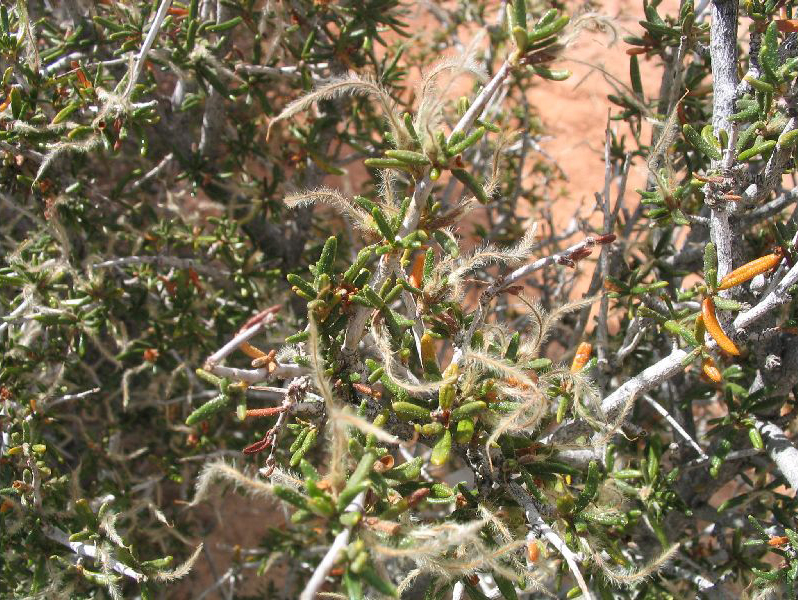
California Mountain Mahogany grows as a shrub or small tree. It typically reaches between 1 and 5 meters tall, with occasional individuals reaching 8 meters.[1][2]
Its branches have an incised and muscular appearance when viewed from the side and appear lobed in cross section. Its leaves have smooth edges near the base and wavy or toothed edges toward their rounded tips.[3][4][5]
Its small white flowers grow in clusters and have a mild scent. Its fruit is a tubular achene with a long, feathery flower style remaining attached.[6][7]
The specific epithet betuloides refers to a resemblance to birch. The genus name Cercocarpus refers to the tail-like appearance of the fruit.[8][9]
Habitat
California Mountain Mahogany typically occupies foothill and mountain areas of California that experience dry summers. Toyon is among the shrubs commonly associated with it in chaparral communities.[10][11]
Diet
Deer, cattle, and sheep browse California Mountain Mahogany.[12][13][14]
Reproduction and life cycle
California Mountain Mahogany produces white flowers. Its fruit is an achene bearing a persistent, elongated, plumelike style.[15][16]
Uses
The extremely hard, reddish-brown wood of California Mountain Mahogany was traditionally used by Indigenous peoples of California to make arrow tips, fishing spears, and digging sticks.[17][18][19][20]
The species is cultivated as an ornamental plant by specialist nurseries. It is planted in native plant gardens, drought-tolerant gardens, and wildlife gardens, and used in designed natural landscaping projects and habitat restoration programs.[21][22][23][24][25][26]
Classification of the California Mountain Mahogany
| Kingdom | Plantae |
|---|---|
| Subkingdom | Pteridobiotina |
| Phylum | Tracheophyta |
| Class | Magnoliopsida |
| Order | Rosales |
| Family | Rosaceae (Rose Family) |
| Subfamily | Dryadoideae |
| Genus | Cercocarpus (Mountain-mahogany) |
| Species | Cercocarpus betuloides Nutt. |
Where the California Mountain Mahogany is found
Checklists and occurrence records place Cercocarpus betuloides in 2 countries across North America. GBIF holds 12,391 georeferenced records of it.
Countries
Regions and cities with the most records
- California, United States 9,181
- Altadena, United States 841
- La Cañada Flintridge, United States 834
- La Crescenta-Montrose, United States 822
- Glendale, United States 788
- Pasadena, United States 783
- South Pasadena, United States 747
- Burbank, United States 715
- Alhambra, United States 646
- San Gabriel, United States 636
- Arcadia, United States 611
- Monrovia, United States 610
- Temple City, United States 576
- Monterey Park, United States 504
- Rosemead, United States 482
- Duarte, United States 463
- Agoura, United States 445
- Los Angeles, United States 411
- Saratoga, United States 408
- Agoura Hills, United States 393
- Sunnyvale, United States 363
- Los Gatos, United States 353
- Campbell, United States 351
- El Monte, United States 342
- Cupertino, United States 331
- Thousand Oaks, United States 331
- Rancho Santa Margarita, United States 330
- Santa Monica, United States 328
- Oregon, United States 290
- Mountain View, United States 280
- Los Altos, United States 279
- Santa Clara, United States 273
- Azusa, United States 271
- Palo Alto, United States 269
- Claremont, United States 268
- San Jose, United States 268
Range as the checklists state it
USA (Arizona, California, Montana, Oregon); Mexico (Baja California Norte, Chihuahua, Coahuila, Sonora)
A number beside a place is its count of GBIF occurrence records. A place without a number comes from a checklist alone. Records show where a species has been observed or collected, which can include escapes and vagrants.
Common names
English
- California Mountain Mahogany
- Birch-leaf Mahogany
- Mountain Mahogany
Names in 7 other languages
- Chinese
- 山紅木
- Czech
- oháňkovník břízový
- Finnish
- kalifornianrautaispensas
- Russian
- Церкокарпус берёзовидный
- Slovak
- chvostíkovec brezovitý
- Spanish
- Caoba de montaña
- xgf
- toobe
Synonyms
10 other scientific names have been used for this species and are now treated as synonyms of Cercocarpus betuloides.
- Cercocarpus betulifolius C.K.Schneid.
- Cercocarpus betulifolius Nutt. ex Hook.
- Cercocarpus betulifolius f. glabrescens C.K.Schneid.
- Cercocarpus betulifolius var. betulifolius
- Cercocarpus betulifolius var. minor C.K.Schneid.
- Cercocarpus betuloides var. multiflorus Jeps.
- Cercocarpus douglasii Rydb.
- Cercocarpus montanus var. glaber (S.Watson) F.L.Martin
- Cercocarpus parvifolius var. betuloides (Nutt.) Sarg.
- Cercocarpus parvifolius var. glaber S.Watson
Subspecies and varieties
- Cercocarpus betuloides var. betuloides (Birch-leaf Cercocarpus) variety
- Cercocarpus betuloides var. blancheae (Island Mountain-mahogany) variety
- Cercocarpus betuloides var. macrourus variety
- Cercocarpus betuloides var. traskiae variety
Related species
-
 Curlleaf Mountain MahoganyCercocarpus ledifolius
-
 Alder-leaved Mountain-mahoganyCercocarpus montanus
- Hairy Mountain-mahoganyCercocarpus breviflorus
-
 Little-leaf Mountain MahoganyCercocarpus intricatus
- Cercocarpus macrophyllus
- Cercocarpus fothergilloides
- Cercocarpus pringlei
- Cercocarpus mexicanus
Compare
Questions and answers
What is the scientific name of the California Mountain Mahogany?
The scientific name of the California Mountain Mahogany is Cercocarpus betuloides. Written with its author, the full name is Cercocarpus betuloides Nutt..
Which family does the California Mountain Mahogany belong to?
Cercocarpus betuloides belongs to the family Rosaceae, in the order Rosales and the class Magnoliopsida.
Where is the California Mountain Mahogany found?
Checklists and occurrence records place Cercocarpus betuloides in 2 countries: United States and Mexico.
What other names does the California Mountain Mahogany have?
Cercocarpus betuloides is also known in English as Birch-leaf Mahogany and Mountain Mahogany.
What is mountain mahogany good for?
Its hard, reddish-brown wood was traditionally used by Indigenous peoples of California to make arrow tips, fishing spears, and digging sticks. The species is also cultivated for ornamental planting, drought-tolerant gardens, wildlife gardens, natural landscaping, and habitat restoration.[17][18][19][21][22][23][24][25][26][20]
Is mountain mahogany a hardwood?
Its wood is extremely hard and reddish-brown.[20]
Where to plant mountain mahogany?
It is planted in native plant gardens, drought-tolerant gardens, and wildlife gardens, and used in designed natural landscaping projects and habitat restoration programs. It typically occupies foothill and mountain areas of California that experience dry summers.[10][22][23][24][25][26]
Is mountain mahogany a tree or a bush?
California Mountain Mahogany grows as a shrub or small tree.[1]
Do deer eat mountain mahogany?
Yes. Deer browse California Mountain Mahogany.[12]
Sources
Passages the profile rests on
- The species grows as a shrub or small tree. Source passage: “is a species of flowering shrub or small tree in the rose family (Rosaceae).” — English Wikipedia
- The species typically grows between 1 and 5 meters tall, with occasional individuals reaching 8 meters. Source passage: “growing from 1 to 5 meters (3 to 16 ft), rarely to 8 m (26 ft).” — English Wikipedia
- Its branches have an incised and muscular appearance when viewed from the side. Source passage: “Its branches are incised and muscular in appearance from the side.” — English Wikipedia
- Its branches appear lobed in cross section. Source passage: “In cross section they appear lobed.” — English Wikipedia
- Its leaves have smooth edges near the base and wavy or toothed edges toward their rounded tips. Source passage: “The leaves are distinctive in that they have smooth edges from the base to about halfway up, then are wavy or toothed to the rounded tip.” — English Wikipedia
- Its small white flowers grow in clusters and have a mild scent. Source passage: “The white flowers are small, clustered, and mildly scented, similar to Acacia.” — English Wikipedia
- Its fruit is a tubular achene with a long, feathery flower style remaining attached. Source passage: “The fruit is a tubular achene with the long, plumelike flower style still attached.” — English Wikipedia
- The specific epithet betuloides refers to a resemblance to birch. Source passage: “thus "betula-like" or "resembling a birch", referring to the birch-like leaves.” — English Wikipedia
- The genus name Cercocarpus refers to the tail-like appearance of the fruit. Source passage: “The genus name, Cercocarpus, comes from the Greek kerkos (tail), referring to the tail-like appearance of the fruit;” — English Wikipedia
- The species typically occupies foothill and mountain areas of California that experience dry summers. Source passage: “It typically grows in summer dry areas of the foothills and mountains of California” — English Wikipedia
- Toyon is among the shrubs commonly associated with this species in chaparral communities. Source passage: “Common shrub associates within the chaparral community include toyon.” — English Wikipedia
- Deer browse this species. Source passage: “Deer, cattle and sheep browse the plant.” — English Wikipedia
- Cattle browse this species. Source passage: “Deer, cattle and sheep browse the plant.” — English Wikipedia
- Sheep browse this species. Source passage: “Deer, cattle and sheep browse the plant.” — English Wikipedia
- The species produces white flowers. Source passage: “The white flowers are small, clustered, and mildly scented, similar to Acacia.” — English Wikipedia
- Its fruit is an achene bearing a persistent, elongated, plumelike style. Source passage: “The fruit is a tubular achene with the long, plumelike flower style still attached.” — English Wikipedia
- The species' hard reddish wood was traditionally used by Indigenous peoples of California to make arrow tips. Source passage: “was traditionally used by the indigenous peoples of California to make arrow tips,” — English Wikipedia
- The species' wood was traditionally used to make fishing spears. Source passage: “fishing spears, and digging sticks.” — English Wikipedia
- The species' wood was traditionally used to make digging sticks. Source passage: “fishing spears, and digging sticks.” — English Wikipedia
- The species' wood is extremely hard and reddish-brown. Source passage: “characterized by their extremely hard reddish-brown wood” — English Wikipedia
- The species is cultivated as an ornamental plant by specialist nurseries. Source passage: “Cercocarpus betuloides is cultivated as an ornamental plant by specialty nurseries” — English Wikipedia
- The species is planted in native plant gardens. Source passage: “for planting in native plant, drought tolerant, and wildlife gardens;” — English Wikipedia
- The species is cultivated for drought-tolerant gardens. Source passage: “for planting in native plant, drought tolerant, and wildlife gardens;” — English Wikipedia
- The species is planted in wildlife gardens. Source passage: “for planting in native plant, drought tolerant, and wildlife gardens;” — English Wikipedia
- The species is used in designed natural landscaping projects. Source passage: “and in designed natural landscaping projects and habitat restoration programs.” — English Wikipedia
- The species is used in habitat restoration programs. Source passage: “and in designed natural landscaping projects and habitat restoration programs.” — English Wikipedia
Data
- Catalogue of Life, 2026-10-16 XR cc by
- Global Biodiversity Information Facility CC BY 4.0
- Wikidata CC0
- GeoNames CC BY 4.0
- Wikimedia Commons per image; credit shown with each image
- Within the Catalogue of Life, this name comes from Synonymic Checklists of the Vascular Plants of the World cc by
References
- Nutt. (1840). Fl. N. Amer. [Torrey & A.Gray] 1: 427 (1840). where the name was published
This species in other databases
- Catalogue of Life 69KQG
- Wikidata Q2946567
- iNaturalist 63977
- World Flora Online wfo-0001014585
- GRIN 317275
Page built on 27 November 2026. See how the catalog is made and all sources and licences.
Cite this page
ScientificNames.org. (2026). Cercocarpus betuloides (California Mountain Mahogany). Retrieved November 27, 2026, from https://scientificnames.org/species/cercocarpus-betuloides
“Cercocarpus betuloides (California Mountain Mahogany).” ScientificNames.org, 2026, scientificnames.org/species/cercocarpus-betuloides. Accessed 27 Nov. 2026.
ScientificNames.org. “Cercocarpus betuloides (California Mountain Mahogany).” Accessed November 27, 2026. https://scientificnames.org/species/cercocarpus-betuloides.
@misc{scientificnames_cercocarpus_betuloides_california_mountain_mahogany,
  author = {{ScientificNames.org}},
  title = {Cercocarpus betuloides (California Mountain Mahogany)},
  year = {2026},
  url = {https://scientificnames.org/species/cercocarpus-betuloides},
  note = {Accessed 2026-11-27}
}