Species · Flowering plants
Alder-leaved Mountain-mahogany Cercocarpus montanus
The scientific name of the Alder-leaved Mountain-mahogany is Cercocarpus montanus. It is a species of flowering plant in the family Rosaceae (rose family), order Rosales.
- Scientific name
- Cercocarpus montanus Raf.
- Common name
- Alder-leaved Mountain-mahogany
- Genus
- Cercocarpus
- Family
- Rosaceae (Rose Family)
- Order
- Rosales
- Class
- Magnoliopsida
- Red List category
- LC Least Concern
- Recorded in
- 2 countries
- Name status
- accepted in the Catalogue of Life

Overview
Cercocarpus montanus occurs in chaparral scrub, on mesas, in the lower Rocky Mountain foothills, and on the Great Plains. It is very tolerant of heat and drought and is considered long-lived.
Written 26 November 2026 from the sources listed below. Each statement was checked against the passage it cites; statements that could not be supported were removed.
Appearance
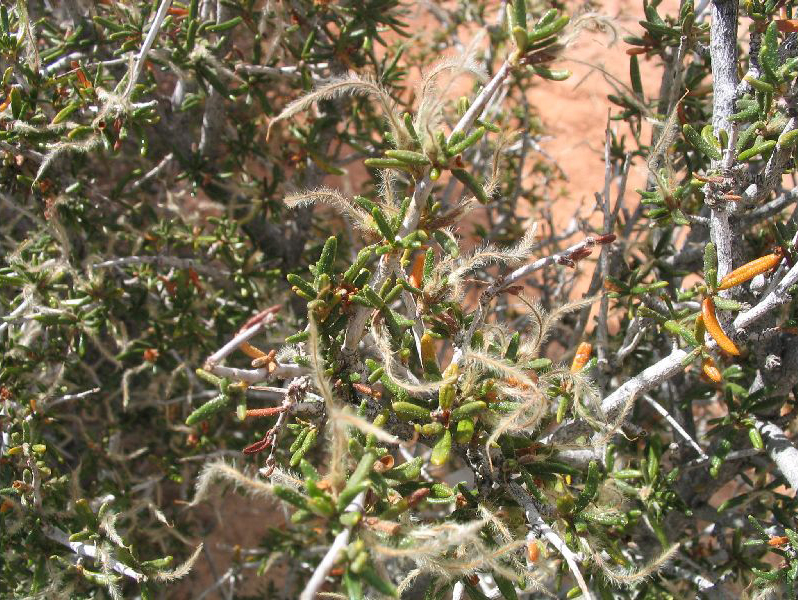
The flowers have five sepals, 25–40 stamens, and one pistil, but no petals. They are radially symmetrical, usually bisexual and rarely unisexual, with a cup-like base and a sweet smell.[1][2][3]
The species can reach approximately 6.1 metres in height. Plants often remain below one metre tall because of browsing by elk and deer.[4][5]
Habitat
The species occurs in chaparral scrub, on mesas, in the lower Rocky Mountain foothills, and on the Great Plains. It occurs in Douglas-fir, ponderosa pine, sagebrush, chaparral, pinyon-juniper, and mountain and plains grassland ecosystems.[6][7]
In Arches National Park, it occurs in desert shrub, pinyon-juniper, and grassland communities. Plants there are reported to reach 1.2–4 metres in height.[8][9]
Diet
Yellow-haired porcupines eat this species. Its fruits provide food for wildlife.[10][11]
Behaviour
Elk and deer browse Alder-leaved Mountain-mahogany, often keeping it below one metre tall.[5][12]
Reproduction and life cycle
The species flowers in April and May in Arches National Park.[13]
Conservation
The species has no special federal legal status.[14]
Uses
Alder-leaved Mountain-mahogany is sometimes cultivated as a drought-tolerant garden plant, particularly within its native range. It is considered a valuable browse plant for wildlife and livestock.[15][16]
Its wood can be used to make tool handles, weaving forks, battens, fire sticks, throwing sticks, prayer sticks, and arrow points. Its roots and bark can produce reddish-brown dye for baskets and leather.[17][18]
Similar species
Alder-leaved Mountain-mahogany hybridizes with curlleaf mountain-mahogany and littleleaf mountain-mahogany where their populations overlap. The variety argenteus is commonly called silverleaf mountain-mahogany.[19][20]
Classification of the Alder-leaved Mountain-mahogany
| Kingdom | Plantae |
|---|---|
| Subkingdom | Pteridobiotina |
| Phylum | Tracheophyta |
| Class | Magnoliopsida |
| Order | Rosales |
| Family | Rosaceae (Rose Family) |
| Subfamily | Dryadoideae |
| Genus | Cercocarpus (Mountain-mahogany) |
| Species | Cercocarpus montanus Raf. |
Where the Alder-leaved Mountain-mahogany is found
Checklists and occurrence records place Cercocarpus montanus in 2 countries across North America. GBIF holds 10,175 georeferenced records of it.
Countries
Regions and cities with the most records
- Colorado, United States 4,298
- California, United States 1,200
- Utah, United States 902
- New Mexico, United States 809
- Colorado Springs, United States 738
- Dakota Ridge, United States 653
- Golden, United States 646
- Lakewood, United States 594
- Columbine, United States 547
- Ken Caryl, United States 546
- Wheat Ridge, United States 525
- Arizona, United States 524
- Arvada, United States 450
- Littleton, United States 433
- Security-Widefield, United States 431
- Encinitas, United States 415
- Englewood, United States 409
- Fort Collins, United States 384
- Poway, United States 371
- Santee, United States 346
- Bostonia, United States 333
- Casa de Oro-Mount Helix, United States 323
- Winter Gardens, United States 318
- El Cajon, United States 315
- Escondido, United States 310
- Rancho San Diego, United States 299
- Lakeside, United States 277
- Loveland, United States 276
- Spring Valley, United States 263
- San Marcos, United States 262
- La Mesa, United States 261
- La Presa, United States 249
- Texas, United States 241
- Lemon Grove, United States 238
- Baja California, Mexico 237
- Vista, United States 231
1 more country has a few records outside this range
These countries hold a few records of Cercocarpus montanus but lie outside the range the checklists give for it. Such records are often zoo or garden specimens, museum material or vagrants, so the species is not counted as occurring there.
Range as the checklists state it
USA (Arizona, Colorado, Idaho, Kansas, Montana, Nebraska, New Mexico, Nevada, Oklahoma, Oregon, South Dakota, Utah, Wyoming); Mexico (Aguascalientes, Baja California Norte, Chihuahua, Coahuila, Hidalgo, Nuevo León, Querétaro, San Luis Potosí, Sonora, Tamaulipas, Zacatecas)
A number beside a place is its count of GBIF occurrence records. A place without a number comes from a checklist alone. Records show where a species has been observed or collected, which can include escapes and vagrants.
Common names
English
- Alder-leaved Mountain-mahogany
- True Mountain Mahogany
- Valley Mahogany
- Valley Mountain Mahogany
- Alder-leaf Cercocarpus
- Alder-leaf Mountain-mahogany
- Mountain-mahogany
- Silverleaf Mountain-mahogany
- True Mountain-mahogany
Names in 5 other languages
- Finnish
- leppärautaispensas
- Polish
- ogoniastek górski
- Slovak
- chvostíkovec horský
- Spanish
- Caoba de montaña
- nav
- Tsé’ásdaazii
Synonyms
9 other scientific names have been used for this species and are now treated as synonyms of Cercocarpus montanus.
- Cercocarpus flabellifolius Rydb.
- Cercocarpus montanus var. flabellifolius (Rydb.) Kearney & Peebles
- Cercocarpus montanus var. montanus
- Cercocarpus parvifolius Nutt. ex Hook. & Arn.
- Cercocarpus parvifolius var. breviflorus Coville ex M.E.Jones
- Cercocarpus parvifolius var. hirsutissimus C.K.Schneid.
- Cercocarpus parvifolius var. minimus C.K.Schneid.
- Cercocarpus parvifolius var. parvifolius
- Cercocarpus parvifolius var. typicus C.K.Schneid.
Subspecies and varieties
Related species
-
 Curlleaf Mountain MahoganyCercocarpus ledifolius
-
 California Mountain MahoganyCercocarpus betuloides
- Hairy Mountain-mahoganyCercocarpus breviflorus
-
 Little-leaf Mountain MahoganyCercocarpus intricatus
- Cercocarpus macrophyllus
- Cercocarpus fothergilloides
- Cercocarpus pringlei
- Cercocarpus mexicanus
Compare
Questions and answers
What is the scientific name of the Alder-leaved Mountain-mahogany?
The scientific name of the Alder-leaved Mountain-mahogany is Cercocarpus montanus. Written with its author, the full name is Cercocarpus montanus Raf..
Which family does the Alder-leaved Mountain-mahogany belong to?
Cercocarpus montanus belongs to the family Rosaceae, in the order Rosales and the class Magnoliopsida.
Where is the Alder-leaved Mountain-mahogany found?
Checklists and occurrence records place Cercocarpus montanus in 2 countries: United States and Mexico.
What is the conservation status of the Alder-leaved Mountain-mahogany?
The IUCN Red List category recorded for Cercocarpus montanus is Least Concern (LC).
What other names does the Alder-leaved Mountain-mahogany have?
Cercocarpus montanus is also known in English as True Mountain Mahogany, Valley Mahogany, Valley Mountain Mahogany, Alder-leaf Cercocarpus, Alder-leaf Mountain-mahogany and Mountain-mahogany.
What is mountain mahogany good for?
Its wood can be used to make tool handles, weaving forks, battens, fire sticks, throwing sticks, prayer sticks, and arrow points. Its roots and bark can produce reddish-brown dye for baskets and leather. It is also cultivated as a drought-tolerant garden plant and is considered a valuable browse plant for wildlife and livestock.[15][16][17][18]
Sources
Passages the profile rests on
- The flowers have five sepals, 25–40 stamens, and one pistil, but no petals. Source passage: “0 petals; 5 white, yellow, brown, or purple sepals; 25 to 40 stamens; 1 pistil” — nps.gov
- The flowers are bisexual or, rarely, unisexual, and have radial symmetry. Source passage: “bisexual, rarely unisexual; radially symmetrical” — nps.gov
- The flowers have a cup-like base and a sweet smell. Source passage: “cup-like base to flower; flowers have sweet smell” — nps.gov
- The species can reach approximately 6.1 metres in height. Source passage: “but can reach 20 feet (6.1 m).” — English Wikipedia
- Plants often remain below one metre tall because of browsing by elk and deer. Source passage: “often remains under 1 metre (3.3 ft) in height because of browsing by elk and deer” — English Wikipedia
- The species occurs in chaparral scrub, on mesas, in the lower Rocky Mountain foothills, and on the Great Plains. Source passage: “common in chaparral scrub, on mesas, the lower foothills of the Rocky Mountains, and the Great Plains” — English Wikipedia
- The species occurs in Douglas-fir, ponderosa pine, sagebrush, chaparral, pinyon-juniper, and mountain and plains grassland ecosystems. Source passage: “FRES20 Douglas-fir FRES21 Ponderosa pine FRES28 Western hardwoods FRES29 Sagebrush FRES32 Texas savanna FRES33 Southwestern shrubsteppe FRES34 Chaparral-mountain shrub FRES35 Pinyon-juniper FRES36 Mountain grasslands FRES38 Plains grasslands” — fs.usda.gov
- Plants in Arches National Park are reported to reach 1.2–4 metres in height. Source passage: “3.96' to 13.2' (1.2 to 4 meters) tall” — nps.gov
- In Arches National Park, the species occurs in desert shrub, pinyon-juniper, and grassland communities. Source passage: “Habitat in Arches National Park: desert shrub, pinyon-juniper and grassland communities” — nps.gov
- Yellow-haired porcupines eat this species. Source passage: “It is also eaten by yellow-haired porcupine.” — English Wikipedia
- The fruits provide food for wildlife. Source passage: “Fruit provides food for wildlife.” — nps.gov
- Elk and deer browse the species, often keeping it below one metre tall. Source passage: “often remains under 1 metre (3.3 ft) in height because of browsing by elk and deer” — English Wikipedia
- The species flowers in April and May in Arches National Park. Source passage: “Blooms in Arches National Park: April, May” — nps.gov
- The species has no special federal legal status. Source passage: “FEDERAL LEGAL STATUS: No special status” — fs.usda.gov
- The species is sometimes cultivated as a drought-tolerant garden plant, particularly within its native range. Source passage: “sometimes grown as a drought tolerant garden plant, particularly in its native range.” — English Wikipedia
- The species is considered a valuable browse plant for wildlife and livestock. Source passage: “it is a valuable browse plant for wildlife and livestock.” — nps.gov
- Its wood can be used to make tool handles, weaving forks, battens, fire sticks, throwing sticks, prayer sticks, and arrow points. Source passage: “The wood from this plant can be used for tool handles, weaving forks, battens, fire sticks, throwing sticks, prayer sticks, and has been used for arrow points.” — nps.gov
- The roots and bark can produce reddish-brown dye for baskets and leather. Source passage: “The roots and bark produce a reddish-brown dye for use on baskets and leather.” — nps.gov
- The variety argenteus is commonly called silverleaf mountain-mahogany. Source passage: “The variety argenteus is commonly known as silverleaf mountain-mahogany.” — English Wikipedia
- The species hybridizes with curlleaf mountain-mahogany and littleleaf mountain-mahogany where their populations overlap. Source passage: “Alderleaf mountain-mahogany hybridizes with curlleaf mountain-mahogany (C. ledifolius) and littleleaf mountain-mahogany (C. intricatus) where populations overlap” — fs.usda.gov
Data
- Catalogue of Life, 2026-10-16 XR cc by
- Global Biodiversity Information Facility CC BY 4.0
- Wikidata CC0
- GeoNames CC BY 4.0
- Wikimedia Commons per image; credit shown with each image
- Within the Catalogue of Life, this name comes from Synonymic Checklists of the Vascular Plants of the World cc by
References
- Raf. (1832). Atlantic J. 1: 146 (1832). where the name was published
This species in other databases
Page built on 27 November 2026. See how the catalog is made and all sources and licences.
Cite this page
ScientificNames.org. (2026). Cercocarpus montanus (Alder-leaved Mountain-mahogany). Retrieved November 27, 2026, from https://scientificnames.org/species/cercocarpus-montanus
“Cercocarpus montanus (Alder-leaved Mountain-mahogany).” ScientificNames.org, 2026, scientificnames.org/species/cercocarpus-montanus. Accessed 27 Nov. 2026.
ScientificNames.org. “Cercocarpus montanus (Alder-leaved Mountain-mahogany).” Accessed November 27, 2026. https://scientificnames.org/species/cercocarpus-montanus.
@misc{scientificnames_cercocarpus_montanus_alder_leaved_mountain_mahogany,
  author = {{ScientificNames.org}},
  title = {Cercocarpus montanus (Alder-leaved Mountain-mahogany)},
  year = {2026},
  url = {https://scientificnames.org/species/cercocarpus-montanus},
  note = {Accessed 2026-11-27}
}