Species · Birds
Blue Malkoha Ceuthmochares aereus
The scientific name of the Blue Malkoha is Ceuthmochares aereus. It is a species of bird in the family Cuculidae (cuckoo), order Cuculiformes. The name dates from 1817.
- Scientific name
- Ceuthmochares aereus (Vieillot, 1817)
- Common name
- Blue Malkoha
- Genus
- Ceuthmochares
- Family
- Cuculidae (Cuckoo)
- Order
- Cuculiformes
- Class
- Aves
- Red List category
- LC Least Concern
- Environment
- terrestrial
- Recorded in
- 27 countries
- Name status
- accepted in the Catalogue of Life
Overview
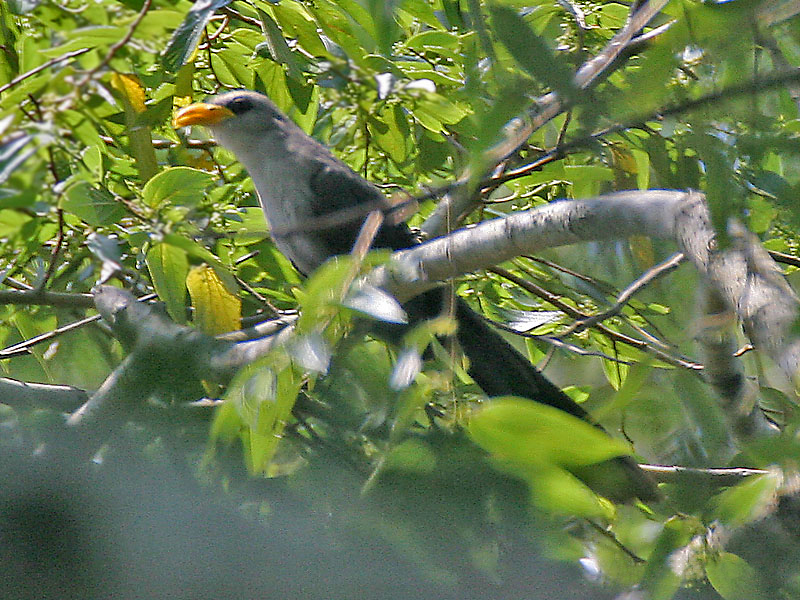
Ceuthmochares aereus occurs in thick habitats, including forests, forest edges and thickets, and is widely distributed across the African tropical rainforest. It has a greyish belly, head and throat, a heavy yellow bill, and a greenish-blue or blue back, wings and tail depending on the subspecies.
Written 26 November 2026 from the sources listed below. Each statement was checked against the passage it cites; statements that could not be supported were removed.
Appearance
The Blue Malkoha has a greyish belly, head and throat and a heavy yellow bill. It is described as an odd, dark blue-and-gray cuckoo with a bright yellow bill.[1][2]
The subspecies Ceuthmochares aereus aereus has a greenish and blue tail, wings and back. The subspecies Ceuthmochares aereus flavirostris has a blue tail, wings and back.[3][4]
Habitat
The Blue Malkoha occurs in thick habitats, including forests, forest edges and thickets. It is widely distributed across the African tropical rainforest.[5][6]
Diet
The Blue Malkoha feeds primarily on insects, including caterpillars, beetles, grasshoppers and crickets. It also eats frogs, slugs, fruit, seeds and leaves.[7][8]
Behaviour
The Blue Malkoha moves through tangled vegetation by making a series of small hops while catching prey. It sometimes accompanies other birds and squirrels to catch insects they flush from vegetation.[9][10]
The Blue Malkoha is secretive and rarely observed.[11]
Reproduction and life cycle
The nest is a rough mass of sticks suspended approximately 2–5 metres above the ground. Both parents participate in caring for the young.[12][13]
Conservation
The Blue Malkoha is described as an uncommon species. It is not considered threatened and is classified as Least Concern by the IUCN.[14][15]
Similar species
The Blue Malkoha was formerly treated as conspecific with the Green Malkoha before the two were split in 2016.[16]
Classification of the Blue Malkoha
| Kingdom | Animalia |
|---|---|
| Phylum | Chordata |
| Subphylum | Vertebrata |
| Infraphylum | Gnathostomata |
| Parvphylum | Osteichthyes |
| Megaclass | Tetrapoda |
| Class | Aves (Bird) |
| Order | Cuculiformes (Cuckoo) |
| Family | Cuculidae (Cuckoo) |
| Genus | Ceuthmochares (Yellowbills) |
| Species | Ceuthmochares aereus (Vieillot, 1817) |
Where the Blue Malkoha is found
Checklists and occurrence records place Ceuthmochares aereus in 27 countries across Africa. GBIF holds 15,305 georeferenced records of it.
Countries
- Angola 257
- Benin 344
- Cameroon 451
- Central African Republic 75
- Democratic Republic of the Congo 616
- Equatorial Guinea 205
- Gabon 262
- Gambia 197
- Ghana 3,025
- Guinea 110
- Guinea-Bissau 92
- Ivory Coast 612
- Kenya 1,321
- Liberia 283
- Malawi 29
- Mozambique 328
- Nigeria 860
- Republic of the Congo 190
- Rwanda 212
- Senegal 30
- Sierra Leone 145
- South Africa 2,382
- Tanzania 67
- Togo 54
- Uganda 3,032
- Zambia 114
- Zimbabwe 12
Regions and cities with the most records
- KwaZulu-Natal, South Africa 1,786
- Central, Ghana 1,301
- Rwiimi, Uganda 610
- Ashanti, Ghana 570
- Eastern, Ghana 566
- Anyinam, Ghana 505
- Masindi, Uganda 435
- Kilifi County, Kenya 428
- Watamu, Kenya 386
- Mtubatuba, South Africa 376
- Kakamega County, Kenya 372
- Western, Ghana 354
- Kakamega, Kenya 330
- Effiduase, Ghana 323
- Konongo, Ghana 322
- Kanungu, Uganda 315
- eSikhaleni, South Africa 312
- Ntungamo, Uganda 281
- Richards Bay, South Africa 241
- Sofala, Mozambique 224
- Bundibugyo, Uganda 219
- Tongaat, South Africa 213
- eMuziwezinto, South Africa 204
- Scottburgh, South Africa 202
- Western Province, Rwanda 201
- Bushekeri, Rwanda 199
- Mtwapa, Kenya 198
- Cyato, Rwanda 197
- Rangiro, Rwanda 197
- Ballitoville, South Africa 195
- South-West, Cameroon 190
- Plateau State, Nigeria 189
- Western, Gambia 188
- Brikama, Gambia 187
- Nyahuka, Uganda 186
- Abuko, Gambia 185
Range as the checklists state it
Africa
A number beside a place is its count of GBIF occurrence records. A place without a number comes from a checklist alone. Records show where a species has been observed or collected, which can include escapes and vagrants.
Common names
English
- Blue Malkoha
- BLMA
- Chattering Yellowbill
- Green Coucal
- Green Malkoha
- Yellowbill
Names in 28 other languages
- Arabic
- كوكال أخضر
- Catalan
- malcoa africà occidental
- Chinese
- 黃嘴藍地鵑, 黄嘴鹃
- Croatian
- zlatnokljuni kukal
- Czech
- kukačka kovová
- Danish
- Gulnæbbet Malkoha
- Dutch
- Blauwe Geelsnavelmalkoha, geelsnavelmalkoha
- Esperanto
- metalblua kukolo
- Estonian
- aafrika malkohakägu
- Finnish
- sinikäki
- French
- Becjaune bronzé, Coucal à bec jaune, Malcoha à bec jaune
- German
- Blauerzkuckuck, Erzkuckuck, Westerzkuckuck
- Hungarian
- sárgacsőrű bozótkakukk
- Italian
- Malcoa africana
- Japanese
- キバシバンケンモドキ
- Lithuanian
- geltonsnapė gegutė
- Norwegian
- blåmalmgjøk
- Norwegian Bokmål
- Malmgjøk
- Polish
- siwianka
- Portuguese
- cucal-azul, cucal-verde, malcoa-azul
- Russian
- Желтоклювая кукушка, Желтоклювая малкоа
- Serbian
- Plava malkoa
- Slovak
- malkoha modrá
- Spanish
- Malcoha Africano, Malcoha africano occidental
- Swedish
- blå gulnäbb
- Turkish
- Afrika Malkohası, Sarı gaga
- Ukrainian
- малкога жовтодзьоба
- Welsh
- malcoa gwyrdd
Synonyms
One other scientific name has been used for this species and is now treated as a synonym of Ceuthmochares aereus.
- Cuculus aereus Vieillot, 1817
Subspecies and varieties
- Ceuthmochares aereus aereus subspecies
- Ceuthmochares aereus flavirostris subspecies
Related species
-
 Green MalkohaCeuthmochares australis
-
 Greater RoadrunnerGeococcyx californianus
- Common CuckooCuculus canorus
-
 Asian KoelEudynamys scolopaceus
-
 Greater CoucalCentropus sinensis
-
 Pacific KoelEudynamys orientalis
-
 Channel-billed CuckooScythrops novaehollandiae
-
 Pheasant CoucalCentropus phasianinus
Compare
Questions and answers
What is the scientific name of the Blue Malkoha?
The scientific name of the Blue Malkoha is Ceuthmochares aereus. Written with its author, the full name is Ceuthmochares aereus (Vieillot, 1817).
Which family does the Blue Malkoha belong to?
Ceuthmochares aereus belongs to the family Cuculidae, in the order Cuculiformes and the class Aves.
Where is the Blue Malkoha found?
Checklists and occurrence records place Ceuthmochares aereus in 27 countries, including Uganda, Ghana, South Africa, Kenya, Nigeria and Democratic Republic of the Congo.
What is the conservation status of the Blue Malkoha?
The IUCN Red List category recorded for Ceuthmochares aereus is Least Concern (LC).
What other names does the Blue Malkoha have?
Ceuthmochares aereus is also known in English as BLMA, Chattering Yellowbill, Green Coucal, Green Malkoha and Yellowbill.
Sources
Passages the profile rests on
- The Blue Malkoha has a greyish belly, head and throat and a heavy yellow bill. Source passage: “The blue malkoha has a greyish belly, head and throat and a heavy yellow bill” — English Wikipedia
- The species is described as an odd, dark blue-and-gray cuckoo with a bright yellow bill. Source passage: “Odd, dark blue-and-gray cuckoo with a bright yellow bill.” — ebird.org
- The subspecies Ceuthmochares aereus aereus has a greenish and blue tail, wings and back. Source passage: “C. aereus aereus has a greenish and blue tail, wings and back” — English Wikipedia
- The subspecies Ceuthmochares aereus flavirostris has a blue tail, wings and back. Source passage: “C. aereus flavirostris has a blue tail, wings and back.” — English Wikipedia
- The Blue Malkoha occurs in thick habitats, including forests, forest edges and thickets. Source passage: “Found in thick habitats including forest, forest edge, and thickets.” — ebird.org
- The species is widely distributed across the African tropical rainforest. Source passage: “It is widely distributed across the African tropical rainforest.” — English Wikipedia
- The Blue Malkoha feeds primarily on insects, including caterpillars, beetles, grasshoppers and crickets. Source passage: “The blue malkoha feeds primarily on insects, particularly caterpillars, beetles, grasshoppers and crickets” — English Wikipedia
- The species also eats frogs, slugs, fruit, seeds and leaves. Source passage: “it will also take frogs, slugs, fruit, seeds and leaves.” — English Wikipedia
- The Blue Malkoha moves through tangled vegetation by making a series of small hops while catching prey. Source passage: “It moves through the tangled vegetation with a series of small hops, snatching prey as it travels.” — English Wikipedia
- The species sometimes accompanies other birds and squirrels to catch insects they flush from vegetation. Source passage: “It will accompany other birds and squirrels, taking the insects flushed by them.” — English Wikipedia
- The Blue Malkoha is secretive and rarely observed. Source passage: “rarely observed due to its secretive behaviour.” — English Wikipedia
- The nest is a rough mass of sticks suspended approximately 2–5 metres above the ground. Source passage: “a rough mass of sticks suspended around 2–5 m above the ground.” — English Wikipedia
- Both parents participate in caring for the young. Source passage: “Both parents care for the young.” — English Wikipedia
- The Blue Malkoha is described as an uncommon species. Source passage: “The blue malkoha is an uncommon species” — English Wikipedia
- The species is not considered threatened and is classified as Least Concern by the IUCN. Source passage: “it is not considered threatened, and is listed as least concern by the IUCN.” — English Wikipedia
- The Blue Malkoha was formerly treated as conspecific with the Green Malkoha before the two were split in 2016. Source passage: “It was formerly conspecific with the green malkoha until split in 2016.” — English Wikipedia
Data
- Catalogue of Life, 2026-10-16 XR cc by
- Global Biodiversity Information Facility CC BY 4.0
- Wikidata CC0
- GeoNames CC BY 4.0
- Wikimedia Commons per image; credit shown with each image
- Within the Catalogue of Life, this name comes from The Integrated Taxonomic Information System cc0
References
- Gill, Frank, & and Minturn Wright. (2006). Birds of the World: Recommended English Names.
- Dickinson, E. C., and J. V. Remsen Jr., eds. (2013). The Howard and Moore Complete Checklist of the Birds of the World, 4th Edition, Vol. 1 Non-Passerines.
This species in other databases
- Catalogue of Life T78H
- Wikidata Q1273372
- iNaturalist 513601
- WoRMS urn:lsid:marinespecies.org:taxname:212683
- Avibase yellow5
Page built on 28 November 2026. See how the catalog is made and all sources and licences.
Cite this page
ScientificNames.org. (2026). Ceuthmochares aereus (Blue Malkoha). Retrieved November 28, 2026, from https://scientificnames.org/species/ceuthmochares-aereus
“Ceuthmochares aereus (Blue Malkoha).” ScientificNames.org, 2026, scientificnames.org/species/ceuthmochares-aereus. Accessed 28 Nov. 2026.
ScientificNames.org. “Ceuthmochares aereus (Blue Malkoha).” Accessed November 28, 2026. https://scientificnames.org/species/ceuthmochares-aereus.
@misc{scientificnames_ceuthmochares_aereus_blue_malkoha,
  author = {{ScientificNames.org}},
  title = {Ceuthmochares aereus (Blue Malkoha)},
  year = {2026},
  url = {https://scientificnames.org/species/ceuthmochares-aereus},
  note = {Accessed 2026-11-28}
}