Species · Birds
Green Malkoha Ceuthmochares australis
The scientific name of the Green Malkoha is Ceuthmochares australis. It is a species of bird in the family Cuculidae (cuckoo), order Cuculiformes. The name dates from 1873.
- Scientific name
- Ceuthmochares australis Sharpe, 1873
- Common name
- Green Malkoha
- Genus
- Ceuthmochares
- Family
- Cuculidae (Cuckoo)
- Order
- Cuculiformes
- Class
- Aves
- Red List category
- LC Least Concern
- Recorded in
- 9 countries
- Name status
- accepted in the Catalogue of Life

Overview
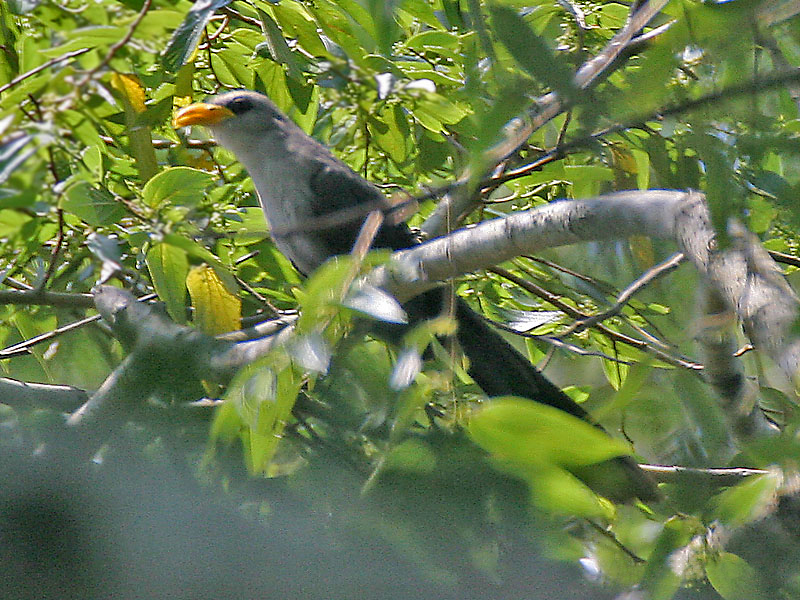
Ceuthmochares australis inhabits dense forests, riverine forests, forest edges, and thickets. It has dark green-and-gray plumage, green tail feathers, wings and back, and a bright yellow bill.
Written 26 November 2026 from the sources listed below. Each statement was checked against the passage it cites; statements that could not be supported were removed.
Appearance
The Green Malkoha has dark green-and-gray plumage, with green tail feathers, wings, and back. Its bill is bright yellow.[1][2][3]
Habitat
The species inhabits dense forests, riverine forests, forest edges, and thickets. Within forests, it typically occupies the subcanopy at heights of 8–30 metres.[4][5][6]
Diet
The Green Malkoha feeds primarily on insects, particularly caterpillars, beetles, grasshoppers, and crickets. It also consumes frogs, slugs, fruit, seeds, and leaves.[7][8]
Behaviour
The species moves through tangled vegetation by making a series of small hops while capturing prey. It sometimes follows other birds and squirrels to catch insects they flush from vegetation.[9][10]
The Green Malkoha is secretive and rarely observed.[11]
Reproduction and life cycle
The Green Malkoha is not a brood parasite and raises its own offspring. During courtship, the male and female face each other and wag their tails from side to side before spreading them.[12][13]
The male presents prey to the female as a courtship gift and feeds her while mounted during mating behaviour.[14][15]
The species lays two white and creamy eggs. Its nest consists of a rough mass of sticks suspended approximately 2–5 metres above the ground.[16][17]
Both parents participate in caring for the young.[18]
Conservation
The Green Malkoha is classified as least concern by the IUCN and is not considered threatened.[19][20]
Similar species
The Green Malkoha and blue malkoha were previously treated as a single species known collectively as the yellowbill.[21]
Classification of the Green Malkoha
| Kingdom | Animalia |
|---|---|
| Phylum | Chordata |
| Subphylum | Vertebrata |
| Infraphylum | Gnathostomata |
| Parvphylum | Osteichthyes |
| Megaclass | Tetrapoda |
| Class | Aves (Bird) |
| Order | Cuculiformes (Cuckoo) |
| Family | Cuculidae (Cuckoo) |
| Genus | Ceuthmochares (Yellowbills) |
| Species | Ceuthmochares australis Sharpe, 1873 |
Where the Green Malkoha is found
Checklists and occurrence records place Ceuthmochares australis in 9 countries across Africa. GBIF holds 4,514 georeferenced records of it.
Countries
- Democratic Republic of the Congo 28
- Ethiopia 98
- Kenya 1,013
- Malawi 131
- Mozambique 350
- South Africa 2,092
- Tanzania 754
- Zambia 9
- Zimbabwe 39
Regions and cities with the most records
- KwaZulu-Natal, South Africa 2,034
- Kilifi County, Kenya 613
- Watamu, Kenya 464
- Malindi, Kenya 266
- Arusha, Tanzania 232
- Usa River, Tanzania 227
- Mtwapa, Kenya 219
- Eshowe, South Africa 207
- Mombasa, Kenya 190
- Jomvu, Kenya 189
- Sofala, Mozambique 189
- eSikhaleni, South Africa 185
- Kingori, Tanzania 177
- Mazeras, Kenya 174
- Mombasa County, Kenya 156
- Arusha, Tanzania 155
- Kwale County, Kenya 129
- Tanga, Tanzania 112
- Morogoro, Tanzania 102
- Inhambane Province, Mozambique 98
- Pwani, Tanzania 92
- Ukunda, Kenya 87
- Scottburgh, South Africa 78
- eMuziwezinto, South Africa 78
- Tongaat, South Africa 75
- Kidatu, Tanzania 71
- Maramba, Tanzania 71
- Muheza, Tanzania 70
- Oromiya, Ethiopia 68
- Ballitoville, South Africa 60
- Ntuzuma, South Africa 59
- Matuga, Kenya 48
- Shakaskraal, South Africa 42
- Durban, South Africa 41
- Richards Bay, South Africa 36
- Empangeni, South Africa 35
Range as the checklists state it
Africa
A number beside a place is its count of GBIF occurrence records. A place without a number comes from a checklist alone. Records show where a species has been observed or collected, which can include escapes and vagrants.
Common names
English
- Green Malkoha
- GRMA
- Whistling Yellowbill
Names in 25 other languages
- Afrikaans
- Groenvleiloerie
- Arabic
- ملاكوهة خضراء
- Catalan
- malcoa africà oriental
- Chinese
- 哨声黄嘴鹃, 綠地鵑
- Croatian
- zelenorepi kukal
- Czech
- kukačka zelenavá
- Danish
- Grønrygget Malkoha
- Dutch
- Groene Geelsnavelmalkoha
- Esperanto
- metalverda kukolo
- French
- Becjaune austral, Malcoha austral
- German
- Grünerzkuckuck, Osterzkuckuck
- Italian
- Malcoa verde
- Japanese
- ミナミバンケンモドキ
- Lithuanian
- Žalioji geltonsnapė gegutė
- Norwegian
- grønnmalmgjøk
- Polish
- siwianka gwiżdżąca
- Portuguese
- cucal-verde, malcoa-verde
- Russian
- Зелёная кукушка, Зелёная малкоа
- Serbian
- Zelena malkoa
- Slovak
- malkoha zelená
- Spanish
- Malcoha africano oriental
- Swedish
- grön gulnäbb
- Turkish
- Doğu Afrika Malkohası
- Ukrainian
- малкога зелена
- Zulu
- umcwicwicwi
Synonyms
One other scientific name has been used for this species and is now treated as a synonym of Ceuthmochares australis.
- Ceuthmochares aereus australis Sharpe, 1873
Related species
-
 Blue MalkohaCeuthmochares aereus
-
 Greater RoadrunnerGeococcyx californianus
- Common CuckooCuculus canorus
-
 Asian KoelEudynamys scolopaceus
-
 Greater CoucalCentropus sinensis
-
 Pacific KoelEudynamys orientalis
-
 Channel-billed CuckooScythrops novaehollandiae
-
 Pheasant CoucalCentropus phasianinus
Compare
Questions and answers
What is the scientific name of the Green Malkoha?
The scientific name of the Green Malkoha is Ceuthmochares australis. Written with its author, the full name is Ceuthmochares australis Sharpe, 1873.
Which family does the Green Malkoha belong to?
Ceuthmochares australis belongs to the family Cuculidae, in the order Cuculiformes and the class Aves.
Where is the Green Malkoha found?
Checklists and occurrence records place Ceuthmochares australis in 9 countries, including South Africa, Kenya, Tanzania, Mozambique, Malawi and Ethiopia.
What is the conservation status of the Green Malkoha?
The IUCN Red List category recorded for Ceuthmochares australis is Least Concern (LC).
What other names does the Green Malkoha have?
Ceuthmochares australis is also known in English as GRMA and Whistling Yellowbill.
Sources
Passages the profile rests on
- The species has green tail feathers, wings, and back. Source passage: “It has a green tail, wings and back.” — English Wikipedia
- The species has a bright yellow bill. Source passage: “Odd, dark, green-and-gray cuckoo with a bright yellow bill.” — ebird.org
- The species has dark green-and-gray plumage. Source passage: “Odd, dark, green-and-gray cuckoo with a bright yellow bill.” — ebird.org
- The species inhabits dense forests, riverine forests, and forest edges. Source passage: “It ranges from dense forest to riverine forest and forest edges.” — English Wikipedia
- The species occupies thick habitats, including forests, forest edges, and thickets. Source passage: “Found in thick habitats including forest, forest edge, and thickets.” — ebird.org
- Within forests, the species typically occupies the subcanopy at heights of 8–30 metres. Source passage: “In the forest it typically lives in the subcanopy at between 8–30 m.” — English Wikipedia
- The species feeds primarily on insects, particularly caterpillars, beetles, grasshoppers, and crickets. Source passage: “The green malkoha feeds primarily on insects, particularly caterpillars, beetles, grasshoppers and crickets” — English Wikipedia
- The species also consumes frogs, slugs, fruit, seeds, and leaves. Source passage: “it will also take frogs, slugs, fruit, seeds and leaves.” — English Wikipedia
- The species moves through tangled vegetation by making a series of small hops while capturing prey. Source passage: “It moves through the tangled vegetation with a series of small hops, snatching prey as it travels.” — English Wikipedia
- The species sometimes follows other birds and squirrels to catch insects they flush from vegetation. Source passage: “It will accompany other birds and squirrels, taking the insects flushed by them.” — English Wikipedia
- The species is secretive and rarely observed. Source passage: “The green malkoha is an uncommon species and rarely observed due to its secretive behaviour.” — English Wikipedia
- The species is not a brood parasite and raises its own offspring. Source passage: “Unlike some other cuckoos the green malkoha is not a brood parasite, instead it cares for its own young.” — English Wikipedia
- During courtship, the male and female face each other and wag their tails from side to side before spreading them. Source passage: “The male and female face each other, first wagging their tails from side to side, then spreading them.” — English Wikipedia
- The male presents prey to the female as a courtship gift. Source passage: “The male also engages in gift giving, presenting the female with prey” — English Wikipedia
- The male feeds the female while mounted during mating behaviour. Source passage: “then mounting her and feeding her while mounted.” — English Wikipedia
- The species lays two white and creamy eggs. Source passage: “Two white and creamy eggs are laid” — English Wikipedia
- The nest consists of a rough mass of sticks suspended approximately 2–5 metres above the ground. Source passage: “a rough mass of sticks suspended around 2–5 m above the ground.” — English Wikipedia
- Both parents participate in caring for the young. Source passage: “Both parents care for the young.” — English Wikipedia
- The species is classified as least concern by the IUCN. Source passage: “and is listed as least concern by the IUCN.” — English Wikipedia
- The species is not considered threatened. Source passage: “However it is not considered threatened” — English Wikipedia
- The green malkoha and blue malkoha were previously treated as a single species known collectively as the yellowbill. Source passage: “This species and the blue malkoha were previously considered conspecific and together known as the yellowbill.” — English Wikipedia
Data
- Catalogue of Life, 2026-10-16 XR cc by
- Global Biodiversity Information Facility CC BY 4.0
- Wikidata CC0
- GeoNames CC BY 4.0
- Wikimedia Commons per image; credit shown with each image
- Within the Catalogue of Life, this name comes from The Integrated Taxonomic Information System cc0
References
- Peters, & James Lee. (1940). Check-List of Birds of the World, Vol. 4.
This species in other databases
Page built on 28 November 2026. See how the catalog is made and all sources and licences.
Cite this page
ScientificNames.org. (2026). Ceuthmochares australis (Green Malkoha). Retrieved November 28, 2026, from https://scientificnames.org/species/ceuthmochares-australis
“Ceuthmochares australis (Green Malkoha).” ScientificNames.org, 2026, scientificnames.org/species/ceuthmochares-australis. Accessed 28 Nov. 2026.
ScientificNames.org. “Ceuthmochares australis (Green Malkoha).” Accessed November 28, 2026. https://scientificnames.org/species/ceuthmochares-australis.
@misc{scientificnames_ceuthmochares_australis_green_malkoha,
  author = {{ScientificNames.org}},
  title = {Ceuthmochares australis (Green Malkoha)},
  year = {2026},
  url = {https://scientificnames.org/species/ceuthmochares-australis},
  note = {Accessed 2026-11-28}
}