Species · Birds
Southern Silvery Kingfisher Ceyx argentatus
The scientific name of the Southern Silvery Kingfisher is Ceyx argentatus. It is a species of bird in the family Alcedinidae (kingfisher), order Coraciiformes. The name dates from 1877.
- Scientific name
- Ceyx argentatus Tweeddale, 1877
- Common name
- Southern Silvery Kingfisher
- Genus
- Ceyx
- Family
- Alcedinidae (Kingfisher)
- Order
- Coraciiformes
- Class
- Aves
- Red List category
- NT Near Threatened
- Recorded in
- 1 country
- Name status
- accepted in the Catalogue of Life

Overview
The Southern Silvery Kingfisher is a monotypic bird with no recognized subspecies. It is endemic to the Philippines and occurs on Dinagat, Siargao, Mindanao and Basilan. Its throat, cheek and belly are bluish-white, distinguishing it from the cream-coloured corresponding parts of the Northern Silvery Kingfisher.
Written 26 November 2026 from the sources listed below. Each statement was checked against the passage it cites; statements that could not be supported were removed.
Appearance
The species has a bright silvery-white throat, vent and ear. Its wings, head and lores have white spots, and it has a black bill and black eyes.[1][2][3]
Its throat, cheek and belly are bluish-white, distinguishing it from the cream-coloured corresponding parts of the Northern Silvery Kingfisher. It also has greenish-blue coloration on its belly and flanks.[4][5]
The Southern Silvery Kingfisher is slightly larger than the Northern Silvery Kingfisher.[6]
Habitat
Its natural habitats include tropical moist lowland forests, streams and rivers. The species appears to depend on forested streams below 1,000 metres in elevation.[7][8]
The species tolerates secondary forest and selectively logged forest. It can also tolerate streamside vegetation within coconut plantations near forest edges.[9][10]
Diet
The species feeds on small fish and crabs. It has also been recorded eating insects.[11][12]
Behaviour
The species perches on low branches beside streams before diving into the water to catch prey. After catching prey, the bird returns to its perch.[13][14]
Reproduction and life cycle
Juveniles and nests have been observed between February and May. The species builds its nests in streamside banks.[15][16]
The breeding behaviour of the species is poorly known.[17]
Conservation
The species is threatened by habitat loss. The IUCN assessed the Southern Silvery Kingfisher as Near Threatened in 2022, with an estimated population of 1,500 to 7,000 mature individuals.[18][19][20]
Logging, agricultural conversion and mining activities contribute to habitat loss within the species' range. Conversion of terminalia forest into rice fields and oil palm plantations also contributes to habitat loss.[21][22]
High siltation levels in watercourses appear to make them unsuitable for the species. Riverine pollution is considered likely to negatively affect the species.[23][24]
Forest clearance at Bislig in Mindanao is being followed by replanting with exotic trees for paper production.[25]
Similar species
The Southern Silvery Kingfisher was formerly considered conspecific with the Northern Silvery Kingfisher. The Northern Silvery Kingfisher occurs in the Visayas.[26][27]
Classification of the Southern Silvery Kingfisher
| Kingdom | Animalia |
|---|---|
| Phylum | Chordata |
| Subphylum | Vertebrata |
| Infraphylum | Gnathostomata |
| Parvphylum | Osteichthyes |
| Megaclass | Tetrapoda |
| Class | Aves (Bird) |
| Order | Coraciiformes (Todies) |
| Family | Alcedinidae (Kingfisher) |
| Subfamily | Alcedininae |
| Genus | Ceyx (Dwarf Kingfishers and Allies) |
| Species | Ceyx argentatus Tweeddale, 1877 |
Where the Southern Silvery Kingfisher is found
Checklists and occurrence records place Ceyx argentatus in 1 country across Asia. GBIF holds 940 georeferenced records of it.
Countries
Regions and cities with the most records
- Bislig, Philippines 266
- Hinatuan, Philippines 178
- Tagbina, Philippines 87
- Zamboanga, Philippines 80
- Recodo, Philippines 79
- Balulang, Philippines 24
- Davao, Philippines 23
- Manolo Fortich, Philippines 23
- Bugo, Philippines 18
- Cagayan de Oro, Philippines 18
- Kidapawan, Philippines 18
- Surallah, Philippines 18
- Bansalan, Philippines 17
- Bunawan, Philippines 17
- Lake Sebu, Philippines 17
- Tagoloan, Philippines 17
- Samal, Philippines 16
- Jagna, Philippines 10
- Veruela, Philippines 10
- Cabadbaran, Philippines 8
- Trento, Philippines 8
- Malaybalay, Philippines 7
- Butuan, Philippines 6
- Impasugong, Philippines 6
- Digos, Philippines 5
- Jasaan, Philippines 5
- Manay, Philippines 5
- Monkayo, Philippines 4
- Abuyog, Philippines 3
- Bah-Bah, Philippines 3
- Baybay, Philippines 3
- Magsaysay, Philippines 3
- Mati, Philippines 3
- NIA Valencia, Philippines 3
- Prosperidad, Philippines 3
- San Francisco, Philippines 3
Range as the checklists state it
Southern Asia
A number beside a place is its count of GBIF occurrence records. A place without a number comes from a checklist alone. Records show where a species has been observed or collected, which can include escapes and vagrants.
Common names
English
- Southern Silvery Kingfisher
- Silvery Kingfisher
- Southern Silvery-Kingfisher
Names in 26 other languages
- Catalan
- blauet pigmeu argentat
- Chinese
- 南方銀色三趾翠鳥, 银翠鸟
- Croatian
- srebrnasti vodomar
- Czech
- ledňáček mindanajský
- Danish
- Sortnæbbet Sølvisfugl
- Dutch
- Zuidelijke Zilverdwergijsvogel
- Esperanto
- arĝenta alciono
- Estonian
- must-jäälind
- Finnish
- hopeakalastaja
- French
- Martin-pêcheur argenté
- German
- Silberzwergfischer
- Italian
- Martin pescatore argentato
- Japanese
- セジロカワセミ
- Lithuanian
- sidabrinis tulžys
- Norwegian
- sølvisfugl
- Polish
- zimorodek srebrzysty
- Portuguese
- guarda-rios-argênteo-do-sul, guarda-rios-prateado, martim-pigmeu-de-mindanau
- Russian
- Серебристый зимородок, Серебристый лесной зимородок
- Serbian
- Južni srebrni vodomar
- Slovak
- rybárik striebristý
- Slovenian
- srebrni vodomec
- Spanish
- Martín Pescador Plateado, Martín pigmeo plateado del sur
- Swedish
- sydlig silverkungsfiskare
- Turkish
- Gümüş yalıçapkını, Güneyli Gümüş Sırtlı Yalıçapkını
- Ukrainian
- рибалочка сріблогузий
- Vietnamese
- Bồng chanh bạc
Synonyms
3 other scientific names have been used for this species and are now treated as synonyms of Ceyx argentatus.
- Alcedo argentata (Tweeddale, 1877)
- Alcedo argentata argentata (Tweeddale, 1877)
- Ceyx argentatus argentatus Tweeddale, 1877
Related species
-
 Black-backed Dwarf KingfisherCeyx erithaca
-
 Azure KingfisherCeyx azureus
-
 Philippine Dwarf KingfisherCeyx melanurus
-
 Little KingfisherCeyx pusillus
-
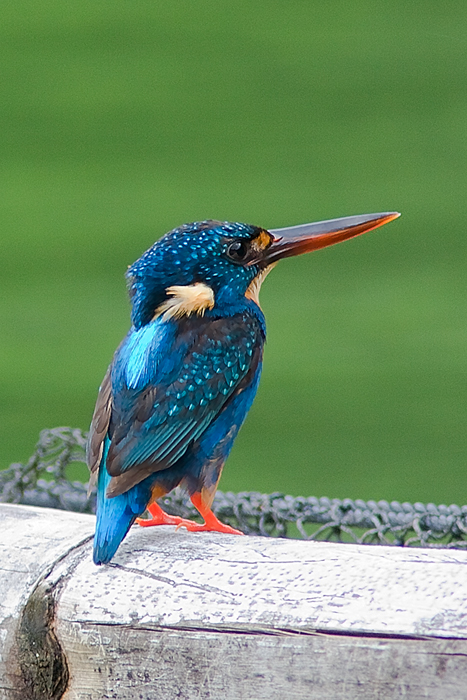 Indigo-banded KingfisherCeyx cyanopectus
-
 Sulawesi Dwarf KingfisherCeyx fallax
-
 Bismarck KingfisherCeyx websteri
-
 Moluccan Dwarf KingfisherCeyx lepidus
Compare
Questions and answers
What is the scientific name of the Southern Silvery Kingfisher?
The scientific name of the Southern Silvery Kingfisher is Ceyx argentatus. Written with its author, the full name is Ceyx argentatus Tweeddale, 1877.
Which family does the Southern Silvery Kingfisher belong to?
Ceyx argentatus belongs to the family Alcedinidae, in the order Coraciiformes and the class Aves.
Where is the Southern Silvery Kingfisher found?
Checklists and occurrence records place Ceyx argentatus in 1 country: Philippines.
What is the conservation status of the Southern Silvery Kingfisher?
The IUCN Red List category recorded for Ceyx argentatus is Near Threatened (NT).
What other names does the Southern Silvery Kingfisher have?
Ceyx argentatus is also known in English as Silvery Kingfisher and Southern Silvery-Kingfisher.
Sources
Passages the profile rests on
- The species has a bright silvery-white throat, vent and ear. Source passage: “It has a bright siilvery-white throat, vent and ear” — English Wikipedia
- Its wings, head and lores have white spots. Source passage: “back with white spots on its wings, head and lores.” — English Wikipedia
- The species has a black bill and black eyes. Source passage: “It has an all black bill and eyes” — English Wikipedia
- Its throat, cheek and belly are bluish-white, distinguishing it from the cream-coloured corresponding parts of the Northern Silvery Kingfisher. Source passage: “by its bluish-white throat, cheek and belly versus the cream-coloured parts of the Northern silvery kingfisher.” — English Wikipedia
- The species has greenish-blue coloration on its belly and flanks. Source passage: “It also is greenish blue on belly and flanks” — English Wikipedia
- The Southern Silvery Kingfisher is slightly larger than the Northern Silvery Kingfisher. Source passage: “and is slightly larger.” — English Wikipedia
- Its natural habitats include tropical moist lowland forests, streams and rivers. Source passage: “Its natural habitats are tropical moist lowland forests, streams and rivers.” — English Wikipedia
- The species appears to depend on forested streams below 1,000 metres in elevation. Source passage: “It appears to be reliant upon forested streams below 1,000 m” — English Wikipedia
- The species tolerates secondary forest and selectively logged forest. Source passage: “will tolerate secondary and selectively logged forest” — English Wikipedia
- The species can also tolerate streamside vegetation within coconut plantations near forest edges. Source passage: “and even streamside vegetation within coconut plantations, close to forest edge.” — English Wikipedia
- The species feeds on small fish and crabs. Source passage: “Diet consists of small fish and crabs.” — English Wikipedia
- The species has also been recorded eating insects. Source passage: “Has also been recorded feeding on insects.” — English Wikipedia
- The species perches on low branches beside streams before diving into the water to catch prey. Source passage: “Perches on a low branch beside a stream and dives in to catch its prey” — English Wikipedia
- After catching prey, the bird returns to its perch. Source passage: “then returns to its perch.” — English Wikipedia
- Juveniles and nests have been observed between February and May. Source passage: “juveniles and nests have been seen from February to May.” — English Wikipedia
- The species builds its nests in streamside banks. Source passage: “Nests in streamside banks.” — English Wikipedia
- The breeding behaviour of the species is poorly known. Source passage: “Not much is known about its breeding behaviour” — English Wikipedia
- The species is threatened by habitat loss. Source passage: “It is threatened by habitat loss.” — English Wikipedia
- The IUCN assessed the Southern Silvery Kingfisher as Near Threatened in 2022. Source passage: “has most recently been assessed for The IUCN Red List of Threatened Species in 2022. listed as Near Threatened” — iucnredlist.org
- The estimated population comprises 1,500 to 7,000 mature individuals. Source passage: “the population being estimated at 1,500 to 7,000 mature individuals.” — English Wikipedia
- Logging, agricultural conversion and mining activities contribute to habitat loss within the species' range. Source passage: “wholesale clearance of forest habitats as a result of logging, agricultural conversion and mining activities occurring within the range.” — English Wikipedia
- Conversion of terminalia forest into rice fields and oil palm plantations contributes to habitat loss. Source passage: “Conversion of terminalia forest into rice fields and oil palm plantation is driving habitat loss elsewhere.” — English Wikipedia
- High siltation levels in watercourses appear to make them unsuitable for the species. Source passage: “Watercourses with high siltation loads, resulting from deforestation, appear not to hold the species” — English Wikipedia
- Riverine pollution is considered likely to negatively affect the species. Source passage: “and riverine pollution is likely to have a similar impact.” — English Wikipedia
- Forest clearance at Bislig in Mindanao is being followed by replanting with exotic trees for paper production. Source passage: “Forest at Bislig (Mindanao) is being cleared under concession and re-planted with exotic trees for paper production.” — English Wikipedia
- The Southern Silvery Kingfisher was formerly considered conspecific with the Northern Silvery Kingfisher. Source passage: “This species and the northern silvery kingfisher, found in the Visayas, were formerly considered conspecific” — English Wikipedia
- The Northern Silvery Kingfisher occurs in the Visayas. Source passage: “the northern silvery kingfisher, found in the Visayas,” — English Wikipedia
Data
- Catalogue of Life, 2026-10-16 XR cc by
- Global Biodiversity Information Facility CC BY 4.0
- Wikidata CC0
- GeoNames CC BY 4.0
- Wikimedia Commons per image; credit shown with each image
- Within the Catalogue of Life, this name comes from The Integrated Taxonomic Information System cc0
References
- Peters, & James Lee. (1945). Check-List of Birds of the World, Vol. 5.
- Dickinson, E. C., and J. V. Remsen Jr., eds. (2013). The Howard and Moore Complete Checklist of the Birds of the World, 4th Edition, Vol. 1 Non-Passerines.
This species in other databases
Page built on 27 November 2026. See how the catalog is made and all sources and licences.
Cite this page
ScientificNames.org. (2026). Ceyx argentatus (Southern Silvery Kingfisher). Retrieved November 27, 2026, from https://scientificnames.org/species/ceyx-argentatus
“Ceyx argentatus (Southern Silvery Kingfisher).” ScientificNames.org, 2026, scientificnames.org/species/ceyx-argentatus. Accessed 27 Nov. 2026.
ScientificNames.org. “Ceyx argentatus (Southern Silvery Kingfisher).” Accessed November 27, 2026. https://scientificnames.org/species/ceyx-argentatus.
@misc{scientificnames_ceyx_argentatus_southern_silvery_kingfisher,
  author = {{ScientificNames.org}},
  title = {Ceyx argentatus (Southern Silvery Kingfisher)},
  year = {2026},
  url = {https://scientificnames.org/species/ceyx-argentatus},
  note = {Accessed 2026-11-27}
}