Species · Birds
Azure Kingfisher Ceyx azureus
The scientific name of the Azure Kingfisher is Ceyx azureus. It is a species of bird in the family Alcedinidae (kingfisher), order Coraciiformes. The name dates from 1801.
- Scientific name
- Ceyx azureus (Latham, 1801)
- Common name
- Azure Kingfisher
- Genus
- Ceyx
- Family
- Alcedinidae (Kingfisher)
- Order
- Coraciiformes
- Class
- Aves
- Red List category
- LC Least Concern
- Recorded in
- 3 countries
- Name status
- accepted in the Catalogue of Life

Overview
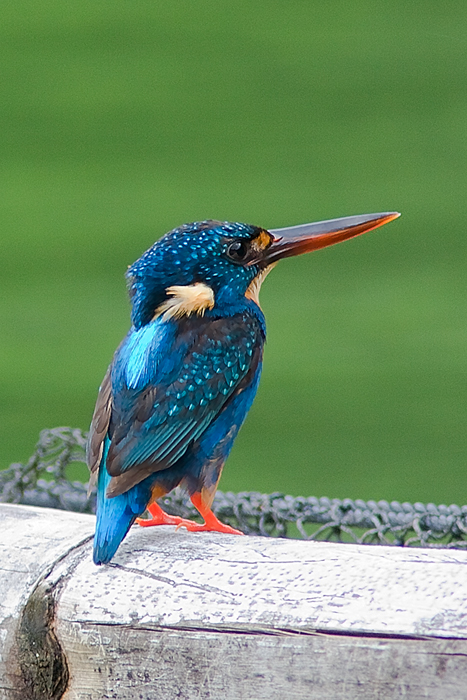
Ceyx azureus occurs in northern and eastern Australia, Tasmania, the lowlands of New Guinea and neighbouring islands, North Maluku and Romang. It has a deep blue to azure back, a white to buff patch on the side of its neck and throat, and rufous-buff underparts with blue-violet streaks.
Written 26 November 2026 from the sources listed below. Each statement was checked against the passage it cites; statements that could not be supported were removed.
Appearance
The Azure Kingfisher measures 17–19 cm in length. Males weigh 29–32 g, while females weigh 31–35 g and are slightly heavier than males.[1][2][3]
Its feet are red and have only two forward-facing toes. Its lores are white and inconspicuous except when viewed from the front, when they appear as two large eye-like spots.[4][5][6]
Habitat
The Azure Kingfisher inhabits the vegetated banks of creeks. It also occurs in tidal estuaries and mangroves.[7][8]
Diet
The Azure Kingfisher feeds on small fish and crustaceans, including shrimps, amphipods and freshwater yabbies. Its diet also includes water beetles, spiders, small frogs and tadpoles.[9][10][11][12]
Behaviour
The Azure Kingfisher is generally sedentary, although some seasonal migration may occur. It often darts rapidly from a perch above the water.[13][14][15]
The species is usually silent. During breeding, it makes a sharp, squeaky call, producing a high-pitched, shrill 'pseet-pseet' sound that is often heard in flight.[16][17][18]
Reproduction and life cycle
The breeding season in northern Australia runs from September to April, while in southern Australia it runs from August to February. The species sometimes produces two broods in a breeding season.[19][20][21]
The nest chamber is located at the end of a burrow approximately one metre long in an earthen creek bank. A typical clutch contains four to six white, rounded and glossy eggs measuring approximately 22 by 19 mm.[22][23][24]
Both parents incubate the eggs for 20–22 days. They feed the hatchlings for a further three to five weeks after incubation.[25][26]
Flooding occasionally destroys the nests. Brown snakes sometimes take the contents of the nests.[27][28]
Conservation
The Azure Kingfisher population is decreasing. The species is classified as Least Concern on the IUCN Red List because of its wide distribution.[29][30]
Similar species
The Australian Museum lists the Little kingfisher as a similar species.[31]
Classification of the Azure Kingfisher
| Kingdom | Animalia |
|---|---|
| Phylum | Chordata |
| Subphylum | Vertebrata |
| Infraphylum | Gnathostomata |
| Parvphylum | Osteichthyes |
| Megaclass | Tetrapoda |
| Class | Aves (Bird) |
| Order | Coraciiformes (Todies) |
| Family | Alcedinidae (Kingfisher) |
| Subfamily | Alcedininae |
| Genus | Ceyx (Dwarf Kingfishers and Allies) |
| Species | Ceyx azureus (Latham, 1801) |
Where the Azure Kingfisher is found
Checklists and occurrence records place Ceyx azureus in 3 countries across Asia and Oceania. GBIF holds 91,437 georeferenced records of it.
Countries
Regions and cities with the most records
- Queensland, Australia 32,980
- New South Wales, Australia 32,297
- Northern Territory, Australia 9,410
- Victoria, Australia 8,526
- Brisbane, Australia 3,326
- Palmerston, Australia 2,843
- Darwin, Australia 2,509
- Narangba, Australia 2,465
- Western Australia, Australia 2,057
- Sunshine Coast, Australia 1,641
- Port Macquarie, Australia 1,231
- Hornsby, Australia 1,184
- Wodonga, Australia 1,087
- Parramatta, Australia 979
- Balwyn North, Australia 952
- Capalaba, Australia 787
- Logan City, Australia 774
- Wollongong, Australia 767
- Burwood, Australia 760
- Central Coast, Australia 737
- Gold Coast, Australia 737
- Cairns, Australia 728
- Sydney, Australia 725
- Caloundra, Australia 714
- Melbourne, Australia 663
- Liverpool, Australia 658
- Taree, Australia 645
- Tasmania, Australia 639
- Coffs Harbour, Australia 607
- Townsville, Australia 574
- Newcastle, Australia 557
- Australian Capital Territory, Australia 418
- Central Province, Papua New Guinea 392
- Canberra, Australia 383
- Tuggeranong, Australia 380
- Hervey Bay, Australia 379
Range as the checklists state it
Southern Asia
Australia
A number beside a place is its count of GBIF occurrence records. A place without a number comes from a checklist alone. Records show where a species has been observed or collected, which can include escapes and vagrants.
Common names
English
- Azure Kingfisher
Names in 27 other languages
- Catalan
- blauet pigmeu atzurat
- Chinese
- 蓝翠鸟, 藍三趾翠鳥, 藍色三趾翠鳥
- Croatian
- azurni vodomar
- Czech
- ledňáček azurový
- Danish
- Azurisfugl
- Dutch
- Azuurijsvogel
- Esperanto
- lazura alciono
- Estonian
- lõuna-jäälind
- Finnish
- papuansinikalastaja
- French
- Martin-pêcheur à dos bleu
- German
- Azurfischer, Azurzwergfischer
- Hungarian
- azúr jégmadár
- Indonesian
- Raja-udang biru-langit
- Italian
- Martin pescatore azzurro
- Japanese
- ルリミツユビカワセミ
- Lithuanian
- australinis tulžys
- Norwegian
- asurisfugl
- Polish
- zimorodek lazurowy
- Portuguese
- guarda-rios-azurite, martim-pescador-azul
- Russian
- Лазурный зимородок, Лазурный лесной зимородок
- Serbian
- Azurnoplavi vodomar
- Slovak
- rybárik kráľovský
- Slovenian
- azurni vodomec, barviti vodomec
- Spanish
- Martín Pescador Zafiro, Martín pescador azur
- Swedish
- azurkungsfiskare
- Turkish
- Mavi yalıçapkını, Mor-Mavi Yalıçapkını
- Ukrainian
- рибалочка ультрамариновий
Synonyms
3 other scientific names have been used for this species and are now treated as synonyms of Ceyx azureus.
- Alcyone azurea Latham, J, 1801
- Alcyonis azurea Latham, J, 1801
- Ceyx azureus azureus Christidis & Boles (2008)
Subspecies and varieties
- Ceyx azureus affinis subspecies
- Ceyx azureus azureus (Azure Kingfisher) subspecies
- Ceyx azureus diemenensis (Tasmanian Azure Kingfisher) subspecies
- Ceyx azureus lessonii subspecies
- Ceyx azureus ochrogaster subspecies
- Ceyx azureus ruficollaris (Northern Australian Azure Kingfisher) subspecies
Related species
-
 Black-backed Dwarf KingfisherCeyx erithaca
-
 Philippine Dwarf KingfisherCeyx melanurus
-
 Little KingfisherCeyx pusillus
-
 Indigo-banded KingfisherCeyx cyanopectus
-
 Sulawesi Dwarf KingfisherCeyx fallax
-
 Bismarck KingfisherCeyx websteri
-
 Southern Silvery KingfisherCeyx argentatus
-
 Moluccan Dwarf KingfisherCeyx lepidus
Compare
Questions and answers
What is the scientific name of the Azure Kingfisher?
The scientific name of the Azure Kingfisher is Ceyx azureus. Written with its author, the full name is Ceyx azureus (Latham, 1801).
Which family does the Azure Kingfisher belong to?
Ceyx azureus belongs to the family Alcedinidae, in the order Coraciiformes and the class Aves.
Where is the Azure Kingfisher found?
Checklists and occurrence records place Ceyx azureus in 3 countries: Australia, Papua New Guinea and Indonesia.
What is the conservation status of the Azure Kingfisher?
The IUCN Red List category recorded for Ceyx azureus is Least Concern (LC).
Where is the Azure Kingfisher found?
The Azure Kingfisher occurs in northern and eastern Australia and Tasmania. Its range also includes the lowlands of New Guinea and neighbouring islands, extending to North Maluku and Romang.[32][33]
Sources
Passages the profile rests on
- The Azure kingfisher measures 17–19 cm in length. Source passage: “The azure kingfisher measures 17–19 cm (6.7–7.5 in) in length” — English Wikipedia
- Male Azure kingfishers weigh 29–32 g. Source passage: “the male weighs 29–32 g (1.0–1.1 oz)” — English Wikipedia
- Female Azure kingfishers weigh 31–35 g and are slightly heavier than males. Source passage: “while the female is slightly heavier at 31–35 g (1.1–1.2 oz).” — English Wikipedia
- Its feet are red and have only two forward-facing toes. Source passage: “The feet are red with only two forward toes.” — English Wikipedia
- Its lores are white and inconspicuous except when viewed from the front. Source passage: “The lores (the region between the eye and the bill) are white and inconspicuous except in front view” — English Wikipedia
- When viewed from the front, its white lores appear as two large eye-like spots. Source passage: “where they stand out as two large white eye-like spots” — English Wikipedia
- The species inhabits the vegetated banks of creeks. Source passage: “The habitat of the azure kingfisher includes the banks of vegetated creeks” — English Wikipedia
- The species occurs in tidal estuaries and mangroves. Source passage: “tidal estuaries, and mangroves.” — English Wikipedia
- The Azure kingfisher feeds on small fish. Source passage: “The azure kingfisher feeds on small fish” — English Wikipedia
- Its diet includes crustaceans such as shrimps, amphipods and freshwater yabbies. Source passage: “crustaceans (such as shrimps, amphipods and freshwater yabbies)” — English Wikipedia
- The species eats water beetles and spiders. Source passage: “water beetles, spiders” — English Wikipedia
- The species eats small frogs and tadpoles. Source passage: “and small frogs or tadpoles.” — English Wikipedia
- The Azure kingfisher is generally sedentary. Source passage: “It is generally sedentary” — English Wikipedia
- Some seasonal migration may occur in the species. Source passage: “although some seasonal migration may occur.” — English Wikipedia
- The Azure kingfisher often darts rapidly from a perch above the water. Source passage: “It is often difficult to see until it quickly darts from a perch above water.” — English Wikipedia
- The species is usually silent. Source passage: “The azure kingfisher is usually silent” — English Wikipedia
- During breeding, the species makes a sharp, squeaky call. Source passage: “but makes a sharp, squeaky call when breeding.” — English Wikipedia
- Its vocalisation is a high-pitched, shrill 'pseet-pseet' sound that is often heard in flight. Source passage: “Its voice is a high-pitched, shrill "pseet-pseet", often in flight.” — English Wikipedia
- The breeding season in northern Australia runs from September to April. Source passage: “The breeding season of the azure kingfisher is from September to April in northern Australia” — English Wikipedia
- The breeding season in southern Australia runs from August to February. Source passage: “and from August to February in southern Australia” — English Wikipedia
- The species sometimes produces two broods in a breeding season. Source passage: “sometimes with two broods.” — English Wikipedia
- The nest chamber is located at the end of a burrow approximately one metre long in an earthen creek bank. Source passage: “The nest is in a chamber at the end of a 1 m (3 ft 3 in) long burrow in an earthen creek bank.” — English Wikipedia
- A typical clutch contains four to six white, rounded and glossy eggs. Source passage: “A clutch of 4–6 white, rounded, glossy eggs” — English Wikipedia
- The eggs measure approximately 22 by 19 mm. Source passage: “measuring 22 mm × 19 mm (0.87 in × 0.75 in), is laid.” — English Wikipedia
- Both parents incubate the eggs for 20–22 days. Source passage: “Both parents incubate the eggs for 20–22 days” — English Wikipedia
- Both parents feed the hatchlings for a further three to five weeks after incubation. Source passage: “and then feed the hatchlings for a further 3 to 5 weeks.” — English Wikipedia
- Flooding occasionally destroys the nests. Source passage: “The nests are occasionally destroyed by floods” — English Wikipedia
- Brown snakes sometimes take the contents of the nests. Source passage: “and their contents may be taken by brown snakes.” — English Wikipedia
- The Azure kingfisher population is decreasing. Source passage: “Although the population of azure kingfishers is decreasing” — English Wikipedia
- The species is classified as Least Concern on the IUCN Red List because of its wide distribution. Source passage: “their wide distribution enables classification as a species of least concern on the IUCN Red List.” — English Wikipedia
- The Australian Museum lists the Little kingfisher as a similar species. Source passage: “Similar species: Little” — australian.museum
- The species occurs in northern and eastern Australia and Tasmania. Source passage: “The azure kingfisher is found in northern and eastern Australia and Tasmania” — English Wikipedia
- Its range includes the lowlands of New Guinea and neighbouring islands, extending to North Maluku and Romang. Source passage: “as well as the lowlands of New Guinea and neighbouring islands, and out to North Maluku and Romang.” — English Wikipedia
Data
- Catalogue of Life, 2026-10-16 XR cc by
- Global Biodiversity Information Facility CC BY 4.0
- Wikidata CC0
- GeoNames CC BY 4.0
- Wikimedia Commons per image; credit shown with each image
- Within the Catalogue of Life, this name comes from The Integrated Taxonomic Information System cc0
References
- Dickinson, E. C., and J. V. Remsen Jr., eds. (2013). The Howard and Moore Complete Checklist of the Birds of the World, 4th Edition, Vol. 1 Non-Passerines.
This species in other databases
Page built on 26 November 2026. See how the catalog is made and all sources and licences.
Cite this page
ScientificNames.org. (2026). Ceyx azureus (Azure Kingfisher). Retrieved November 26, 2026, from https://scientificnames.org/species/ceyx-azureus
“Ceyx azureus (Azure Kingfisher).” ScientificNames.org, 2026, scientificnames.org/species/ceyx-azureus. Accessed 26 Nov. 2026.
ScientificNames.org. “Ceyx azureus (Azure Kingfisher).” Accessed November 26, 2026. https://scientificnames.org/species/ceyx-azureus.
@misc{scientificnames_ceyx_azureus_azure_kingfisher,
  author = {{ScientificNames.org}},
  title = {Ceyx azureus (Azure Kingfisher)},
  year = {2026},
  url = {https://scientificnames.org/species/ceyx-azureus},
  note = {Accessed 2026-11-26}
}