Species · Mammals
California Pocket Mouse Chaetodipus californicus
The scientific name of the California Pocket Mouse is Chaetodipus californicus. It is a species of mammal in the family Heteromyidae (pocket mice), order Rodentia. The name dates from 1889.
- Scientific name
- Chaetodipus californicus (Merriam, 1889)
- Common name
- California Pocket Mouse
- Genus
- Chaetodipus
- Family
- Heteromyidae (Pocket Mice)
- Order
- Rodentia
- Class
- Mammalia
- Red List category
- LC Least Concern
- Recorded in
- 2 countries
- Name status
- accepted in the Catalogue of Life

Overview
Chaetodipus californicus has conspicuous white, grooved hairs or spines on its rump and a prominent tuft of hairs on its tail.
Written 26 November 2026 from the sources listed below. Each statement was checked against the passage it cites; statements that could not be supported were removed.
Appearance
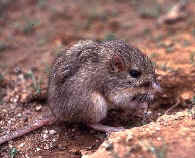
The California Pocket Mouse has brownish-gray upper fur and yellowish-white underparts. Its rump has conspicuous white, grooved hairs or spines.[1][2]
Its tail is brownish above, light underneath, and has a prominent tuft of hairs measuring 9–14 mm. Its ears are relatively large, with long black or buffy hairs at their base, and its hind feet are relatively large and yellowish-white.[3][4][5][6]
Its overall body length ranges from 190 to 224 mm, and its tail measures 103–143 mm. Its hind feet measure 24–29 mm. Its average body weight is 23 g, with recorded weights ranging from 18 to 29 g.[7][8][9][10][11]
Habitat
The species occupies montane hardwood forests throughout its range. Its habitats also include annual grasslands and sagebrush communities.[12][13]
It is most abundant where grassland and chaparral habitats occur close together. Its elevational range extends from sea level to 2,400 m.[14][15]
The species is native to California and northern Baja California in northwestern Mexico. Eight recognized subspecies occur across its distribution.[16][17]
Diet
The species primarily consumes seeds from annual grasses and forbs. Insects and leafy vegetation supplement its diet seasonally.[18][19]
It obtains water from moisture contained in seeds and leafy vegetation rather than regularly drinking water. It uses long foreclaws to sift for seeds buried in soil.[20][21]
Behaviour
The California Pocket Mouse is nocturnal and aggressively solitary. It spends daytime hours inside burrow systems and plugs burrow entrances with earth to maintain low temperatures and high humidity.[22][23][24]
Individuals can travel distances of up to 850 m within 24 hours and can climb small trees and shrubs. Its home range has been estimated at up to 56.74 hectares.[25][26][27]
When threatened, the species communicates aggressively through tooth-chattering noises and growling.[28]
Reproduction and life cycle
The species typically produces one litter annually, occasionally producing two, between April and July. Litter sizes range from two to seven young, averaging four.[29][30]
Gestation lasts approximately 25 days, and young are generally weaned at approximately three weeks of age. Females reach reproductive maturity at approximately three months of age.[31][32][33]
Females give birth in burrows excavated in soft soil.[34]
Conservation
Habitat loss associated with human development threatens the species. Domestic livestock grazing reduces the vegetation cover needed by the species to avoid predators.[35][36]
Its known habitat is shrinking because of climate change and human activities, including residential development.[37]
Similar species
The San Diego pocket mouse (Chaetodipus fallax) can be confused with the California Pocket Mouse. The San Diego pocket mouse has shorter, rounder ears measuring 7–9 mm.[38][39]
Uses
The species contributes to soil aeration through its fossorial activity. Its external cheek pouches are used to store seeds.[40][41]
Its dental formula corresponds to 20 teeth.[42]
Classification of the California Pocket Mouse
| Kingdom | Animalia |
|---|---|
| Phylum | Chordata |
| Subphylum | Vertebrata |
| Infraphylum | Gnathostomata |
| Parvphylum | Osteichthyes |
| Megaclass | Tetrapoda |
| Class | Mammalia (Mammal) |
| Subclass | Theria |
| Infraclass | Eutheria |
| Order | Rodentia (Rodent) |
| Suborder | Castorimorpha |
| Family | Heteromyidae (Pocket Mice) |
| Subfamily | Perognathinae (Silky Pocket Mice) |
| Genus | Chaetodipus (Hispid Pocket Mice) |
| Species | Chaetodipus californicus (Merriam, 1889) |
Where the California Pocket Mouse is found
Checklists and occurrence records place Chaetodipus californicus in 2 countries across North America. GBIF holds 3,888 georeferenced records of it.
Countries
Regions and cities with the most records
- California, United States 2,742
- Walnut Creek, United States 281
- Lafayette, United States 272
- Moraga, United States 269
- Orinda, United States 255
- Berkeley, United States 254
- Albany, United States 253
- Baja California, Mexico 251
- Alameda, United States 248
- El Cerrito, United States 248
- Oakland, United States 248
- Richmond, United States 246
- San Pablo, United States 245
- San Leandro, United States 244
- Pinole, United States 242
- Hercules, United States 240
- San Francisco, United States 206
- Bayview-Hunters Point, United States 167
- Pleasant Hill, United States 150
- Soledad, United States 144
- Martinez, United States 126
- Greenfield, United States 121
- Burbank, United States 90
- Glendale, United States 84
- Altadena, United States 77
- Marina, United States 77
- La Crescenta-Montrose, United States 74
- Salinas, United States 73
- La Cañada Flintridge, United States 72
- Monrovia, United States 70
- San Gabriel, United States 70
- Monterey, United States 69
- Pacific Grove, United States 69
- Seaside, United States 69
- Prunedale, United States 68
- Temple City, United States 68
Range as the checklists state it
Middle America
North America
A number beside a place is its count of GBIF occurrence records. A place without a number comes from a checklist alone. Records show where a species has been observed or collected, which can include escapes and vagrants.
Common names
English
- California Pocket Mouse
Names in 8 other languages
- Czech
- pytlouš kalifornský
- Dutch
- Californische Muisgoffer
- Finnish
- kaliforniantaskuhiiri
- German
- Kalifornische Taschenmaus
- Japanese
- カリフォルニアポケットマウス
- Polish
- chomikomyszka kalifornijska
- Russian
- Калифорнийский щетинистый прыгун
- Spanish
- Ratón-de abazones de California
Synonyms
One other scientific name has been used for this species and is now treated as a synonym of Chaetodipus californicus.
- Perognathus californicus Merriam, 1889
Subspecies and varieties
- Chaetodipus californicus bensoni subspecies
- Chaetodipus californicus bernardinus subspecies
- Chaetodipus californicus californicus subspecies
- Chaetodipus californicus dispar subspecies
- Chaetodipus californicus femoralis (Dulzura Pocket Mouse) subspecies
- Chaetodipus californicus marinensis subspecies
- Chaetodipus californicus mesopolius subspecies
- Chaetodipus californicus ochrus subspecies
Related species
-
 Rock Pocket MouseChaetodipus intermedius
-
 Desert Pocket MouseChaetodipus penicillatus
-
 Spiny Pocket MouseChaetodipus spinatus
-
 Little Desert Pocket MouseChaetodipus arenarius
-
 Hispid Pocket MouseChaetodipus hispidus
-
 Bailey's Pocket MouseChaetodipus baileyi
-
 Nelson's Pocket MouseChaetodipus nelsoni
-
 Long-tailed Pocket MouseChaetodipus formosus
Compare
Questions and answers
What is the scientific name of the California Pocket Mouse?
The scientific name of the California Pocket Mouse is Chaetodipus californicus. Written with its author, the full name is Chaetodipus californicus (Merriam, 1889).
Which family does the California Pocket Mouse belong to?
Chaetodipus californicus belongs to the family Heteromyidae, in the order Rodentia and the class Mammalia.
Where is the California Pocket Mouse found?
Checklists and occurrence records place Chaetodipus californicus in 2 countries: United States and Mexico.
What is the conservation status of the California Pocket Mouse?
The IUCN Red List category recorded for Chaetodipus californicus is Least Concern (LC).
Why is it called a pocket mouse?
The California Pocket Mouse has external cheek pouches that it uses to store seeds.[40]
Sources
Passages the profile rests on
- The species has brownish-gray upper fur and yellowish-white underparts. Source passage: “Overall body coloration is brownish-gray on top, and yellowish-white underneath” — animaldiversity.org
- The species has conspicuous white, grooved hairs or spines on its rump. Source passage: “Conspicuous white, grooved hairs, or spines, are found on the rump.” — animaldiversity.org
- Its tail is brownish above, light underneath, and has a prominent tuft of hairs. Source passage: “Like the body, the tail is brownish above and light below, with a prominent tuft of hairs at its base.” — animaldiversity.org
- Its ears are relatively large and have long black or buffy hairs at their base. Source passage: “Ears are large for a pocket mouse, with long black or buffy hairs at their base nearly as long as the ear.” — animaldiversity.org
- Its hind feet are relatively large and yellowish-white. Source passage: “Hind feet are also large, and their color is yellowish-white.” — animaldiversity.org
- The tuft on its tail measures 9–14 mm. Source passage: “The tail features a distinctive tuft measuring 9-14 mm.” — animaldiversity.org
- Its overall body length ranges from 190 to 224 mm. Source passage: “Its overall body length is 190-224 mm” — animaldiversity.org
- Its tail measures 103–143 mm in length. Source passage: “with a tail length of 103-143 mm.” — animaldiversity.org
- Its hind feet measure 24–29 mm. Source passage: “hind feet, import characters when distinguishing C. californicus from other members of its genus, measure 9-144 mm and 24-29 mm respectively.” — animaldiversity.org
- Its average body weight is 23 g. Source passage: “The average weight for this species is 23 g.” — animaldiversity.org
- Its recorded weight ranges from 18 to 29 g. Source passage: “and weight is 18-29 g.” — English Wikipedia
- The species occupies montane hardwood forests throughout its range. Source passage: “These include montane hardwood, valley foothill hardwood-conifer, valley foothill hardwood” — animaldiversity.org
- Its habitats include annual grasslands and sagebrush communities. Source passage: “annual grassland, sagebrush, chamise-redshank and montane chaparral, and coastal scrub.” — animaldiversity.org
- It is most abundant where grassland and chaparral habitats occur close together. Source passage: “C. californicus occurs in greatest abundance in habitats where grassland and chaparral are in close proximity.” — animaldiversity.org
- Its elevational range extends from sea level to 2,400 m. Source passage: “with an overall range in elevation from sea level to 2400 m.” — animaldiversity.org
- The species is native to California and northern Baja California in northwestern Mexico. Source passage: “Chaetodipus californicus is native to California in the western United States and northern Baja California state in north-western Mexico.” — English Wikipedia
- Eight recognized subspecies occur across the species' distribution. Source passage: “Eight known subspecies of C. californicus exist throughout its distribution.” — English Wikipedia
- The species primarily consumes seeds from annual grasses and forbs. Source passage: “C. californicus is primarily a grainivore, consuming the seeds from annual grasses and forbs.” — animaldiversity.org
- Insects and leafy vegetation supplement its diet seasonally. Source passage: “Insects and leafy vegetation supplement this diet seasonally.” — animaldiversity.org
- The species obtains water from moisture contained in seeds and leafy vegetation rather than regularly drinking water. Source passage: “C. californicus rarely, if ever, drinks water, obtaining its water through moisture stored in seeds and leafy vegetation.” — animaldiversity.org
- It uses long foreclaws to sift for seeds buried in soil. Source passage: “The forefeet of C. californicus are equipped with long claws, which are used to sift for seeds buried in soil.” — animaldiversity.org
- The species is nocturnal and aggressively solitary. Source passage: “C. californicus is nocturnal and aggressively solitary.” — animaldiversity.org
- It spends daytime hours inside burrow systems. Source passage: “During the day they remain in their burrow systems” — animaldiversity.org
- It plugs its burrow entrances with earth to maintain low temperatures and high humidity. Source passage: “the entrances of which are plugged with earth to keep the temperature low and humidity high.” — animaldiversity.org
- Individuals can travel distances of up to 850 m within 24 hours. Source passage: “movement of adult individuals of up to 850 m in a 24 hour period have been recorded in trapping studies.” — animaldiversity.org
- The species can climb small trees and shrubs. Source passage: “they are known to be agile in climbing tinot small trees and shrubs.” — animaldiversity.org
- Its home range has been estimated at up to 56.74 hectares. Source passage: “Trapping studies suggest an extensive home range of up to 56.74 ha.” — animaldiversity.org
- It communicates aggressively through tooth-chattering noises and growling when threatened. Source passage: “C. californicus is also known to make an aggressive, tooth-chattering noise, and will growl when threatened.” — animaldiversity.org
- The species typically produces one litter annually, occasionally producing two, between April and July. Source passage: “C. californicus typically produce one litter a year (occasionally two) between April and July.” — animaldiversity.org
- Litter sizes range from two to seven young, averaging four. Source passage: “Litter size ranges from 2-7, with and average of 4 young.” — animaldiversity.org
- Gestation lasts approximately 25 days. Source passage: “Gestation takes about 25 days” — animaldiversity.org
- Young are generally weaned at approximately three weeks of age. Source passage: “young are typically weaned in about three weeks.” — animaldiversity.org
- Females reach reproductive maturity at approximately three months of age. Source passage: “Females reach reproductive maturity around the age of 3 months” — animaldiversity.org
- Females give birth in burrows excavated in soft soil. Source passage: “Adult females give birth to their young in burrows dug in soft soil.” — animaldiversity.org
- Habitat loss associated with human development threatens the species. Source passage: “C. californicus is threatened by habitat loss where human development occurs in its range.” — animaldiversity.org
- Domestic livestock grazing reduces vegetation cover needed by the species to avoid predators. Source passage: “Grazing activity of domestic livestock reduces cover necessary for predator avoidance.” — animaldiversity.org
- The known habitat of the species is shrinking because of climate change and human activities including residential development. Source passage: “the known habitat of the Californian pocket mouse is shrinking due to climate change and other human activities such as residential development.” — English Wikipedia
- The San Diego pocket mouse (Chaetodipus fallax) is a species that can be confused with the California pocket mouse. Source passage: “The San Diego Pocket Mouse ( C. fallax ) is easily confused with C. californicus .” — animaldiversity.org
- The San Diego pocket mouse has shorter, rounder ears measuring 7–9 mm. Source passage: “The ears of C. fallax are shorter and rounder, with a length of 7-9 mm” — animaldiversity.org
- The species has external cheek pouches for storing seeds. Source passage: “C. californicus has external cheek pouches which it uses to store seeds.” — English Wikipedia
- The species contributes to soil aeration through its fossorial activity. Source passage: “As fossorial animals, they help to aerate the soil.” — animaldiversity.org
- The species has a dental formula corresponding to 20 teeth. Source passage: “1.0.1.31.0.1.3 × 2 = 20 teeth in total.” — English Wikipedia
Data
- Catalogue of Life, 2026-10-16 XR cc by
- Global Biodiversity Information Facility CC BY 4.0
- Wikidata CC0
- GeoNames CC BY 4.0
- Wikimedia Commons per image; credit shown with each image
- Within the Catalogue of Life, this name comes from The Integrated Taxonomic Information System cc0
References
- N. Am. Fauna vol.1 p.26 where the name was published
- Wilson, Don E., and DeeAnn M. Reeder, eds. (1993). Mammal Species of the World: A Taxonomic and Geographic Reference, 2nd Ed., 3rd Printing.
- Wilson, Don E., and Sue Ruff, eds. (1999). The Smithsonian Book of North American Mammals.
- Wilson, Don E., and F. Russell Cole. (2000). Common Names of Mammals of the World.
- Wilson, Don E., and DeeAnn M. Reeder, eds. (2005). Mammal Species of the World: A Taxonomic and Geographic Reference, 3rd Ed., Vols. 1 & 2.
- Hafner, M. S. / Wilson, Don E., T. E. Lacher Jr., and R. A. Mittermeier, eds. (2016). Family Heteromyidae (Pocket Mice, Kangaroo Mice and Kangaroo Rats). Handbook of the Mammals of the World. Vol. 6: Lagomorphs and Rodents I.
- Burgin, Connor J., Don E. Wilson, Russell A. Mittermeier, Anthony B. Rylands, et al. (2020). Illustrated Checklist of the Mammals of the World. Vol. 1. Monotremata to Rodentia.
This species in other databases
Page built on 28 November 2026. See how the catalog is made and all sources and licences.
Cite this page
ScientificNames.org. (2026). Chaetodipus californicus (California Pocket Mouse). Retrieved November 28, 2026, from https://scientificnames.org/species/chaetodipus-californicus
“Chaetodipus californicus (California Pocket Mouse).” ScientificNames.org, 2026, scientificnames.org/species/chaetodipus-californicus. Accessed 28 Nov. 2026.
ScientificNames.org. “Chaetodipus californicus (California Pocket Mouse).” Accessed November 28, 2026. https://scientificnames.org/species/chaetodipus-californicus.
@misc{scientificnames_chaetodipus_californicus_california_pocket_mouse,
  author = {{ScientificNames.org}},
  title = {Chaetodipus californicus (California Pocket Mouse)},
  year = {2026},
  url = {https://scientificnames.org/species/chaetodipus-californicus},
  note = {Accessed 2026-11-28}
}