Species · Fishes
Suttkus Sea Toad Chaunax suttkusi
The scientific name of the Suttkus Sea Toad is Chaunax suttkusi. It is a species of fish in the family Chaunacidae (sea toad), order Lophiiformes. The name dates from 1989.
- Scientific name
- Chaunax suttkusi Caruso, 1989
- Common name
- Suttkus Sea Toad
- Genus
- Chaunax
- Family
- Chaunacidae (Sea Toad)
- Order
- Lophiiformes
- Class
- Teleostei
- Red List category
- LC Least Concern
- Environment
- marine
- Recorded in
- 24 countries
- Name status
- accepted in the Catalogue of Life

Overview
The Suttkus Sea Toad (Chaunax suttkusi Caruso, 1989) is a fish in the family Chaunacidae, order Lophiiformes and class Teleostei. It inhabits soft-bottom substrates along the continental shelf at depths of 220–1,060 m in the Atlantic Ocean and Mediterranean Sea. It has a globular, slightly compressed body, loose skin covered with robust denticles and a visible dorsal spine bearing a black, filamentous lure.
Written 27 November 2026 from the sources listed below. Each statement was checked against the passage it cites; statements that could not be supported were removed.
Habitat
The Suttkus Sea Toad is bathydemersal and inhabits depths of 220–1,060 m. It occurs on soft-bottom substrates along the continental shelf.[1][2]
It occurs in the Atlantic Ocean, with its eastern Atlantic distribution extending from Ireland south to Angola. The Azores are included within its distribution.[3][4][5]
In the western Atlantic, it occurs from South Carolina south to the Rio Grande Rise. It has also been recorded in the Mediterranean Sea.[6][7]
Appearance
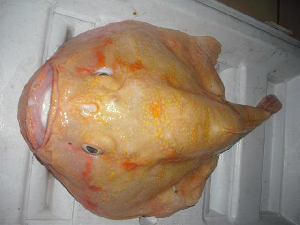
The Suttkus Sea Toad has a globular, slightly compressed body that tapers toward a small, rounded caudal fin. Its head is large and somewhat cuboid, with small eyes covered by transparent skin.[8][9]
Its large oblique mouth contains numerous small, thin, sharp vertical teeth. Its loose, flabby skin is densely covered with robust denticles.[10][11]
Its visible dorsal spine bears a mop-like lure composed of black filaments. The dorsal fin is positioned toward the rear of the body and contains 10–12 soft rays, while the anal fin contains 6–7 soft rays.[12][13][14][15]
Its overall coloration ranges from pale pink to rosy pink, with red markings on the upper and lateral surfaces of the head and fins. The undersides of its head and body are whitish.[16][17]
The lateral line has 29–42 pores on the upper body and 11–13 pores on the head.[18]
The maximum published total length is 26.7 cm, and the maximum published weight is 359 g.[19][20]
Behaviour
When not being used to attract prey, the species lowers its illicium into a flat, concave depression on its snout.[21]
Similar species
The Suttkus Sea Toad belongs to the Chaunax fimbriatus species group within the genus Chaunax.[22]
Classification of the Suttkus Sea Toad
| Kingdom | Animalia |
|---|---|
| Phylum | Chordata |
| Subphylum | Vertebrata |
| Infraphylum | Gnathostomata |
| Parvphylum | Osteichthyes |
| Gigaclass | Actinopterygii |
| Superclass | Actinopteri |
| Class | Teleostei (Teleost) |
| Order | Lophiiformes (Anglerfish) |
| Suborder | Chaunacoidei |
| Family | Chaunacidae (Sea Toad) |
| Genus | Chaunax |
| Species | Chaunax suttkusi Caruso, 1989 |
Where the Suttkus Sea Toad is found
Checklists and occurrence records place Chaunax suttkusi in 24 countries. GBIF holds 388 georeferenced records of it.
Countries
- Angola 16
- Bahamas 8
- Barbados 3
- Belize 6
- Bonaire, Saint Eustatius and Saba 3
- Brazil 3
- Cabo Verde 7
- Colombia 12
- Cuba 11
- Dominica 3
- French Guiana 4
- Guinea 3
- Honduras 6
- Liberia 6
- Mauritania 5
- Mexico 29
- Nicaragua 18
- Panama 13
- Puerto Rico 5
- Senegal 4
- Suriname 8
- United States 197
- Venezuela 7
- Western Sahara 11
Regions and cities with the most records
2 more countries have a few records outside this range
These countries hold a few records of Chaunax suttkusi but lie outside the range the checklists give for it. Such records are often zoo or garden specimens, museum material or vagrants, so the species is not counted as occurring there.
A number beside a place is its count of GBIF occurrence records. A place without a number comes from a checklist alone. Records show where a species has been observed or collected, which can include escapes and vagrants.
Common names
English
- Suttkus Sea Toad
Names in 2 other languages
- Czech
- žaboškleb Suttkusův
- Spanish
- pez gomita blanco
Synonyms
One other scientific name has been used for this species and is now treated as a synonym of Chaunax suttkusi.
- Chaunax suttkus Caruso, 1989
Related species
-
 Furry CoffinfishChaunax endeavouri
-
 Pink FrogmouthChaunax pictus
-
 Redeye GaperChaunax stigmaeus
-
 Abe's FrogmouthChaunax abei
-
 Sea ToadChaunax fimbriatus
- Sea-toadChaunax breviradius
- Chaunax flammeus
- Naked-belly FrogmouthChaunax nudiventer
Compare
Questions and answers
What is the scientific name of the Suttkus Sea Toad?
The scientific name of the Suttkus Sea Toad is Chaunax suttkusi. Written with its author, the full name is Chaunax suttkusi Caruso, 1989.
Which family does the Suttkus Sea Toad belong to?
Chaunax suttkusi belongs to the family Chaunacidae, in the order Lophiiformes and the class Teleostei.
Where is the Suttkus Sea Toad found?
Checklists and occurrence records place Chaunax suttkusi in 24 countries, including United States, Mexico, Nicaragua, Angola, Panama and Colombia.
What is the conservation status of the Suttkus Sea Toad?
The IUCN Red List category recorded for Chaunax suttkusi is Least Concern (LC).
What is the scientific name for the sea toad?
The scientific name of the Suttkus Sea Toad is Chaunax suttkusi Caruso, 1989.[23]
Is the coffinfish real?
The Suttkus Sea Toad is a real fish species belonging to the family Chaunacidae.[23]
Is the sea toad a fish?
Yes. The Suttkus Sea Toad is a fish in the class Teleostei, order Lophiiformes and family Chaunacidae.[23]
Sources
Passages the profile rests on
- The species is bathydemersal and inhabits depths of 220–1,060 m. Source passage: “This is a bathydemersal species found at depths between 220 and 1,060 m (720 and 3,480 ft)” — English Wikipedia
- The species occurs on soft-bottom substrates along the continental shelf. Source passage: “on soft bottoms on the continental shelf.” — English Wikipedia
- The species occurs in the Atlantic Ocean. Source passage: “Chaunax suttkusi is found in the Atlantic Ocean.” — English Wikipedia
- In the eastern Atlantic, its distribution extends from Ireland south to Angola. Source passage: “In the eastern Atlantic it occurs from Ireland south as far as Angola” — English Wikipedia
- The Azores are included within the species' distribution. Source passage: “its range includes the Azores” — English Wikipedia
- In the western Atlantic, the species occurs from South Carolina south to the Rio Grande Rise. Source passage: “in the western Atlantic it can be found from South Carolina as far south as the Rio Grande Rise.” — English Wikipedia
- The species has also been recorded in the Mediterranean Sea. Source passage: “It has also been found in the Mediterranean Sea.” — English Wikipedia
- The species has a globular, slightly compressed body that tapers toward a small, rounded caudal fin. Source passage: “Chaunax suttkusi has a globular, slight compressed body which tapers to a small, rounded caudal fin.” — English Wikipedia
- Its head is large and somewhat cuboid, with small eyes covered by transparent skin. Source passage: “The large head is somewhat cuboid with small eyes which are covered in transparent skin.” — English Wikipedia
- Its large oblique mouth contains numerous small, thin, sharp vertical teeth. Source passage: “The large, oblique mouth is equipped with many small, thin, sharp vertical teeth” — English Wikipedia
- The species has loose, flabby skin densely covered with robust denticles. Source passage: “The loose, flabby skin has a dense covering of robust denticles.” — English Wikipedia
- Its visible dorsal spine bears a mop-like lure composed of filaments. Source passage: “only the first, the illicium is visible. The illicium is tipped with a lure, or esca which is a mop-like tuft of filaments.” — English Wikipedia
- The filaments of its lure are black. Source passage: “with the filaments of the esca being black.” — English Wikipedia
- Its dorsal fin is positioned toward the rear of the body and contains 10–12 soft rays. Source passage: “The dorsal fin is on the rear of the body and contains between 10 and 12 soft rays” — English Wikipedia
- Its anal fin contains 6–7 soft rays. Source passage: “while the anal fin has 6 or 7 soft rays.” — English Wikipedia
- Its overall coloration ranges from pale pink to rosy pink, with red markings on the upper and lateral surfaces of the head and fins. Source passage: “The overall colour is pale pink to rosy pink, with red on the top and sides of the head and fins” — English Wikipedia
- The undersides of its head and body are whitish. Source passage: “the undersides of both the head and body are whitish.” — English Wikipedia
- The lateral line has 29–42 pores on the upper body and 11–13 pores on the head. Source passage: “The main part of the lateral line on the upper body contains between 29 and 42 pores with between 11 and 13 pores on the head.” — English Wikipedia
- The maximum published total length of the species is 26.7 cm. Source passage: “This species has a maximum published total length of 26.7 cm (10.5 in)” — English Wikipedia
- The maximum published weight of the species is 359 g. Source passage: “a maximum published weight of 359 g (12.7 oz).” — English Wikipedia
- The species lowers its illicium into a flat, concave depression on its snout when it is not being used to attract prey. Source passage: “The illicium is lowered into a flat, concave depression on the snout when not being used to attract prey.” — English Wikipedia
- The species belongs to the Chaunax fimbriatus species group within the genus Chaunax. Source passage: “Within the genus Chaunax this species is placed in the Chaunax fimbriatus species group.” — English Wikipedia
- The species was formally described in 1989 by American ichthyologist John H. Caruso. Source passage: “Chaunax suttkisi was first formally described in 1989 by the American ichthyologist John H. Caruso” — English Wikipedia
Data
- Catalogue of Life, 2026-10-16 XR cc by
- Global Biodiversity Information Facility CC BY 4.0
- Wikidata CC0
- GeoNames CC BY 4.0
- Wikimedia Commons per image; credit shown with each image
- Within the Catalogue of Life, this name comes from World Register of Marine Species cc by
References
- Caruso, J. H. (1989). Systematics and distribution of Atlantic chaunacid anglerfishes (Pisces: Lophiiformes). Copeia, 1989. https://doi.org/10.2307/1445616 Link where the name was published
This species in other databases
- Catalogue of Life TQT2
- Wikidata Q2680277
- iNaturalist 120695
- WoRMS urn:lsid:marinespecies.org:taxname:126540
- ITIS 622870
Page built on 28 November 2026. See how the catalog is made and all sources and licences.
Cite this page
ScientificNames.org. (2026). Chaunax suttkusi (Suttkus Sea Toad). Retrieved November 28, 2026, from https://scientificnames.org/species/chaunax-suttkusi
“Chaunax suttkusi (Suttkus Sea Toad).” ScientificNames.org, 2026, scientificnames.org/species/chaunax-suttkusi. Accessed 28 Nov. 2026.
ScientificNames.org. “Chaunax suttkusi (Suttkus Sea Toad).” Accessed November 28, 2026. https://scientificnames.org/species/chaunax-suttkusi.
@misc{scientificnames_chaunax_suttkusi_suttkus_sea_toad,
  author = {{ScientificNames.org}},
  title = {Chaunax suttkusi (Suttkus Sea Toad)},
  year = {2026},
  url = {https://scientificnames.org/species/chaunax-suttkusi},
  note = {Accessed 2026-11-28}
}