Species · Birds
Black-fronted Bushshrike Chlorophoneus nigrifrons
The scientific name of the Black-fronted Bushshrike is Chlorophoneus nigrifrons. It is a species of bird in the family Malaconotidae (bushshrike), order Passeriformes. The name dates from 1896.
- Scientific name
- Chlorophoneus nigrifrons (Reichenow, 1896)
- Common name
- Black-fronted Bushshrike
- Genus
- Chlorophoneus
- Family
- Malaconotidae (Bushshrike)
- Order
- Passeriformes
- Class
- Aves
- Red List category
- LC Least Concern
- Recorded in
- 9 countries
- Name status
- accepted in the Catalogue of Life

Overview
Chlorophoneus nigrifrons inhabits forests, primarily in East Africa, and is restricted to montane forests in many parts of its range.
Written 26 November 2026 from the sources listed below. Each statement was checked against the passage it cites; statements that could not be supported were removed.
Appearance
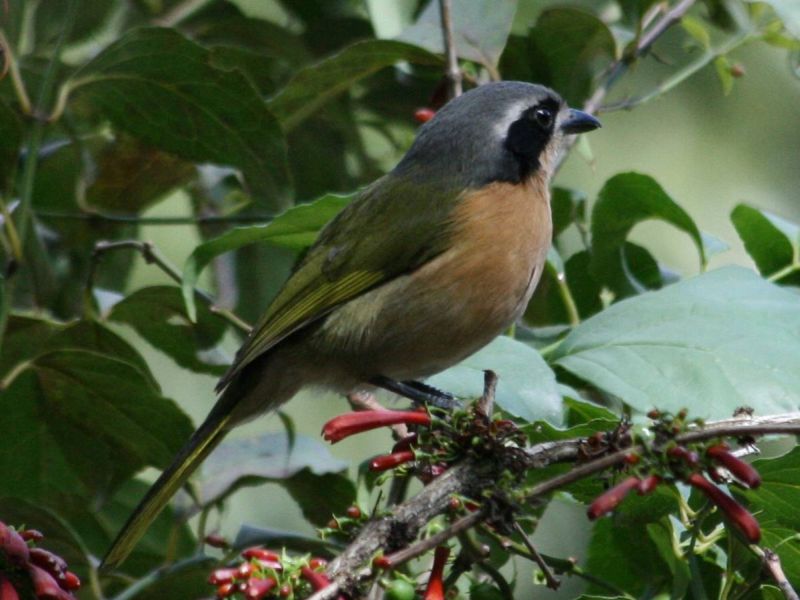
The species has four different colour morphs. The orange morph has a black mask and forehead, orange underparts, and yellow colouring beneath the tail.[1][2]
The red morph has a redder throat and breast than the orange morph, with a yellow belly and undertail-coverts. The buff morph has buff underparts and a pale throat.[3][4]
The black morph has a completely black face, forehead, throat and breast, with a green belly and undertail-coverts. Another described colour variation has a black breast and yellow belly.[5][6]
Juveniles have buffish underparts with dark barring and yellow edges on their wing feathers. The species measures 18–19 centimetres in length.[7][8]
Similar species
The Black-fronted Bushshrike forms a superspecies with the many-colored bushshrike (Chlorophoneus multicolor). The two are sometimes treated as a single species.[9][10]
Habitat
The species inhabits forests, primarily in East Africa. It is restricted to montane forests in many parts of its range.[11][12]
The subspecies Chlorophoneus nigrifrons nigrifrons occurs from central Kenya south through Tanzania to northern Malawi. Chlorophoneus nigrifrons manningi occurs from southeastern Democratic Republic of the Congo to northern Zambia.[13][14]
Chlorophoneus nigrifrons sandgroundi occurs in southern Malawi, Mozambique, eastern Zimbabwe and northeastern South Africa. The species has a patchy geographical distribution.[15][16]
Behaviour
The species forages in the canopy and middle levels of forests. Outside the breeding season, it joins mixed-species feeding flocks.[17][18]
Its song consists of repeated bell-like phrases. Pairs frequently sing duets together.[19][20]
Conservation
The species was most recently assessed for the IUCN Red List of Threatened Species in 2024.[21]
Classification of the Black-fronted Bushshrike
| Kingdom | Animalia |
|---|---|
| Phylum | Chordata |
| Subphylum | Vertebrata |
| Infraphylum | Gnathostomata |
| Parvphylum | Osteichthyes |
| Megaclass | Tetrapoda |
| Class | Aves (Bird) |
| Order | Passeriformes (Passerine) |
| Family | Malaconotidae (Bushshrike) |
| Genus | Chlorophoneus (Chlorophoneus Bushshrikes) |
| Species | Chlorophoneus nigrifrons (Reichenow, 1896) |
Where the Black-fronted Bushshrike is found
Checklists and occurrence records place Chlorophoneus nigrifrons in 9 countries across Africa. GBIF holds 4,758 georeferenced records of it.
Countries
- Democratic Republic of the Congo 69
- Kenya 1,054
- Malawi 123
- Mozambique 87
- Republic of the Congo 3
- South Africa 1,049
- Tanzania 1,271
- Zambia 394
- Zimbabwe 708
Regions and cities with the most records
- Limpopo, South Africa 996
- Manicaland, Zimbabwe 695
- Tzaneen, South Africa 484
- Tanga, Tanzania 454
- Machipanda, Mozambique 402
- Arusha, Tanzania 368
- Kiambu County, Kenya 367
- Kirinyaga County, Kenya 361
- Kerugoya, Kenya 359
- Mai, Kenya 297
- Maai Mahiu, Kenya 296
- Limuru, Kenya 288
- Githunguri, Kenya 284
- Lushoto, Tanzania 280
- Matui, Tanzania 280
- Mazinde, Tanzania 280
- Usa River, Tanzania 253
- Mutare, Zimbabwe 244
- Arusha, Tanzania 185
- North-Western, Zambia 181
- Makuyuni, Tanzania 170
- Copperbelt, Zambia 154
- Morogoro, Tanzania 139
- Kingori, Tanzania 137
- Maramba, Tanzania 135
- Korogwe, Tanzania 132
- Muheza, Tanzania 119
- Duiwelskloof, South Africa 117
- Iringa, Tanzania 103
- Kilimanjaro, Tanzania 103
- Chambishi, Zambia 101
- Chingola, Zambia 100
- Kiratu, Tanzania 92
- Mankweng, South Africa 54
- Mpumalanga, South Africa 50
- Meru County, Kenya 47
Range as the checklists state it
Africa
A number beside a place is its count of GBIF occurrence records. A place without a number comes from a checklist alone. Records show where a species has been observed or collected, which can include escapes and vagrants.
Common names
English
- Black-fronted Bushshrike
- BFBU
- Black-fronted Bush-shrike
Names in 25 other languages
- Afrikaans
- Swartoogboslaksman
- Catalan
- gladiador de front negre
- Chinese
- 黑額叢伯勞, 黑额丛鵙
- Croatian
- crnočela čagra
- Czech
- ťuhýkovec černočelý
- Danish
- Sortpandet Busktornskade
- Dutch
- Reichenows Bosklauwier
- Esperanto
- nigrafrunta malakonoto
- Estonian
- ida-pagulind
- Finnish
- idänkirjolepinkäinen
- French
- Gladiateur à front noir, Gonolek à front noir
- German
- Graustirn-Würger, Graustirnwürger
- Italian
- Averla di macchia frontenera
- Japanese
- クロガオミドリヤブモズ
- Lithuanian
- juodakaktė žalsvoji medšarkė
- Norwegian
- svartpannebuskvarsler
- Polish
- dzierzbik czarnoczelny
- Portuguese
- bubu-de-testa-preta, picanço-de-testa-preta
- Russian
- Серолобый кустарниковый сорокопут, Черногрудый гладиатор
- Serbian
- Crnočeli teloforus svračak
- Slovak
- mäsiarik čiernočelý
- Spanish
- Bubú frentinegro
- Swedish
- svartpannad busktörnskata
- Turkish
- Kara Alınlı Çalıkasabı
- Ukrainian
- вюргер чорнолобий
Synonyms
7 other scientific names have been used for this species and are now treated as synonyms of Chlorophoneus nigrifrons.
- Chlorophoneus nigrescens Sclater, WL, 1931
- Laniarius nigrifrons Reichenow, 1896
- Malaconotus multicolor nigrifrons Reichenow, A, 1896
- Malaconotus nigrifrons Reichenow, A, 1896
- Telephorus nigrifrons Reichenow, A, 1896
- Telophorus nigrescens Sclater, WL, 1931
- Telophorus nigrifrons (Reichenow, 1896)
Subspecies and varieties
- Chlorophoneus nigrifrons manningi subspecies
- Chlorophoneus nigrifrons nigrifrons subspecies
- Chlorophoneus nigrifrons sandgroundi (Southern Blackfronted Bushshrike) subspecies
Related species
-
 Orange-breasted BushshrikeChlorophoneus sulfureopectus
-
 Olive BushshrikeChlorophoneus olivaceus
- Mount Kupe BushshrikeChlorophoneus kupeensis
-
 Bocage's BushshrikeChlorophoneus bocagei
-
 Many-colored BushshrikeChlorophoneus multicolor
-
 Southern BoubouLaniarius ferrugineus
-
 Crimson-breasted ShrikeLaniarius atrococcineus
-
 Grey-headed BushshrikeMalaconotus blanchoti
Compare
Questions and answers
What is the scientific name of the Black-fronted Bushshrike?
The scientific name of the Black-fronted Bushshrike is Chlorophoneus nigrifrons. Written with its author, the full name is Chlorophoneus nigrifrons (Reichenow, 1896).
Which family does the Black-fronted Bushshrike belong to?
Chlorophoneus nigrifrons belongs to the family Malaconotidae, in the order Passeriformes and the class Aves.
Where is the Black-fronted Bushshrike found?
Checklists and occurrence records place Chlorophoneus nigrifrons in 9 countries, including Tanzania, Kenya, South Africa, Zimbabwe, Zambia and Malawi.
What is the conservation status of the Black-fronted Bushshrike?
The IUCN Red List category recorded for Chlorophoneus nigrifrons is Least Concern (LC).
What other names does the Black-fronted Bushshrike have?
Chlorophoneus nigrifrons is also known in English as BFBU and Black-fronted Bush-shrike.
Sources
Passages the profile rests on
- The species has four different colour morphs. Source passage: “Pretty bushshrike that has four different morphs.” — ebird.org
- The orange colour morph has a black mask and forehead, orange underparts, and yellow colouring beneath the tail. Source passage: “The orange morph has a black mask and forehead and orange underparts, shading to yellow under the tail.” — English Wikipedia
- The red colour morph has a redder throat and breast than the orange morph, with a yellow belly and undertail-coverts. Source passage: “The red morph is similar but redder on the throat and breast with yellow on the belly and undertail-coverts.” — English Wikipedia
- The buff colour morph has buff underparts and a pale throat. Source passage: “The buff form has buff underparts and a pale throat.” — English Wikipedia
- The black colour morph has a completely black face, forehead, throat and breast, with a green belly and undertail-coverts. Source passage: “The black morph has an entirely black face, forehead, throat and breast and green belly and undertail-coverts.” — English Wikipedia
- One described colour variation has a black breast and yellow belly. Source passage: “a black breast and yellow belly” — ebird.org
- Juveniles have buffish underparts with dark barring and yellow edges on their wing feathers. Source passage: “Juvenile birds have buffish underparts with dark barring and yellow edges to the wing-feathers.” — English Wikipedia
- The species measures 18–19 centimetres in length. Source passage: “The bird is 18–19 centimetres long.” — English Wikipedia
- The Black-fronted Bushshrike forms a superspecies with the many-colored bushshrike (Chlorophoneus multicolor). Source passage: “It forms a superspecies with the many-colored bushshrike (C. multicolor)” — English Wikipedia
- The Black-fronted Bushshrike and the many-colored bushshrike are sometimes treated as a single species. Source passage: “the two are sometimes considered to be a single species.” — English Wikipedia
- The species inhabits forests, primarily in East Africa. Source passage: “It inhabits forests mainly in East Africa.” — English Wikipedia
- The species is restricted to montane forests in many parts of its range. Source passage: “It has a patchy distribution and is restricted to montane forests in many areas.” — English Wikipedia
- The subspecies Chlorophoneus nigrifrons nigrifrons occurs from central Kenya south through Tanzania to northern Malawi. Source passage: “C. n. nigrifrons occurs from central Kenya southwards through Tanzania to northern Malawi.” — English Wikipedia
- The subspecies Chlorophoneus nigrifrons manningi occurs from southeastern Democratic Republic of the Congo to northern Zambia. Source passage: “C. n. manningi is found from the south-eastern part of the Democratic Republic of the Congo to northern Zambia.” — English Wikipedia
- The subspecies Chlorophoneus nigrifrons sandgroundi occurs in southern Malawi, Mozambique, eastern Zimbabwe and northeastern South Africa. Source passage: “C. n. sandgroundi occurs in southern Malawi, Mozambique, eastern Zimbabwe and north-eastern South Africa.” — English Wikipedia
- The species has a patchy geographical distribution. Source passage: “It has a patchy distribution” — English Wikipedia
- The species forages in the canopy and middle levels of forests. Source passage: “It forages in the canopy and middle levels of the forest” — English Wikipedia
- Outside the breeding season, the species joins mixed-species feeding flocks. Source passage: “joins mixed-species feeding flocks outside the breeding season.” — English Wikipedia
- The species produces repeated bell-like phrases in its song. Source passage: “The song includes repeated bell-like phrases.” — English Wikipedia
- Pairs frequently sing duets together. Source passage: “Pairs often duet together.” — English Wikipedia
- The species was most recently assessed for the IUCN Red List of Threatened Species in 2024. Source passage: “Black-fronted Bushshrike Chlorophoneus nigrifrons has most recently been assessed for The IUCN Red List of Threatened Species in 2024.” — iucnredlist.org
Data
- Catalogue of Life, 2026-10-16 XR cc by
- Global Biodiversity Information Facility CC BY 4.0
- Wikidata CC0
- GeoNames CC BY 4.0
- Wikimedia Commons per image; credit shown with each image
- Within the Catalogue of Life, this name comes from The Integrated Taxonomic Information System cc0
This species in other databases
Page built on 29 November 2026. See how the catalog is made and all sources and licences.
Cite this page
ScientificNames.org. (2026). Chlorophoneus nigrifrons (Black-fronted Bushshrike). Retrieved November 29, 2026, from https://scientificnames.org/species/chlorophoneus-nigrifrons
“Chlorophoneus nigrifrons (Black-fronted Bushshrike).” ScientificNames.org, 2026, scientificnames.org/species/chlorophoneus-nigrifrons. Accessed 29 Nov. 2026.
ScientificNames.org. “Chlorophoneus nigrifrons (Black-fronted Bushshrike).” Accessed November 29, 2026. https://scientificnames.org/species/chlorophoneus-nigrifrons.
@misc{scientificnames_chlorophoneus_nigrifrons_black_fronted_bushshrike,
  author = {{ScientificNames.org}},
  title = {Chlorophoneus nigrifrons (Black-fronted Bushshrike)},
  year = {2026},
  url = {https://scientificnames.org/species/chlorophoneus-nigrifrons},
  note = {Accessed 2026-11-29}
}