Species · Birds
Orange-breasted Bushshrike Chlorophoneus sulfureopectus
The scientific name of the Orange-breasted Bushshrike is Chlorophoneus sulfureopectus. It is a species of bird in the family Malaconotidae (bushshrike), order Passeriformes. The name dates from 1831.
- Scientific name
- Chlorophoneus sulfureopectus (R. P. Lesson, 1831)
- Common name
- Orange-breasted Bushshrike
- Genus
- Chlorophoneus
- Family
- Malaconotidae (Bushshrike)
- Order
- Passeriformes
- Class
- Aves
- Red List category
- LC Least Concern
- Recorded in
- 36 countries
- Name status
- accepted in the Catalogue of Life

Overview
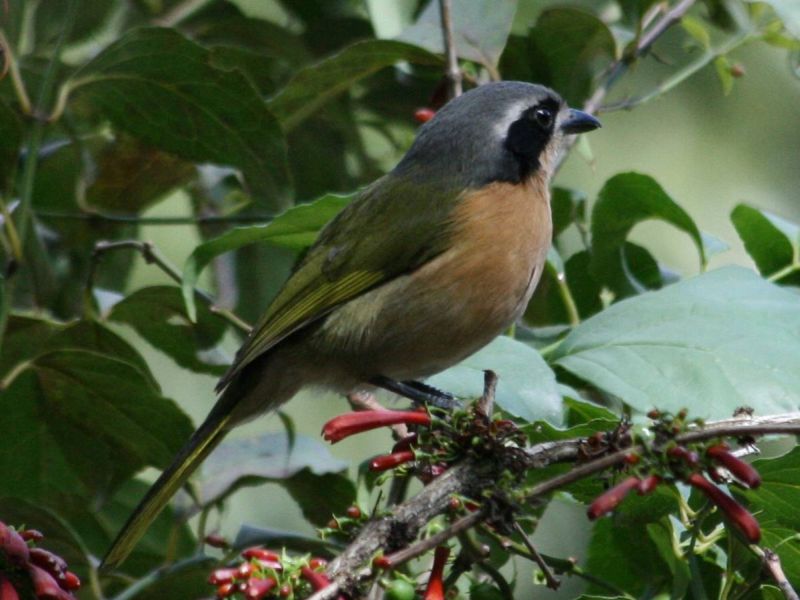
Chlorophoneus sulfureopectus occurs widely throughout Sub-Saharan Africa and inhabits subtropical or tropical dry forests, dry savanna, and moist savanna. It has gray, yellow, and green plumage, a dark eye, an orange chest, a distinctive yellow forehead, and a short eyebrow.
Written 26 November 2026 from the sources listed below. Each statement was checked against the passage it cites; statements that could not be supported were removed.
Appearance
The Orange-breasted Bushshrike has gray, yellow, and green plumage. It has a dark eye, an orange chest, a distinctive yellow forehead, and a short eyebrow.[1][2][3][4][5]
Habitat
The Orange-breasted Bushshrike occurs widely throughout Sub-Saharan Africa, although it is relatively absent from most of Central Africa, Southern Africa, and the Horn of Africa.[6]
It inhabits subtropical or tropical dry forests, dry savanna, and moist savanna.[7][8][9]
Diet
The Orange-breasted Bushshrike feeds mainly on insects, including beetles, caterpillars, bees, ants, and wasps.[10][11][12][13][14][15]
Behaviour
The Orange-breasted Bushshrike is not migratory.[16]
Classification of the Orange-breasted Bushshrike
| Kingdom | Animalia |
|---|---|
| Phylum | Chordata |
| Subphylum | Vertebrata |
| Infraphylum | Gnathostomata |
| Parvphylum | Osteichthyes |
| Megaclass | Tetrapoda |
| Class | Aves (Bird) |
| Order | Passeriformes (Passerine) |
| Family | Malaconotidae (Bushshrike) |
| Genus | Chlorophoneus (Chlorophoneus Bushshrikes) |
| Species | Chlorophoneus sulfureopectus (R. P. Lesson, 1831) |
Where the Orange-breasted Bushshrike is found
Checklists and occurrence records place Chlorophoneus sulfureopectus in 36 countries across Africa. GBIF holds 116,672 georeferenced records of it.
Countries
- Angola 268
- Benin 219
- Botswana 2,304
- Burkina Faso 69
- Burundi 8
- Cameroon 111
- Central African Republic 25
- Chad 23
- Democratic Republic of the Congo 325
- Eswatini 2,170
- Ethiopia 778
- Gambia 308
- Ghana 757
- Guinea 109
- Guinea-Bissau 148
- Ivory Coast 44
- Kenya 7,142
- Liberia 8
- Malawi 711
- Mali 4
- Mozambique 1,888
- Namibia 2,075
- Niger 3
- Nigeria 2,414
- Republic of the Congo 16
- Rwanda 310
- Senegal 158
- Sierra Leone 52
- South Africa 77,502
- South Sudan 8
- Sudan 17
- Tanzania 3,368
- Togo 12
- Uganda 2,482
- Zambia 5,009
- Zimbabwe 5,827
Regions and cities with the most records
- Limpopo, South Africa 23,989
- Mpumalanga, South Africa 22,579
- KwaZulu-Natal, South Africa 17,538
- Gauteng, South Africa 6,314
- North West, South Africa 3,884
- Mbombela, South Africa 2,721
- Pretoria, South Africa 2,043
- Centurion, South Africa 1,893
- Matabeleland North, Zimbabwe 1,866
- Pietermaritzburg, South Africa 1,838
- Eastern Cape, South Africa 1,731
- Komatipoort, South Africa 1,715
- Tekwane, South Africa 1,699
- White River, South Africa 1,664
- Plateau State, Nigeria 1,563
- Bukuru, Nigeria 1,446
- Modimolle, South Africa 1,425
- Randburg, South Africa 1,419
- Matsulu, South Africa 1,416
- Jos, Nigeria 1,407
- Roodepoort, South Africa 1,332
- Southern Province, Zambia 1,331
- Livingstone, Zambia 1,315
- Lubombo Region, Eswatini 1,279
- Bela Bela, South Africa 1,276
- Victoria Falls, Zimbabwe 1,270
- Krugersdorp, South Africa 1,259
- Lusaka Province, Zambia 1,250
- Pinetown, South Africa 1,229
- Arusha, Tanzania 1,148
- Ntuzuma, South Africa 1,109
- Mpumalanga, South Africa 1,104
- Johannesburg, South Africa 1,098
- Imara Daima Estate, Kenya 1,086
- Soweto, South Africa 1,080
- Masvingo Province, Zimbabwe 1,076
1 more country has a few records outside this range
These countries hold a few records of Chlorophoneus sulfureopectus but lie outside the range the checklists give for it. Such records are often zoo or garden specimens, museum material or vagrants, so the species is not counted as occurring there.
Range as the checklists state it
Africa
A number beside a place is its count of GBIF occurrence records. A place without a number comes from a checklist alone. Records show where a species has been observed or collected, which can include escapes and vagrants.
Common names
English
- Orange-breasted Bushshrike
- Orange-breasted Bush-shrike
- SBBU
- Sulphur-breasted Bush-shrike
- Sulphur-breasted Bushshrike
Names in 25 other languages
- Afrikaans
- Oranjeborsboslaksman
- Catalan
- gladiador pit de sofre
- Chinese
- 橙胸丛鵙, 橙胸叢伯勞
- Croatian
- žutočela čagra
- Czech
- ťuhýkovec zlatoprsý
- Danish
- Svovlbrystet Busktornskade
- Dutch
- Oranje Bosklauwier
- Esperanto
- sulfurbrusta malakonoto
- Estonian
- kuldkulm-pagulind
- Finnish
- kultakurkkulepinkäinen
- French
- Gladiateur soufré, Gonolek soufré
- German
- Orangebrust-Würger, Orangebrustwürger
- Hungarian
- kénbegyű bozótgébics
- Italian
- Averla di macchia pettozolfo
- Japanese
- ミドリヤブモズ
- Lithuanian
- rusvakrūtė žalsvoji medšarkė
- Norwegian
- svovelbuskvarsler
- Polish
- dzierzbik złoty
- Portuguese
- bubu-enxofrado, picanço-de-peito-laranja
- Russian
- Желтобрюхий гладиатор, Желтогрудый кустарниковый сорокопут
- Slovak
- mäsiarik zlatý
- Spanish
- Bubú azufrado
- Swedish
- orangebröstad busktörnskata
- Turkish
- Safran Göğüslü Çalıkasabı
- Ukrainian
- вюргер золотистий
Synonyms
6 other scientific names have been used for this species and are now treated as synonyms of Chlorophoneus sulfureopectus.
- Chlorophoneus sulphureopectus Lesson, RP, 1831
- Lanius sulfureopectus R. P. Lesson, 1831
- Malaconotus sulfureopectus Lesson, RP, 1831
- Malaconotus sulfureopectus sulfureopectus Dowsett & Forbes-Watson (1993)
- Malaconotus sulfuropectus sulfuropectus Lesson, RP, 1831
- Telophorus sulfureopectus (R. P. Lesson, 1831)
Subspecies and varieties
- Chlorophoneus sulfureopectus similis (Southern Orange-breasted Bushshrike) subspecies
- Chlorophoneus sulfureopectus sulfureopectus (Orange-breasted Bushshrike) subspecies
Related species
-
 Olive BushshrikeChlorophoneus olivaceus
-
 Black-fronted BushshrikeChlorophoneus nigrifrons
- Mount Kupe BushshrikeChlorophoneus kupeensis
-
 Bocage's BushshrikeChlorophoneus bocagei
-
 Many-colored BushshrikeChlorophoneus multicolor
-
 Southern BoubouLaniarius ferrugineus
-
 Crimson-breasted ShrikeLaniarius atrococcineus
-
 Grey-headed BushshrikeMalaconotus blanchoti
Compare
Questions and answers
What is the scientific name of the Orange-breasted Bushshrike?
The scientific name of the Orange-breasted Bushshrike is Chlorophoneus sulfureopectus. Written with its author, the full name is Chlorophoneus sulfureopectus (R. P. Lesson, 1831).
Which family does the Orange-breasted Bushshrike belong to?
Chlorophoneus sulfureopectus belongs to the family Malaconotidae, in the order Passeriformes and the class Aves.
Where is the Orange-breasted Bushshrike found?
Checklists and occurrence records place Chlorophoneus sulfureopectus in 36 countries, including South Africa, Kenya, Zimbabwe, Zambia, Tanzania and Uganda.
What is the conservation status of the Orange-breasted Bushshrike?
The IUCN Red List category recorded for Chlorophoneus sulfureopectus is Least Concern (LC).
What other names does the Orange-breasted Bushshrike have?
Chlorophoneus sulfureopectus is also known in English as Orange-breasted Bush-shrike, SBBU, Sulphur-breasted Bush-shrike and Sulphur-breasted Bushshrike.
Sources
Passages the profile rests on
- The species has gray, yellow, and green plumage. Source passage: “A striking gray, yellow, and green bushshrike with a dark eye, an orange chest, and a distinctive yellow forehead and short eyebrow.” — ebird.org
- The species has a dark eye. Source passage: “A striking gray, yellow, and green bushshrike with a dark eye, an orange chest, and a distinctive yellow forehead and short eyebrow.” — ebird.org
- The species has an orange chest. Source passage: “A striking gray, yellow, and green bushshrike with a dark eye, an orange chest, and a distinctive yellow forehead and short eyebrow.” — ebird.org
- The species has a distinctive yellow forehead. Source passage: “A striking gray, yellow, and green bushshrike with a dark eye, an orange chest, and a distinctive yellow forehead and short eyebrow.” — ebird.org
- The species has a short eyebrow. Source passage: “A striking gray, yellow, and green bushshrike with a dark eye, an orange chest, and a distinctive yellow forehead and short eyebrow.” — ebird.org
- The species occurs widely throughout Sub-Saharan Africa, although it is relatively absent from most of Central Africa, Southern Africa, and the Horn of Africa. Source passage: “The orange-breasted bushshrike is widespread throughout Sub-Saharan Africa (relatively absent from most of Central, Southern and the Horn of Africa).” — English Wikipedia
- The species inhabits subtropical or tropical dry forests. Source passage: “Its natural habitats are subtropical or tropical dry forests, dry savanna and moist savanna.” — English Wikipedia
- The species inhabits dry savanna. Source passage: “Its natural habitats are subtropical or tropical dry forests, dry savanna and moist savanna.” — English Wikipedia
- The species inhabits moist savanna. Source passage: “Its natural habitats are subtropical or tropical dry forests, dry savanna and moist savanna.” — English Wikipedia
- The species feeds mainly on insects. Source passage: “The bushshrike eats mainly insects, such as beetles, caterpillars, bees, ants, and wasps.” — English Wikipedia
- Beetles are among the insects eaten by the species. Source passage: “The bushshrike eats mainly insects, such as beetles, caterpillars, bees, ants, and wasps.” — English Wikipedia
- Caterpillars are among the insects eaten by the species. Source passage: “The bushshrike eats mainly insects, such as beetles, caterpillars, bees, ants, and wasps.” — English Wikipedia
- Bees are among the insects eaten by the species. Source passage: “The bushshrike eats mainly insects, such as beetles, caterpillars, bees, ants, and wasps.” — English Wikipedia
- Ants are among the insects eaten by the species. Source passage: “The bushshrike eats mainly insects, such as beetles, caterpillars, bees, ants, and wasps.” — English Wikipedia
- Wasps are among the insects eaten by the species. Source passage: “The bushshrike eats mainly insects, such as beetles, caterpillars, bees, ants, and wasps.” — English Wikipedia
- The species is not migratory. Source passage: “It is not a migrant species.” — English Wikipedia
Data
- Catalogue of Life, 2026-10-16 XR cc by
- Global Biodiversity Information Facility CC BY 4.0
- Wikidata CC0
- GeoNames CC BY 4.0
- Wikimedia Commons per image; credit shown with each image
- Within the Catalogue of Life, this name comes from The Integrated Taxonomic Information System cc0
This species in other databases
Page built on 26 November 2026. See how the catalog is made and all sources and licences.
Cite this page
ScientificNames.org. (2026). Chlorophoneus sulfureopectus (Orange-breasted Bushshrike). Retrieved November 26, 2026, from https://scientificnames.org/species/chlorophoneus-sulfureopectus
“Chlorophoneus sulfureopectus (Orange-breasted Bushshrike).” ScientificNames.org, 2026, scientificnames.org/species/chlorophoneus-sulfureopectus. Accessed 26 Nov. 2026.
ScientificNames.org. “Chlorophoneus sulfureopectus (Orange-breasted Bushshrike).” Accessed November 26, 2026. https://scientificnames.org/species/chlorophoneus-sulfureopectus.
@misc{scientificnames_chlorophoneus_sulfureopectus_orange_breasted_bushshrike,
  author = {{ScientificNames.org}},
  title = {Chlorophoneus sulfureopectus (Orange-breasted Bushshrike)},
  year = {2026},
  url = {https://scientificnames.org/species/chlorophoneus-sulfureopectus},
  note = {Accessed 2026-11-26}
}