Species · Molluscs
Guamanian Nerite Clithon oualaniense
The scientific name of the Guamanian Nerite is Clithon oualaniense. It is a species of mollusc in the family Neritidae (nerites), order Cycloneritida. The name dates from 1831.
- Scientific name
- Clithon oualaniense (Lesson, 1831)
- Common name
- Guamanian Nerite
- Genus
- Clithon
- Family
- Neritidae (Nerites)
- Order
- Cycloneritida
- Class
- Gastropoda
- Environment
- brackish, freshwater
- Recorded in
- 25 countries
- Name status
- accepted in the Catalogue of Life
Overview
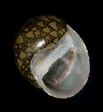
Clithon oualaniense (Lesson, 1831), known as the Guamanian Nerite, is a brackish-water snail with an operculum belonging to the family Neritidae. The species inhabits soft-bottomed intertidal environments and seagrass beds containing Zostera japonica. Its shell coloration pattern varies considerably among individuals.
Written 27 November 2026 from the sources listed below. Each statement was checked against the passage it cites; statements that could not be supported were removed.
Habitat
The species inhabits soft-bottomed intertidal environments. It also occurs in seagrass beds containing Zostera japonica.[1][2]
Appearance
Shell coloration patterns vary considerably among individuals.[3]
Behaviour
The species is active during daylight and inactive at night. Individuals bury themselves in mud during high tide, probably to avoid aquatic predators.[4][5]
During low tide, individuals emerge onto the surface to feed and mate.[6]
The species can occur at densities of 347 individuals per square metre.[7]
Diet
The species is herbivorous and feeds on microalgae and detritus.[8]
Classification of the Guamanian Nerite
| Kingdom | Animalia |
|---|---|
| Phylum | Mollusca |
| Class | Gastropoda (Gastropod) |
| Subclass | Neritimorpha |
| Order | Cycloneritida |
| Superfamily | Neritoidea |
| Family | Neritidae (Nerites) |
| Subfamily | Neritininae |
| Genus | Clithon |
| Species | Clithon oualaniense (Lesson, 1831) |
Where the Guamanian Nerite is found
Checklists and occurrence records place Clithon oualaniense in 25 countries. GBIF holds 1,156 georeferenced records of it.
Countries
- Australia 240
- China 21
- Cook Islands 6
- Fiji 54
- French Polynesia 4
- Guam 10
- Hong Kong 77
- India 60
- Indonesia 69
- Japan 156
- Kiribati 3
- Malaysia 46
- Micronesia 11
- New Caledonia 12
- New Zealand 3
- Papua New Guinea 21
- Philippines 153
- Samoa 4
- Singapore 46
- Solomon Islands 5
- Sri Lanka 41
- Taiwan 20
- Thailand 59
- Vanuatu 4
- Vietnam 31
Regions and cities with the most records
- Queensland, Australia 80
- Shui Chuen O, Hong Kong 51
- Tsing Yi Town, Hong Kong 51
- City One, Hong Kong 50
- Hang Hau, Hong Kong 50
- Pok Hong, Hong Kong 50
- Sai Kung, Hong Kong 50
- San Tin, Hong Kong 50
- Sha Tin Wai, Hong Kong 50
- Siu Lek Yuen, Hong Kong 50
- Sun Tin Wai, Hong Kong 50
- Tseung Kwan O, Hong Kong 50
- Tsz Ching Estate, Hong Kong 50
- Tsz Wan Shan, Hong Kong 50
- Wo Che, Hong Kong 50
- Choi Wan, Hong Kong 49
- Fo Tan, Hong Kong 49
- Ma On Shan, Hong Kong 49
- Sau Mau Ping, Hong Kong 49
- Sha Tin, Hong Kong 49
- Tai Shui Hang, Hong Kong 49
- Tai Wai, Hong Kong 49
- Choi Hung Estate, Hong Kong 47
- Choi Wan Estate (I & II), Hong Kong 47
- Chuk Yuen, Hong Kong 47
- Chuk Yuen North Estate, Hong Kong 47
- Kam Ying, Hong Kong 47
- Keng Hau, Hong Kong 47
- Kwun Tong, Hong Kong 47
- Lam Tin, Hong Kong 47
- Lee On, Hong Kong 47
- San Po Kong, Hong Kong 47
- Shuen Wan, Hong Kong 47
- Tai Mei Tuk, Hong Kong 47
- Tak Long Estate, Hong Kong 47
- Tiu Keng Leng, Hong Kong 47
4 more countries have a few records outside this range
These countries hold a few records of Clithon oualaniense but lie outside the range the checklists give for it. Such records are often zoo or garden specimens, museum material or vagrants, so the species is not counted as occurring there.
A number beside a place is its count of GBIF occurrence records. A place without a number comes from a checklist alone. Records show where a species has been observed or collected, which can include escapes and vagrants.
Common names
English
- Guamanian Nerite
- Dubious Nerite
Names in 5 other languages
- Chinese
- 小石蜑螺, 小石蜑螺 奧萊彩螺
- German
- Bunte Zwergdiademschnecke
- Japanese
- ヒメカノコ
- Portuguese
- Nerite-porcelana
- Thai
- หอยถั่วเขียว
Synonyms
38 other scientific names have been used for this species and are now treated as synonyms of Clithon oualaniense.
- Clithon (Pictoneritina) oualaniensis (Lesson, 1831)
- Clithon nubila Busch, 1843
- Clithon oualaniensis (Lesson, 1831)
- Clithon ovalaniensis Lesson, 1831
- Clithon ualanensis Martens, 1897
- Nerita (Neritina) ceylanensis Récluz, 1851
- Nerita guttata Récluz, 1841
- Nerita nebulata Récluz, 1843
- Neritina (Clithon) cincta Récluz, 1850
- Neritina (Vitta) pulchella Mörch, 1872
- Neritina baconi Reeve, 1856
- Neritina coluber Hanley & Theobald, 1876
- Neritina conferta E. von Martens, 1878
- Neritina deficiens Mabille, 1887
- Neritina delicatula Mousson, 1870
- Neritina frondicincta E. von Martens, 1878
- Neritina gaimardi Souleyet, 1842
- Neritina garretti Mousson, 1870
- Neritina multipicta Mousson, 1870
- Neritina nigrobifasciata E. von Martens, 1878
- Neritina ornatella Mousson, 1870
- Neritina oualanensis Morlet, 1889
- Neritina oualaniensis Lesson, 1831
- Neritina ovalaniensis Mousson, 1865
- Neritina parcepicta E. von Martens, 1878
- Neritina polydelta E. von Martens, 1878
- Neritina ualanensis E. von Martens, 1878
- Neritina ualanensis Martens, 1897
- Neritina ualanensis var. conferta E. von Martens, 1878
- Neritina ualanensis var. diremta E. von Martens, 1878
- Neritina ualanensis var. frondicincta E. von Martens, 1878
- Neritina ualanensis var. nigrobifasciata E. von Martens, 1878
- Neritina ualanensis var. parcepicta E. von Martens, 1878
- Neritina ualanensis var. polydelta E. von Martens, 1878
- Pictoneritina oualaniensis Lesson, 1831
- Theodoxus oualaniense (Lesson, 1831)
- Neritina guttata Récluz, 1841 ambiguous synonym
- Neritina nubila von dem Busch, 1843 ambiguous synonym
Related species
-
 Thorn NeriteClithon corona
-
 Zebra Crown NeriteClithon diadema
-
 Clithon faba
- Clithon spinosum
- Clithon lentiginosum
- Clithon mertonianum
- Clithon coronatum
- Clithon chlorostoma
Compare
Questions and answers
What is the scientific name of the Guamanian Nerite?
The scientific name of the Guamanian Nerite is Clithon oualaniense. Written with its author, the full name is Clithon oualaniense (Lesson, 1831).
Which family does the Guamanian Nerite belong to?
Clithon oualaniense belongs to the family Neritidae, in the order Cycloneritida and the class Gastropoda.
Where is the Guamanian Nerite found?
Checklists and occurrence records place Clithon oualaniense in 25 countries, including Australia, Japan, Philippines, Hong Kong, Indonesia and India.
What other names does the Guamanian Nerite have?
Clithon oualaniense is also known in English as Dubious Nerite.
What do nerite snails eat?
The Guamanian Nerite is herbivorous and feeds on microalgae and detritus.[8]
Sources
Passages the profile rests on
- The species inhabits soft-bottomed intertidal environments. Source passage: “It inhabits soft bottoms of intertidal habitats.” — English Wikipedia
- The species also occurs in seagrass beds containing Zostera japonica. Source passage: “It also inhabits sea grass bed with Zostera japonica.” — English Wikipedia
- The shell coloration pattern varies considerably among individuals. Source passage: “The coloration pattern on the shell is very variable.” — English Wikipedia
- The species is active during daylight and inactive at night. Source passage: “The activity of Clithon oualaniense is diurnal; snails are active during the daytime and inactive at night.” — English Wikipedia
- Individuals bury themselves in mud during high tide, probably to avoid aquatic predators. Source passage: “It bury itself into the mud, when the tide is high, probably to avoid water predators.” — English Wikipedia
- Individuals emerge onto the surface to feed and mate during low tide. Source passage: “They are on the surface feeding and mating when the tide is low.” — English Wikipedia
- The species can occur at densities of 347 individuals per square metre. Source passage: “347 snails per m² was recorded” — English Wikipedia
- The species is herbivorous and feeds on microalgae and detritus. Source passage: “Clithon oualaniense is herbivorous, feeding of microalgae and on detritus.” — English Wikipedia
Data
- Catalogue of Life, 2026-10-16 XR cc by
- Global Biodiversity Information Facility CC BY 4.0
- Wikidata CC0
- GeoNames CC BY 4.0
- Wikimedia Commons per image; credit shown with each image
- Within the Catalogue of Life, this name comes from World Register of Marine Species cc by
This species in other databases
Page built on 27 November 2026. See how the catalog is made and all sources and licences.
Cite this page
ScientificNames.org. (2026). Clithon oualaniense (Guamanian Nerite). Retrieved November 27, 2026, from https://scientificnames.org/species/clithon-oualaniense
“Clithon oualaniense (Guamanian Nerite).” ScientificNames.org, 2026, scientificnames.org/species/clithon-oualaniense. Accessed 27 Nov. 2026.
ScientificNames.org. “Clithon oualaniense (Guamanian Nerite).” Accessed November 27, 2026. https://scientificnames.org/species/clithon-oualaniense.
@misc{scientificnames_clithon_oualaniense_guamanian_nerite,
  author = {{ScientificNames.org}},
  title = {Clithon oualaniense (Guamanian Nerite)},
  year = {2026},
  url = {https://scientificnames.org/species/clithon-oualaniense},
  note = {Accessed 2026-11-27}
}