Species · Birds
Boat-billed Heron Cochlearius cochlearius
The scientific name of the Boat-billed Heron is Cochlearius cochlearius. It is a species of bird in the family Ardeidae (heron), order Pelecaniformes. The name dates from 1766.
- Scientific name
- Cochlearius cochlearius (Linnaeus, 1766)
- Common name
- Boat-billed Heron
- Genus
- Cochlearius
- Family
- Ardeidae (Heron)
- Order
- Pelecaniformes
- Class
- Aves
- Red List category
- LC Least Concern
- Environment
- freshwater, terrestrial
- Recorded in
- 21 countries
- Name status
- accepted in the Catalogue of Life
Overview
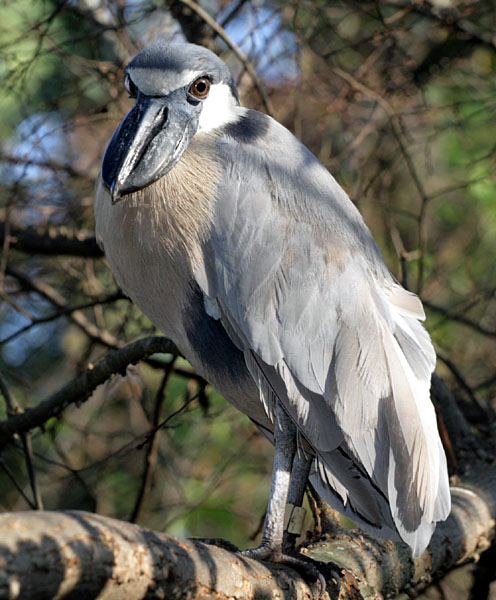
Cochlearius cochlearius is distinguished by its massive, broad, scoop-like black bill and a crest that is larger in males.
Written 26 November 2026 from the sources listed below. Each statement was checked against the passage it cites; statements that could not be supported were removed.
Appearance
Adult birds have pale grey to white plumage, chestnut-colored abdomens, and black flanks. They have a massive, broad, scoop-like bill that is mainly black.[1][2]
Adults grow to approximately 54 cm in length. Their crest is larger in males and is thought to contribute to mate attraction.[3][4]
Females are slightly smaller, grayer, and shorter-crested than males. Juveniles are darker than adults and lack a crest.[5][6]
Newly hatched nestlings have green-yellow skin, gray down on their upperparts, black upper bills, and green-yellow legs.[7]
Habitat
The Boat-billed Heron inhabits mangrove swamps, seasonal lagoons, and estuaries. It also occurs in mangroves and freshwater marshes in tropical lowlands.[8][9][10]
The species nests in mangroves.[11]
Diet
The Boat-billed Heron feeds on small mammals, amphibians, annelids, molluscs, and insects.[12]
Its diet includes crabs and shrimp, including Penaeus and Macrobrachium. It also consumes small fish, including the sleeper goby Dormitator latifrons, as well as mullet, snook, and catfish.[13][14][15]
Behaviour
The Boat-billed Heron is nocturnal and roosts in trees during daylight, often in loose groups. Individuals have been observed leaving their roosts approximately 30 minutes after sundown to forage.[16][17][18]
It forages in vegetated streams, shallow water, and lagoons. In streams, individuals use low-hanging branches and mangrove roots as perches above the water.[19][20]
Individuals can forage by walking through water up to 10 cm deep or searching along pond edges. They capture fish by lunging at them or scooping the water surface with their bills.[21][22]
The species uses stationary or slow-stalking feeding as well as techniques that involve disturbing the water and chasing prey. It has been observed not feeding in daylight, moonlight, or artificial light.[23][24]
Reproduction and life cycle
The Boat-billed Heron breeds during the rainy season and has been recorded producing two clutches during a breeding season. The first clutch may be laid in February, near the end of the dry season.[25][26][27]
Clutches contain between two and four eggs. The first nesting period generally produces more eggs than the second.[28][29]
The species generally nests in colonies but can also nest alone. It nests semi-colonially in mangrove trees, constructing nests from twigs.[30][31][32]
The eggs are bluish-white. Human disturbance can reduce reproductive success because individuals avoid human contact and may abandon their nests.[33][34]
Conservation
The global assessment records a continuing decline in mature individuals and in the area, extent, or quality of the species' habitat.[35][36]
Conservation sites have been identified across the species' entire range. The species occurs in at least one protected area.[37][38]
Classification of the Boat-billed Heron
| Kingdom | Animalia |
|---|---|
| Phylum | Chordata |
| Subphylum | Vertebrata |
| Infraphylum | Gnathostomata |
| Parvphylum | Osteichthyes |
| Megaclass | Tetrapoda |
| Class | Aves (Bird) |
| Order | Pelecaniformes (Herons) |
| Family | Ardeidae (Heron) |
| Genus | Cochlearius |
| Species | Cochlearius cochlearius (Linnaeus, 1766) |
Where the Boat-billed Heron is found
Checklists and occurrence records place Cochlearius cochlearius in 21 countries across North America and South America. GBIF holds 61,206 georeferenced records of it.
Countries
- Argentina 81
- Belize 5,714
- Bolivia 369
- Brazil 4,962
- Colombia 2,143
- Costa Rica 25,844
- Ecuador 2,237
- El Salvador 360
- French Guiana 76
- Guatemala 1,681
- Guyana 328
- Honduras 1,082
- Mexico 8,877
- Nicaragua 691
- Panama 4,142
- Paraguay 26
- Peru 1,457
- Suriname 175
- Trinidad and Tobago 327
- United States 17
- Venezuela 617
Regions and cities with the most records
- Puntarenas Province, Costa Rica 8,805
- Alajuela Province, Costa Rica 7,981
- Mato Grosso, Brazil 3,288
- Limón Province, Costa Rica 3,178
- Guanacaste Province, Costa Rica 2,536
- Alcalde Díaz, Panama 2,384
- Panamá, Panama 2,330
- Belize District, Belize 2,306
- Chilibre, Panama 2,288
- Panama City, Panama 2,197
- Curundú, Panama 2,155
- Ancón, Panama 2,149
- Nayarit, Mexico 2,145
- Arraiján, Panama 2,112
- San Miguelito, Panama 2,092
- Veracruz, Panama 1,929
- Orange Walk District, Belize 1,382
- Cartago Province, Costa Rica 1,277
- Sucumbíos, Ecuador 1,268
- Petén, Guatemala 1,256
- Heredia Province, Costa Rica 1,116
- Turrialba, Costa Rica 1,080
- Quintana Roo, Mexico 947
- Yucatán, Mexico 879
- Oaxaca, Mexico 865
- Orellana Province, Ecuador 822
- Loreto, Peru 821
- Stann Creek, Belize 756
- Chiapas, Mexico 705
- Cayo District, Belize 647
- Veracruz, Mexico 580
- Madre de Dios, Peru 570
- Mato Grosso do Sul, Brazil 567
- Atlántida Department, Honduras 518
- San Rafael, Costa Rica 499
- San Ignacio, Belize 492
1 more country has a few records outside this range
These countries hold a few records of Cochlearius cochlearius but lie outside the range the checklists give for it. Such records are often zoo or garden specimens, museum material or vagrants, so the species is not counted as occurring there.
Range as the checklists state it
Middle America
South America
A number beside a place is its count of GBIF occurrence records. A place without a number comes from a checklist alone. Records show where a species has been observed or collected, which can include escapes and vagrants.
Common names
English
- Boat-billed Heron
Names in 37 other languages
- Arabic
- بلشون أبو قارب, بلشون منقار القارب
- Bulgarian
- Ширококлюна чапла
- Catalan
- Martinet cullerot, bec de bota
- Chinese
- 船嘴鷺, 船嘴鹭
- Czech
- volavčík člunozobý
- Danish
- Bådnæbshejre
- Dutch
- schuitbekreiger
- Esperanto
- Ŝipbekulo, ŝipbeka ardeo
- Estonian
- lodinokk-haigur
- Finnish
- ruuhinokka
- French
- Savacou huppé
- German
- Kahnschnabel, Kahnschnabelreiher
- Hebrew
- אנפת מקור-סירה
- Hungarian
- kanálcsőrű bakcsó
- Italian
- Becco a cucchiaio
- Japanese
- ヒロハシサギ
- Kazakh
- Қарақтұмсық
- Lithuanian
- Laivasnapis, luotasnapis
- Norwegian
- båtnebbhegre
- Papiamento
- Garabèt Boca di Lancha, Garabèt Bok'i Lancha
- Persian
- حواصیل نوکزورقی
- Polish
- rakojad
- Portuguese
- arapapá, garça-de-bico-largo
- Russian
- Челноклюв
- Serbian
- Krupnokljuni gak
- Slovak
- savaku člnozobý
- Spanish
- Chocuaco, Garza cucharona, Garza cucharón, Garza pico de bota, Martinete cucharón, Pico Cuchara
- Swedish
- båtnäbb
- Tamil
- படகு அலகுக் கொக்கு
- Turkish
- Kayık gagalı balıkçıl, Yassı Gagalı Balıkçıl
- Ukrainian
- квак широкодзьобий
- Vietnamese
- Diệc mỏ thuyền
- Welsh
- crëyr gylfinbraff
- avk
- Zenki
- grn
- Arapapa
- nav
- Daateel
- pnb
- کشتی چنج بگلا
Synonyms
5 other scientific names have been used for this species and are now treated as synonyms of Cochlearius cochlearius.
- Cancroma cochlearia Linnaeus, 1766
- Cancroma vulgaris Leach, WE, 1815
- Cochlearius cochlearia (Linnaeus, 1766)
- Cochlearius cochlearia cochlearius BirdLife International (2004)
- Cochlearius cochlearia cochlearius Sibley & Monroe (1990, 1993)
Subspecies and varieties
- Cochlearius cochlearius cochlearius subspecies
- Cochlearius cochlearius panamensis (Panamanian Boat-billed Heron) subspecies
- Cochlearius cochlearius phillipsi subspecies
- Cochlearius cochlearius ridgwayi (Honduran Boat-billed Heron) subspecies
- Cochlearius cochlearius zeledoni subspecies
Related species
-
 Great Blue HeronArdea herodias
-
 Great EgretArdea alba
-
 Grey HeronArdea cinerea
-
 Little EgretEgretta garzetta
-
 Black-crowned Night HeronNycticorax nycticorax
-
 Green HeronButorides virescens
-
 Western Cattle EgretArdea ibis
-
 Eurasian BitternBotaurus stellaris
Compare
Questions and answers
What is the scientific name of the Boat-billed Heron?
The scientific name of the Boat-billed Heron is Cochlearius cochlearius. Written with its author, the full name is Cochlearius cochlearius (Linnaeus, 1766).
Which family does the Boat-billed Heron belong to?
Cochlearius cochlearius belongs to the family Ardeidae, in the order Pelecaniformes and the class Aves.
Where is the Boat-billed Heron found?
Checklists and occurrence records place Cochlearius cochlearius in 21 countries, including Costa Rica, Mexico, Belize, Brazil, Panama and Ecuador.
What is the conservation status of the Boat-billed Heron?
The IUCN Red List category recorded for Cochlearius cochlearius is Least Concern (LC).
What are some interesting facts about boat-billed herons?
The Boat-billed Heron is the only living member of the genus Cochlearius. It is nocturnal, has a massive scoop-like bill, and has been observed leaving its daytime roosts approximately 30 minutes after sundown to forage. Its genus name derives from Latin words referring to a spoon shaped like a snail shell.[2][16][17][18][39][40]
What do boat billed herons eat?
They eat small mammals, amphibians, annelids, molluscs, insects, crabs, shrimp, and fish. Recorded fish prey include the sleeper goby Dormitator latifrons, mullet, snook, and catfish.[12][13][14][15]
What habitat does a heron live in?
The Boat-billed Heron inhabits mangrove swamps, seasonal lagoons, estuaries, and freshwater marshes in tropical lowlands. It also forages in vegetated streams and shallow water.[8][9][10][19]
Where do boat billed herons live?
The species' native range extends from Mexico to Peru, Brazil, and northeastern Argentina. It is recorded in Argentina, Belize, Bolivia, Colombia, Costa Rica, Ecuador, El Salvador, French Guiana, Guatemala, Guyana, Honduras, Mexico, Nicaragua, Panama, Paraguay, Peru, Suriname, Trinidad and Tobago, and Venezuela. It is nonmigratory.[41][42][43]
Sources
Passages the profile rests on
- Adult birds have pale grey to white plumage, chestnut-colored abdomens, and black flanks. Source passage: “Adults are pale grey to white in color, with chestnut-colored abdomens and black flanks.” — English Wikipedia
- The species has a massive, broad, scoop-like bill that is mainly black. Source passage: “The massive, broad, scoop-like bill, which gives rise to this species' name, is mainly black.” — English Wikipedia
- Adults possess a crest that is larger in males and is thought to contribute to mate attraction. Source passage: “This bird is also adorned with a crest which is thought to be used in mate attraction as it is larger in males.” — English Wikipedia
- Adults grow to approximately 54 cm in length. Source passage: “The boat-billed heron grows to about 54 cm (21 in) long.” — English Wikipedia
- Females are slightly smaller, grayer, and shorter-crested than males. Source passage: “females are slightly smaller, grayer in appearance, and have shorter crests than males.” — English Wikipedia
- Juveniles are darker than adults and lack a crest. Source passage: “Juveniles are darker in color than adults and lack a crest.” — English Wikipedia
- Newly hatched nestlings have green-yellow skin, gray down on their upperparts, black upper bills, and green-yellow legs. Source passage: “Newly hatched nestlings have green-yellow skin, with their upperparts covered in gray down feathers. Their upper bill is black, and they have green-yellow legs.” — English Wikipedia
- The species inhabits mangrove swamps. Source passage: “It lives in mangrove swamps from Mexico south to Peru and Brazil.” — English Wikipedia
- The species inhabits seasonal lagoons and estuaries. Source passage: “They are nonmigratory birds that tend to live in seasonal lagoons and estuaries, and nest in mangroves.” — English Wikipedia
- The species occurs in mangroves and freshwater marshes in tropical lowlands. Source passage: “Bizarre nocturnal heron of mangroves and freshwater marshes in tropical lowlands” — ebird.org
- The species nests in mangroves. Source passage: “They are nonmigratory birds that tend to live in seasonal lagoons and estuaries, and nest in mangroves.” — English Wikipedia
- The species feeds on small mammals, amphibians, annelids, molluscs, and insects. Source passage: “Boat-billed herons feed on small mammals, amphibians, annelids, molluscs, insects, crabs, shrimp such as Penaeus and Macrobrachium, and small fish” — English Wikipedia
- Crabs and shrimp, including Penaeus and Macrobrachium, are part of the species' diet. Source passage: “crabs, shrimp such as Penaeus and Macrobrachium” — English Wikipedia
- The species consumes small fish, including the sleeper goby Dormitator latifrons. Source passage: “small fish such as Dormitator latifrons, a species of sleeper goby.” — English Wikipedia
- Other recorded fish prey include mullet, snook, and catfish. Source passage: “Other fish preyed upon include mullet, snook, and catfish.” — English Wikipedia
- The species is nocturnal. Source passage: “It is a nocturnal bird” — English Wikipedia
- The species roosts in trees during daylight, often in loose groups. Source passage: “spends the daytime roosting in trees, often in loose groups.” — ebird.org
- Individuals have been observed leaving their roosts approximately 30 minutes after sundown to forage. Source passage: “have been seen leaving the roost 30 minutes after sundown to feed.” — English Wikipedia
- The species forages in vegetated streams, shallow water, and lagoons. Source passage: “They tend to forage in vegetative streams, shallow water, and lagoons.” — English Wikipedia
- When foraging in streams, individuals use low-hanging branches and mangrove roots as perches above the water. Source passage: “When foraging in streams, they use low-hanging branches and mangrove roots to stand over the water.” — English Wikipedia
- Individuals can forage by walking through water up to 10 cm deep or searching along pond edges. Source passage: “In ponds, they will walk slowly through the water up to 10 cm (4 in) deep or will forage near the water's edge.” — English Wikipedia
- The species captures fish by lunging at them or scooping the water surface with its bill. Source passage: “they will lunge at fish or scoop the surface of the water with their bills” — English Wikipedia
- The species uses both stationary or slow-stalking feeding and techniques that involve disturbing the water and chasing prey. Source passage: “standing and slowly stalking prey, or disturbing the water and chasing prey.” — English Wikipedia
- The species has been observed not feeding in daylight, moonlight, or artificial light. Source passage: “they do not feed when a light source is present such as daylight, moonlight, or artificial light.” — English Wikipedia
- The species breeds during the rainy season. Source passage: “Boat-billed herons breed during the rainy season” — English Wikipedia
- The species has been recorded producing two clutches during a breeding season. Source passage: “have been recorded as producing two clutches during this time” — English Wikipedia
- The first clutch may be laid in February, near the end of the dry season. Source passage: “laying their first clutch in February during the end of the dry season.” — English Wikipedia
- Clutches contain between two and four eggs. Source passage: “Their clutch sizes range from two to four eggs” — English Wikipedia
- The first nesting period generally produces more eggs than the second. Source passage: “with more eggs being laid during the first nesting period than the second.” — English Wikipedia
- The species generally nests in colonies but can also nest alone. Source passage: “They usually nest in colonies but have been observed nesting solitarily.” — English Wikipedia
- The species nests semi-colonially in mangrove trees. Source passage: “breeds semi-colonially in mangrove trees” — English Wikipedia
- Nests are constructed from twigs. Source passage: “laying two to four bluish-white eggs in a twig nest.” — English Wikipedia
- The eggs are bluish-white. Source passage: “laying two to four bluish-white eggs in a twig nest.” — English Wikipedia
- Human disturbance can reduce reproductive success because individuals avoid human contact and may abandon their nests. Source passage: “Human disturbance can decrease reproductive success, as herons tend to avoid human contact and will abandon nests if necessary.” — English Wikipedia
- The global assessment records a continuing decline in mature individuals. Source passage: “Continuing decline of mature individuals” — iucnredlist.org
- The global assessment records a continuing decline in the area, extent, or quality of the species' habitat. Source passage: “Continuing decline in area, extent and/or quality of habitat” — iucnredlist.org
- Conservation sites have been identified across the species' entire range. Source passage: “Conservation sites identified : Yes, over entire range” — iucnredlist.org
- The species occurs in at least one protected area. Source passage: “Occurs in at least one protected area : Yes” — iucnredlist.org
- The genus name Cochlearius derives from Latin words referring to a spoon shaped like a snail shell. Source passage: “The name Cochlearius is from the Latin cocleare, coclearis, or cochlearium for a "spoon in the form of a snail shell".” — English Wikipedia
- The species is the only living member of the genus Cochlearius. Source passage: “It is the only member of the genus Cochlearius” — English Wikipedia
- The species' native range extends from Mexico to Peru, Brazil, and northeastern Argentina. Source passage: “Boat-billed herons have a huge native range that reaches from Mexico to Peru, Brazil, and northeastern Argentina.” — English Wikipedia
- The species is nonmigratory. Source passage: “They are nonmigratory birds” — English Wikipedia
- The species is recorded in Argentina, Belize, Bolivia, Colombia, Costa Rica, Ecuador, El Salvador, French Guiana, Guatemala, Guyana, Honduras, Mexico, Nicaragua, Panama, Paraguay, Peru, Suriname, Trinidad and Tobago, and Venezuela. Source passage: “Argentina; Belize; Bolivia, Plurinational States of; Colombia; Costa Rica; Ecuador; El Salvador; French Guiana; Guatemala; Guyana; Honduras; Mexico; Nicaragua; Panama; Paraguay; Peru; Suriname; Trinidad and Tobago; Venezuela, Bolivarian Republic of” — iucnredlist.org
Data
- Catalogue of Life, 2026-10-16 XR cc by
- Global Biodiversity Information Facility CC BY 4.0
- Wikidata CC0
- GeoNames CC BY 4.0
- Wikimedia Commons per image; credit shown with each image
- Within the Catalogue of Life, this name comes from The Integrated Taxonomic Information System cc0
References
- Syst. Nat., ed. 10, 1: 233. 1766 where the name was published
- Taylor, Rowland H., Gary W. Kaiser, and Mark C. Drever. (2000). Eradication of Norway Rats for Recovery of Seabird Habitat on Langara Island, British Columbia. Restoration Ecology, Vol. 8, Issue 2.
- Gill, Frank, & and Minturn Wright. (2006). Birds of the World: Recommended English Names.
This species in other databases
- Catalogue of Life WN29
- Wikidata Q210341
- iNaturalist 5036
- WoRMS urn:lsid:marinespecies.org:taxname:422582
- Avibase bobher1
Page built on 27 November 2026. See how the catalog is made and all sources and licences.
Cite this page
ScientificNames.org. (2026). Cochlearius cochlearius (Boat-billed Heron). Retrieved November 27, 2026, from https://scientificnames.org/species/cochlearius-cochlearius
“Cochlearius cochlearius (Boat-billed Heron).” ScientificNames.org, 2026, scientificnames.org/species/cochlearius-cochlearius. Accessed 27 Nov. 2026.
ScientificNames.org. “Cochlearius cochlearius (Boat-billed Heron).” Accessed November 27, 2026. https://scientificnames.org/species/cochlearius-cochlearius.
@misc{scientificnames_cochlearius_cochlearius_boat_billed_heron,
  author = {{ScientificNames.org}},
  title = {Cochlearius cochlearius (Boat-billed Heron)},
  year = {2026},
  url = {https://scientificnames.org/species/cochlearius-cochlearius},
  note = {Accessed 2026-11-27}
}