Species · Amphibians
Bell Glass Frog Cochranella nola
The scientific name of the Bell Glass Frog is Cochranella nola. It is a species of amphibian in the family Centrolenidae (glass frog), order Anura. The name dates from 1996.
- Scientific name
- Cochranella nola Harvey, 1996
- Common name
- Bell Glass Frog
- Genus
- Cochranella
- Family
- Centrolenidae (Glass Frog)
- Order
- Anura
- Class
- Amphibia
- Red List category
- LC Least Concern
- Recorded in
- 2 countries
- Name status
- accepted in the Catalogue of Life

Overview
The Bell Glass Frog (Cochranella nola Harvey, 1996) is an amphibian in the family Centrolenidae, order Anura, and class Amphibia. It inhabits subtropical or tropical moist montane forests and rivers in Bolivia and has also been recorded in Peru. It has transparent skin on the hind portion of its ventral surface, through which its yellow intestines can be seen.
Written 27 November 2026 from the sources listed below. Each statement was checked against the passage it cites; statements that could not be supported were removed.
Appearance
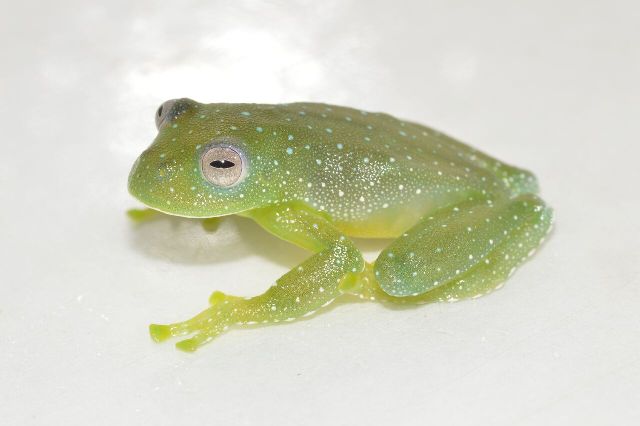
The dorsal surface and flanks are uniformly green with fine white speckling. These surfaces are finely granulated, while the hands and feet are smooth.[1][2]
The species has a truncated snout, vomerine teeth, widely separated eyes, and small, indistinct tympani. Its upper lip is white, its tongue is green, and its iris is white with dark reticulations and a horizontal pupil.[3][4]
Its limbs are slender, and its digits have adhesive toepads. It has extensive webbing between fingers III and IV and between its toes, and its bones are dark green.[5][6][7]
Adult males measure approximately 21 mm in length, while adult females measure approximately 25 mm.[8][9]
Habitat
The species inhabits subtropical or tropical moist montane forests and rivers. In Bolivia, it has been recorded near watercourses in dry semi-deciduous montane forests, wetter montane forests, and lowland rainforests.[10][11]
At its type locality, it inhabits shallow, fast-flowing streams with rocky-gravel beds and sections exposed to direct sunlight. It has been recorded at elevations between approximately 500 and 1,750 m.[12][13]
Behaviour
The species is arboreal. During the breeding season, males call from locations near fast-flowing streams, including streambed rocks and foliage above the water.[14][15]
At the type locality, calling males have been observed on vegetation approximately 2 m above the water. Up to six males may call together in a chorus while remaining several centimetres apart.[16][17]
Male calls consist either of isolated high-pitched sounds or groups of three rapidly repeated sounds. In southeastern Peru, males have been recorded calling at night between approximately 19:00 and 22:00.[18][19]
The species has been the subject of a published report specifically concerning mouth-gaping behaviour.[20]
Reproduction and life cycle
Females deposit egg clutches on wet boulders.[21]
Conservation
The species is classified as Near Threatened by the International Union for Conservation of Nature.[22]
Pollution of breeding streams is identified as a threat. Agricultural runoff is a potential source of pollution affecting these streams.[23][24]
The discovery of an additional locality in Peru was considered a reason to reassess the species' conservation status.[25]
Classification of the Bell Glass Frog
| Kingdom | Animalia |
|---|---|
| Phylum | Chordata |
| Subphylum | Vertebrata |
| Infraphylum | Gnathostomata |
| Parvphylum | Osteichthyes |
| Megaclass | Tetrapoda |
| Class | Amphibia (Amphibians) |
| Order | Anura (Frogs) |
| Family | Centrolenidae (Glass Frog) |
| Subfamily | Centroleninae |
| Genus | Cochranella (Cochran Frogs) |
| Species | Cochranella nola Harvey, 1996 |
Where the Bell Glass Frog is found
Checklists and occurrence records place Cochranella nola in 2 countries. GBIF holds 23 georeferenced records of it.
Countries
Regions and cities with the most records
A number beside a place is its count of GBIF occurrence records. A place without a number comes from a checklist alone. Records show where a species has been observed or collected, which can include escapes and vagrants.
Common names
English
- Bell Glass Frog
Names in 1 other language
- Spanish
- Rana de Cristal Campana
Related species
-
 Granular Glass FrogCochranella granulosa
-
 Fringe-Limbed Tree FrogCochranella euknemos
-
 Mache Glass FrogCochranella mache
-
 Resplendent GlassfrogCochranella resplendens
- Wilhelmina Cochran FrogCochranella geijskesi
- Ramirez's Cochran FrogCochranella ramirezi
- Duida Cochran FrogCochranella duidaeana
- Ridge Cochran FrogCochranella euhystrix
Compare
Questions and answers
What is the scientific name of the Bell Glass Frog?
The scientific name of the Bell Glass Frog is Cochranella nola. Written with its author, the full name is Cochranella nola Harvey, 1996.
Which family does the Bell Glass Frog belong to?
Cochranella nola belongs to the family Centrolenidae, in the order Anura and the class Amphibia.
Where is the Bell Glass Frog found?
Checklists and occurrence records place Cochranella nola in 2 countries: Bolivia and Peru.
What is the conservation status of the Bell Glass Frog?
The IUCN Red List category recorded for Cochranella nola is Least Concern (LC).
What is the scientific name of a glass frog?
The scientific name of the Bell Glass Frog is Cochranella nola Harvey, 1996.[26]
How rare is a glass frog?
The Bell Glass Frog is classified as Near Threatened by the International Union for Conservation of Nature.[22]
Sources
Passages the profile rests on
- Its dorsal surface and flanks are uniformly green with fine white speckling. Source passage: “The dorsal surface and flanks of this frog are a uniform green with fine white speckling” — English Wikipedia
- Its dorsal surface and flanks are finely granulated, whereas its hands and feet are smooth. Source passage: “The dorsal surface and flanks are finely granulated while the hands and feet are smooth.” — English Wikipedia
- The species has a truncated snout, vomerine teeth, widely separated eyes, and small, indistinct tympani. Source passage: “This frog has a truncated snout and vomerine teeth, widely-separated eyes and small, indistinct tympani.” — English Wikipedia
- Its upper lip is white, its tongue is green, and its iris is white with dark reticulations and a horizontal pupil. Source passage: “The upper lip is white, the tongue is green and the iris is white, with dark reticulations, and a horizontal pupil.” — English Wikipedia
- Its limbs are slender and its digits have adhesive toepads. Source passage: “The limbs are slender, the digits having adhesive toepads;” — English Wikipedia
- The species has extensive webbing between fingers III and IV and between its toes. Source passage: “there is extensive webbing between fingers III and IV, and between the toes.” — English Wikipedia
- Its bones are dark green. Source passage: “The bones are dark green.” — English Wikipedia
- Adult males measure approximately 21 mm in length. Source passage: “Males are about 21 mm (0.8 in) long” — English Wikipedia
- Adult females measure approximately 25 mm in length. Source passage: “females are a little larger at 25 mm (1.0 in).” — English Wikipedia
- The species inhabits subtropical or tropical moist montane forests and rivers. Source passage: “Its natural habitats are subtropical or tropical moist montane forests and rivers.” — English Wikipedia
- In Bolivia, the species has been recorded near watercourses in dry semi-deciduous montane forests, wetter montane forests, and lowland rainforests. Source passage: “where it occurred near water courses in dry, semi-deciduous montane forests, damper montane forests and lowland rainforests” — English Wikipedia
- At its type locality, the species inhabits shallow, fast-flowing streams with rocky-gravel beds and sections exposed to direct sunlight. Source passage: “where the species inhabits a shallow (<1 m) fast-flowing stream with a rocky-gravel bed and sections exposed to direct sun;” — English Wikipedia
- The species has been recorded at elevations between approximately 500 and 1,750 m. Source passage: “at altitudes between about 500 and 1,750 m (1,600 and 5,700 ft).” — English Wikipedia
- The species is arboreal. Source passage: “Cochranella nola is a small arboreal species of glass frog.” — English Wikipedia
- During the breeding season, males call from locations near fast-flowing streams, including streambed rocks and foliage above the water. Source passage: “In the breeding season, males call from near fast-flowing streams, either from rocks in the streambed, or from foliage up to a few meters above the water.” — English Wikipedia
- Calling males have been observed on vegetation approximately 2 m above the water at the type locality. Source passage: “calling males were observed on vegetation ~ 2 m above the water” — English Wikipedia
- Up to six males may call together in a chorus while remaining several centimetres apart. Source passage: “Up to six males may call in chorus, spaced out a few centimetres apart.” — English Wikipedia
- Male calls consist either of isolated high-pitched sounds or groups of three rapidly repeated sounds. Source passage: “The calls are either single high-pitched "pinks" at irregular intervals, or groups of three "pinks" in quick succession.” — English Wikipedia
- Males in southeastern Peru have been recorded calling at night between approximately 19:00 and 22:00. Source passage: “with nocturnal calling (~19:00-22:00 h) along streamside vegetation” — English Wikipedia
- The species has been the subject of a published report specifically concerning mouth-gaping behaviour. Source passage: “Mouth-gaping behavior in the Bell Glass Frog, Cochranella nola (Anura: Centrolenidae)” — journals.ku.edu
- Females deposit egg clutches on wet boulders. Source passage: “Females lay clutches of eggs on wet boulders.” — English Wikipedia
- The species is classified as Near Threatened by the International Union for Conservation of Nature. Source passage: “the International Union for Conservation of Nature has rated it as "near-threatened".” — English Wikipedia
- Pollution of breeding streams is identified as a threat to the species. Source passage: “it is threatened by pollution of the streams where it breeds” — English Wikipedia
- Agricultural runoff is identified as a potential source of pollution affecting the species' breeding streams. Source passage: “which can suffer from agricultural run-off” — English Wikipedia
- The discovery of an additional locality in Peru was considered a reason to reassess the species' conservation status. Source passage: “Now that it has been recorded from a further location in Peru, this frog's conservation status may need to be reassessed.” — English Wikipedia
- The species was described by Harvey in 1996. Source passage: “Cochranella nola Harvey 1996” — pmc.ncbi.nlm.nih.gov
Data
- Catalogue of Life, 2026-10-16 XR cc by
- Global Biodiversity Information Facility CC BY 4.0
- Wikidata CC0
- GeoNames CC BY 4.0
- Wikimedia Commons per image; credit shown with each image
- Within the Catalogue of Life, this name comes from The Integrated Taxonomic Information System cc0
References
- A new species of glass frog (Anura: Centrolenidae: Cochranella) from Bolivia, and the taxonomic status of Cochranella flavidigitata. (1996). Herpetologica, 52(3), 427–435. https://bionames.org/references/fad3416d88d61dc9d5c9a7dab9e57430 Link where the name was published
This species in other databases
Page built on 29 November 2026. See how the catalog is made and all sources and licences.
Cite this page
ScientificNames.org. (2026). Cochranella nola (Bell Glass Frog). Retrieved November 29, 2026, from https://scientificnames.org/species/cochranella-nola
“Cochranella nola (Bell Glass Frog).” ScientificNames.org, 2026, scientificnames.org/species/cochranella-nola. Accessed 29 Nov. 2026.
ScientificNames.org. “Cochranella nola (Bell Glass Frog).” Accessed November 29, 2026. https://scientificnames.org/species/cochranella-nola.
@misc{scientificnames_cochranella_nola_bell_glass_frog,
  author = {{ScientificNames.org}},
  title = {Cochranella nola (Bell Glass Frog)},
  year = {2026},
  url = {https://scientificnames.org/species/cochranella-nola},
  note = {Accessed 2026-11-29}
}