Species · Amphibians
Resplendent Glassfrog Cochranella resplendens
The scientific name of the Resplendent Glassfrog is Cochranella resplendens. It is a species of amphibian in the family Centrolenidae (glass frog), order Anura. The name dates from 1973.
- Scientific name
- Cochranella resplendens (Lynch & Duellman, 1973)
- Common name
- Resplendent Glassfrog
- Genus
- Cochranella
- Family
- Centrolenidae (Glass Frog)
- Order
- Anura
- Class
- Amphibia
- Red List category
- LC Least Concern
- Recorded in
- 2 countries
- Name status
- accepted in the Catalogue of Life
Overview
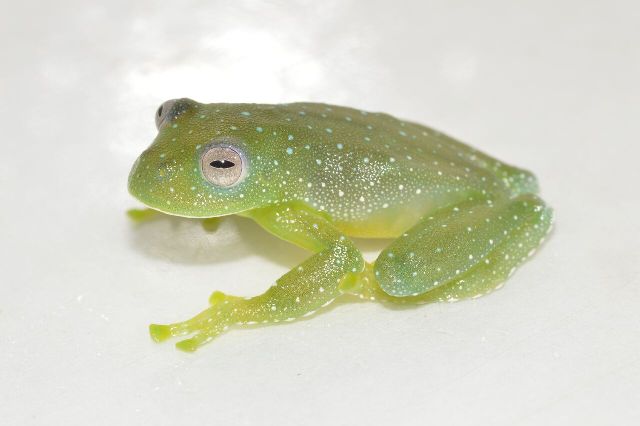
The Resplendent Glassfrog belongs to the Cochranella granulosa group. It occurs in Bolivia, Brazil, Colombia, Ecuador, and Peru. Its dorsal surface is dark green with numerous white to bluish-white dots.
Written 27 November 2026 from the sources listed below. Each statement was checked against the passage it cites; statements that could not be supported were removed.
Appearance
The Resplendent Glassfrog has a round snout when viewed dorsally and a gradually sloping snout profile when viewed laterally. Its tympanum is visible, with a membrane pigmented like the surrounding skin and a partly visible annulus. It has a low supratympanic fold.[1][2][3]
Its fingers are partially webbed, while its toes are extensively webbed. The dorsal surface is dark green with numerous white to bluish-white dots, and the ventral surfaces are white except for the transparent posterior quarter.[4][5][6]
The iris ranges from whitish cream to beige and has fine grey to brown reticulation. Adult males measure approximately 27 mm in snout-to-vent length.[7][8]
Habitat
The Resplendent Glassfrog inhabits lowland tropical primary and secondary rainforests and sub-Andean forests. Individuals occur on vegetation near running water.[9][10][11][12]
Outside the breeding season, the species may inhabit the forest canopy.[13]
Reproduction and life cycle
Females lay eggs on leaves above streams.[14]
Conservation
The Resplendent Glassfrog is considered rare. Habitat loss and habitat fragmentation threaten the species.[15][16][17]
Its apparent rarity may partly result from inadequate observation methods.[18]
Similar species
The distinctiveness of Cochranella ritae has been discussed in relation to Cochranella resplendens. Cochranella phryxa has been suggested as a possible synonym of the Resplendent Glassfrog.[19][20]
Classification of the Resplendent Glassfrog
| Kingdom | Animalia |
|---|---|
| Phylum | Chordata |
| Subphylum | Vertebrata |
| Infraphylum | Gnathostomata |
| Parvphylum | Osteichthyes |
| Megaclass | Tetrapoda |
| Class | Amphibia (Amphibians) |
| Order | Anura (Frogs) |
| Family | Centrolenidae (Glass Frog) |
| Subfamily | Centroleninae |
| Genus | Cochranella (Cochran Frogs) |
| Species | Cochranella resplendens (Lynch & Duellman, 1973) |
Where the Resplendent Glassfrog is found
Checklists and occurrence records place Cochranella resplendens in 2 countries. GBIF holds 40 georeferenced records of it.
Countries
Regions and cities with the most records
A number beside a place is its count of GBIF occurrence records. A place without a number comes from a checklist alone. Records show where a species has been observed or collected, which can include escapes and vagrants.
Common names
English
- Resplendent Glassfrog
- Resplendent Cochran Frog
Names in 4 other languages
- Czech
- rosněnka zářivá
- Portuguese
- Sapo de vidro resplandecente
- Russian
- Обворожительная стеклянная лягушка
- Spanish
- Rana de Cristal Resplandeciente
Synonyms
2 other scientific names have been used for this species and are now treated as synonyms of Cochranella resplendens.
- Centrolenella resplendens Lynch & Duellman, 1973
- Cochranella phryxa Aguayo-Vedia & Harvey, 2006
Related species
-
 Granular Glass FrogCochranella granulosa
-
 Fringe-Limbed Tree FrogCochranella euknemos
-
 Mache Glass FrogCochranella mache
-
 Bell Glass FrogCochranella nola
- Wilhelmina Cochran FrogCochranella geijskesi
- Ramirez's Cochran FrogCochranella ramirezi
- Duida Cochran FrogCochranella duidaeana
- Ridge Cochran FrogCochranella euhystrix
Compare
Questions and answers
What is the scientific name of the Resplendent Glassfrog?
The scientific name of the Resplendent Glassfrog is Cochranella resplendens. Written with its author, the full name is Cochranella resplendens (Lynch & Duellman, 1973).
Which family does the Resplendent Glassfrog belong to?
Cochranella resplendens belongs to the family Centrolenidae, in the order Anura and the class Amphibia.
Where is the Resplendent Glassfrog found?
Checklists and occurrence records place Cochranella resplendens in 2 countries: Ecuador and Colombia.
What is the conservation status of the Resplendent Glassfrog?
The IUCN Red List category recorded for Cochranella resplendens is Least Concern (LC).
What other names does the Resplendent Glassfrog have?
Cochranella resplendens is also known in English as Resplendent Cochran Frog.
What is the adult male body size?
Adult males measure approximately 27 mm in snout-to-vent length. The female body size is unknown.[8][21]
What is the origin of the scientific name?
The specific epithet resplendens derives from the Latin verb resplendo, meaning to glitter. It refers to the frog's jewel-like appearance.[22][23]
What was the species originally called?
The species was originally described under the name Centrolenella resplendens in 1973.[24]
Where is the type locality?
The type locality is Santa Cecilia, at 340 m elevation, in Napo Province, Ecuador.[25]
Sources
Passages the profile rests on
- The frog has a round snout when viewed dorsally and a gradually sloping snout profile when viewed laterally. Source passage: “The snout is round in dorsal view and gradually inclined in lateral profile.” — English Wikipedia
- The tympanum is visible, but its membrane is pigmented like the surrounding skin and its annulus is only partly visible. Source passage: “The tympanum is visible but the tympanic membrane is pigmented as the surrounding skin and the tympanic annulus is only partially visible.” — English Wikipedia
- The frog has a low supratympanic fold. Source passage: “A low low supratympanic fold is evident.” — English Wikipedia
- Its fingers are partially webbed, while its toes are extensively webbed. Source passage: “The fingers are partially webbed and the toes are extensively webbed.” — English Wikipedia
- Its dorsal surface is dark green with numerous white to bluish-white dots. Source passage: “The dorsum is dark green with many white to bluish-white dots.” — English Wikipedia
- Its ventral surfaces are white except for the transparent posterior quarter. Source passage: “The ventral surfaces are white apart from the posterior one-fourth, which is transparent.” — English Wikipedia
- Its iris ranges from whitish cream to beige and has fine grey to brown reticulation. Source passage: “The iris is whitish cream to beige, with a fine grey to brown reticulation.” — English Wikipedia
- Adult males measure approximately 27 mm in snout-to-vent length. Source passage: “Males measure about 27 mm (1.1 in) in snout–vent length;” — English Wikipedia
- The species inhabits lowland tropical primary rainforests. Source passage: “The species' natural habitats are lowland tropical primary” — English Wikipedia
- The species inhabits lowland tropical secondary rainforests. Source passage: “and secondary rainforests as well as sub-Andean forests.” — English Wikipedia
- The species also occurs in sub-Andean forests. Source passage: “as well as sub-Andean forests.” — English Wikipedia
- Individuals occur on vegetation near running water. Source passage: “It occurs on vegetation near running water.” — English Wikipedia
- Outside the breeding season, the species may inhabit the forest canopy. Source passage: “Outside the breeding season it might inhabit the forest canopy.” — English Wikipedia
- Females lay eggs on leaves above streams. Source passage: “The eggs are laid on leaves above streams.” — English Wikipedia
- The species is considered rare. Source passage: “It is a rare species” — English Wikipedia
- Habitat loss threatens the species. Source passage: “threatened by habitat loss and fragmentation.” — English Wikipedia
- Habitat fragmentation threatens the species. Source passage: “threatened by habitat loss and fragmentation.” — English Wikipedia
- The species' apparent rarity may partly result from inadequate observation methods. Source passage: “Its rarity, however, may be an artefact caused by inadequate methods to observe it.” — English Wikipedia
- Cochranella resplendens has been discussed in relation to the distinctiveness of Cochranella ritae. Source passage: “commented on the distinctiveness of Cochranella resplendens from Cochranella ritae;” — amphibiansoftheworld.amnh.org
- Cochranella phryxa has been suggested as a possible synonym of Cochranella resplendens. Source passage: “suggested that Cochranella phryxa may actually be a synonym of Cochranella resplendens.” — amphibiansoftheworld.amnh.org
- The female body size is unknown. Source passage: “female size is unknown.” — English Wikipedia
- The specific epithet resplendens derives from the Latin verb resplendo, meaning to glitter. Source passage: “The specific name resplendens is derived from the Latin verb resplendo (="to glitter")” — English Wikipedia
- The specific epithet refers to the frog's jewel-like appearance. Source passage: “and hints to the jewel-like appearance of this frog.” — English Wikipedia
- The species was originally described under the name Centrolenella resplendens in 1973. Source passage: “Centrolenella resplendens Lynch and Duellman, 1973, Occas. Pap. Mus. Nat. Hist. Univ. Kansas, 16: 51.” — amphibiansoftheworld.amnh.org
- The type locality is Santa Cecilia, at 340 m elevation, in Napo Province, Ecuador. Source passage: “Type locality: "Santa Cecilia, 340 m, Provincia Napo, Ecuador".” — amphibiansoftheworld.amnh.org
Data
- Catalogue of Life, 2026-10-16 XR cc by
- Global Biodiversity Information Facility CC BY 4.0
- Wikidata CC0
- GeoNames CC BY 4.0
- Wikimedia Commons per image; credit shown with each image
- Within the Catalogue of Life, this name comes from The Integrated Taxonomic Information System cc0
This species in other databases
Page built on 28 November 2026. See how the catalog is made and all sources and licences.
Cite this page
ScientificNames.org. (2026). Cochranella resplendens (Resplendent Glassfrog). Retrieved November 28, 2026, from https://scientificnames.org/species/cochranella-resplendens
“Cochranella resplendens (Resplendent Glassfrog).” ScientificNames.org, 2026, scientificnames.org/species/cochranella-resplendens. Accessed 28 Nov. 2026.
ScientificNames.org. “Cochranella resplendens (Resplendent Glassfrog).” Accessed November 28, 2026. https://scientificnames.org/species/cochranella-resplendens.
@misc{scientificnames_cochranella_resplendens_resplendent_glassfrog,
  author = {{ScientificNames.org}},
  title = {Cochranella resplendens (Resplendent Glassfrog)},
  year = {2026},
  url = {https://scientificnames.org/species/cochranella-resplendens},
  note = {Accessed 2026-11-28}
}