Species · Reptiles
Limbless Snake-tooth Skink Coeranoscincus frontalis
The scientific name of the Limbless Snake-tooth Skink is Coeranoscincus frontalis. It is a species of reptile in the family Scincidae (skink), order Squamata. The name dates from 1888.
- Scientific name
- Coeranoscincus frontalis (de Vis, 1888)
- Common name
- Limbless Snake-tooth Skink
- Genus
- Coeranoscincus
- Family
- Scincidae (Skink)
- Order
- Squamata
- Class
- Reptilia
- Red List category
- LC Least Concern
- Recorded in
- 1 country
- Name status
- accepted in the Catalogue of Life
Overview
Coeranoscincus frontalis is endemic to north-eastern Queensland, Australia. It has no externally visible traces of limbs.
Written 27 November 2026 from the sources listed below. Each statement was checked against the passage it cites; statements that could not be supported were removed.
Appearance
The Limbless Snake-tooth Skink has no externally visible traces of limbs. Its snout–vent length ranges from 70 to 291 mm.[1][2]
Habitat
The Limbless Snake-tooth Skink inhabits rainforest in coastal ranges and lowlands.[3]
Behaviour
The Limbless Snake-tooth Skink has a fossorial lifestyle.[4]
Similar species
Saiphos frontalis, Anomalopus frontalis and Ophioscincus frontalis are synonyms of Coeranoscincus frontalis.[5][6][7]
Classification of the Limbless Snake-tooth Skink
| Kingdom | Animalia |
|---|---|
| Phylum | Chordata |
| Subphylum | Vertebrata |
| Infraphylum | Gnathostomata |
| Parvphylum | Osteichthyes |
| Megaclass | Tetrapoda |
| Class | Reptilia (Reptile) |
| Order | Squamata (Snakes) |
| Suborder | Autarchoglossa |
| Family | Scincidae (Skink) |
| Subfamily | Sphenomorphinae |
| Genus | Coeranoscincus |
| Species | Coeranoscincus frontalis (de Vis, 1888) |
Where the Limbless Snake-tooth Skink is found
Checklists and occurrence records place Coeranoscincus frontalis in 1 country across Oceania. GBIF holds 126 georeferenced records of it.
Countries
Regions and cities with the most records
Range as the checklists state it
Australia (Queensland)
A number beside a place is its count of GBIF occurrence records. A place without a number comes from a checklist alone. Records show where a species has been observed or collected, which can include escapes and vagrants.
Common names
English
- Limbless Snake-tooth Skink
- Limbless Snake-Skink
- Limbless Snake-toothed Skink
Synonyms
One other scientific name has been used for this species and is now treated as a synonym of Coeranoscincus frontalis.
- Ophioscincus frontalis de Vis, 1888
Related species
-
 Three-toed Snake-tooth SkinkCoeranoscincus reticulatus
-
 ShinglebackTiliqua rugosa
-
 Five-lined SkinkPlestiodon fasciatus
- Common Garden SkinkLampropholis guichenoti
-
 Blue-tailed SkinkCryptoblepharus egeriae
-
 Red-eyed Crocodile SkinkTribolonotus gracilis
-
 Common Blue-tongued SkinkTiliqua scincoides
-
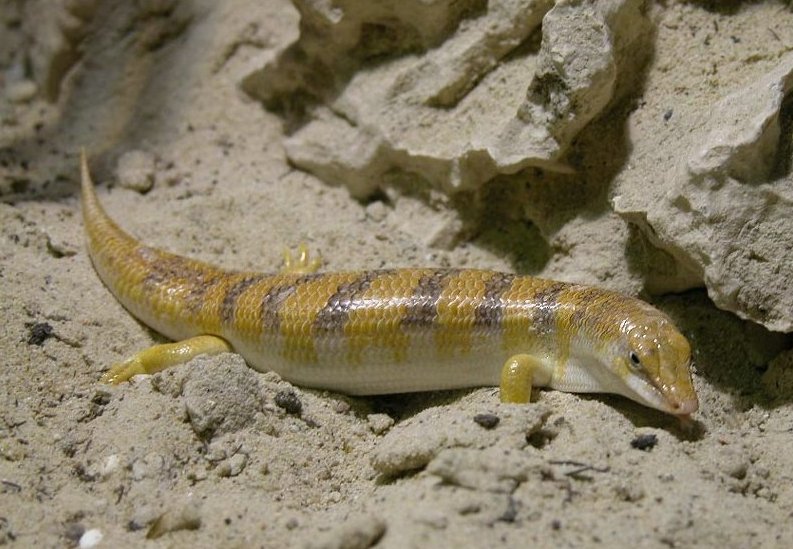 Sandfish SkinkScincus scincus
Compare
Questions and answers
What is the scientific name of the Limbless Snake-tooth Skink?
The scientific name of the Limbless Snake-tooth Skink is Coeranoscincus frontalis. Written with its author, the full name is Coeranoscincus frontalis (de Vis, 1888).
Which family does the Limbless Snake-tooth Skink belong to?
Coeranoscincus frontalis belongs to the family Scincidae, in the order Squamata and the class Reptilia.
Where is the Limbless Snake-tooth Skink found?
Checklists and occurrence records place Coeranoscincus frontalis in 1 country: Australia.
What is the conservation status of the Limbless Snake-tooth Skink?
The IUCN Red List category recorded for Coeranoscincus frontalis is Least Concern (LC).
What other names does the Limbless Snake-tooth Skink have?
Coeranoscincus frontalis is also known in English as Limbless Snake-Skink and Limbless Snake-toothed Skink.
What habitats do skinks live in?
The Limbless Snake-tooth Skink inhabits rainforest in coastal ranges and lowlands.[3]
Sources
Passages the profile rests on
- Coeranoscincus frontalis has no externally visible traces of limbs. Source passage: “There are no external traces of the limbs.” — English Wikipedia
- Coeranoscincus frontalis has a snout–vent length ranging from 70 to 291 mm. Source passage: “Coeranoscincus frontalis measure 70–291 mm (2.8–11.5 in) in snout–vent length.” — English Wikipedia
- Coeranoscincus frontalis inhabits rainforest in coastal ranges and lowlands. Source passage: “occurs in the rainforest of coastal ranges and lowlands.” — English Wikipedia
- Coeranoscincus frontalis has a fossorial lifestyle. Source passage: “It is a large, fossorial skink” — English Wikipedia
- Saiphos frontalis is a synonym of Coeranoscincus frontalis. Source passage: “Synonyms. Saiphos frontalis.” — wildnet.science-data.qld.gov.au
- Anomalopus frontalis is a synonym of Coeranoscincus frontalis. Source passage: “Anomalopus frontalis (De Vis, 1888) synonym” — bie.ala.org.au
- Ophioscincus frontalis is a synonym of Coeranoscincus frontalis. Source passage: “Ophioscincus frontalis De Vis, 1888 synonym” — bie.ala.org.au
Data
- Catalogue of Life, 2026-10-16 XR cc by
- Global Biodiversity Information Facility CC BY 4.0
- Wikidata CC0
- GeoNames CC BY 4.0
- Within the Catalogue of Life, this name comes from The Reptile Database cc by
References
- De Vis, C. W. (1888). A contribution to the herpetology of Queensland. Proc. Linn. Soc. New South Wales (2) 2: 811-826 [1887].
- Greer A E, & Cogger H G. (1985). Systematics of the reduce-limbed and limbless skinks currently assigned to the genus Anomalopus (Lacertilia: Scincidae). Rec. Austral. Mus. 37(1) 1985: 11-54. Link
- Wells, R.W., & Wellington, C.R. (1988). Amphibians and reptiles of the Upper Cox’s River area, Sydney Basin, New South Wales, Australia, with comments on Greer & Cogger’s recent reclassification of the genus Anomalopus (sensu lato). Australian Herpetologist 505: 1-15.
- Cogger, H. G. (2000). Reptiles and Amphibians of Australia, 6th ed. Ralph Curtis Publishing, Sanibel Island, 808 Pp.
- Couper, P., Covacevich, J., Amey, A., & Baker, A. (2006). The genera of skinks (Family Scincidae) of Australia and its island territories: diversity, distribution and identification. in: Merrick, J.R., Archer, M., Hickey, G.M. & Lee, M.S.Y. (eds.). Evolution and Zoogeography of Australasian Vertebrates. Australian Scientific Publishing, Sydney, Pp. 367-384.
- Wilson, S., & Swan, G. (2010). A complete guide to reptiles of Australia, 3rd ed. Chatswood: New Holland, 558 Pp.
- Skinner, Adam; Mark N. Hutchinson, Michael S.Y. Lee. (2013). Phylogeny and Divergence Times of Australian Sphenomorphus Group Skinks (Scincidae, Squamata). Molecular Phylogenetics and Evolution 69 (3): 906–918.
- Cogger, H. G. (2014). Reptiles and Amphibians of Australia, 7th ed. CSIRO Publishing, Xxx + 1033 Pp.
- Singhal, Sonal; Huateng Huang, Maggie R. Grundler, María R. Marchán-Rivadeneira, Iris Holmes, Pascal O. Title, Stephen C. Donnellan, and Daniel L. Rabosky. (2018). Does Population Structure Predict the Rate of Speciation? A Comparative Test across Australia’s Most Diverse Vertebrate Radiation. The American Naturalist 192 (4): 432-447.
- Hutchinson, M. N., Couper, P., Amey, A., & Worthington-Wilmer, J. (2021). Diversity and Systematics of Limbless Skinks (Anomalopus) from Eastern Australia and the Skeletal Changes that Accompany the Substrate Swimming Body Form. Journal of Herpetology 55 (4): 361-384.
- Zimin, A., Zimin, S. V., Shine, R., Avila, L., Bauer, A., Böhm, M., Brown, R., Barki, G., de Oliveira Caetano, G. H., Castro Herrera, F., Chapple, D. G., Chirio, L., Colli, G. R., Doan, T. M., Glaw, F., Grismer, L. L., Itescu, Y., Kraus, F., LeBreton, M.; [...] Uetz, P.; Wagner, P.; Roll, U. & Meiri, S. (2022). A global analysis of viviparity in squamates highlights its prevalence in cold climates. Global Ecology and Biogeography, 00, 1–16.
- Uetz, P. H., Patel, M., Gbadamosi, Z., Nguyen, A., & Shoope, S. (2024). A Reference Database of Reptile Images. Taxonomy 4: 723–732.
This species in other databases
Page built on 29 November 2026. See how the catalog is made and all sources and licences.
Cite this page
ScientificNames.org. (2026). Coeranoscincus frontalis (Limbless Snake-tooth Skink). Retrieved November 29, 2026, from https://scientificnames.org/species/coeranoscincus-frontalis
“Coeranoscincus frontalis (Limbless Snake-tooth Skink).” ScientificNames.org, 2026, scientificnames.org/species/coeranoscincus-frontalis. Accessed 29 Nov. 2026.
ScientificNames.org. “Coeranoscincus frontalis (Limbless Snake-tooth Skink).” Accessed November 29, 2026. https://scientificnames.org/species/coeranoscincus-frontalis.
@misc{scientificnames_coeranoscincus_frontalis_limbless_snake_tooth_skink,
  author = {{ScientificNames.org}},
  title = {Coeranoscincus frontalis (Limbless Snake-tooth Skink)},
  year = {2026},
  url = {https://scientificnames.org/species/coeranoscincus-frontalis},
  note = {Accessed 2026-11-29}
}