Species · Flowering plants
Spleenwortleaf Goldthread Coptis aspleniifolia
The scientific name of the Spleenwortleaf Goldthread is Coptis aspleniifolia. It is a species of flowering plant in the family Ranunculaceae (crowfoot family), order Ranunculales.
- Scientific name
- Coptis aspleniifolia Salisb.
- Common name
- Spleenwortleaf Goldthread
- Genus
- Coptis
- Family
- Ranunculaceae (Crowfoot Family)
- Order
- Ranunculales
- Class
- Magnoliopsida
- Recorded in
- 2 countries
- Name status
- accepted in the Catalogue of Life
Overview
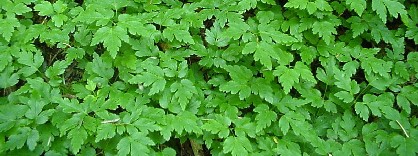
Spleenwortleaf Goldthread is an evergreen perennial flowering plant in the family Ranunculaceae. It occurs in temperate rain forests, wet woods, and bogs, and commonly grows in the understory of coniferous forests. It is distinguished by its dark green, glossy, fernlike leaves and yellow to pale brown rhizomes.
Written 27 November 2026 from the sources listed below. Each statement was checked against the passage it cites; statements that could not be supported were removed.
Appearance
Spleenwortleaf Goldthread is mostly hairless and typically reaches a height of 5 to 30 centimeters. It produces basal leaves resembling those of ferns.[1][2][3]
Its dark green, glossy leaves are fernlike and divided into at least five segments. The leaves are twice pinnate and have pinnatifid leaflets.[4][5]
Its rhizomes range in color from yellow to pale brown.[6]
Its flowers are pale greenish-white or yellow. Each flower has five to seven sepals and five to seven thin petals.[7][8]
Habitat
Spleenwortleaf Goldthread occurs in temperate rain forests of its native region. It commonly grows in the herb-layer understory of coniferous forests.[9][10]
The species grows on gleysolic or organic soils and also occurs in wet woods and bogs.[11][12]
Diet
Spleenwortleaf Goldthread provides a food source for deer.[13]
Behaviour
Spleenwortleaf Goldthread provides protective ground cover within its ecosystem. Its shade helps retain moisture in the soil.[14][15]
Reproduction and life cycle
Spleenwortleaf Goldthread produces flowers in mid-spring. Each flower stalk bears two or three nodding flowers.[16][17]
Conservation
Spleenwortleaf Goldthread is considered common and widespread within its native range. It is described as non-invasive and non-poisonous.[18][19][20]
Uses
Spleenwortleaf Goldthread contributes to ecosystem ground cover and soil moisture retention.[21]
Classification of the Spleenwortleaf Goldthread
| Kingdom | Plantae |
|---|---|
| Subkingdom | Pteridobiotina |
| Phylum | Tracheophyta |
| Class | Magnoliopsida |
| Order | Ranunculales |
| Family | Ranunculaceae (Crowfoot Family) |
| Subfamily | Coptidoideae |
| Tribe | Coptideae |
| Genus | Coptis (Goldthread) |
| Species | Coptis aspleniifolia Salisb. |
Where the Spleenwortleaf Goldthread is found
Checklists and occurrence records place Coptis aspleniifolia in 2 countries across North America. GBIF holds 1,832 georeferenced records of it.
Countries
Regions and cities with the most records
- British Columbia, Canada 1,057
- Alaska, United States 484
- North Vancouver, Canada 87
- West Vancouver, Canada 87
- Riley Park, Canada 81
- Vancouver, Canada 81
- Juneau, United States 76
- Victoria-Fraserview, Canada 50
- Burnaby, Canada 29
- Washington, United States 19
- Coquitlam, Canada 17
- Port Coquitlam, Canada 17
- Courtenay, Canada 15
- Maple Ridge, Canada 11
- Pitt Meadows, Canada 11
- Port Moody, Canada 8
- New Westminster, Canada 7
- Oregon, United States 4
- Campbell River, Canada 3
2 more countries have a few records outside this range
These countries hold a few records of Coptis aspleniifolia but lie outside the range the checklists give for it. Such records are often zoo or garden specimens, museum material or vagrants, so the species is not counted as occurring there.
Range as the checklists state it
Alaska; Canada (British Columbia); USA (Washington State)
A number beside a place is its count of GBIF occurrence records. A place without a number comes from a checklist alone. Records show where a species has been observed or collected, which can include escapes and vagrants.
Common names
English
- Spleenwortleaf Goldthread
- Fern-leaved Goldthread
- Spleenwort-leaved Goldthread
Names in 3 other languages
- Chinese
- 蕨葉黃連
- French
- coptide à feuilles d'asplénie
- Swedish
- bräkenkoptis
Synonyms
2 other scientific names have been used for this species and are now treated as synonyms of Coptis aspleniifolia.
- Chrysocoptis asplenifolia Nutt.
- Coptis aspleniifolia var. biternata Huth
Related species
- Chinese GoldthreadCoptis chinensis
-
 GoldthreadCoptis trifolia
-
 Japanese GoldthreadCoptis japonica
-
 Yunnan GoldthreadCoptis teeta
-
 Coptis laciniata
- Coptis quinquesecta
-
 Western GoldthreadCoptis occidentalis
-
 Coptis quinquefolia
Compare
Questions and answers
What is the scientific name of the Spleenwortleaf Goldthread?
The scientific name of the Spleenwortleaf Goldthread is Coptis aspleniifolia. Written with its author, the full name is Coptis aspleniifolia Salisb..
Which family does the Spleenwortleaf Goldthread belong to?
Coptis aspleniifolia belongs to the family Ranunculaceae, in the order Ranunculales and the class Magnoliopsida.
Where is the Spleenwortleaf Goldthread found?
Checklists and occurrence records place Coptis aspleniifolia in 2 countries: Canada and United States.
What other names does the Spleenwortleaf Goldthread have?
Coptis aspleniifolia is also known in English as Fern-leaved Goldthread and Spleenwort-leaved Goldthread.
Sources
Passages the profile rests on
- Coptis aspleniifolia is an evergreen perennial plant that is mostly hairless. Source passage: “An evergreen perennial, the fernleaf goldthread is mostly hairless” — English Wikipedia
- The plant produces basal leaves resembling those of ferns. Source passage: “Its leaves resemble those of ferns, are all basal” — English Wikipedia
- The plant typically reaches a height of 5 to 30 centimeters. Source passage: “five to 30 centimeters in height.” — English Wikipedia
- Its leaves are dark green, glossy, fernlike, and divided into at least five segments. Source passage: “dark-green and glossy and divided into five or more segments.” — English Wikipedia
- Its leaves are twice pinnate and have pinnatifid leaflets. Source passage: “Leaves twice pinnate with pinnatifid leaflets, shiny, fernlike” — fieldguide.mt.gov
- Its rhizomes range in color from yellow to pale brown. Source passage: “yellow to pale brown rhizomes.” — fieldguide.mt.gov
- Its flowers are pale greenish-white or yellow. Source passage: “with a pale greenish white or yellow flower.” — English Wikipedia
- Each flower has five to seven sepals and five to seven thin petals. Source passage: “each with five to seven sepals and five to seven thin petals.” — English Wikipedia
- The species occurs in temperate rain forests of its native region. Source passage: “is a native plant of the temperate rain forests of the region.” — English Wikipedia
- The plant commonly grows in the herb-layer understory of coniferous forests. Source passage: “It is often found in the understory of the herb layer of coniferous forests” — English Wikipedia
- The species grows on gleysolic or organic soils. Source passage: “on gleysolic or organic soils.” — English Wikipedia
- The species also occurs in wet woods and bogs. Source passage: “Also found in wet woods and bogs” — English Wikipedia
- The plant provides a food source for deer. Source passage: “providing a food source for deer.” — English Wikipedia
- The plant provides protective ground cover within its ecosystem. Source passage: “serving as a protective ground cover” — English Wikipedia
- Its shade helps retain moisture in the soil. Source passage: “keeping moisture in the ground by providing shade” — English Wikipedia
- The species produces flowers in mid-spring. Source passage: “The fernleaf goldthread blooms in mid-spring” — English Wikipedia
- Each flower stalk bears two or three nodding flowers. Source passage: “It has two or three nodding flowers per stalk” — English Wikipedia
- The species is considered common and widespread within its native range. Source passage: “The plant is considered common and widespread in its native range.” — English Wikipedia
- The species is described as non-invasive. Source passage: “the fernleaf goldthread is not invasive” — English Wikipedia
- The plant is described as non-poisonous. Source passage: “not invasive or poisonous.” — English Wikipedia
- The plant contributes to ecosystem ground cover and soil moisture retention. Source passage: “serving as a protective ground cover, keeping moisture in the ground by providing shade” — English Wikipedia
Data
- Catalogue of Life, 2026-10-16 XR cc by
- Global Biodiversity Information Facility CC BY 4.0
- Wikidata CC0
- GeoNames CC BY 4.0
- Wikimedia Commons per image; credit shown with each image
- Within the Catalogue of Life, this name comes from Synonymic Checklists of the Vascular Plants of the World cc by
References
- Salisb. (1807). Trans. Linn. Soc. London 8: 306 (1807). where the name was published
This species in other databases
- Catalogue of Life Y72G
- Wikidata Q1666287
- iNaturalist 160861
- World Flora Online wfo-0000619844
- GRIN 456722
Page built on 27 November 2026. See how the catalog is made and all sources and licences.
Cite this page
ScientificNames.org. (2026). Coptis aspleniifolia (Spleenwortleaf Goldthread). Retrieved November 27, 2026, from https://scientificnames.org/species/coptis-aspleniifolia
“Coptis aspleniifolia (Spleenwortleaf Goldthread).” ScientificNames.org, 2026, scientificnames.org/species/coptis-aspleniifolia. Accessed 27 Nov. 2026.
ScientificNames.org. “Coptis aspleniifolia (Spleenwortleaf Goldthread).” Accessed November 27, 2026. https://scientificnames.org/species/coptis-aspleniifolia.
@misc{scientificnames_coptis_aspleniifolia_spleenwortleaf_goldthread,
  author = {{ScientificNames.org}},
  title = {Coptis aspleniifolia (Spleenwortleaf Goldthread)},
  year = {2026},
  url = {https://scientificnames.org/species/coptis-aspleniifolia},
  note = {Accessed 2026-11-27}
}