Species · Flowering plants
Chinese Goldthread Coptis chinensis
The scientific name of the Chinese Goldthread is Coptis chinensis. It is a species of flowering plant in the family Ranunculaceae (crowfoot family), order Ranunculales.
- Scientific name
- Coptis chinensis Franch.
- Common name
- Chinese Goldthread
- Genus
- Coptis
- Family
- Ranunculaceae (Crowfoot Family)
- Order
- Ranunculales
- Class
- Magnoliopsida
- Recorded in
- 2 countries
- Name status
- accepted in the Catalogue of Life
Overview
Chinese goldthread is native to China. Its rhizomes contain the isoquinoline alkaloids berberine, palmatine, and coptisine.
Written 26 November 2026 from the sources listed below. Each statement was checked against the passage it cites; statements that could not be supported were removed.
Uses
Chinese goldthread is one of the 50 fundamental herbs used in traditional Chinese medicine, where it is called duǎn è huánglián. It is used to treat digestive and respiratory disorders.[1][2][3]
Chinese goldthread has been used traditionally as a dye, particularly for wool and other fibers.[4]
Chinese goldthread has been reported to have anti-cancer, anti-inflammatory, and anti-bacterial properties. Research findings also indicate that it possesses anti-microbial and anti-inflammatory activity.[5][6][7]
Similar species
Palmatine was identified as an alkaloid unique to Coptis chinensis among the three species compared. Neither Hydrastis canadensis nor Coptis trifolia contains all the alkaloids present in Coptis chinensis used in Chinese medicine.[8][9]
Classification of the Chinese Goldthread
| Kingdom | Plantae |
|---|---|
| Subkingdom | Pteridobiotina |
| Phylum | Tracheophyta |
| Class | Magnoliopsida |
| Order | Ranunculales |
| Family | Ranunculaceae (Crowfoot Family) |
| Subfamily | Coptidoideae |
| Tribe | Coptideae |
| Genus | Coptis (Goldthread) |
| Species | Coptis chinensis Franch. |
Where the Chinese Goldthread is found
Checklists and occurrence records place Coptis chinensis in 2 countries across Asia. GBIF holds 253 georeferenced records of it.
Countries
Regions and cities with the most records
- Hubei, China 56
- Guangxi, China 21
- Jingling, China 20
- Sichuan, China 19
- Chongqing, China 18
- Jiangxi, China 15
- Zhejiang, China 10
- Lichuan, China 7
- Hunan, China 6
- Yunnan, China 6
- Conglin, China 5
- Daguan, China 5
- Gecheng, China 5
- Guangdong, China 5
- Nanchuan, China 5
- Nanping, China 5
- Shaanxi, China 5
- Xinglong, China 5
- Daxie, China 4
- Nanbin, China 4
- Sanhe, China 4
- Tuanbao, China 4
- Xialu, China 4
- Guizhou, China 3
- Kaili, China 3
- Longchang, China 3
- Mianyang, China 3
- Panghai, China 3
- Sankeshu, China 3
- Wanshui, China 3
- Zhouxi, China 3
- Anhui, China 2
- Fujian, China 1
Range as the checklists state it
China (Guizhou, Hubei, Hunan, S-Shaanxi, Sichuan); Vietnam
A number beside a place is its count of GBIF occurrence records. A place without a number comes from a checklist alone. Records show where a species has been observed or collected, which can include escapes and vagrants.
Common names
English
- Chinese Goldthread
Names in 4 other languages
- Chinese
- huang lian, 味連, 粪鬼伞, 黃連, 黄莲 味莲、川莲、鸡瓜莲, 黄连
- Japanese
- シナオウレン
- Slovak
- niťolist čínsky
- Swedish
- kinakoptis
Synonyms
5 other scientific names have been used for this species and are now treated as synonyms of Coptis chinensis.
- Coptis chinensis var. angustiloba W.Y.Kong
- Coptis chinensis var. chinensis
- Coptis teeta subvar. rhizomata
- Coptis teeta subvar. rhizomatosa H.Lév.
- Coptis teeta var. chinensis (Franch.) Finet & Gagnep.
Subspecies and varieties
Related species
-
 GoldthreadCoptis trifolia
-
 Japanese GoldthreadCoptis japonica
-
 GoldthreadCoptis teeta
-
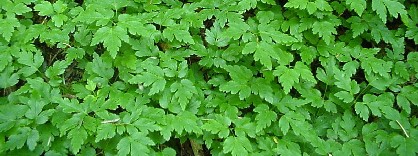 Fern-leaved GoldthreadCoptis aspleniifolia
-
 Coptis laciniata
- Coptis quinquesecta
-
 Western GoldthreadCoptis occidentalis
-
 Coptis quinquefolia
Compare
Questions and answers
What is the scientific name of the Chinese Goldthread?
The scientific name of the Chinese Goldthread is Coptis chinensis. Written with its author, the full name is Coptis chinensis Franch..
Which family does the Chinese Goldthread belong to?
Coptis chinensis belongs to the family Ranunculaceae, in the order Ranunculales and the class Magnoliopsida.
Where is the Chinese Goldthread found?
Checklists and occurrence records place Coptis chinensis in 2 countries: China and Vietnam.
Is Coptis the same as berberine?
No. Chinese goldthread contains berberine, which is one of several alkaloids found in the plant. Other alkaloids include palmatine, epiberberine, coptisine, jaterorhizine, and columbamine.[10][11]
What is Chinese Coptis good for?
Chinese goldthread is used in traditional Chinese medicine to treat digestive and respiratory disorders. It has also been reported to have anti-cancer, anti-inflammatory, and anti-bacterial properties, and research findings indicate anti-microbial activity.[5][3][6][7]
Sources
Passages the profile rests on
- Coptis chinensis is one of the 50 fundamental herbs used in traditional Chinese medicine. Source passage: “Coptis chinensis is one of the 50 fundamental herbs used in traditional Chinese medicine” — English Wikipedia
- In traditional Chinese medicine, Coptis chinensis is called duǎn è huánglián. Source passage: “where it is called duǎn è huánglián (Chinese: 短萼黄连).” — English Wikipedia
- Coptis chinensis is used in Chinese medicine to treat digestive and respiratory disorders. Source passage: “Coptis chinensis which is used to treat digestive and respiratory disorders in Chinese medicine” — pmc.ncbi.nlm.nih.gov
- Coptis chinensis has been used traditionally as a dye, particularly for wool and other fibers. Source passage: “it has been traditionally used as a dye, especially for wool and other fibers.” — English Wikipedia
- Coptis chinensis has been reported to have anti-cancer, anti-inflammatory, and anti-bacterial properties. Source passage: “It has been proved to have anti‐cancer, anti‐inflammatory, and anti‐bacterial properties” — English Wikipedia
- Research findings indicate that Coptis chinensis possesses anti-microbial activity. Source passage: “Bioassays on Coptis chinensis and Hydrastis canadensis indicate that both herbs possess anti-microbial activities” — pmc.ncbi.nlm.nih.gov
- Research findings indicate that Coptis chinensis has anti-inflammatory activity. Source passage: “In addition, Coptis chinensis is anti-inflammatory” — pmc.ncbi.nlm.nih.gov
- The study identified palmatine as an alkaloid unique to Coptis chinensis among the three species compared. Source passage: “Hydrastine and palmatine were unique to Hydrastis canadensis and Coptis chinensis respectively.” — pmc.ncbi.nlm.nih.gov
- The study found that neither Hydrastis canadensis nor Coptis trifolia contains all the alkaloids present in Coptis chinensis used in Chinese medicine. Source passage: “Neither Hydrastis canadensis nor Coptis trifolia contains all the alkaloids found in Coptis chinensis used in Chinese medicine.” — pmc.ncbi.nlm.nih.gov
- The rhizomes of Coptis chinensis contain the isoquinoline alkaloids berberine, palmatine, and coptisine. Source passage: “The rhizomes of Coptis chinensis contain the isoquinoline alkaloids berberine, palmatine, and coptisine among others.” — English Wikipedia
- Coptis chinensis contains the alkaloids berberine, palmatine, epiberberine, coptisine, jaterorhizine, and columbamine. Source passage: “Coptis chinensis contains alkaloids such as berberine, palmatine, epiberberine, coptisine, jaterorhizine and columbamine.” — pmc.ncbi.nlm.nih.gov
Data
- Catalogue of Life, 2026-10-16 XR cc by
- Global Biodiversity Information Facility CC BY 4.0
- Wikidata CC0
- GeoNames CC BY 4.0
- Within the Catalogue of Life, this name comes from Synonymic Checklists of the Vascular Plants of the World cc by
References
- Franch. (1897). J. Bot. [Morot] 11(14): 231 (1897). where the name was published
This species in other databases
- Catalogue of Life Y72J
- Wikidata Q842233
- iNaturalist 497721
- World Flora Online wfo-0000619848
- GRIN 402553
Page built on 26 November 2026. See how the catalog is made and all sources and licences.
Cite this page
ScientificNames.org. (2026). Coptis chinensis (Chinese Goldthread). Retrieved November 26, 2026, from https://scientificnames.org/species/coptis-chinensis
“Coptis chinensis (Chinese Goldthread).” ScientificNames.org, 2026, scientificnames.org/species/coptis-chinensis. Accessed 26 Nov. 2026.
ScientificNames.org. “Coptis chinensis (Chinese Goldthread).” Accessed November 26, 2026. https://scientificnames.org/species/coptis-chinensis.
@misc{scientificnames_coptis_chinensis_chinese_goldthread,
  author = {{ScientificNames.org}},
  title = {Coptis chinensis (Chinese Goldthread)},
  year = {2026},
  url = {https://scientificnames.org/species/coptis-chinensis},
  note = {Accessed 2026-11-26}
}