Species · Flowering plants
Spotted Coralroot Corallorhiza maculata
The scientific name of the Spotted Coralroot is Corallorhiza maculata. It is a species of flowering plant in the family Orchidaceae (orchid), order Asparagales.
- Scientific name
- Corallorhiza maculata Raf.
- Common name
- Spotted Coralroot
- Genus
- Corallorhiza
- Family
- Orchidaceae (Orchid)
- Order
- Asparagales
- Class
- Liliopsida
- Recorded in
- 5 countries
- Name status
- accepted in the Catalogue of Life

Overview
Corallorhiza maculata grows mostly in montane woodlands and occurs in Mexico, Guatemala, Canada, Saint Pierre and Miquelon, and much of the western and northern United States. It is a leafless plant with coral-like underground structures and flowers whose white lips bear deep red spots.
Written 26 November 2026 from the sources listed below. Each statement was checked against the passage it cites; statements that could not be supported were removed.
Appearance
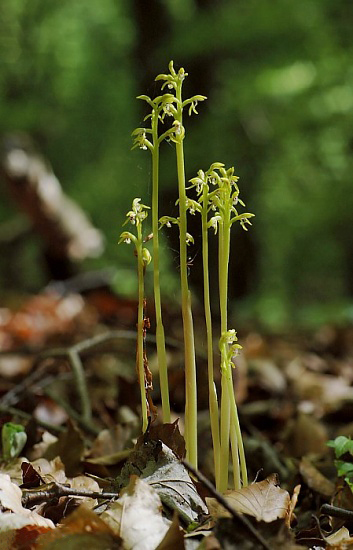
Spotted coralroot grows as an erect, leafless flowering stalk without photosynthetic green tissues. Its rhizome and lower stem often form branched structures resembling coral.[1][2][3]
The flowering stalk measures between 4 and 24 inches tall and can be yellowish-brown, reddish-brown, or reddish-purple. It bears dark red scales and between 10 and 30 flowers arranged in a raceme.[4][5][6][7]
Each flower has three sepals, two lateral petals, and a lip. The sepals are dark red or brown tinged with purple, the lateral petals are reddish, and the white lip bears deep red or reddish-purple spots.[8][9][10][11]
Habitat
Spotted coralroot grows mostly in montane woodlands and occurs in woodland and forest areas. It grows in partial shade and in soils ranging from moist to occasionally dry.[12][13][14]
Diet
Spotted coralroot obtains energy by parasitizing fungi belonging to the family Russulaceae. It receives nutrients from mycorrhizal fungi rather than through photosynthesis.[15][16]
Reproduction and life cycle
Spotted coralroot has three recognized varieties: occidentalis, maculata, and mexicana. It flowers from July through August.[17][18]
The flowers can self-pollinate and can also be pollinated by insects, including flies and bees.[19][20]
The fruits are ovoid capsules that appear in August and September. Each capsule can reach 0.75 inches in length.[21][22]
Seed is the recommended propagation method.[23]
Uses
Several Native American groups historically dried the stems and brewed them into tea for medicinal purposes. The tea was used for colds, pneumonia, and skin irritation.[24][25]
Conservation
In North Carolina, spotted coralroot has been recorded in the southwestern mountains. Its numbers have declined there in recent years, and it is rarely found in the state.[26][27]
The species is difficult to cultivate and does not survive transplantation. Collecting these wildflowers from North Carolina National Forests is illegal according to the USDA.[28][29]
Similar species
Corallorhiza maculata var. occidentalis flowers approximately two weeks earlier than var. maculata. Its middle lip lobe is wider than that of var. maculata.[30][31]
Corallorhiza maculata var. mexicana is native to Guatemala and Mexico.[32]
Classification of the Spotted Coralroot
| Kingdom | Plantae |
|---|---|
| Subkingdom | Pteridobiotina |
| Phylum | Tracheophyta |
| Class | Liliopsida |
| Order | Asparagales |
| Family | Orchidaceae (Orchid) |
| Genus | Corallorhiza (Coralroot) |
| Species | Corallorhiza maculata Raf. |
Where the Spotted Coralroot is found
Checklists and occurrence records place Corallorhiza maculata in 5 countries across North America. GBIF holds 27,353 georeferenced records of it.
Countries
Regions and cities with the most records
- California, United States 4,694
- British Columbia, Canada 3,553
- Washington, United States 2,270
- Colorado, United States 1,409
- Oregon, United States 1,348
- Alberta, Canada 1,052
- Langford, Canada 999
- Colwood, Canada 968
- Esquimalt, Canada 867
- Ontario, Canada 821
- Saanich, Canada 797
- Victoria, Canada 791
- Central Saanich, Canada 787
- Oak Bay, Canada 730
- Montana, United States 696
- Idaho, United States 587
- Quebec, Canada 565
- San Rafael, United States 547
- Michigan, United States 541
- Harewood, Canada 538
- Nanaimo, Canada 517
- Minnesota, United States 466
- Sooke, Canada 465
- Arizona, United States 399
- Anacortes, United States 390
- Oakland, United States 347
- New Mexico, United States 346
- Berkeley, United States 338
- Alameda, United States 333
- Lafayette, United States 332
- Moraga, United States 332
- Orinda, United States 332
- Wyoming, United States 329
- Albany, United States 328
- Pennsylvania, United States 312
- El Cerrito, United States 310
A number beside a place is its count of GBIF occurrence records. A place without a number comes from a checklist alone. Records show where a species has been observed or collected, which can include escapes and vagrants.
Common names
English
- Spotted Coralroot
- Large Coralroot
- Summer Coralroot
Names in 4 other languages
- Chinese
- 斑點珊瑚蘭
- French
- corallorhize maculée
- Russian
- Ладьян пятнистый
- Ukrainian
- Коральковець плямистий
Synonyms
2 other scientific names have been used for this species and are now treated as synonyms of Corallorhiza maculata.
- Cladorhiza maculata (Raf.) Raf.
- Corallorhiza maculata f. maculata
Subspecies and varieties
- Corallorhiza maculata var. maculata (Large Coralroot) variety
- Corallorhiza maculata var. mexicana variety
- Corallorhiza maculata var. occidentalis (Western Spotted Coralroot) variety
Related species
-
 Early CoralrootCorallorhiza trifida
-
 Fall Coral-RootCorallorhiza odontorhiza
-
 Pacific CoralrootCorallorhiza mertensiana
-
 Striped CoralrootCorallorhiza striata
-
 Spring CoralrootCorallorhiza wisteriana
-
 Bentley's CoralrootCorallorhiza bentleyi
- Corallorhiza bulbosa
- Corallorhiza macrantha
Compare
Questions and answers
What is the scientific name of the Spotted Coralroot?
The scientific name of the Spotted Coralroot is Corallorhiza maculata. Written with its author, the full name is Corallorhiza maculata Raf..
Which family does the Spotted Coralroot belong to?
Corallorhiza maculata belongs to the family Orchidaceae, in the order Asparagales and the class Liliopsida.
Where is the Spotted Coralroot found?
Checklists and occurrence records place Corallorhiza maculata in 5 countries: United States, Canada, Mexico, Guatemala and Saint Pierre and Miquelon.
What other names does the Spotted Coralroot have?
Corallorhiza maculata is also known in English as Large Coralroot and Summer Coralroot.
Sources
Passages the profile rests on
- The plant has no leaves or photosynthetic green tissues. Source passage: “There are no leaves and no photosynthetic green tissues.” — English Wikipedia
- Its rhizome and lower stem often form branched structures resembling coral. Source passage: “The rhizome and lower stem are often knotted into branched coral shapes.” — English Wikipedia
- The plant grows as an erect, leafless flowering stalk. Source passage: “It grows as an erect scape, measuring from 4 to 24 inches tall, and has no leaves.” — plants.ces.ncsu.edu
- The stems bear dark red scales and orchid flowers. Source passage: “The stems bear dark red scales and intricate orchid flowers.” — English Wikipedia
- The flowering stalk measures between 4 and 24 inches tall. Source passage: “The stem is an upright, smooth scape that grows 4 to 24 inches tall” — plants.ces.ncsu.edu
- The flowering stalk can be yellowish-brown, reddish-brown, or reddish-purple. Source passage: “The scape of the spotted coralroot varies from yellowish-brown, reddish-brown, or reddish-purple.” — plants.ces.ncsu.edu
- The plant produces between 10 and 30 flowers arranged in a raceme. Source passage: “Ten to thirty flowers are arranged in a raceme.” — plants.ces.ncsu.edu
- The flowers have dark red or brown sepals tinged with purple. Source passage: “The sepals are dark red or brown tinged with purple, long and pointed.” — English Wikipedia
- The lateral petals are reddish, while the lip is white with deep red spots. Source passage: “The side petals are reddish, and the lip petal is bright clean white with deep red spots.” — English Wikipedia
- Each flower has three sepals, two lateral petals, and a lip. Source passage: “Each flower has three sepals, two lateral petals, and a lip.” — plants.ces.ncsu.edu
- The flower lip may be white with reddish-purple spots. Source passage: “The lip of the flower may be white and spotted reddish-purple.” — plants.ces.ncsu.edu
- The species grows mostly in montane woodlands. Source passage: “It grows mostly in montane woodlands.” — English Wikipedia
- The species grows in woodland and forest areas. Source passage: “typically found in woodland and forest areas.” — plants.ces.ncsu.edu
- The species thrives in partial shade and soils ranging from moist to occasionally dry. Source passage: “Thrives in partial shade and moist to occasionally dry soil.” — plants.ces.ncsu.edu
- The species obtains energy by parasitizing fungi belonging to the family Russulaceae. Source passage: “obtains energy by parasitizing the mycelium of fungi in the family Russulaceae.” — English Wikipedia
- The species receives nutrients from mycorrhizal fungi rather than through photosynthesis. Source passage: “This plant is mycoheterotropic and receives its nutrients from mycorrhizal fungi rather than by photosynthesis.” — plants.ces.ncsu.edu
- The species has three recognized varieties: occidentalis, maculata, and mexicana. Source passage: “It has three varieties: C. maculata var. occidentalis (western spotted coralroot), C. maculata var. maculata (eastern spotted coralroot or summer coralroot), and C. maculata var. mexicana.” — English Wikipedia
- The species flowers from July through August. Source passage: “Blooming occurs from July to August.” — plants.ces.ncsu.edu
- The flowers can self-pollinate and can also be pollinated by insects. Source passage: “The flowers can self-pollinate but are also pollinated by insects.” — plants.ces.ncsu.edu
- Flies and bees pollinate the species. Source passage: “Pollinated by flies and bees.” — plants.ces.ncsu.edu
- The fruits are ovoid capsules that appear in August and September. Source passage: “The fruits appear in August and September and consist of an ovoid capsule.” — plants.ces.ncsu.edu
- The fruit capsule can reach 0.75 inches in length. Source passage: “The fruit is an ovoid capsule and measures up to 0.75 inches long.” — plants.ces.ncsu.edu
- Seed is the recommended propagation method. Source passage: “Recommended Propagation Strategy: Seed” — plants.ces.ncsu.edu
- Several Native American groups historically dried the stems and brewed them into tea for medicinal purposes. Source passage: “Several Native American groups historically used the orchid's stems dried and brewed as a tea” — English Wikipedia
- Historically, the tea made from its stems was used for colds, pneumonia, and skin irritation. Source passage: “for such maladies as colds, pneumonia, and skin irritation.” — English Wikipedia
- In North Carolina, the species has been recorded in the southwestern mountains. Source passage: “The only variety found in North Carolina is Corallorhiza maculata var. maculata, and it was located in the southwest mountains.” — plants.ces.ncsu.edu
- The species has declined in North Carolina in recent years and is rarely found there. Source passage: “In North Carolina, this plant has been declining over recent years and is rarely found.” — plants.ces.ncsu.edu
- The species is difficult to cultivate and does not survive transplantation. Source passage: “Spotted coralroots are difficult to cultivate and will not survive if transplanted.” — plants.ces.ncsu.edu
- Collecting these wildflowers from North Carolina National Forests is illegal according to the USDA. Source passage: “it is illegal to collect these wildflowers from our National Forests according to the USDA.” — plants.ces.ncsu.edu
- The variety Corallorhiza maculata var. occidentalis flowers approximately two weeks earlier than var. maculata. Source passage: “flowers 2 weeks earlier than var. maculata” — plants.ces.ncsu.edu
- The middle lip lobe of Corallorhiza maculata var. occidentalis is wider than that of var. maculata. Source passage: “the middle lobe of the lip is wider” — plants.ces.ncsu.edu
- Corallorhiza maculata var. mexicana is native to Guatemala and Mexico. Source passage: “Corallorhiza maculata var. mexicananative to Guatemala and Mexico” — plants.ces.ncsu.edu
Data
- Catalogue of Life, 2026-10-16 XR cc by
- Global Biodiversity Information Facility CC BY 4.0
- Wikidata CC0
- GeoNames CC BY 4.0
- Wikimedia Commons per image; credit shown with each image
- Within the Catalogue of Life, this name comes from The World Checklist of Vascular Plants (WCVP) cc by
References
- Amer. Monthly Mag. & Crit. Rev. 2: 119 (1817) where the name was published
This species in other databases
- Catalogue of Life 5ZZDF
- Wikidata Q2996998
- iNaturalist 49475
- World Flora Online wfo-0000924334
- GRIN 448269
Page built on 28 November 2026. See how the catalog is made and all sources and licences.
Cite this page
ScientificNames.org. (2026). Corallorhiza maculata (Spotted Coralroot). Retrieved November 28, 2026, from https://scientificnames.org/species/corallorhiza-maculata
“Corallorhiza maculata (Spotted Coralroot).” ScientificNames.org, 2026, scientificnames.org/species/corallorhiza-maculata. Accessed 28 Nov. 2026.
ScientificNames.org. “Corallorhiza maculata (Spotted Coralroot).” Accessed November 28, 2026. https://scientificnames.org/species/corallorhiza-maculata.
@misc{scientificnames_corallorhiza_maculata_spotted_coralroot,
  author = {{ScientificNames.org}},
  title = {Corallorhiza maculata (Spotted Coralroot)},
  year = {2026},
  url = {https://scientificnames.org/species/corallorhiza-maculata},
  note = {Accessed 2026-11-28}
}