Species · Flowering plants
Early Coralroot Corallorhiza trifida
The scientific name of the Early Coralroot is Corallorhiza trifida. It is a species of flowering plant in the family Orchidaceae (orchid), order Asparagales.
- Scientific name
- Corallorhiza trifida Châtel.
- Common name
- Early Coralroot
- Genus
- Corallorhiza
- Family
- Orchidaceae (Orchid)
- Order
- Asparagales
- Class
- Liliopsida
- Recorded in
- 47 countries
- Name status
- accepted in the Catalogue of Life
Overview
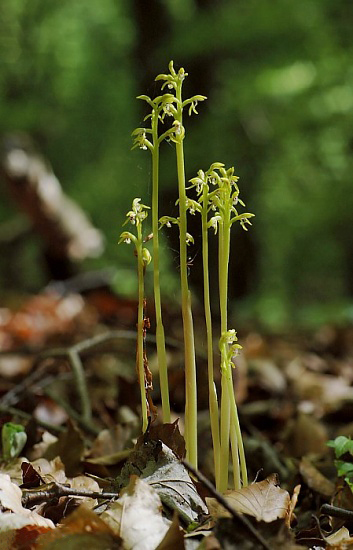
Early coralroot is an herbaceous perennial wildflower in the family Orchidaceae. It occurs across Canada, the northern United States, and Alaska, and has a circumboreal distribution. It has yellowish-green coloration, lacks true leaves, and produces flowers with commonly purple-spotted petals.
Written 26 November 2026 from the sources listed below. Each statement was checked against the passage it cites; statements that could not be supported were removed.
Appearance
Early coralroot has yellowish-green coloration and lacks true leaves. Its reduced leaves form sheaths around a flowering stalk that emerges from a small, flattened, coral-shaped rhizome.[1][2][3]
The flowering stalk ranges from yellow-green to green and reaches approximately 8 to 35 centimeters in height. Its inflorescence is a loose to dense raceme containing anywhere from a few to numerous flowers.[3][4][5]
Its flowers are fully open and spreading, and are generally yellow-green, although their sepals can sometimes be brownish-purple. The petals commonly have purple spots, while the flower lip is generally white but can occasionally have purple spots.[6][7][8][9]
Its fruit is a capsule.[10]
Habitat
Early coralroot occurs in both coniferous and deciduous habitats with humus-rich soils.[11]
It occurs across Canada, the northern United States, and Alaska, extending south into the central northern Rocky Mountains. Several glacial relict populations occur south of its main North American distribution.[12][13]
The species has a circumboreal distribution and has been reported from the United States, Canada, Russia, China, Japan, Korea, India, Nepal, Kashmir, and Pakistan. It has also been recorded in almost every European country.[14][15][16]
Diet
Early coralroot obtains some of its nutrients through an association with fungi of the genus Tomentella. It also produces some of its own carbon nutrition through autotrophy using chlorophyll.[17][18]
Behaviour
Early coralroot can grow above ground as a single flowering stalk or as multiple stalks arising from one clone.[19]
Reproduction and life cycle
Early coralroot flowers from spring through midsummer. It produces capsule fruits.[20][21]
Similar species
Yellow-green forms of Corallorhiza wisteriana, Corallorhiza odontorhiza, and Corallorhiza maculata can occasionally be mistaken for early coralroot where their ranges overlap.[22]
Classification of the Early Coralroot
| Kingdom | Plantae |
|---|---|
| Subkingdom | Pteridobiotina |
| Phylum | Tracheophyta |
| Class | Liliopsida |
| Order | Asparagales |
| Family | Orchidaceae (Orchid) |
| Genus | Corallorhiza (Coralroot) |
| Species | Corallorhiza trifida Châtel. |
Where the Early Coralroot is found
Checklists and occurrence records place Corallorhiza trifida in 47 countries across Asia, Europe and North America. GBIF holds 63,085 georeferenced records of it.
Countries
- Aland Islands 61
- Albania 4
- Austria 1,744
- Belarus 20
- Belgium 16
- Bulgaria 8
- Canada 3,878
- China 62
- Croatia 10
- Czechia 154
- Denmark 303
- Estonia 422
- Finland 4,559
- France 6,479
- Georgia 20
- Germany 3,163
- Greece 12
- Greenland 162
- Hungary 6
- Iceland 618
- India 8
- Italy 353
- Kazakhstan 17
- Kyrgyzstan 2
- Latvia 19
- Liechtenstein 43
- Lithuania 7
- Mongolia 11
- Montenegro 10
- Nepal 5
- North Korea 6
- Norway 6,591
- Pakistan 2
- Poland 392
- Romania 12
- Russia 2,554
- Saint Pierre and Miquelon 4
- Slovakia 417
- Slovenia 55
- Spain 88
- Sweden 18,502
- Switzerland 5,632
- The Netherlands 17
- Turkey 1
- Ukraine 66
- United Kingdom 2,627
- United States 3,943
Regions and cities with the most records
- Auvergne-Rhône-Alpes, France 4,344
- Jämtland, Sweden 2,869
- Norrbotten, Sweden 2,318
- Bavaria, Germany 2,247
- Scotland, United Kingdom 2,022
- Västernorrland, Sweden 1,679
- Gävleborg, Sweden 1,477
- Västra Götaland, Sweden 1,271
- Västerbotten, Sweden 1,269
- Provence-Alpes-Côte d'Azur, France 1,109
- Bern, Switzerland 958
- Dalarna, Sweden 947
- Lapland, Finland 842
- Alberta, Canada 810
- Valais, Switzerland 803
- Jönköping, Sweden 764
- Nordland, Norway 740
- Ontario, Canada 675
- Sallanches, France 648
- Monthey, Switzerland 625
- Östergötland, Sweden 618
- Stockholm, Sweden 598
- Uppsala, Sweden 587
- Kronoberg, Sweden 554
- Buskerud, Norway 502
- Quebec, Canada 491
- Cluses, France 470
- Vaud, Switzerland 451
- Tyrol, Austria 430
- Finnmark, Norway 424
- Irkutsk Oblast, Russia 423
- Occitanie, France 422
- Salzburg, Austria 419
- Troms, Norway 403
- Montreux, Switzerland 382
- Södermanland, Sweden 367
A number beside a place is its count of GBIF occurrence records. A place without a number comes from a checklist alone. Records show where a species has been observed or collected, which can include escapes and vagrants.
Common names
English
- Early Coralroot
- Coralroot Orchid
- Northern Coralroot
- Pale Coralroot
- Yellow Coralroot
Names in 22 other languages
- Chinese
- 珊瑚蘭
- Czech
- korálice trojklaná
- Danish
- Almindelig koralrod, Koralrod
- Dutch
- Koraalwortel
- Estonian
- kõdu-koralljuur
- Finnish
- harajuuri, taigaharajuuri
- French
- Orchidée-corail, coralline, corallorhize, corallorhize trifide, racine-de-corail
- German
- Gewöhnliche Korallenwurz, Korallenwurz
- Hungarian
- Korallgyökér, apró korallgyökér
- Italian
- Coralloriza trifida
- Japanese
- サンゴネラン, チョウセンラン
- Korean
- 나도애기무엽란
- Lithuanian
- Nariuotoji ilgalūpė
- Northern Sami
- korállaruohtas
- Polish
- Żłobik koralowy
- Russian
- Ладьян трёхраздельный
- Slovak
- koralica lesná
- Slovenian
- trokrpi koralasti koren
- Swedish
- korallrot
- Turkish
- Kurbağa Salebi, Mercansalebi
- Ukrainian
- Коральковець тричінадрізаний
- Welsh
- Tegeirian Gwraidd Cwrel, Tegeirian Gwreiddgwrel
Synonyms
43 other scientific names have been used for this species and are now treated as synonyms of Corallorhiza trifida.
- Coralliorrhiza innata R.Br.
- Corallorhiza anandae Malhotra & Balodi
- Corallorhiza corallorhiza (L.) H.Karst.
- Corallorhiza corallorhiza (L.) MacMill.
- Corallorhiza corallorhiza subsp. coloradensis Cockerell
- Corallorhiza corallorhiza var. coloradensis (Cockerell) Ames
- Corallorhiza corallorrhiza var. coloradensis Cockerell
- Corallorhiza dentata Host
- Corallorhiza ericetorum Drejer
- Corallorhiza halleri Rich.
- Corallorhiza innata R.Br.
- Corallorhiza innata subsp. ericetorum (Drejer) Nyman
- Corallorhiza innata var. discolor Rchb.
- Corallorhiza innata var. ericetorum (Drejer) Rchb.f.
- Corallorhiza innata var. virescens (Drejer) Farr
- Corallorhiza intacta Cham. & Schltdl.
- Corallorhiza integra Châtel.
- Corallorhiza jacquemontii Decne.
- Corallorhiza nemoralis Sw. ex Nyman
- Corallorhiza neottia Scop.
- Corallorhiza occidentalis Bach.Pyl.
- Corallorhiza trifida f. ericetorum (Drejer) Soó
- Corallorhiza trifida f. integra (Châtel.) Soó
- Corallorhiza trifida f. suaveolens Bordz.
- Corallorhiza trifida f. verna (Nutt.) P.M.Br.
- Corallorhiza trifida subsp. virescens (Drejer) Løjtnant
- Corallorhiza trifida var. ericetorum (Drejer) Rchb.f.
- Corallorhiza trifida var. integra (Châtel.) Schinz & Thell.
- Corallorhiza trifida var. trifida
- Corallorhiza trifida var. verna (Nutt.) Fernald
- Corallorhiza trifida var. virescens (Drejer) Farw.
- Corallorhiza trifida var. virescens (Farr) Fernald
- Corallorhiza verna Nutt.
- Corallorhiza virescens Drejer
- Corallorhiza wyomingensis Hellm. & K.Hellm.
- Corallorrhiza jacquemontii Decne.
- Corallorrhiza trifida Châtel.
- Cymbidium corallorhiza (L.) Sw.
- Epidendrum corallorhizon (L.) Poir.
- Epipactis corallorhiza (L.) Crantz
Showing 40 of 43.
Related species
-
 Spotted CoralrootCorallorhiza maculata
-
 Fall Coral-RootCorallorhiza odontorhiza
-
 Pacific CoralrootCorallorhiza mertensiana
-
 Striped CoralrootCorallorhiza striata
-
 Spring CoralrootCorallorhiza wisteriana
-
 Bentley's CoralrootCorallorhiza bentleyi
- Corallorhiza bulbosa
- Corallorhiza macrantha
Compare
Questions and answers
What is the scientific name of the Early Coralroot?
The scientific name of the Early Coralroot is Corallorhiza trifida. Written with its author, the full name is Corallorhiza trifida Châtel..
Which family does the Early Coralroot belong to?
Corallorhiza trifida belongs to the family Orchidaceae, in the order Asparagales and the class Liliopsida.
Where is the Early Coralroot found?
Checklists and occurrence records place Corallorhiza trifida in 47 countries, including Sweden, Norway, France, Switzerland, Finland and United States.
What other names does the Early Coralroot have?
Corallorhiza trifida is also known in English as Coralroot Orchid, Northern Coralroot, Pale Coralroot and Yellow Coralroot.
Is coralroot an orchid?
Yes. Early coralroot belongs to the family Orchidaceae.[23]
What is a coral root?
The name Corallorhiza trifida refers to its coral-like underground rhizomes and the three-lobed lip of its individual flowers.[24]
Sources
Passages the profile rests on
- Corallorhiza trifida has yellowish-green coloration and lacks true leaves. Source passage: “Corallorhiza trifida is yellowish green in color, leafless” — English Wikipedia
- The species has reduced leaves that form sheaths around its flowering stalk. Source passage: “The leaves are reduced to sheaths surrounding a simple scape (stalk of the inflorescence), yellow-green to green.” — fs.usda.gov
- Its flowering stalk ranges in color from yellow-green to green and emerges from a small, flattened, coral-shaped rhizome. Source passage: “The yellow-green to green scape emerges from a small, flattish, coral-shaped rhizome.” — fs.usda.gov
- Its inflorescence is a loose to dense raceme containing anywhere from a few to numerous flowers. Source passage: “The inflorescence is a lax to dense raceme of few to numerous flowers.” — fs.usda.gov
- The flowering stalk of Corallorhiza trifida reaches approximately 8 to 35 centimeters in height. Source passage: “Corallorhiza trifida attains a height of 8 to 35 centimeters.” — fs.usda.gov
- Its flowers are fully open and spreading. Source passage: “Flowers are fully open and spreading.” — fs.usda.gov
- Its flowers are generally yellow-green, although their sepals can sometimes be brownish-purple. Source passage: “The flowers are generally yellow-green, the sepals are occasionally brownish-purple” — fs.usda.gov
- Its petals commonly have purple spots. Source passage: “with the petals commonly spotted with purple” — fs.usda.gov
- Its flower lip is generally white but can occasionally have purple spots. Source passage: “the lip is generally white, occasionally purple-spotted.” — fs.usda.gov
- Its fruit is a capsule. Source passage: “The fruit is a capsule.” — fs.usda.gov
- The species occurs in both coniferous and deciduous habitats with humus-rich soils. Source passage: “The species occurs in a broad array of coniferous to deciduous habitats in humus rich soils.” — fs.usda.gov
- The species occurs across Canada, the northern United States, and Alaska, extending south into the central northern Rocky Mountains. Source passage: “broad distribution across Canada and the northern United states into Alaska, south into the central northern Rocky Mountains” — fs.usda.gov
- Several glacial relict populations occur south of its main North American distribution. Source passage: “with several glacial relictual populations to the south.” — fs.usda.gov
- Corallorhiza trifida has a circumboreal distribution. Source passage: “with a circumboreal distribution.” — English Wikipedia
- The species has been reported from the United States, Canada, Russia, China, Japan, Korea, India, Nepal, Kashmir, and Pakistan. Source passage: “The species has been reported from the United States, Canada, Russia, China, Japan, Korea, India, Nepal, Kashmir, Pakistan” — English Wikipedia
- The species has been recorded in almost every European country. Source passage: “and almost every country in Europe.” — English Wikipedia
- Corallorhiza trifida obtains some of its nutrients through an association with fungi of the genus Tomentella. Source passage: “deriving some, but not all of its nutrients from association with fungi of genus Tomentella.” — English Wikipedia
- The species produces some of its own carbon nutrition through autotrophy using chlorophyll. Source passage: “It also contains chlorophyll, with which it supplies some of its own carbon nutrition via autotrophy.” — English Wikipedia
- The species can grow above ground as a single flowering stalk or as multiple stalks arising from one clone. Source passage: “Early coralroot occurs occasionally as a single aboveground flowering scape or as several scapes from a clone.” — fs.usda.gov
- Corallorhiza trifida produces capsule fruits. Source passage: “The fruit is a capsule.” — fs.usda.gov
- The species flowers from spring through midsummer. Source passage: “Corallorhiza trifida flowers from spring to midsummer.” — fs.usda.gov
- Yellow-green forms of Corallorhiza wisteriana, Corallorhiza odontorhiza, and Corallorhiza maculata can occasionally be mistaken for Corallorhiza trifida where their ranges overlap. Source passage: “Yellow-green to green color variants of Corallorhiza wisteriana, C. odontorhiza and C. maculata are occasionally misidentified as Corallorhiza trifida where their ranges overlap.” — fs.usda.gov
- The species belongs to the genus Corallorhiza and the family Orchidaceae. Source passage: “It is classified in the genus Corallorhiza as part of the Orchidaceae family.” — English Wikipedia
- The name Corallorhiza trifida refers to its coral-like underground rhizomes and the three-lobed lip of its individual flowers. Source passage: “Corallorhiza trifida (Corallorhiza – corallion – coral and rhiza – root; coral-root and trifida – 3-parted) refers to the underground stems, rhizomes, appearing like an ocean coral and the individual flowers having 3-lobed lip.” — fs.usda.gov
Data
- Catalogue of Life, 2026-10-16 XR cc by
- Global Biodiversity Information Facility CC BY 4.0
- Wikidata CC0
- GeoNames CC BY 4.0
- Wikimedia Commons per image; credit shown with each image
- Within the Catalogue of Life, this name comes from The World Checklist of Vascular Plants (WCVP) cc by
References
- Spec. Inaug. Corallorrhiza: 8 (1760) where the name was published
This species in other databases
Page built on 29 November 2026. See how the catalog is made and all sources and licences.
Cite this page
ScientificNames.org. (2026). Corallorhiza trifida (Early Coralroot). Retrieved November 29, 2026, from https://scientificnames.org/species/corallorhiza-trifida
“Corallorhiza trifida (Early Coralroot).” ScientificNames.org, 2026, scientificnames.org/species/corallorhiza-trifida. Accessed 29 Nov. 2026.
ScientificNames.org. “Corallorhiza trifida (Early Coralroot).” Accessed November 29, 2026. https://scientificnames.org/species/corallorhiza-trifida.
@misc{scientificnames_corallorhiza_trifida_early_coralroot,
  author = {{ScientificNames.org}},
  title = {Corallorhiza trifida (Early Coralroot)},
  year = {2026},
  url = {https://scientificnames.org/species/corallorhiza-trifida},
  note = {Accessed 2026-11-29}
}