Species · Flowering plants
Service-tree Cormus domestica
The scientific name of the Service-tree is Cormus domestica. It is a species of flowering plant in the family Rosaceae (rose family), order Rosales.
- Scientific name
- Cormus domestica (L.) Spach
- Common name
- Service-tree
- Genus
- Cormus
- Family
- Rosaceae (Rose Family)
- Order
- Rosales
- Class
- Magnoliopsida
- Recorded in
- 36 countries
- Name status
- accepted in the Catalogue of Life

Overview
Service-tree is a wild fruit tree belonging to the Rosaceae family.
Written 27 November 2026 from the sources listed below. Each statement was checked against the passage it cites; statements that could not be supported were removed.
Appearance
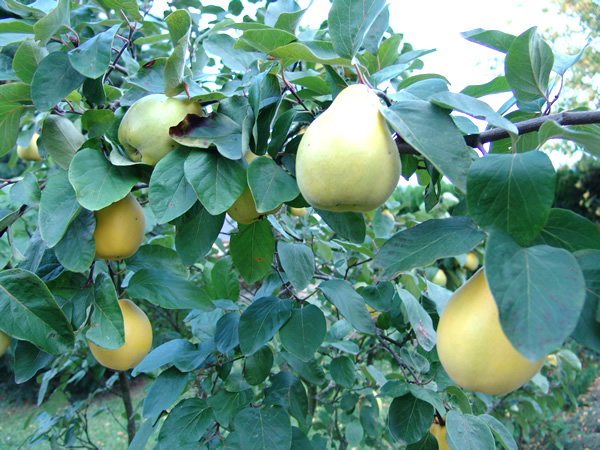
The species produces pear-shaped or apple-shaped fruits. Ripe fruits suitable for consumption are brown or yellowish in colour.[1][2]
The average weight of an individual fruit is 25 g. The fruit diameter can reach a maximum of 4.5 cm.[3][4]
Habitat
The species grows on several soil types, including soils poor in nutrients. It requires good sun exposure and a mild temperate climate.[5][6]
Uses
The fruits are used for culinary and medicinal purposes. The species is also used as an ornamental tree in urban areas.[7][8]
The species provides ecosystem services that contribute to biodiversity maintenance.[9]
Behaviour
The harvested fruit flesh remains astringent and tough before undergoing postharvest softening. The fruits are traditionally stored for at least two weeks after harvesting before consumption.[10][11]
Fruit ripening involves changes in colour, sugar content, acidity, aroma and cell-wall structure. Fruit softening is associated with the accumulation of xyloglucan endotransglucosylase/hydrolase, pectin acetylesterase, beta-galactosidase and pectinesterase.[12][13]
Reproduction and life cycle
The fruits generally ripen between September and October.[14]
Conservation
The species is described as rare and uncommon. Its natural spread has progressively declined.[15][16]
Cultivation of the species for fruit production has become increasingly limited. The species is threatened by the expansion of more profitable fruit tree species.[17][18]
Classification of the Service-tree
| Kingdom | Plantae |
|---|---|
| Subkingdom | Pteridobiotina |
| Phylum | Tracheophyta |
| Class | Magnoliopsida |
| Order | Rosales |
| Family | Rosaceae (Rose Family) |
| Subfamily | Amygdaloideae |
| Tribe | Maleae |
| Subtribe | Malinae |
| Genus | Cormus |
| Species | Cormus domestica (L.) Spach |
Where the Service-tree is found
Checklists and occurrence records place Cormus domestica in 36 countries across Africa, Asia, Europe and Oceania. GBIF holds 41,280 georeferenced records of it.
Countries where it is native or its origin is not stated
- Albania 3
- Algeria 7
- Austria 243
- Belgium 21
- Bulgaria 4
- Croatia 165
- Cyprus 3
- Estonia 3
- France 27,169
- Greece 38
- Hungary 42
- Italy 824
- Kosovo
- Luxembourg 114
- Moldova
- Montenegro
- Morocco
- North Macedonia 1
- Poland
- Portugal 72
- Romania 7
- Russia 13
- San Marino
- Serbia 6
- Slovakia 259
- Slovenia 18
- Spain 6,129
- Switzerland 2,317
- Turkey 35
- Ukraine 265
- United Kingdom 576
Countries where it has been introduced
Regions and cities with the most records
- Provence-Alpes-Côte d'Azur, France 8,232
- Catalonia, Spain 3,299
- Auvergne-Rhône-Alpes, France 3,105
- Occitanie, France 2,990
- Centre-Val de Loire, France 2,495
- Bourgogne-Franche-Comté, France 2,402
- Valencia, Spain 1,673
- Schaffhausen, Switzerland 1,535
- Schaffhausen, Switzerland 1,468
- Singen, Germany 1,344
- Pays de la Loire, France 1,219
- Grand Est, France 1,158
- Nice, France 1,122
- Bavaria, Germany 1,088
- Vence, France 968
- Saint-Laurent-du-Var, France 887
- Cardedeu, Spain 849
- Sant Celoni, Spain 826
- Cagnes-sur-Mer, France 789
- Manosque, France 668
- Monaco, Monaco 667
- Canovelles, Spain 658
- Saint-Maximin-la-Sainte-Baume, France 648
- Granollers, Spain 641
- Menton, France 634
- Brignoles, France 620
- Île-de-France, France 617
- La Crau, France 601
- La Valette-du-Var, France 579
- Martorell, Spain 551
- Terrassa, Spain 545
- Sant Andreu de la Barca, Spain 539
- Sant Quirze del Vallès, Spain 537
- Toulon, France 537
- Rubí, Spain 534
- Caldes de Montbui, Spain 531
1 more country has a few records outside this range
These countries hold a few records of Cormus domestica but lie outside the range the checklists give for it. Such records are often zoo or garden specimens, museum material or vagrants, so the species is not counted as occurring there.
Range as the checklists state it
England (England, Wales); Luxembourg; Germany (Baden-Württemberg, Bayern, Hessen [I], Nordrhein-Westfalen, Rheinland-Pfalz, Saarland [I], Sachsen-Anhalt [I], Thüringen); Austria; Czech Republic [I]; Poland [c]; Slovakia; Hungary; Portugal [c]; Spain; Baleares [c]; France; Corsica; Sardinia [c]; Italy; Sicily; Malta [I]; San Marino; Slovenia; Croatia; Bosnia & Hercegovina; Montenegro; Serbia; Kosovo; North Macedonia; Albania; Romania; Bulgaria; Greece (mountains of mainland, Thasos, Samothraki, Evvoia, Sporades, Andros, Tinos); Moldova; Ukraine [c]; Crimea; Morocco; Algeria; Uzbekistan [I]; Northern Caucasus; Turkey (Inner Anatolia, N-Anatolia, NW-Anatolia: Bithynia, S-Anatolia, WN-Anatolia); Australia [I] (New South Wales [I])
A number beside a place is its count of GBIF occurrence records. A place without a number comes from a checklist alone. Records show where a species has been observed or collected, which can include escapes and vagrants.
Common names
English
- Service-tree
- Sorb Tree
- Whitty Pear
- Servicetree
- True Service-tree
Names in 23 other languages
- Catalan
- Server, Servera
- Chinese
- 歐亞花楸, 羅旺樹
- Czech
- jeřáb oskeruše
- Danish
- Storfrugtet røn
- Dutch
- Tamme lijsterbes
- Estonian
- aedpihlakas
- French
- Sorbier domestique, cormier
- German
- Speierling, Sperbelbaum, Sperberbaum, Spierapfel, Spierling, Sporapfel, Spreigel
- Hungarian
- Házi berkenye
- Italian
- sorbo comune, sorbo domestico
- Lithuanian
- Naminis šermukšnis
- Macedonian
- Оскоруша
- Polish
- jarząb domowy
- Portuguese
- sorveira
- Russian
- rjabina domašnaja, rjabina krymskaja, Рябина домашняя
- Slovak
- jarabina oskorušová
- Slovenian
- skorš
- Spanish
- Serbal, serbal común
- Swedish
- äppelrönn
- Turkish
- üvez
- Ukrainian
- Дерен домашній
- arg
- Cerollera
- srd
- Sorba
Synonyms
44 other scientific names have been used for this species and are now treated as synonyms of Cormus domestica.
- Cormus domestica var. aucubifolia Lavallée
- Cormus domestica var. maliformis Lavallée
- Cormus domestica var. microcarpa Lavallée
- Cormus domestica var. monstrosa Lavallée
- Cormus domestica var. paradisiaca Lavallée
- Cormus domestica var. piriformis Lavallée
- Cormus domestica var. pusilla Lavallée
- Cormus domestica var. upsaliensis Lavallée
- Crataegus austera Salisb.
- Malus sorbus (Gaertn.) Borkh.
- Prunus sorbus (Gaertn.) G.Gaertn., B.Mey. & Scherb.
- Prunus sorbus Sennikov & Kurtto
- Pyrenia sorbus (Gaertn.) Clairv.
- Pyrus domestica (L.) Sm.
- Pyrus domestica var. maliformis Kirchn. & J.Eichler
- Pyrus domestica var. piriformis Kirchn. & J.Eichler
- Pyrus domestica var. pomifera (Hayne) M.F.Fay
- Pyrus domestica var. pyrifera (Hayne) M.F.Fay
- Pyrus sorbus Borkh.
- Pyrus sorbus Gaertn.
- Pyrus sorbus var. maliformis (Lodd.) Loudon
- Pyrus sorbus var. pyriformis (Lodd.) Loudon
- Sorbus domestica L.
- Sorbus domestica f. maliformis (Lodd.) Gams
- Sorbus domestica f. maliformis (Kirchn. & J.Eichler) Hegi
- Sorbus domestica f. piriformis (Kirchn. & J.Eichler) Gams
- Sorbus domestica f. pomifera (Hayne) Rehder
- Sorbus domestica f. pyrifera (Hayne) Rehder
- Sorbus domestica f. pyriformis (Lodd.) Gams
- Sorbus domestica var. albida Risso
- Sorbus domestica var. elongata Risso
- Sorbus domestica var. macrocarpa Risso
- Sorbus domestica var. maliformis Lodd.
- Sorbus domestica var. maliformis G.Kirchn.
- Sorbus domestica var. microcarpa Risso
- Sorbus domestica var. obtinui Bertol.
- Sorbus domestica var. obtusata Diap.
- Sorbus domestica var. pomifera (Hayne) Rehder
- Sorbus domestica var. pyrifera (Hayne) Rehder
- Sorbus domestica var. pyriformis Lodd.
Showing 40 of 44.
Related species
-
 QuinceCydonia oblonga
-
 LoquatEriobotrya japonica
-
 AlmondPrunus amygdalus
-
 BlackthornPrunus spinosa
-
 Bradford PearPyrus calleryana
-
 CloudberryRubus chamaemorus
-
 Asian PearPyrus pyrifolia
-
 RowanSorbus aucuparia
Compare
Questions and answers
What is the scientific name of the Service-tree?
The scientific name of the Service-tree is Cormus domestica. Written with its author, the full name is Cormus domestica (L.) Spach.
Which family does the Service-tree belong to?
Cormus domestica belongs to the family Rosaceae, in the order Rosales and the class Magnoliopsida.
Where is the Service-tree found?
Checklists and occurrence records place Cormus domestica in 36 countries, including France, Spain, Switzerland, Italy, United Kingdom and Ukraine.
What other names does the Service-tree have?
Cormus domestica is also known in English as Sorb Tree, Whitty Pear, Servicetree and True Service-tree.
What are service trees?
Service-tree is a wild fruit tree belonging to the Rosaceae family.[19]
Sources
Passages the profile rests on
- The species produces pear-shaped or apple-shaped fruits. Source passage: “C. domestica fruits can be distinguished according to whether they are pear- or apple-shaped.” — pmc.ncbi.nlm.nih.gov
- Ripe fruits suitable for consumption are brown or yellowish in colour. Source passage: “Ripe C. domestica fruits suitable for consumption are brown or yellowish coloured” — pmc.ncbi.nlm.nih.gov
- The average weight of an individual fruit is 25 g. Source passage: “The average weight of a C. domestica fruit is 25 g” — pmc.ncbi.nlm.nih.gov
- The fruit diameter can reach a maximum of 4.5 cm. Source passage: “its diameter can reach a maximum of 4.5 cm” — pmc.ncbi.nlm.nih.gov
- The species grows on several soil types, including soils poor in nutrients. Source passage: “ability to grow on several soil types, even those poor in nutrients.” — pmc.ncbi.nlm.nih.gov
- The species requires good sun exposure and a mild temperate climate. Source passage: “It needs good sun exposure and a mild temperate climate” — pmc.ncbi.nlm.nih.gov
- The fruits are used for culinary and medicinal purposes. Source passage: “These fruits with distinctive flavours can be used for various culinary and medicinal purposes” — pmc.ncbi.nlm.nih.gov
- The species is used as an ornamental tree in urban areas. Source passage: “and is also used as an ornamental tree in urban areas” — pmc.ncbi.nlm.nih.gov
- The species provides ecosystem services that contribute to biodiversity maintenance. Source passage: “it provides several ecosystem services for biodiversity maintenance” — pmc.ncbi.nlm.nih.gov
- The harvested fruit flesh remains astringent and tough before undergoing postharvest softening. Source passage: “the C. domestica fruit flesh remains astringent and tough when harvested.” — pmc.ncbi.nlm.nih.gov
- The fruits are traditionally stored for at least two weeks after harvesting before consumption. Source passage: “Traditionally, these fruits are harvested and stored for at least 2 weeks before consumption.” — pmc.ncbi.nlm.nih.gov
- Fruit ripening involves changes in colour, sugar content, acidity, aroma and cell-wall structure. Source passage: “alteration in colour, alteration in composition and quantity of sugars, organic and volatile acids that modify flavour and aroma, and alteration to the cell walls” — pmc.ncbi.nlm.nih.gov
- Fruit softening is associated with the accumulation of xyloglucan endotransglucosylase/hydrolase, pectin acetylesterase, beta-galactosidase and pectinesterase. Source passage: “Enzymes, such as xyloglucan endotransglucosylase/hydrolase, pectin acetylesterase, beta-galactosidase and pectinesterase, accumulated during fruit ripening” — pmc.ncbi.nlm.nih.gov
- The fruits generally ripen between September and October. Source passage: “ripen in September-October.” — pmc.ncbi.nlm.nih.gov
- The species is described as rare and uncommon. Source passage: “The Service Tree, Cormus domestica (= Sorbus domestica L.) (Rosaceae), is a rare and uncommon species of wild fruit tree” — pmc.ncbi.nlm.nih.gov
- The natural spread of the species has progressively declined. Source passage: “Unfortunately, the natural spread of this species has progressively eroded” — pmc.ncbi.nlm.nih.gov
- Cultivation of the species for fruit production has become increasingly limited. Source passage: “cultivation for fruit production is now even more limited” — pmc.ncbi.nlm.nih.gov
- The species is threatened by the expansion of more profitable fruit tree species. Source passage: “the spread of more profitable fruit tree species, resulted in its progressive erosion.” — pmc.ncbi.nlm.nih.gov
- The species is a wild fruit tree belonging to the Rosaceae family. Source passage: “Cormus domestica (L.) is a monophyletic wild fruit tree belonging to the Rosaceae family” — pmc.ncbi.nlm.nih.gov
Data
- Catalogue of Life, 2026-10-16 XR cc by
- Global Biodiversity Information Facility CC BY 4.0
- Wikidata CC0
- GeoNames CC BY 4.0
- Wikimedia Commons per image; credit shown with each image
- Within the Catalogue of Life, this name comes from Synonymic Checklists of the Vascular Plants of the World cc by
References
- Spach. (1834). Hist. Nat. Vég. [Spach] 2: 97 (1834). where the name was published
This species in other databases
- Catalogue of Life 6B58W
- Wikidata Q18593737
- iNaturalist 1277867
- World Flora Online wfo-0001003501
- GRIN 496061
Page built on 29 November 2026. See how the catalog is made and all sources and licences.
Cite this page
ScientificNames.org. (2026). Cormus domestica (Service-tree). Retrieved November 29, 2026, from https://scientificnames.org/species/cormus-domestica
“Cormus domestica (Service-tree).” ScientificNames.org, 2026, scientificnames.org/species/cormus-domestica. Accessed 29 Nov. 2026.
ScientificNames.org. “Cormus domestica (Service-tree).” Accessed November 29, 2026. https://scientificnames.org/species/cormus-domestica.
@misc{scientificnames_cormus_domestica_service_tree,
  author = {{ScientificNames.org}},
  title = {Cormus domestica (Service-tree)},
  year = {2026},
  url = {https://scientificnames.org/species/cormus-domestica},
  note = {Accessed 2026-11-29}
}