Species · Reptiles
Solomon Islands Skink Corucia zebrata
The scientific name of the Solomon Islands Skink is Corucia zebrata. It is a species of reptile in the family Scincidae (skink), order Squamata. The name dates from 1855.
- Scientific name
- Corucia zebrata Gray, 1855
- Common name
- Solomon Islands Skink
- Genus
- Corucia
- Family
- Scincidae (Skink)
- Order
- Squamata
- Class
- Reptilia
- Red List category
- NT Near Threatened
- Recorded in
- 2 countries
- Name status
- accepted in the Catalogue of Life

Overview
The Solomon Islands Skink is a reptile and the only species in the genus Corucia. The species is native to Papua New Guinea and the Solomon Islands archipelago. It has a prehensile tail that functions as an additional limb for climbing between branches.
Written 26 November 2026 from the sources listed below. Each statement was checked against the passage it cites; statements that could not be supported were removed.
Appearance
The Solomon Islands Skink has a long, slender body, short strong legs, and a triangular head with small round eyes. Its scales are dark green and commonly have light brown or black speckles, while the scales on its underside range from light yellow to different shades of green.[1][2][3]
Its four feet have thick, curved nails that help it climb and grip tree limbs. Its prehensile tail functions as an additional limb for climbing between branches.[4][5]
Males generally have broader heads and more slender bodies than females. Males also have a V-shaped scale pattern behind the cloacal opening that females lack.[6][7]
Adults can reach 81 cm in total length, including the tail, which accounts for more than half the animal's total length. Adult common-subspecies males average 71 cm and females average 61 cm, while northern-subspecies males average 61 cm and females average 56 cm.[8][9][10][11]
The common subspecies weighs approximately 850 g, compared with approximately 500 g for the northern subspecies.[12]
Habitat
The Solomon Islands Skink is strictly arboreal and usually occupies the upper canopy of forested areas. Adults commonly establish territories within the canopy of individual trees.[13][14]
The species commonly occurs in strangler fig trees when suitable epiphytic food plants are present. It also inhabits trees in semi-cleared areas and cultivated food gardens where its food plants grow.[15][16]
Diet
The Solomon Islands Skink is herbivorous and consumes leaves, flowers, fruits, and growing shoots. Its recorded food plants include Epipremnum pinnatum, which it can consume without ill effects despite its calcium oxalate content.[17][18][19]
Juveniles sometimes consume adult feces to obtain microorganisms needed for digestion. Newborns have been observed eating their placental sacs after birth and do not consume other food during their first two days.[20][21][22]
Behaviour
The Solomon Islands Skink is crepuscular, with its greatest activity occurring around dawn and dusk. It feeds primarily at dusk and also feeds during dawn to a lesser extent.[23][24]
The species uses its eyesight to identify potential threats and food. It uses its sense of smell to recognize its territory and other members of its social group, gathering scents by flicking its tongue and transferring them to the Jacobson's organ in its mouth.[25][26][27]
Individuals live in communal social groups known as circuli. Both sexes defend their territories and may behave aggressively toward individuals outside their family groups.[28][29]
Reproduction and life cycle
The Solomon Islands Skink reproduces through viviparous matrotrophy, with females providing a placenta to their offspring. Gestation lasts approximately six to eight months.[30][31]
Most births involve a single offspring, although twins occasionally occur. At least one occurrence of triplets has been documented.[32][33]
Newborns of the northern subspecies average approximately 29 cm in length and weigh 80 g. Newborns of the common subspecies average approximately 30 cm in length and weigh 175 g.[34][35]
Newborns remain in their social group for six to twelve months and receive protection from adults in the group. Juveniles generally leave their birth group and establish a new family group around one year of age, sometimes earlier.[36][37]
Females exhibit strong protective behaviour around the time of birth.[38]
Conservation
Extensive logging is a serious threat to the species' survival. Consumption by native people and demand for the pet trade also threaten wild populations.[39][40]
The species was listed in CITES Appendix II in 1992. This listing permits limits on international commercial trade.[41][42]
Similar species
The closest living relatives of the Solomon Islands Skink include blue-tongued skinks of the genus Tiliqua. Skinks of the genus Egernia are also identified as close living relatives.[43][44]
Classification of the Solomon Islands Skink
| Kingdom | Animalia |
|---|---|
| Phylum | Chordata |
| Subphylum | Vertebrata |
| Infraphylum | Gnathostomata |
| Parvphylum | Osteichthyes |
| Megaclass | Tetrapoda |
| Class | Reptilia (Reptile) |
| Order | Squamata (Snakes) |
| Suborder | Autarchoglossa |
| Family | Scincidae (Skink) |
| Subfamily | Egerniinae |
| Genus | Corucia |
| Species | Corucia zebrata Gray, 1855 |
Where the Solomon Islands Skink is found
Checklists and occurrence records place Corucia zebrata in 2 countries. GBIF holds 257 georeferenced records of it.
Countries
Regions and cities with the most records
- Bougainville, Papua New Guinea 39
- Guadalcanal Province, Solomon Islands 9
- Western Province, Solomon Islands 9
- Malaita Province, Solomon Islands 6
- Honiara, Solomon Islands 5
- Isabel Province, Solomon Islands 5
- Malango, Solomon Islands 5
- Tandai, Solomon Islands 5
2 more countries have a few records outside this range
These countries hold a few records of Corucia zebrata but lie outside the range the checklists give for it. Such records are often zoo or garden specimens, museum material or vagrants, so the species is not counted as occurring there.
Range as the checklists state it
Papua New Guinea: Solomon Islands
A number beside a place is its count of GBIF occurrence records. A place without a number comes from a checklist alone. Records show where a species has been observed or collected, which can include escapes and vagrants.
Common names
English
- Solomon Islands Skink
- Monkey Skink
- Monkey-tailed Skink
- Prehensile-tailed Skink
- Solomon Island Prehensile-tailed Skink
- Solomon Island Skink
Names in 5 other languages
- Czech
- scink šalomounský
- Danish
- Snohaleskink
- German
- Wickelschwanz-Skink
- Japanese
- オマキトカゲ
- Russian
- Гигантский цепкохвостый сцинк, Цепкохвостый сцинк
Subspecies and varieties
- Corucia zebrata alfredschmidti subspecies
- Corucia zebrata zebrata subspecies
Related species
-
 ShinglebackTiliqua rugosa
-
 Five-lined SkinkPlestiodon fasciatus
- Common Garden SkinkLampropholis guichenoti
-
 Blue-tailed SkinkCryptoblepharus egeriae
-
 Red-eyed Crocodile SkinkTribolonotus gracilis
-
 Common Blue-tongued SkinkTiliqua scincoides
-
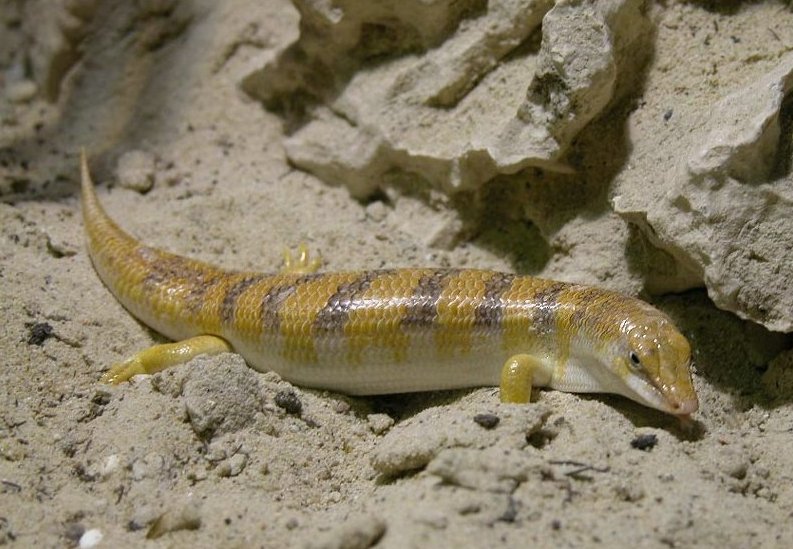 Sandfish SkinkScincus scincus
-
 Land MulletBellatorias major
Compare
Questions and answers
What is the scientific name of the Solomon Islands Skink?
The scientific name of the Solomon Islands Skink is Corucia zebrata. Written with its author, the full name is Corucia zebrata Gray, 1855.
Which family does the Solomon Islands Skink belong to?
Corucia zebrata belongs to the family Scincidae, in the order Squamata and the class Reptilia.
Where is the Solomon Islands Skink found?
Checklists and occurrence records place Corucia zebrata in 2 countries: Solomon Islands and Papua New Guinea.
What is the conservation status of the Solomon Islands Skink?
The IUCN Red List category recorded for Corucia zebrata is Near Threatened (NT).
What other names does the Solomon Islands Skink have?
Corucia zebrata is also known in English as Monkey Skink, Monkey-tailed Skink, Prehensile-tailed Skink, Solomon Island Prehensile-tailed Skink and Solomon Island Skink.
Sources
Passages the profile rests on
- The species has a long, slender body, short strong legs, and a triangular head with small round eyes. Source passage: “The Solomon Islands skink has a long, slender body, strong, short legs, and a triangular shaped head with small round eyes.” — English Wikipedia
- Its scales are dark green and commonly have light brown or black speckles. Source passage: “The scales of Solomon Islands skinks are a dark green but are often speckled with light brown or black.” — English Wikipedia
- The scales on its underside range from light yellow to different shades of green. Source passage: “The scales on the underside vary from light yellow to different shades of green.” — English Wikipedia
- Its four feet have thick, curved nails that help it climb and grip tree limbs. Source passage: “The toes on all four legs have thick, curved nails used for climbing and gripping tree limbs.” — English Wikipedia
- Its prehensile tail functions as an additional limb for climbing between branches. Source passage: “Some of its common names (prehensile-tailed skink, monkey-tailed skink, monkey skink) refer to its fully prehensile tail which the species uses as a fifth limb for climbing.” — English Wikipedia
- Males generally have broader heads and more slender bodies than females. Source passage: “Male Solomon Islands skinks tend to have a broader head and a more slender body shape than female skinks.” — English Wikipedia
- Males have a V-shaped scale pattern behind the cloacal opening that females lack. Source passage: “Males have a V-shaped pattern of scales just aft of the cloacal opening, which is not present in female skinks.” — English Wikipedia
- Adults can reach 81 cm in total length, including the tail. Source passage: “adults can reach a total length (including tail) of 32 inches (81 cm) when fully grown” — English Wikipedia
- The tail accounts for more than half the animal's total length. Source passage: “with the tail accounting for more than half this length.” — English Wikipedia
- Adult common-subspecies males average 71 cm in total length, while females average 61 cm. Source passage: “The common Solomon Islands skinks are slightly longer with the males averaging 28 inches (71 cm) and the females averaging 24 inches (61 cm) in total length.” — English Wikipedia
- Adult northern-subspecies males average 61 cm in total length, while females average 56 cm. Source passage: “The northern Solomon Islands skink is the shorter of the two subspecies with males averaging 24 inches (61 cm) and females averaging 22 inches (56 cm) in total length.” — English Wikipedia
- The common subspecies weighs approximately 850 g, compared with approximately 500 g for the northern subspecies. Source passage: “The common Solomon Islands skink, at 850 grams (1.87 lb), weighs more than the northern Solomon Islands skink, which weighs closer to 500 grams (1.1 lb).” — English Wikipedia
- The species is strictly arboreal and usually occupies the upper canopy of forested areas. Source passage: “Both subspecies of the Solomon Islands skink are strictly arboreal, usually inhabiting the upper canopy of forested areas throughout its range.” — English Wikipedia
- Adults commonly establish territories within the canopy of individual trees. Source passage: “The adults commonly establish a territory within the canopy of one tree.” — English Wikipedia
- The species commonly occurs in strangler fig trees when suitable epiphytic food plants are present. Source passage: “It commonly occurs in the strangler fig tree (Ficus sp.), provided the epiphytic growth of its several food plants are present.” — English Wikipedia
- It also inhabits trees in semi-cleared areas and cultivated food gardens where its food plants grow. Source passage: “It occurs in trees in semi-cleared areas and cultivated food gardens, again provided its food plants occur there.” — English Wikipedia
- The species is herbivorous and consumes leaves, flowers, fruits, and growing shoots. Source passage: “Solomon Islands skinks are herbivores, feeding on the leaves, flowers, fruit, and growing shoots of several different species of plants.” — English Wikipedia
- Its recorded food plants include Epipremnum pinnatum. Source passage: “This includes the somewhat toxic (due to high concentrations of calcium oxalate) Epipremnum pinnatum (cf. E. aureum) plant” — English Wikipedia
- The species can consume Epipremnum pinnatum without ill effects despite its calcium oxalate content. Source passage: “which the lizard eats without ill effect.” — English Wikipedia
- Juveniles sometimes consume adult feces to obtain microorganisms needed for digestion. Source passage: “Juvenile skinks often eat feces from adults in order to acquire the essential microflora to digest their food.” — English Wikipedia
- Newborns have been observed eating their placental sacs after birth. Source passage: “Newborn skinks have been observed consuming their placental sac after birth” — English Wikipedia
- Newborns do not consume other food during their first two days after birth. Source passage: “and will not feed on other food for the first two days.” — English Wikipedia
- The species is crepuscular, with its greatest activity occurring around dawn and dusk. Source passage: “As a crepuscular animal, it is most active during the dusk and dawn hours” — English Wikipedia
- It feeds primarily at dusk and also feeds during dawn to a lesser extent. Source passage: “feeding primarily at dusk. it also is active and eats during the hours of dawn, though to a lesser extent.” — English Wikipedia
- It uses its eyesight to identify potential threats and food. Source passage: “It has quite good eyesight and relies upon it to identify threats, as well as potential food.” — English Wikipedia
- It uses its sense of smell to recognize its territory and other members of its social group. Source passage: “It relies heavily on its sense of smell and uses it to identify its territory and other members of its group, called a circulus.” — English Wikipedia
- It gathers scents by flicking its tongue and transferring them to the Jacobson's organ in its mouth. Source passage: “Like snakes, the skink "smells" by flicking its tongue to gather scents and when the tongue is retracted, it touches it to the opening of a Jacobson's organ at the roof of its mouth.” — English Wikipedia
- Individuals live in communal social groups known as circuli. Source passage: “The Solomon Islands skink is one of the few species of reptile that lives in a communal group known as a circulus.” — English Wikipedia
- Both sexes defend their territories and may behave aggressively toward individuals outside their family groups. Source passage: “Both male and female specimens are known to be territorial and often hostile towards members not a part of their family group.” — English Wikipedia
- The species reproduces through viviparous matrotrophy, with females providing a placenta to their offspring. Source passage: “The Solomon Islands skink reproduces by viviparous matrotrophy: the female provides a placenta for its young” — English Wikipedia
- Gestation lasts approximately six to eight months. Source passage: “which are born after a gestation period of six to eight months” — English Wikipedia
- Most births involve a single offspring, although twins occasionally occur. Source passage: “Almost all births are single babies, but occasionally twins will be born.” — English Wikipedia
- At least one occurrence of triplets has been documented. Source passage: “At least one instance of triplets has occurred according to herpetologist Bert Langerwerf.” — English Wikipedia
- Newborns of the northern subspecies average approximately 29 cm in length and weigh 80 g. Source passage: “the northern Solomon Islands skinks are approximately 29 centimetres (11 in) in length and weigh 80 grams (0.18 lb)” — English Wikipedia
- Newborns of the common subspecies average approximately 30 cm in length and weigh 175 g. Source passage: “whereas the common Solomon Islands skinks are 30 centimetres (12 in) and 175 grams (0.386 lb) when they are born.” — English Wikipedia
- Newborns remain in their social group for six to twelve months and receive protection from adults in the group. Source passage: “The newborn skink will stay within its circulus for six to twelve months during which time it will be protected by not only its parents but other unrelated adult skinks within the group.” — English Wikipedia
- Juveniles generally leave their birth group and establish a new family group around one year of age, sometimes earlier. Source passage: “Around one year of age, sometimes earlier, the juvenile will move off to form a new family group.” — English Wikipedia
- Females exhibit strong protective behaviour around the time of birth. Source passage: “Females exhibit fierce protective behavior around the time of birth” — English Wikipedia
- Extensive logging is a serious threat to the species' survival. Source passage: “Extensive logging is a serious ongoing threat to the survival of this species” — English Wikipedia
- Consumption by native people and demand for the pet trade also threaten wild populations. Source passage: “as is consumption for food by native people, and export demand for the pet trade.” — English Wikipedia
- The species was listed in CITES Appendix II in 1992. Source passage: “in 1992 Corucia zebrata was listed as a CITES Appendix II animal” — English Wikipedia
- Its CITES Appendix II listing permits limits on international commercial trade. Source passage: “which allows limits to be placed on the number of animals in commercial trade between countries.” — English Wikipedia
- The closest living relatives of this species include blue-tongued skinks of the genus Tiliqua. Source passage: “The closest living relatives of C. zebrata are the blue-tongued skinks of the genus Tiliqua” — English Wikipedia
- Skinks of the genus Egernia are also identified as close living relatives. Source passage: “and skinks of the genus Egernia of Australia, New Guinea, and Indonesia” — English Wikipedia
Data
- Catalogue of Life, 2026-10-16 XR cc by
- Global Biodiversity Information Facility CC BY 4.0
- Wikidata CC0
- GeoNames CC BY 4.0
- Wikimedia Commons per image; credit shown with each image
- Within the Catalogue of Life, this name comes from The Reptile Database cc by
References
- Gray, J. E. (1856). New genus of fish-scaled lizards (Scissosarae) from New Guinea. Ann. Mag. Nat. Hist. (2) 18: 345-346.
- Boulenger, G. A. (1886). On the reptiles and batrachians of the Solomon Islands. Trans. Zool. Soc. London 12: 35-62.
- Schmidt, & KP. (1932). Reptiles and Amphibians from the Solomon Islands. Field Mus. Nat. Hist. Zool. Ser. - 18 (9): 175-190.
- Burt, Charles E.; Burt, May Danheim. (1932). Herpetological results of the Whitney South Sea Expedition. VI. Pacific island amphibians and reptiles in the collection of the American Museum of Natural History. Bull. Amer. Mus. Nat. Hist. 63 (5): 461-597.
- Honegger, R. E. (1975). Beitrag zur Kenntnis des Wickelskinkes Corucia zebrata. Salamandra 11 (1): 27-32.
- Jungfer, K.-H. & Janzen, ? (1985). Der Wickelskink. Herpetofauna 7 (36): 22.
- Estes, Richard; Queiroz, Kevin de & Gauthier, Jacques. (1988). Phylogenetic Relationships within Squamata. In: Estes, Richard & Pregill, Gregory (Hrsg.): Phylogenetic Relationships of the Lizard Families: Essays Commemorating Charles L. Camp. - Stanford: Stanford University Press; Pp. 119-281.
- Schmidt, A. A. (1991). Zur Haltung und Fortpflanzung des Wickelskinks Corucia zebrata GRAY, 1855. Salamandra 27 (4): 238-245.
- Adler,G.H.; Austin,C.C. & Dudley,R. (1995). Dispersal and speciation of skinks among archipelagos in the tropical Pacific Ocean. Evolutionary Ecology 9: 529-541.
- Köhler, G. (1997). Eine neue Unterart des Wickelschwanzskinkes Corucia zebrata von Bougainvillle, Papua-Neuguinea. Salamandra 33 (1): 61-68.
- Schmidt, A. A. (1998). Weitere Anmerkungen zur Rassenbildung und Geschlechtsunterscheidung von Corucia zebrata. Elaphe 6 (2): 2-5.
- Hauschild, A. (1998). Corucia zebrata GRAY, 1855. Sauria 20 Suppl.: 421–426.
- Bonetti, & Mathilde. (2002). 100 Sauri. Mondadori (Milano), 192 Pp.
- Obst, F.-J. (2004). Alfred A. Schmidt zum 80. Geburtstag. Salamandra 40 (1): 1-10.
- Obst, & Fritz Jürgen. (2004). Alfred A. Schmidt – unser „Gründungsvater“ wurde 80 Jahre! Sekretär 4 (1):
- Mann, S. L., & Meek, R. (2004). Understanding the relationship between body temperature and activity patterns in the giant Solomon Island skink, Corucia zebrata, as a contribution to the effectiveness of captive breeding programmes. Applied Herpetology 1 (3): 287-298.
- Ziegler, T. (2005). Nachzuchterfolge 2002 im Aquarium des Kölner Zoos. Herpetofauna 25 (142): 22-24 [2003/2004].
- McCoy, M. (2006). Reptiles of the Solomon Islands. Pensoft Series Faunistica 57, 212 Pp.
- Brenneman, Rick A.; Engberg, S.E.; Shore, G.D. & Edward E. Louis Jr. (2007). PRIMER NOTE: Characterization of 21 microsatellite marker loci in the prehensile-tailed skink (Corucia zebrata). Molecular Ecology Notes 7: 1281–1283.
- Böhme, & Wolfgang. (2010). A list of the herpetological type specimens in the Zoologisches Forschungsmuseum Alexander Koenig, Bonn. Bonn Zoological Bulletin 59: 79-108.
- Hagen, Ingerid J. and C. Michael Bull. (2011). Home Ranges in the Trees: Radiotelemetry of the Prehensile Tailed Skink, Corucia zebrata. Journal of Herpetology 45 (1): 36-39.
- Lima, A.; Höss, S.; Elser, G.; Kühne, H.; Glaw, F. & Vences, M. (2011). Vorläufige Untersuchungen zur genetischen Variabilität beim Wickelschwanzskink. Elaphe 19 (3): 6-10.
- Hagen, Ingerid J.; Ivar Herfindal, Stephen C. Donnellan, and C. Michael Bull. (2013). Fine Scale Genetic Structure in a Population of the Prehensile Tailed Skink, Corucia zebrata. Journal of Herpetology Jun 2013, Vol. 47, No. 2: 308-313.
- Zollweg, & Z, M. (2013). Wickelschwanzskinke – oder: Manche sind gleich, andere sind gleicher. Reptilia (Münster) 18 (104): 50-58.
- Böhme, & Wolfgang. (2014). Herpetology in Bonn. Mertensiella 21. Vi + 256 Pp.
This species in other databases
Page built on 28 November 2026. See how the catalog is made and all sources and licences.
Cite this page
ScientificNames.org. (2026). Corucia zebrata (Solomon Islands Skink). Retrieved November 28, 2026, from https://scientificnames.org/species/corucia-zebrata
“Corucia zebrata (Solomon Islands Skink).” ScientificNames.org, 2026, scientificnames.org/species/corucia-zebrata. Accessed 28 Nov. 2026.
ScientificNames.org. “Corucia zebrata (Solomon Islands Skink).” Accessed November 28, 2026. https://scientificnames.org/species/corucia-zebrata.
@misc{scientificnames_corucia_zebrata_solomon_islands_skink,
  author = {{ScientificNames.org}},
  title = {Corucia zebrata (Solomon Islands Skink)},
  year = {2026},
  url = {https://scientificnames.org/species/corucia-zebrata},
  note = {Accessed 2026-11-28}
}