Species · Fishes
Bronze Corydoras Corydoras aeneus
The scientific name of the Bronze Corydoras is Corydoras aeneus. It is a species of fish in the family Callichthyidae (mailed catfishes), order Siluriformes. The name dates from 1858.
- Scientific name
- Corydoras aeneus (Gill, 1858)
- Common name
- Bronze Corydoras
- Genus
- Corydoras
- Family
- Callichthyidae (Mailed Catfishes)
- Order
- Siluriformes
- Class
- Teleostei
- Red List category
- LC Least Concern
- Environment
- freshwater
- Recorded in
- 11 countries
- Name status
- accepted in the Catalogue of Life

Overview
Bronze Corydoras is a fish frequently kept as an aquarium fish. The species inhabits quiet, shallow waters and running waters, with a reported distribution extending from Colombia and Trinidad to the Río de la Plata basin. Adults have a yellow or pink body, a white belly, blue-grey coloration over the head and back, and a distinctive brownish-orange patch immediately before the dorsal fin.
Written 26 November 2026 from the sources listed below. Each statement was checked against the passage it cites; statements that could not be supported were removed.
Appearance
Adults have a yellow or pink body, a white belly, and blue-grey coloration over the head and back. The upper sides are often greenish, while the fins are yellow or pink and lack markings.[1][2][3]
A brownish-orange patch on the head immediately before the dorsal fin is a distinctive identification feature when viewed from above. The dorsal, pectoral, and adipose fins possess sharp barbs containing mild poison.[4][5]
Adult males reach approximately 6.5 cm in length, while adult females reach approximately 7 cm. Females have a higher body profile than males because of their larger abdominal region.[6][7][8]
Habitat
The species inhabits quiet, shallow waters with soft bottoms and also occurs in running waters. Its habitat can contain heavily polluted clouds of mud disturbed from the bottom.[9][10][11]
In its native habitat, the species occurs in water temperatures ranging from 25 to 28 °C. The hardness of its native waters ranges from 5 to 19 DGH.[12][13]
The species is widely distributed in South America east of the Andes. Its reported distribution extends from Colombia and Trinidad to the Río de la Plata basin.[14][15]
Diet
The species feeds on worms, benthic crustaceans, insects, and plant matter.[16]
In aquariums, the species accepts a wide variety of flake, pelleted, live, and frozen foods.[17]
Behaviour
The species typically forms schools containing 20 to 30 individuals. It is sociable and is recommended for group keeping in aquariums.[18][19]
The species obtains additional oxygen by swimming to the surface and taking air into its mouth. Air is absorbed through the intestinal wall, with excess air expelled through the vent.[20][21]
In aquariums, individuals continually search the bottom for food and occasionally swim to the surface to obtain air.[22]
Reproduction and life cycle
Reproduction begins with the onset of the rainy season and the associated changes in water chemistry. Females spawn egg clutches containing 10–20 eggs with multiple males, but each complete clutch is fertilized by sperm from a single male.[23][24][25]
During courtship, the female attaches her mouth to the male's genital opening in a T-position. The female ingests the sperm and subsequently releases it with her eggs into a pouch formed by her pelvic fins.[26][27]
In the wild, eggs are deposited on waterweeds. The eggs possess small villi-like surface protuberances that make them adhesive, allowing them to adhere to specific locations or to one another.[28][29][30]
Males do not establish territories or compete directly for females. Female mate choice is not observed, and mating is described as more or less random; male reproductive success is directly related to courtship frequency.[31][32][33]
Under aquarium breeding conditions, a female can produce up to 200 eggs during a spawning period lasting two to three hours. Aquarium eggs gradually darken over approximately three to seven days before hatching.[34][35]
Newly hatched fry generally remain near the bottom of the aquarium and feed on detritus and small food items. Females may spawn again within two to three weeks.[36][37]
Uses
The species is frequently kept as an aquarium fish. It is bred and commercially produced in large quantities in the United States, Europe, and Singapore.[38][39]
Classification of the Bronze Corydoras
| Kingdom | Animalia |
|---|---|
| Phylum | Chordata |
| Subphylum | Vertebrata |
| Infraphylum | Gnathostomata |
| Parvphylum | Osteichthyes |
| Gigaclass | Actinopterygii |
| Superclass | Actinopteri |
| Class | Teleostei (Teleost) |
| Order | Siluriformes (Catfish) |
| Family | Callichthyidae (Mailed Catfishes) |
| Subfamily | Corydoradinae |
| Genus | Corydoras (Cory) |
| Species | Corydoras aeneus (Gill, 1858) |
Where the Bronze Corydoras is found
Checklists and occurrence records place Corydoras aeneus in 11 countries across South America. GBIF holds 1,505 georeferenced records of it.
Countries
- Argentina 35
- Bolivia 52
- Brazil 1,014
- Colombia 45
- Ecuador 6
- French Guiana 31
- Guyana 3
- Paraguay 119
- Peru 37
- Suriname 49
- Venezuela 114
Regions and cities with the most records
- São Paulo, Brazil 374
- Paraná, Brazil 228
- Mato Grosso do Sul, Brazil 133
- Mato Grosso, Brazil 81
- Sertanópolis, Brazil 45
- Ibiporã, Brazil 43
- Arapongas, Brazil 38
- Itirapina, Brazil 32
- Londrina, Brazil 30
- Portuguesa, Venezuela 29
- Bonito, Brazil 27
- Pará, Brazil 27
- São Carlos, Brazil 26
- Botucatu, Brazil 23
- Barinas, Venezuela 22
- Central Department, Paraguay 22
- Apucarana, Brazil 21
- Corrientes, Argentina 20
- Rio Claro, Brazil 20
- Guanarito, Venezuela 19
- Teodoro Sampaio, Brazil 19
- Concepción, Paraguay 18
- Bolívar, Venezuela 17
- Itauguá, Paraguay 17
- Capiatá, Paraguay 16
- Rio Grande do Sul, Brazil 16
- Jandaia do Sul, Brazil 15
- Mandaguari, Brazil 15
- Paraguarí, Paraguay 15
- Santa Cruz Department, Bolivia 15
- Caacupé, Paraguay 14
- Charqueada, Brazil 14
- Limpio, Paraguay 14
- Maringá, Brazil 14
- Mirassol, Brazil 14
- Bady Bassitt, Brazil 13
4 more countries have a few records outside this range
These countries hold a few records of Corydoras aeneus but lie outside the range the checklists give for it. Such records are often zoo or garden specimens, museum material or vagrants, so the species is not counted as occurring there.
A number beside a place is its count of GBIF occurrence records. A place without a number comes from a checklist alone. Records show where a species has been observed or collected, which can include escapes and vagrants.
Common names
English
- Bronze Corydoras
- Bronze Cory
- Gold Laser Corydoras
- Green Corydoras
- Orange Venezuelan Corydoras
Names in 14 other languages
- Afrikaans
- Brons Corydoras
- Czech
- pancéřníček zelený
- Danish
- Kobberpansermalle
- Dutch
- Bronzen pantsermeerval
- French
- Aeneus
- German
- Goldschulter-Panzerwels, Goldstreifen-Panzerwels, Goldstreifenpanzerwels, Metallpanzerwels
- Italian
- Corydoras bronzeo
- Norwegian Bokmål
- metallpansermalle
- Polish
- Kirysek spiżowy
- Portuguese
- Caborja, Coridora, Tamuata
- Russian
- Бронзовый панцирник
- Thai
- ปลาแพะเขียว
- Ukrainian
- Коридорас золотистий, Сомик золотистий
- srm
- Kwikwi
Synonyms
11 other scientific names have been used for this species and are now treated as synonyms of Corydoras aeneus.
- Callichthys aeneus (Gill, 1858)
- Corydoras aeheus (Gill, 1858)
- Corydoras aenaeus (Gill, 1858)
- Corydoras macrosteus Regan, 1912
- Corydoras microps Eigenmann & Kennedy, 1903
- Corydoras schultzei Holly, 1940
- Corydoras schulzei Holly, 1940
- Corydoras venezuelanus Ihering, 1911
- Hoplosoma aeneum Gill, 1858
- Hoplosternum aeneum (Gill, 1858)
- Osteogaster aenea (Gill, 1858)
Related species
-
 Pygmy CorydorasCorydoras pygmaeus
-
 Panda CorydorasCorydoras panda
-
 Sterba's CorydorasCorydoras sterbai
-
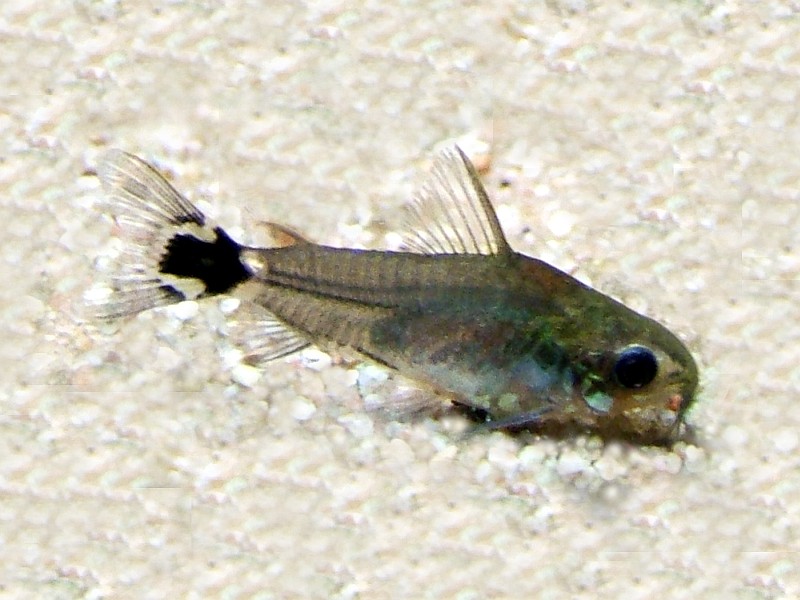 Micro CatfishCorydoras hastatus
-
 Threestripe CorydorasCorydoras trilineatus
-
 Leopard CorydorasCorydoras julii
-
 Salt and Pepper CatfishCorydoras habrosus
-
 Adolf's CatfishCorydoras adolfoi
Compare
Questions and answers
What is the scientific name of the Bronze Corydoras?
The scientific name of the Bronze Corydoras is Corydoras aeneus. Written with its author, the full name is Corydoras aeneus (Gill, 1858).
Which family does the Bronze Corydoras belong to?
Corydoras aeneus belongs to the family Callichthyidae, in the order Siluriformes and the class Teleostei.
Where is the Bronze Corydoras found?
Checklists and occurrence records place Corydoras aeneus in 11 countries, including Brazil, Paraguay, Venezuela, Bolivia, Suriname and Colombia.
What is the conservation status of the Bronze Corydoras?
The IUCN Red List category recorded for Corydoras aeneus is Least Concern (LC).
What other names does the Bronze Corydoras have?
Corydoras aeneus is also known in English as Bronze Cory, Gold Laser Corydoras, Green Corydoras and Orange Venezuelan Corydoras.
How big do bronze corydora catfish get?
Adult males reach approximately 6.5 cm in length, while adult females reach approximately 7 cm.[6][7]
How many bronze corydoras should be kept together?
The species typically forms schools containing 20 to 30 individuals. It is sociable and is recommended for group keeping in aquariums.[18][19]
What is the scientific name for Corydoras?
The scientific name given for Bronze Corydoras is Corydoras aeneus.[40]
What do bronze corydoras eat?
The species feeds on worms, benthic crustaceans, insects, and plant matter. In aquariums, it accepts flake, pelleted, live, and frozen foods.[16][17]
How long do bronze corydoras live?
The average lifespan is approximately 10 years.[41]
Sources
Passages the profile rests on
- Adults have a yellow or pink body, a white belly, and blue-grey coloration over the head and back. Source passage: “It has a yellow or pink body, white belly, and is blue-grey over its head and back.” — English Wikipedia
- The fins are yellow or pink and lack markings. Source passage: “Its fins are yellow or pink and immaculate.” — English Wikipedia
- The upper sides are often greenish in color. Source passage: “Their upper sides are often a greenish color” — English Wikipedia
- A brownish-orange patch on the head immediately before the dorsal fin is a distinctive identification feature when viewed from above. Source passage: “A brownish-orange patch is usually present on the head, just before the dorsal fin, and is its most distinctive feature when viewed from above in the stream.” — English Wikipedia
- The dorsal, pectoral, and adipose fins possess sharp barbs containing mild poison. Source passage: “the dorsal, pectoral and adipose fins have an additional sharp barb and have a mild poison” — English Wikipedia
- Adult males reach approximately 6.5 cm in length. Source passage: “The adult size is 6½ cm for males” — English Wikipedia
- Adult females reach approximately 7 cm in length. Source passage: “a slightly larger 7 cm for females” — English Wikipedia
- Females have a higher body profile than males because of their larger abdominal region. Source passage: “Females have a slightly higher body frame than males in accordance with their larger abdominal region.” — English Wikipedia
- The species inhabits quiet, shallow waters with soft bottoms. Source passage: “They are found in quiet, shallow waters with soft bottoms” — English Wikipedia
- The species also occurs in running waters. Source passage: “but it also inhabits running waters.” — English Wikipedia
- Its habitat can contain heavily polluted clouds of mud disturbed from the bottom. Source passage: “that can sometimes be heavily polluted by clouds of disturbed mud from the bottom” — English Wikipedia
- In its native habitat, the species occurs in water temperatures ranging from 25 to 28 °C. Source passage: “In its native habitat, it inhabits waters with a temperature range of 25 to 28 °C” — English Wikipedia
- The hardness of its native waters ranges from 5 to 19 DGH. Source passage: “hardness 5 to 19 DGH.” — English Wikipedia
- The species is widely distributed in South America east of the Andes. Source passage: “It is widely distributed in South America on the eastern side of the Andes” — English Wikipedia
- Its reported distribution extends from Colombia and Trinidad to the Río de la Plata basin. Source passage: “from Colombia and Trinidad to the Río de la Plata basin” — English Wikipedia
- The species feeds on worms, benthic crustaceans, insects, and plant matter. Source passage: “It feeds on worms, benthic crustaceans, insects, and plant matter.” — English Wikipedia
- In aquariums, the species accepts a wide variety of flake, pelleted, live, and frozen foods. Source passage: “they are omnivores and can eat a wide variety of flake and pelleted food, as well as many live and frozen foods.” — English Wikipedia
- The species typically forms schools containing 20 to 30 individuals. Source passage: “It typically stays in schools of 20 to 30 individuals.” — English Wikipedia
- The species is sociable and is recommended for group keeping in aquariums. Source passage: “They prefer being kept in groups of 5 or more, being sociable fish” — English Wikipedia
- The species obtains additional oxygen by swimming to the surface and taking air into its mouth. Source passage: “they rapidly come to the surface of the water and draw air in through their mouth.” — English Wikipedia
- Air taken in at the surface is absorbed through the intestinal wall, with excess air expelled through the vent. Source passage: “This air is then absorbed through the wall of the intestine and any surplus air is expelled through the vent.” — English Wikipedia
- In aquariums, individuals continually search the bottom for food and occasionally swim to the surface to obtain air. Source passage: “They ceaselessly comb the bottom of the aquarium for food and therefore disturb it slightly, sending up detritus and waste material that has settled loosely on the bottom; and occasionally darting to the surface to get air.” — English Wikipedia
- Reproduction begins with the onset of the rainy season and the associated changes in water chemistry. Source passage: “Reproduction occurs with the onset of the rainy season, which changes the water chemistry.” — English Wikipedia
- Females spawn egg clutches containing 10–20 eggs with multiple males. Source passage: “Females spawn 10–20 egg-clutches with multiple males at a time” — English Wikipedia
- Each complete egg clutch is fertilized by sperm from a single male. Source passage: “but an entire egg clutch is inseminated by the sperm of a single male.” — English Wikipedia
- During courtship, the female attaches her mouth to the male's genital opening in a T-position. Source passage: “The female will attach her mouth to the male's genital opening, creating the well-known "T-position" many Corydoras exhibit during courtship.” — English Wikipedia
- The female ingests the sperm and subsequently releases it with her eggs into a pouch formed by her pelvic fins. Source passage: “The female will then drink the sperm. The sperm rapidly moves through her intestines and is discharged together with her eggs into a pouch formed by her pelvic fins.” — English Wikipedia
- In the wild, eggs are deposited on waterweeds. Source passage: “In the wild, eggs are laid on waterweeds.” — English Wikipedia
- The eggs possess small villi-like surface protuberances that make them adhesive. Source passage: “The eggs of O. aenea exhibit a unique surface pattern with small villi-like protuberances” — English Wikipedia
- The egg surface structures allow eggs to adhere to specific locations or to one another. Source passage: “These structures allow the eggs to be adhesive and stick to a specific place or to each other.” — English Wikipedia
- Males do not establish territories or compete directly for females. Source passage: “Males do not form territories or compete over females” — English Wikipedia
- Female mate choice is not observed, and mating is described as more or less random. Source passage: “On the other hand, females do not choose between males. Mating is more or less random” — English Wikipedia
- Male reproductive success is directly related to courtship frequency. Source passage: “therefore, male reproductive success is directly related to courtship frequency.” — English Wikipedia
- Under aquarium breeding conditions, a female can produce up to 200 eggs during a spawning period lasting two to three hours. Source passage: “After several acts of spawning, which span a total of two to three hours, one female will have produced up to 200 eggs.” — English Wikipedia
- Aquarium eggs gradually darken over approximately three to seven days before hatching. Source passage: “Once deposited, the eggs gradually grow darker in color over the course of around 3-7 days.” — English Wikipedia
- Newly hatched fry generally remain near the bottom of the aquarium and feed on detritus and small food items. Source passage: “The newly hatched fry will generally keep to the bottom of the tank, feeding on detritus and any small food they find.” — English Wikipedia
- Females may spawn again within two to three weeks. Source passage: “The parents may spawn again within two to three weeks.” — English Wikipedia
- The species is frequently kept as an aquarium fish. Source passage: “often kept as an aquarium fish.” — English Wikipedia
- The species is bred and commercially produced in large quantities in the United States, Europe, and Singapore. Source passage: “It is easily bred and is produced in commercial quantities in the United States, Europe, and Singapore.” — English Wikipedia
- The species has historically also been referred to as Corydoras aeneus. Source passage: “and has historically also been referred to as Corydoras aeneus.” — English Wikipedia
- The average lifespan is approximately 10 years. Source passage: “Their average life span is 10 years.” — English Wikipedia
Data
- Catalogue of Life, 2026-10-16 XR cc by
- Global Biodiversity Information Facility CC BY 4.0
- Wikidata CC0
- GeoNames CC BY 4.0
- Wikimedia Commons per image; credit shown with each image
- Within the Catalogue of Life, this name comes from World Register of Marine Species cc by
This species in other databases
Page built on 26 November 2026. See how the catalog is made and all sources and licences.
Cite this page
ScientificNames.org. (2026). Corydoras aeneus (Bronze Corydoras). Retrieved November 26, 2026, from https://scientificnames.org/species/corydoras-aeneus
“Corydoras aeneus (Bronze Corydoras).” ScientificNames.org, 2026, scientificnames.org/species/corydoras-aeneus. Accessed 26 Nov. 2026.
ScientificNames.org. “Corydoras aeneus (Bronze Corydoras).” Accessed November 26, 2026. https://scientificnames.org/species/corydoras-aeneus.
@misc{scientificnames_corydoras_aeneus_bronze_corydoras,
  author = {{ScientificNames.org}},
  title = {Corydoras aeneus (Bronze Corydoras)},
  year = {2026},
  url = {https://scientificnames.org/species/corydoras-aeneus},
  note = {Accessed 2026-11-26}
}