Species · Fishes
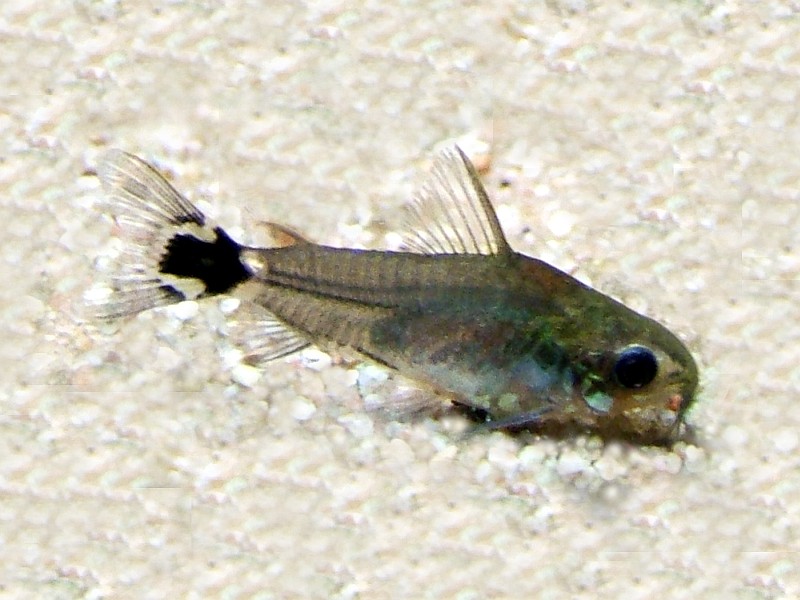
Pygmy Corydoras Corydoras pygmaeus
The scientific name of the Pygmy Corydoras is Corydoras pygmaeus. It is a species of fish in the family Callichthyidae (mailed catfishes), order Siluriformes. The name dates from 1966.
- Scientific name
- Corydoras pygmaeus Knaack, 1966
- Common name
- Pygmy Corydoras
- Genus
- Corydoras
- Family
- Callichthyidae (Mailed Catfishes)
- Order
- Siluriformes
- Class
- Teleostei
- Environment
- freshwater
- Recorded in
- 4 countries
- Name status
- accepted in the Catalogue of Life

Overview
The species occurs in tributaries of the Nanay River in Peru, the Aguarico River in Ecuador, and the Madeira River in western Brazil. It has a silver-colored body marked by an unbroken black horizontal line running from the snout to the caudal peduncle.
Written 26 November 2026 from the sources listed below. Each statement was checked against the passage it cites; statements that could not be supported were removed.
Appearance
The body is silver-colored, with an unbroken black horizontal line running from the snout to the caudal peduncle. A second thin black line runs along the lower side from behind the ventral fins into the tail.[1][2]
Light black or dark gray shading extends along the upper body from the snout to the tail. Females have broader and rounder bodies than males, particularly when carrying eggs.[3][4]
The species reaches a maximum length of approximately 3.2 centimeters. Adult males typically measure approximately 1.9 centimeters, while adult females typically measure approximately 2.5 centimeters.[5][6][7]
Habitat
The species inhabits tropical freshwater environments. Its reported water temperature range is 22–26 °C, and its reported water hardness range is 2–25 dGH.[8][9][10]
Diet
The species feeds on worms, benthic crustaceans, insects, and plant matter.[11]
Behaviour
The species is peaceful and forms shoals. In aquariums, it commonly swims in shoals in the middle and lower regions.[12][13]
It is usually maintained in aquarium groups of at least four individuals.[14]
Reproduction and life cycle
Females lay approximately 100 eggs per spawning event. During fertilization, a female holds two to four eggs at a time in a pouch formed by her pelvic fins.[15][16]
Egg fertilization by the male takes approximately 30 seconds. Females attach fertilized eggs to a surface, where they remain for approximately three days before hatching.[17][18]
The eggs are opaque and have a slight tan and opal coloration. The fry hatch approximately two to three days after the eggs are laid.[19][20]
Newly hatched fry initially have vertical body stripes that fade by the end of their first month. They begin developing coloration approximately five days after hatching and begin to resemble adults approximately two weeks after hatching.[21][22][23]
Young fish reach approximately 13 millimeters in length within six to eight weeks after hatching.[24]
Similar species
Corydoras hastatus is a species with a similar appearance to the Pygmy Corydoras.[25]
Classification of the Pygmy Corydoras
| Kingdom | Animalia |
|---|---|
| Phylum | Chordata |
| Subphylum | Vertebrata |
| Infraphylum | Gnathostomata |
| Parvphylum | Osteichthyes |
| Gigaclass | Actinopterygii |
| Superclass | Actinopteri |
| Class | Teleostei (Teleost) |
| Order | Siluriformes (Catfish) |
| Family | Callichthyidae (Mailed Catfishes) |
| Subfamily | Corydoradinae |
| Genus | Corydoras (Cory) |
| Species | Corydoras pygmaeus Knaack, 1966 |
Where the Pygmy Corydoras is found
Checklists and occurrence records place Corydoras pygmaeus in 4 countries across South America. GBIF holds 40 georeferenced records of it.
Countries
Regions and cities with the most records
- Loreto, Peru 10
- Amazonas Department, Colombia 5
- Pará, Brazil 4
- Tabatinga, Brazil 4
- Leticia, Colombia 3
- Mato Grosso, Brazil 3
A number beside a place is its count of GBIF occurrence records. A place without a number comes from a checklist alone. Records show where a species has been observed or collected, which can include escapes and vagrants.
Common names
English
- Pygmy Corydoras
- Pygmy Catfish
Names in 3 other languages
- Czech
- pancéřníček malý
- Polish
- Kirysek karłowaty
- Spanish
- Caracha
Synonyms
One other scientific name has been used for this species and is now treated as a synonym of Corydoras pygmaeus.
- Gastrodermus pygmaeus (Knaack, 1966)
Related species
-
 Bronze CorydorasCorydoras aeneus
-
 Panda CorydorasCorydoras panda
-
 Sterba's CorydorasCorydoras sterbai
-
 Dwarf CorydorasCorydoras hastatus
-
 Threestripe CorydorasCorydoras trilineatus
-
 Leopard CorydorasCorydoras julii
-
 Salt and Pepper CatfishCorydoras habrosus
-
 Adolf's CatfishCorydoras adolfoi
Compare
Questions and answers
What is the scientific name of the Pygmy Corydoras?
The scientific name of the Pygmy Corydoras is Corydoras pygmaeus. Written with its author, the full name is Corydoras pygmaeus Knaack, 1966.
Which family does the Pygmy Corydoras belong to?
Corydoras pygmaeus belongs to the family Callichthyidae, in the order Siluriformes and the class Teleostei.
Where is the Pygmy Corydoras found?
Checklists and occurrence records place Corydoras pygmaeus in 4 countries: Peru, Brazil, Colombia and Ecuador.
What other names does the Pygmy Corydoras have?
Corydoras pygmaeus is also known in English as Pygmy Catfish.
Can I keep 4 pygmy corys?
Yes. The species is usually maintained in aquarium groups of at least four individuals.[14]
How big will pygmy corys get?
The species reaches a maximum length of approximately 3.2 centimeters. Adult males typically measure approximately 1.9 centimeters, and adult females approximately 2.5 centimeters.[5][6][7]
What food do pygmy corys eat?
They feed on worms, benthic crustaceans, insects, and plant matter.[11]
Sources
Passages the profile rests on
- The fish has a silver-colored body with an unbroken black horizontal line running from the snout to the caudal peduncle. Source passage: “The pygmy corydoras is a silver-colored fish, with an unbroken black line that runs horizontally along the center of the sides of the fish from the tip of its snout to its caudal peduncle.” — English Wikipedia
- A second thin black line runs along the lower side of the body from behind the ventral fins into the tail. Source passage: “It has a second thin black line along the lower part of the side of the body, from behind the ventral fins and continuing into the tail.” — English Wikipedia
- The upper body has light black or dark gray shading extending from the snout to the tail. Source passage: “The top part of the body has a light black or dark gray shading that starts on the top of its snout and ends at the tail.” — English Wikipedia
- Females have a broader and rounder body shape than males, particularly when carrying eggs. Source passage: “In addition to their larger length, females are also rounder and broader than males, especially when they have eggs.” — English Wikipedia
- The species reaches a maximum length of approximately 3.2 centimeters. Source passage: “The maximum length of the species is about 3.2 centimeters (1.3 in)” — English Wikipedia
- Adult males typically measure approximately 1.9 centimeters in length. Source passage: “typical adult sizes are 1.9 centimeters (0.75 in) for males” — English Wikipedia
- Adult females typically measure approximately 2.5 centimeters in length. Source passage: “2.5 centimeters (1.0 in) for females.” — English Wikipedia
- The species inhabits tropical freshwater environments. Source passage: “The pygmy corydoras lives in a tropical climate” — English Wikipedia
- Its reported water temperature range is 22–26 °C. Source passage: “a temperature range of 22–26 °C (72–79 °F).” — English Wikipedia
- Its reported water hardness range is 2–25 dGH. Source passage: “a water hardness of 2 – 25 dGH” — English Wikipedia
- The species feeds on worms, benthic crustaceans, insects, and plant matter. Source passage: “It feeds on worms, benthic crustaceans, insects, and plant matter.” — English Wikipedia
- The species is peaceful and forms shoals. Source passage: “It is a peaceful fish, shoaling fish” — English Wikipedia
- The species commonly swims in shoals in the middle and lower regions of aquariums. Source passage: “Unlike the larger more common Corydoras, they often swim in shoals around the mid water and lower regions of the tank.” — English Wikipedia
- The species is usually maintained in groups of at least four individuals in aquariums. Source passage: “They are schooling fish that are usually kept in groups of at least four” — English Wikipedia
- Females lay approximately 100 eggs per spawning event. Source passage: “The pygmy corydoras lays approximately 100 eggs at a time.” — English Wikipedia
- During fertilization, the female holds two to four eggs at a time in a pouch formed by her pelvic fins. Source passage: “The female holds 2–4 eggs at a time in a pouch formed by her pelvic fins” — English Wikipedia
- Egg fertilization by the male takes approximately 30 seconds. Source passage: “while they are fertilized by the male, which takes about 30 seconds.” — English Wikipedia
- Females attach fertilized eggs to a surface, where they remain for approximately three days before hatching. Source passage: “where she attaches the sticky eggs to a surface, where they will remain for about three days before hatching.” — English Wikipedia
- The eggs are opaque and have a slight tan and opal coloration. Source passage: “Eggs of the fish are opaque, with a slight tan and opal color.” — English Wikipedia
- The fry hatch approximately two to three days after the eggs are laid. Source passage: “Fry hatch after two or three days” — English Wikipedia
- Newly hatched fry initially have vertical body stripes that fade by the end of their first month. Source passage: “Newly hatched fry have vertical stripes along the sides of their bodies that fade by the end of their first month” — English Wikipedia
- Fry begin developing coloration approximately five days after hatching. Source passage: “Fry hatch after two or three days, and begin to develop coloration after about five days.” — English Wikipedia
- Fry begin to resemble adults approximately two weeks after hatching. Source passage: “They do not begin to resemble adults until about two weeks after hatching” — English Wikipedia
- Young fish reach approximately 13 millimeters in length within six to eight weeks after hatching. Source passage: “Young fry grow rapidly after hatching, reaching 13 millimeters (0.51 in) in six to eight weeks.” — English Wikipedia
- Corydoras hastatus is a species with a similar appearance to the pygmy corydoras. Source passage: “A species of Corydoras with a similar appearance, Corydoras hastatus” — English Wikipedia
- The species occurs in tributaries of the Nanay River in Peru. Source passage: “in Peru in tributaries of the Nanay River” — English Wikipedia
- The species occurs in tributaries of the Aguarico River in Ecuador. Source passage: “in Ecuador in tributaries of the Aguarico River” — English Wikipedia
- The species occurs in tributaries of the Madeira River in western Brazil. Source passage: “in western Brazil in tributaries of the Madeira River.” — English Wikipedia
Data
- Catalogue of Life, 2026-10-16 XR cc by
- Global Biodiversity Information Facility CC BY 4.0
- Wikidata CC0
- GeoNames CC BY 4.0
- Wikimedia Commons per image; credit shown with each image
- Within the Catalogue of Life, this name comes from World Register of Marine Species cc by
References
- Knaack, J. (1966). Ein Zwergpanzerwels - Corydoras pygmaeus. Die Aquarien- und Terrarienzeitschrift (DATZ). 19 (6): 168-169. where the name was published
This species in other databases
Page built on 27 November 2026. See how the catalog is made and all sources and licences.
Cite this page
ScientificNames.org. (2026). Corydoras pygmaeus (Pygmy Corydoras). Retrieved November 27, 2026, from https://scientificnames.org/species/corydoras-pygmaeus
“Corydoras pygmaeus (Pygmy Corydoras).” ScientificNames.org, 2026, scientificnames.org/species/corydoras-pygmaeus. Accessed 27 Nov. 2026.
ScientificNames.org. “Corydoras pygmaeus (Pygmy Corydoras).” Accessed November 27, 2026. https://scientificnames.org/species/corydoras-pygmaeus.
@misc{scientificnames_corydoras_pygmaeus_pygmy_corydoras,
  author = {{ScientificNames.org}},
  title = {Corydoras pygmaeus (Pygmy Corydoras)},
  year = {2026},
  url = {https://scientificnames.org/species/corydoras-pygmaeus},
  note = {Accessed 2026-11-27}
}