Species · Amphibians
Craugastor polaclavus
Craugastor polaclavus has no English name on record in the checklists used here. It is a species of amphibian in the family Craugastoridae (robber frogs), order Anura. The name dates from 2022.
- Scientific name
- Craugastor polaclavus Jameson, Streicher, Manuelli, Head & Smith, 2022
- Genus
- Craugastor
- Family
- Craugastoridae (Robber Frogs)
- Order
- Anura
- Class
- Amphibia
- Recorded in
- 1 country
- Name status
- accepted in the Catalogue of Life
Overview
Wikidata describes Craugastor polaclavus as “species of amphibian”.
Classification of Craugastor polaclavus
| Kingdom | Animalia |
|---|---|
| Phylum | Chordata |
| Subphylum | Vertebrata |
| Infraphylum | Gnathostomata |
| Parvphylum | Osteichthyes |
| Megaclass | Tetrapoda |
| Class | Amphibia (Amphibians) |
| Order | Anura (Frogs) |
| Superfamily | Brachycephaloidea |
| Family | Craugastoridae (Robber Frogs) |
| Genus | Craugastor (Northern Rainfrogs) |
| Species | Craugastor polaclavus Jameson, Streicher, Manuelli, Head & Smith, 2022 |
Origin of the name. Etymology. - The specific epithet is a combination of the Latin pola meaning small and clavus meaning wart. The name is an allusion to the small size and rugose appearance of several individuals in the type series. Phylogenetics. - Craugastor polaclavus was inferred to be the sister taxon of C. candelariensis with strong support in the concatenated analysis (90 ML; 0.99 BAYES; Fig. 3) and nDNA-only analysis (ML> 90, BAYES> 0.90; Fig. 5). The placement of C. polaclavus was less certain in the mtDNA, where it was found to be the sister taxon of a clade containing C. cf. hobartsmithi t C. rubinus (ML ¼ 51, BAYES ¼ 0.74; Fig. 4). In terms of genetic distances (Table 4), C. polaclavus was most similar to C. portilloensis (5.8 %), followed by similarity to C. bitonium (5.9 %).
Where Craugastor polaclavus is found
Checklists and occurrence records place Craugastor polaclavus in 1 country. GBIF holds 4 georeferenced records of it.
Countries
Regions and cities with the most records
A number beside a place is its count of GBIF occurrence records. A place without a number comes from a checklist alone. Records show where a species has been observed or collected, which can include escapes and vagrants.
Related species
-
 Barking FrogCraugastor augusti
- Craugastor myllomyllon
- Corquin Robber FrogCraugastor anciano
-
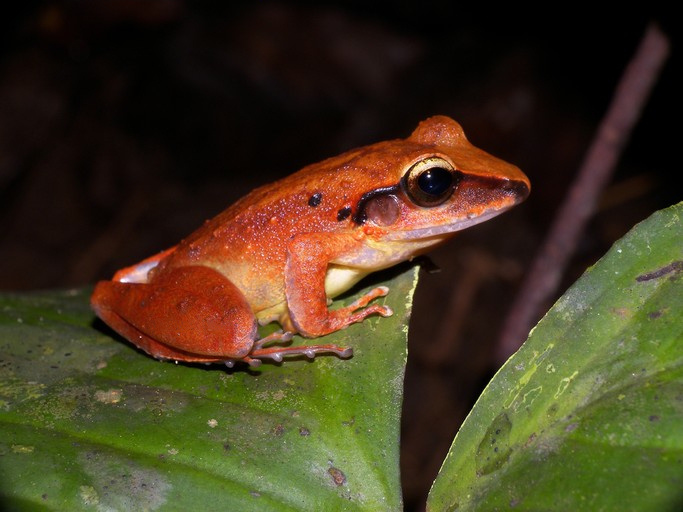 Fitzinger's Robber FrogCraugastor fitzingeri
- Sierra de Omoa Streamside FrogCraugastor omoaensis
-
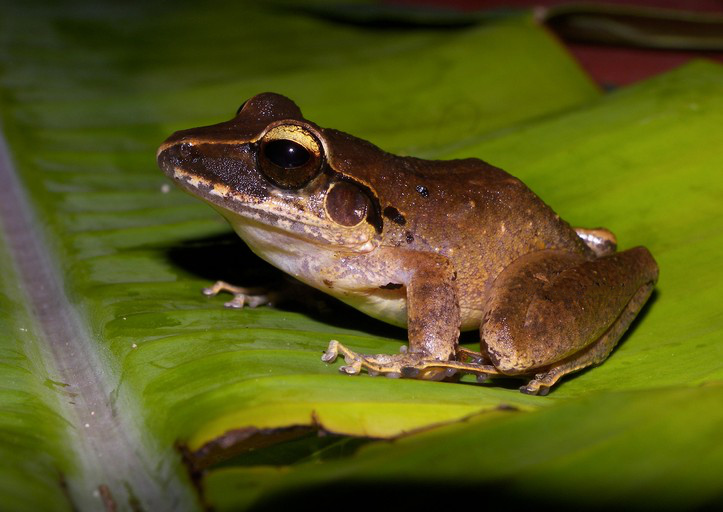 Robber FrogCraugastor raniformis
- McCranie's Robber FrogCraugastor chrysozetetes
- Yellow-legged Rain FrogCraugastor andi
Compare
Sources
Data
- Catalogue of Life, 2026-10-16 XR cc by
- Global Biodiversity Information Facility CC BY 4.0
- Wikidata CC0
- GeoNames CC BY 4.0
- Within the Catalogue of Life, this name comes from The Integrated Taxonomic Information System cc0
References
- Jameson, Tom J. M., Jeffrey W. Streicher, Luigi Manuelli, Jason J. Head & Eric Smith. 2022. Miniaturization in Direct-Developing Frogs from Mexico with the Description of Six New Species. Herpetological Monographs 36: 1-48. Link where the name was published
This species in other databases
Page built on 27 November 2026. See how the catalog is made and all sources and licences.
Cite this page
ScientificNames.org. (2026). Craugastor polaclavus. Retrieved November 27, 2026, from https://scientificnames.org/species/craugastor-polaclavus
“Craugastor polaclavus.” ScientificNames.org, 2026, scientificnames.org/species/craugastor-polaclavus. Accessed 27 Nov. 2026.
ScientificNames.org. “Craugastor polaclavus.” Accessed November 27, 2026. https://scientificnames.org/species/craugastor-polaclavus.
@misc{scientificnames_craugastor_polaclavus,
  author = {{ScientificNames.org}},
  title = {Craugastor polaclavus},
  year = {2026},
  url = {https://scientificnames.org/species/craugastor-polaclavus},
  note = {Accessed 2026-11-27}
}