Species · Amphibians
Pacific Broad-headed Litter Frog Craugastor rugosus
The scientific name of the Pacific Broad-headed Litter Frog is Craugastor rugosus. It is a species of amphibian in the family Craugastoridae (robber frogs), order Anura. The name dates from 1873.
- Scientific name
- Craugastor rugosus (Peters, 1873)
- Common name
- Pacific Broad-headed Litter Frog
- Genus
- Craugastor
- Family
- Craugastoridae (Robber Frogs)
- Order
- Anura
- Class
- Amphibia
- Red List category
- LC Least Concern
- Recorded in
- 3 countries
- Name status
- accepted in the Catalogue of Life

Overview
Craugastor rugosus occurs in Costa Rica and southwestern Panama, inhabiting humid tropical lowland rainforests and moist premontane forests. It is distinguished by its broad head, warty back, hourglass-shaped dorsal ridges, and black and scarlet-red markings on the inner thighs.
Written 27 November 2026 from the sources listed below. Each statement was checked against the passage it cites; statements that could not be supported were removed.
Appearance
The back is covered in warts and resembles that of a toad. The upper back bears hourglass-shaped ridges outlined by lighter-coloured stripes, and the digits of the limbs lack webbing.[1][2][3]
The dorsal surface is dark brown, dark grey, or black, while the underside is mottled with brown, white, and red. The undersides of the thighs can be yellowish or orange, the inner thighs have alternating black and bright scarlet-red bars, and the groin has conspicuous white and black markings.[4][5][6][7][8]
Juveniles initially have white-tipped dorsal warts that darken as they age. Their inner thighs are black-and-white barred, and the undersides of their legs and groin are orange-red.[9][10][11]
Females can reach 69 mm in snout–vent length, while males can reach 44 mm.[12][13]
Habitat
The species occurs in humid and hot tropical lowland rainforests and moist premontane forests. It is usually found among forest leaf litter.[14][15][16]
It has been recorded at elevations between 10 and 1,220 metres above sea level. It can persist in heavily altered former forest habitats.[17][18]
Diet
The species generally preys on beetles. It may also prey on lizards and other frogs.[19][20]
Behaviour
The frog has been observed hopping on the forest floor during daylight. It is considered likely to be an ambush predator.[21][22]
Reproduction and life cycle
The species is thought unlikely to produce a mating call.[23]
Conservation
The species was considered threatened by habitat loss by the IUCN in 2004.[24]
Classification of the Pacific Broad-headed Litter Frog
| Kingdom | Animalia |
|---|---|
| Phylum | Chordata |
| Subphylum | Vertebrata |
| Infraphylum | Gnathostomata |
| Parvphylum | Osteichthyes |
| Megaclass | Tetrapoda |
| Class | Amphibia (Amphibians) |
| Order | Anura (Frogs) |
| Superfamily | Brachycephaloidea |
| Family | Craugastoridae (Robber Frogs) |
| Genus | Craugastor (Northern Rainfrogs) |
| Species | Craugastor rugosus (Peters, 1873) |
Where the Pacific Broad-headed Litter Frog is found
Checklists and occurrence records place Craugastor rugosus in 3 countries. GBIF holds 238 georeferenced records of it.
Countries
Regions and cities with the most records
- Puntarenas Province, Costa Rica 184
- Heredia Province, Costa Rica 10
- Chiriquí Province, Panama 3
- Rivas, Nicaragua 3
- Rivas Department, Nicaragua 3
1 more country has a few records outside this range
These countries hold a few records of Craugastor rugosus but lie outside the range the checklists give for it. Such records are often zoo or garden specimens, museum material or vagrants, so the species is not counted as occurring there.
A number beside a place is its count of GBIF occurrence records. A place without a number comes from a checklist alone. Records show where a species has been observed or collected, which can include escapes and vagrants.
Common names
English
- Pacific Broad-headed Litter Frog
- Rugose Robber Frog
- Veragua Robber Frog
Names in 2 other languages
- Italian
- Rana ladrona rugosa
- Spanish
- rana ladrona de rugose
Synonyms
9 other scientific names have been used for this species and are now treated as synonyms of Craugastor rugosus.
- Craugastor florulentus (Cope, 1893)
- Eleutherodactylus florulentus (Cope, 1893)
- Eleutherodactylus pelviculus (Cope, 1877)
- Eleutherodactylus rugosus (Peters, 1873)
- Hylodes florulentus (Cope, 1893)
- Hylodes pelviculus (Cope, 1877)
- Hylodes rugosus Peters, 1873
- Lithodytes florulentus Cope, 1893
- Lithodytes pelviculus Cope, 1877
Related species
-
 Barking FrogCraugastor augusti
- Craugastor myllomyllon
- Corquin Robber FrogCraugastor anciano
-
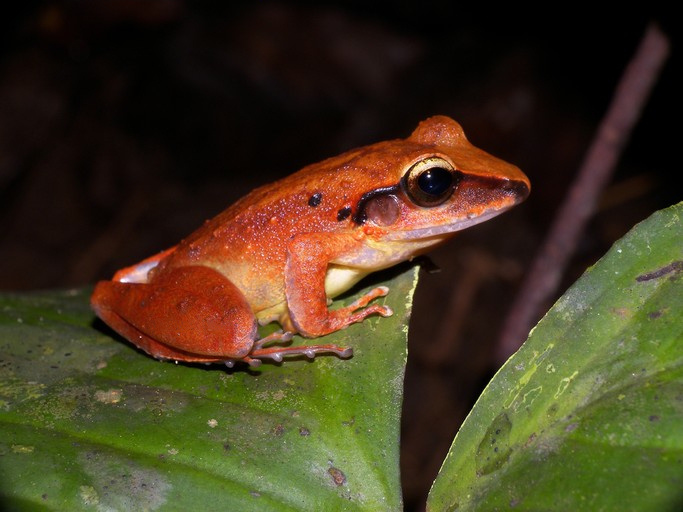 Fitzinger's Robber FrogCraugastor fitzingeri
- Sierra de Omoa Streamside FrogCraugastor omoaensis
-
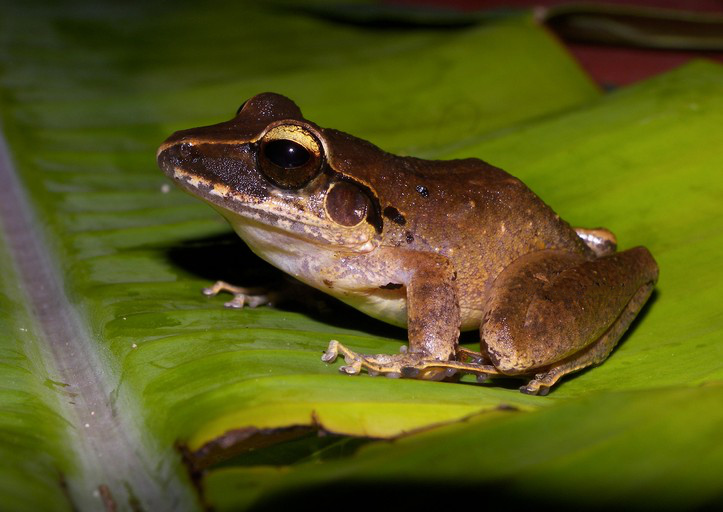 Robber FrogCraugastor raniformis
- McCranie's Robber FrogCraugastor chrysozetetes
- Yellow-legged Rain FrogCraugastor andi
Compare
Questions and answers
What is the scientific name of the Pacific Broad-headed Litter Frog?
The scientific name of the Pacific Broad-headed Litter Frog is Craugastor rugosus. Written with its author, the full name is Craugastor rugosus (Peters, 1873).
Which family does the Pacific Broad-headed Litter Frog belong to?
Craugastor rugosus belongs to the family Craugastoridae, in the order Anura and the class Amphibia.
Where is the Pacific Broad-headed Litter Frog found?
Checklists and occurrence records place Craugastor rugosus in 3 countries: Costa Rica, Panama and Nicaragua.
What is the conservation status of the Pacific Broad-headed Litter Frog?
The IUCN Red List category recorded for Craugastor rugosus is Least Concern (LC).
What other names does the Pacific Broad-headed Litter Frog have?
Craugastor rugosus is also known in English as Rugose Robber Frog and Veragua Robber Frog.
Sources
Passages the profile rests on
- The back is covered in warts and has an appearance resembling that of a toad. Source passage: “The dorsum (back) is covered in warts and the creature appears much like a toad.” — English Wikipedia
- The upper back bears hourglass-shaped ridges outlined by lighter-coloured stripes. Source passage: “There are hourglass-shaped ridges on the upper back, these are lined in lighter coloured stripes.” — English Wikipedia
- The digits of the limbs lack webbing. Source passage: “There is no webbing between the digits of the limbs.” — English Wikipedia
- The dorsal surface is dark brown, dark grey, or black. Source passage: “The dorsum is dark brown, dark grey, or black in colour.” — English Wikipedia
- The underside is mottled with brown, white, and red coloration. Source passage: “The ventral surface of the animal is mottled brown with white and red.” — English Wikipedia
- The undersides of the thighs can be yellowish or orange. Source passage: “The ventral surfaces of the thighs may be either yellowish or orange.” — English Wikipedia
- The inner thighs have alternating black and bright scarlet-red bars. Source passage: “The inner thighs are ornamented with alternating bars of black and bright scarlet red;” — English Wikipedia
- The groin has conspicuous white and black markings. Source passage: “The groin has bright white and black marks.” — English Wikipedia
- Juveniles initially have white-tipped dorsal warts that darken as they age. Source passage: “the dorsal warts are tipped in white at first but darken with age,” — English Wikipedia
- Juveniles have black-and-white barred inner thighs. Source passage: “the inner thighs are barred with white and black,” — English Wikipedia
- Juveniles have orange-red undersides of the legs and groin. Source passage: “the ventral surfaces of the legs and groin are orange-red.” — English Wikipedia
- Females can reach 69 mm in snout–vent length. Source passage: “females to 69 mm (2.7 in) in snout–vent length,” — English Wikipedia
- Males can reach 44 mm in snout–vent length. Source passage: “males to 44 mm (1.7 in)” — English Wikipedia
- The species occurs in humid and hot tropical lowland rainforests. Source passage: “humid and hot tropical lowland rainforests,” — English Wikipedia
- The species inhabits moist premontane forests. Source passage: “moist premontane forest,” — English Wikipedia
- The frog is usually found among forest leaf litter. Source passage: “It is usually found amongst the leaf litter of the forest.” — English Wikipedia
- The species can persist in heavily altered former forest habitats. Source passage: “heavily altered former forest habitats.” — English Wikipedia
- The species has been recorded at elevations between 10 and 1,220 metres above sea level. Source passage: “it is found at altitudes from 10 m (33 ft) to 1,220 m (4,000 ft) above sea level.” — English Wikipedia
- The species generally preys on beetles. Source passage: “generally preys on beetles,” — English Wikipedia
- The species may also prey on lizards and other frogs. Source passage: “but may also attack lizards and other frogs.” — English Wikipedia
- The frog has been observed hopping on the forest floor during daylight. Source passage: “It has been seen hopping on the forest floor during the day.” — English Wikipedia
- The species is considered likely to be an ambush predator. Source passage: “It is likely an ambush predator” — English Wikipedia
- The species is thought unlikely to produce a mating call. Source passage: “This frog is thought likely to not make a mating call.” — English Wikipedia
- The species was considered threatened by habitat loss by the IUCN in 2004. Source passage: “According to the IUCN it was threatened by habitat loss in 2004.” — English Wikipedia
Data
- Catalogue of Life, 2026-10-16 XR cc by
- Global Biodiversity Information Facility CC BY 4.0
- Wikidata CC0
- GeoNames CC BY 4.0
- Wikimedia Commons per image; credit shown with each image
- Within the Catalogue of Life, this name comes from The Integrated Taxonomic Information System cc0
This species in other databases
Page built on 29 November 2026. See how the catalog is made and all sources and licences.
Cite this page
ScientificNames.org. (2026). Craugastor rugosus (Pacific Broad-headed Litter Frog). Retrieved November 29, 2026, from https://scientificnames.org/species/craugastor-rugosus
“Craugastor rugosus (Pacific Broad-headed Litter Frog).” ScientificNames.org, 2026, scientificnames.org/species/craugastor-rugosus. Accessed 29 Nov. 2026.
ScientificNames.org. “Craugastor rugosus (Pacific Broad-headed Litter Frog).” Accessed November 29, 2026. https://scientificnames.org/species/craugastor-rugosus.
@misc{scientificnames_craugastor_rugosus_pacific_broad_headed_litter_frog,
  author = {{ScientificNames.org}},
  title = {Craugastor rugosus (Pacific Broad-headed Litter Frog)},
  year = {2026},
  url = {https://scientificnames.org/species/craugastor-rugosus},
  note = {Accessed 2026-11-29}
}