Species · Amphibians
Almirante Robber Frog Craugastor talamancae
The scientific name of the Almirante Robber Frog is Craugastor talamancae. It is a species of amphibian in the family Craugastoridae (robber frogs), order Anura. The name dates from 1931.
- Scientific name
- Craugastor talamancae (Dunn, 1931)
- Common name
- Almirante Robber Frog
- Genus
- Craugastor
- Family
- Craugastoridae (Robber Frogs)
- Order
- Anura
- Class
- Amphibia
- Red List category
- LC Least Concern
- Recorded in
- 2 countries
- Name status
- accepted in the Catalogue of Life

Overview
Craugastor talamancae occurs on the Atlantic versant of Panama and Costa Rica, and in southeastern Nicaragua. It typically has brown dorsal coloration, a dark bar through the eye, barred arms and legs, and white ventral surfaces.
Written 27 November 2026 from the sources listed below. Each statement was checked against the passage it cites; statements that could not be supported were removed.
Appearance
Males reach a snout–vent length of 30 mm, while females reach 50 mm. Its toes are moderately webbed.[1][2][3]
Its dorsal coloration is typically brown, with a characteristic dark bar extending through the eye and characteristic barring on the arms and legs. Its ventral surfaces are white, with some yellow coloration toward the posterior.[4][5][6][7]
Its throat may have a reddish coloration. The iris is golden in the upper portion and brown in the lower portion.[8][9]
Juveniles have a prominent white line along the lip.[10]
Habitat
The Almirante Robber Frog inhabits humid lowland and montane secondary forests, as well as humid lowland and montane old-growth forests. It occurs at elevations between 15 and 646 m above sea level.[11][12][13][14][15]
It can sometimes occur in modified habitats.[16]
Diet
Its diet consists of small arthropods other than hemipterans.[17]
Behaviour
The Almirante Robber Frog is nocturnal. It hides in leaf litter during the daytime and typically moves to low-lying vegetation at night.[18][19][20]
Males produce a high-pitched mew as their advertisement call.[21]
Conservation
The species is common in some parts of its range but has declined and become rare in others. It is recorded from several protected areas.[22][23][24]
Habitat loss caused by agricultural deforestation and logging threatens the species. Climate-driven reductions in standing leaf litter also threaten it.[25][26]
Chytrid fungus has been detected in the species. It was assessed for the IUCN Red List in 2014.[27][28]
Classification of the Almirante Robber Frog
| Kingdom | Animalia |
|---|---|
| Phylum | Chordata |
| Subphylum | Vertebrata |
| Infraphylum | Gnathostomata |
| Parvphylum | Osteichthyes |
| Megaclass | Tetrapoda |
| Class | Amphibia (Amphibians) |
| Order | Anura (Frogs) |
| Superfamily | Brachycephaloidea |
| Family | Craugastoridae (Robber Frogs) |
| Genus | Craugastor (Northern Rainfrogs) |
| Species | Craugastor talamancae (Dunn, 1931) |
Where the Almirante Robber Frog is found
Checklists and occurrence records place Craugastor talamancae in 2 countries. GBIF holds 886 georeferenced records of it.
Countries
Regions and cities with the most records
- Coclé, Panama 117
- Limón Province, Costa Rica 76
- Heredia Province, Costa Rica 68
- Bocas del Toro Province, Panama 31
- Panamá, Panama 19
- Siquirres, Costa Rica 11
- Alajuela Province, Costa Rica 7
- Changuinola, Panama 7
- Colón, Panama 7
- Guápiles, Costa Rica 6
- Los Santos Province, Panama 5
- Cartago Province, Costa Rica 4
- Cativá, Panama 4
- Sabanitas, Panama 4
- Guanacaste Province, Costa Rica 3
- Limón, Costa Rica 3
- Puntarenas Province, Costa Rica 3
- Veraguas Province, Panama 3
A number beside a place is its count of GBIF occurrence records. A place without a number comes from a checklist alone. Records show where a species has been observed or collected, which can include escapes and vagrants.
Common names
English
- Almirante Robber Frog
- White-lipped Rain Frog
Names in 2 other languages
- Italian
- Rana della pioggia labbra bianche
- Russian
- Длинноногая листовая лягушка
Synonyms
One other scientific name has been used for this species and is now treated as a synonym of Craugastor talamancae.
- Eleutherodactylus talamancae Dunn, 1931
Related species
-
 Barking FrogCraugastor augusti
- Craugastor myllomyllon
- Corquin Robber FrogCraugastor anciano
-
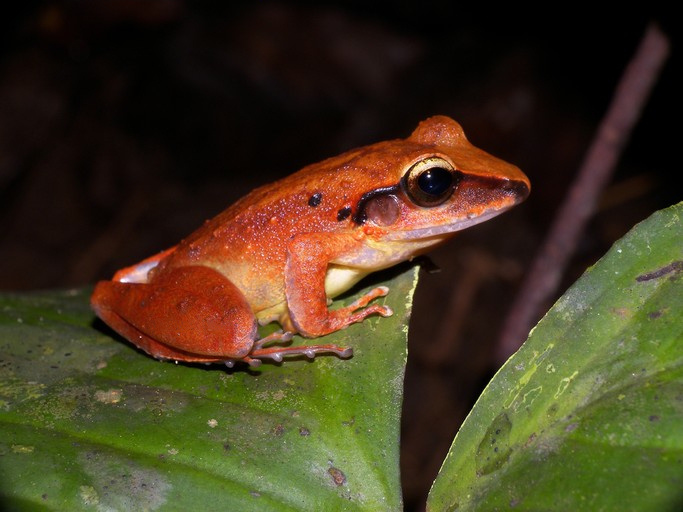 Fitzinger's Robber FrogCraugastor fitzingeri
- Sierra de Omoa Streamside FrogCraugastor omoaensis
-
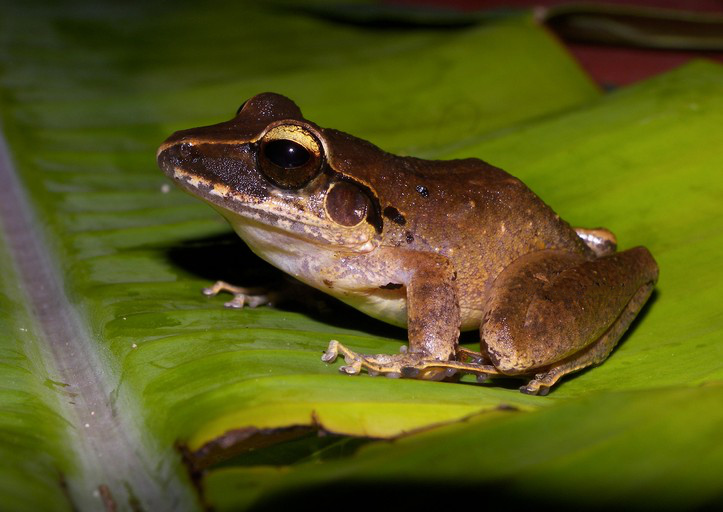 Robber FrogCraugastor raniformis
- McCranie's Robber FrogCraugastor chrysozetetes
- Yellow-legged Rain FrogCraugastor andi
Compare
Questions and answers
What is the scientific name of the Almirante Robber Frog?
The scientific name of the Almirante Robber Frog is Craugastor talamancae. Written with its author, the full name is Craugastor talamancae (Dunn, 1931).
Which family does the Almirante Robber Frog belong to?
Craugastor talamancae belongs to the family Craugastoridae, in the order Anura and the class Amphibia.
Where is the Almirante Robber Frog found?
Checklists and occurrence records place Craugastor talamancae in 2 countries: Panama and Costa Rica.
What is the conservation status of the Almirante Robber Frog?
The IUCN Red List category recorded for Craugastor talamancae is Least Concern (LC).
What other names does the Almirante Robber Frog have?
Craugastor talamancae is also known in English as White-lipped Rain Frog.
Sources
Passages the profile rests on
- Males reach a snout–vent length of 30 mm. Source passage: “Males grow to 30 mm (1.2 in) and females to 50 mm (2.0 in) in snout–vent length.” — English Wikipedia
- Females reach a snout–vent length of 50 mm. Source passage: “Males grow to 30 mm (1.2 in) and females to 50 mm (2.0 in) in snout–vent length.” — English Wikipedia
- Its toes are moderately webbed. Source passage: “The toes are moderately webbed.” — English Wikipedia
- Its dorsal coloration is typically brown. Source passage: “Dorsal color is typically brown.” — English Wikipedia
- A dark bar extending through the eye is characteristic of this species. Source passage: “A dark bar running through the eye and barring on the arms and legs is characteristic for this species.” — English Wikipedia
- Its arms and legs have characteristic barring. Source passage: “A dark bar running through the eye and barring on the arms and legs is characteristic for this species.” — English Wikipedia
- Its ventral surfaces are white, with some yellow coloration toward the posterior. Source passage: “The ventral surfaces are white, with some yellow coloration towards the posterior parts.” — English Wikipedia
- Its throat may have a reddish coloration. Source passage: “The throat may have a reddish shade.” — English Wikipedia
- Its iris is golden in the upper portion and brown in the lower portion. Source passage: “The iris is golden above and brown below.” — English Wikipedia
- Juveniles have a prominent white line along the lip. Source passage: “Juveniles have a prominent white lip line.” — English Wikipedia
- The species inhabits humid lowland secondary forests. Source passage: “Craugastor talamancae in humid lowland and montane secondary and old growth forests at elevations of 15–646 m (49–2,119 ft) above sea level.” — English Wikipedia
- The species inhabits humid montane secondary forests. Source passage: “Craugastor talamancae in humid lowland and montane secondary and old growth forests at elevations of 15–646 m (49–2,119 ft) above sea level.” — English Wikipedia
- The species occurs in humid lowland old-growth forests. Source passage: “Craugastor talamancae in humid lowland and montane secondary and old growth forests at elevations of 15–646 m (49–2,119 ft) above sea level.” — English Wikipedia
- The species occurs in humid montane old-growth forests. Source passage: “Craugastor talamancae in humid lowland and montane secondary and old growth forests at elevations of 15–646 m (49–2,119 ft) above sea level.” — English Wikipedia
- It occurs at elevations between 15 and 646 m above sea level. Source passage: “Craugastor talamancae in humid lowland and montane secondary and old growth forests at elevations of 15–646 m (49–2,119 ft) above sea level.” — English Wikipedia
- It can sometimes occur in modified habitats. Source passage: “It can sometimes occur in modified habitats.” — English Wikipedia
- Its diet consists of small arthropods other than hemipterans. Source passage: “The diet consists of small arthropods other than hemipterans.” — English Wikipedia
- The species is nocturnal. Source passage: “It is a nocturnal frog that hides in leaf litter during the day, but typically moves to low-lying vegetation at night.” — English Wikipedia
- It hides in leaf litter during the daytime. Source passage: “It is a nocturnal frog that hides in leaf litter during the day, but typically moves to low-lying vegetation at night.” — English Wikipedia
- It typically moves to low-lying vegetation at night. Source passage: “It is a nocturnal frog that hides in leaf litter during the day, but typically moves to low-lying vegetation at night.” — English Wikipedia
- Males produce a high-pitched mew as their advertisement call. Source passage: “The male advertisement call is a high-pitched mew.” — English Wikipedia
- The species is common in some parts of its range. Source passage: “Craugastor talamancae is common in parts of its range but has declined and is rare in others.” — English Wikipedia
- The species has declined and become rare in some parts of its range. Source passage: “Craugastor talamancae is common in parts of its range but has declined and is rare in others.” — English Wikipedia
- The species is recorded from several protected areas. Source passage: “It is known from several protected areas.” — English Wikipedia
- Habitat loss caused by agricultural deforestation and logging threatens the species. Source passage: “It is threatened by habitat loss (deforestation caused by agriculture and logging).” — English Wikipedia
- Climate-driven reductions in standing leaf litter threaten the species. Source passage: “It is also threatened by climate-driven reductions in quantity of standing leaf litter.” — English Wikipedia
- Chytrid fungus has been detected in the species. Source passage: “Chytrid fungus has also been detected in the species.” — English Wikipedia
- The species was assessed for the IUCN Red List in 2014. Source passage: “Almirante Robber Frog Craugastor talamancae has most recently been assessed for The IUCN Red List of Threatened Species in 2014.” — iucnredlist.org
Data
- Catalogue of Life, 2026-10-16 XR cc by
- Global Biodiversity Information Facility CC BY 4.0
- Wikidata CC0
- GeoNames CC BY 4.0
- Wikimedia Commons per image; credit shown with each image
- Within the Catalogue of Life, this name comes from The Integrated Taxonomic Information System cc0
This species in other databases
Page built on 29 November 2026. See how the catalog is made and all sources and licences.
Cite this page
ScientificNames.org. (2026). Craugastor talamancae (Almirante Robber Frog). Retrieved November 29, 2026, from https://scientificnames.org/species/craugastor-talamancae
“Craugastor talamancae (Almirante Robber Frog).” ScientificNames.org, 2026, scientificnames.org/species/craugastor-talamancae. Accessed 29 Nov. 2026.
ScientificNames.org. “Craugastor talamancae (Almirante Robber Frog).” Accessed November 29, 2026. https://scientificnames.org/species/craugastor-talamancae.
@misc{scientificnames_craugastor_talamancae_almirante_robber_frog,
  author = {{ScientificNames.org}},
  title = {Craugastor talamancae (Almirante Robber Frog)},
  year = {2026},
  url = {https://scientificnames.org/species/craugastor-talamancae},
  note = {Accessed 2026-11-29}
}