Species · Birds
Pale-browed Tinamou Crypturellus transfasciatus
The scientific name of the Pale-browed Tinamou is Crypturellus transfasciatus. It is a species of bird in the family Tinamidae (tinamou), order Tinamiformes. The name dates from 1878.
- Scientific name
- Crypturellus transfasciatus (P. L. Sclater & Salvin, 1878)
- Common name
- Pale-browed Tinamou
- Genus
- Crypturellus
- Family
- Tinamidae (Tinamou)
- Order
- Tinamiformes
- Class
- Aves
- Red List category
- NT Near Threatened
- Recorded in
- 2 countries
- Name status
- accepted in the Catalogue of Life

Overview
Crypturellus transfasciatus inhabits arid regions of western Ecuador and northwestern Peru along the Pacific slope, at elevations of up to 1,500 m. It has a prominent white supercilium, pink legs and a very plump body that appears to lack a tail.
Written 26 November 2026 from the sources listed below. Each statement was checked against the passage it cites; statements that could not be supported were removed.
Appearance
The Pale-browed Tinamou has greyish-brown upperparts finely marked with black vermiculations, a white throat, greyish to buffy underparts and barred flanks. It has a brown crown, a prominent white supercilium and pink legs.[1]
The species has a very plump body and appears to lack a tail. It measures approximately 28 cm in length.[2][3]
Habitat
The Pale-browed Tinamou inhabits subtropical and tropical arid forests at elevations reaching 1,500 m. It is characteristic of dry forests and is associated with the Ecuadorian dry forests and Tumbes–Piura dry forests ecoregions.[4][5][6]
The species occurs in western Ecuador and northwestern Peru. Its Ecuadorian distribution includes southern Manabí, Guayas, coastal and extreme western El Oro, and extreme northwestern Loja.[7][8]
Its Peruvian distribution includes Tumbes and western Piura, excluding coastal areas. It occurs in arid regions along the Pacific slope as far south as Lambayeque.[9][10]
Diet
The Pale-browed Tinamou feeds on fruit collected from the ground or low-growing bushes. It also consumes small quantities of invertebrates, flower buds, tender leaves, seeds and roots.[11][12]
Behaviour
The Pale-browed Tinamou walks on the forest floor and is secretive.[13]
Reproduction and life cycle
The species nests on the ground in dense brush or among raised root buttresses. Males incubate eggs that may originate from as many as five different females.[14][15]
Males raise the chicks until they are capable of independence.[16]
Conservation
The Pale-browed Tinamou is classified as Near Threatened by the IUCN and has a decreasing population. Its occurrence range is approximately 41,900 km².[17][18][19]
Widespread deforestation and habitat degradation threaten the species. Livestock overgrazing and logging contribute to habitat degradation affecting its population.[20][21]
Hunting for food is an additional threat. Agricultural activities also contribute to population losses, although they are the least significant listed threat.[22][23]
Classification of the Pale-browed Tinamou
| Kingdom | Animalia |
|---|---|
| Phylum | Chordata |
| Subphylum | Vertebrata |
| Infraphylum | Gnathostomata |
| Parvphylum | Osteichthyes |
| Megaclass | Tetrapoda |
| Class | Aves (Bird) |
| Order | Tinamiformes (Tinamou) |
| Family | Tinamidae (Tinamou) |
| Genus | Crypturellus (Crypturellus Tinamous) |
| Species | Crypturellus transfasciatus (P. L. Sclater & Salvin, 1878) |
Where the Pale-browed Tinamou is found
Checklists and occurrence records place Crypturellus transfasciatus in 2 countries across South America. GBIF holds 3,904 georeferenced records of it.
Countries
Regions and cities with the most records
- Loja, Ecuador 1,155
- Manabí, Ecuador 943
- Guayas, Ecuador 761
- Tumbes, Peru 377
- Guayaquil, Ecuador 376
- Piura, Peru 317
- Portoviejo, Ecuador 237
- Santa Elena, Ecuador 160
- Eloy Alfaro, Ecuador 157
- El Oro, Ecuador 102
- El Triunfo, Ecuador 98
- Daule, Ecuador 89
- Arenillas, Ecuador 86
- Chone, Ecuador 53
- Zarumilla, Peru 53
- Calceta, Ecuador 52
- La Breita, Peru 52
- Huaquillas, Ecuador 46
- Los Ríos, Ecuador 43
- Santa Rosa, Ecuador 35
- Tumbes, Peru 27
- Jipijapa, Ecuador 26
- Montecristi, Ecuador 25
- Bahía de Caráquez, Ecuador 24
- Pedro Carbo, Ecuador 12
- Vinces, Ecuador 11
- Lambayeque, Peru 10
- Manta, Ecuador 10
- Playas, Ecuador 10
- Ventanas, Ecuador 10
- Cariamanga, Ecuador 9
- Sucre, Ecuador 8
- Machala, Ecuador 7
- Santa Elena, Ecuador 6
- Chulucanas, Peru 5
- La Libertad, Ecuador 5
Range as the checklists state it
South America
A number beside a place is its count of GBIF occurrence records. A place without a number comes from a checklist alone. Records show where a species has been observed or collected, which can include escapes and vagrants.
Common names
English
- Pale-browed Tinamou
Names in 26 other languages
- Arabic
- تنام شاحب الجبين
- Catalan
- tinamú cellut
- Chinese
- 淡眉穴䳍, 蒼眉穴(共鳥)
- Croatian
- obrvasti tinamu
- Czech
- tinama světlebrvá
- Danish
- Lysbrynet Tinamu
- Dutch
- Wenkbrauwtinamoe
- Esperanto
- palbrova tinamo
- Estonian
- valgekulm-metstinamu
- Finnish
- valkokulmatinami
- French
- Tinamou à grands sourcils
- German
- Brauentinamu
- Italian
- Tinamo dai sopraccigli
- Japanese
- マミジロシギダチョウ
- Lithuanian
- Baltaburvis tinamas, baltabruvis tinamas
- Norwegian
- hvitbryntinamu
- Polish
- kusacz jasnobrewy
- Portuguese
- Inhambu-de-sobrancelhas-claras, inambu-de-sobrancelhas-claras, inhambu-de-sobrancelhas, tinamu-de-sobrancelha
- Russian
- Тусклый криптуреллус, Тусклый скрытохвост
- Serbian
- Tinamu sa svetlom obrvom
- Slovak
- tinama dažďová
- Spanish
- Perdiz de Ceja Pálida, Tinamú cejudo
- Swedish
- ljusbrynad tinamo
- Turkish
- Sürmeli Tinamu
- Ukrainian
- татаупа білобровий
- Welsh
- tinamŵ aelwyn
Synonyms
5 other scientific names have been used for this species and are now treated as synonyms of Crypturellus transfasciatus.
- Crypturellus rubripes Taczanowski, W, 1886
- Crypturellus transfasciatus rubripes Taczanowski, W, 1886
- Crypturellus transfasciatus transfasciatus Salvin, O; Sclater, PL, 1878
- Crypturus rubripes Taczanowski, W, 1886
- Crypturus transfasciatus Salvin, O; Sclater, PL, 1878
Related species
-
 Little TinamouCrypturellus soui
-
 Brown TinamouCrypturellus obsoletus
-
 Tataupa TinamouCrypturellus tataupa
-
 Cinereous TinamouCrypturellus cinereus
-
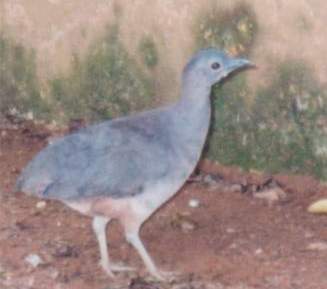 Undulated TinamouCrypturellus undulatus
-
 Thicket TinamouCrypturellus cinnamomeus
-
 Small-billed TinamouCrypturellus parvirostris
-
 Slaty-breasted TinamouCrypturellus boucardi
Compare
Questions and answers
What is the scientific name of the Pale-browed Tinamou?
The scientific name of the Pale-browed Tinamou is Crypturellus transfasciatus. Written with its author, the full name is Crypturellus transfasciatus (P. L. Sclater & Salvin, 1878).
Which family does the Pale-browed Tinamou belong to?
Crypturellus transfasciatus belongs to the family Tinamidae, in the order Tinamiformes and the class Aves.
Where is the Pale-browed Tinamou found?
Checklists and occurrence records place Crypturellus transfasciatus in 2 countries: Ecuador and Peru.
What is the conservation status of the Pale-browed Tinamou?
The IUCN Red List category recorded for Crypturellus transfasciatus is Near Threatened (NT).
Sources
Passages the profile rests on
- The species has greyish-brown upperparts finely marked with black vermiculations, a white throat, greyish to buffy underparts, barred flanks, a brown crown, a prominent white supercilium, and pink legs. Source passage: “greyish-brown upper coat which is finely vermiculated with black, and a white throat, with the remainder of its underparts greyish to buffy. Its flanks are barred, and it has a very brown crown, and a prominent white supercilium. Its legs are pink.” — English Wikipedia
- The species measures approximately 28 cm in length. Source passage: “The pale-browed tinamou is approximately 28 cm (11 in) in length.” — English Wikipedia
- The species has a very plump body and appears to lack a tail. Source passage: “Very plump; looks tailless.” — ebird.org
- The species inhabits subtropical and tropical arid forests at elevations reaching 1,500 m. Source passage: “found in subtropical and tropical arid forests up to 1,500 m (4,900 ft) in altitude.” — English Wikipedia
- The species is associated with the Ecuadorian dry forests and Tumbes–Piura dry forests ecoregions. Source passage: “It inhabits the Ecuadorian dry forests and Tumbes–Piura dry forests ecoregions.” — English Wikipedia
- The species is characteristic of dry forests. Source passage: “A distinctive tinamou of dry forests” — ebird.org
- The species occurs in western Ecuador and northwestern Peru. Source passage: “This species is native to western Ecuador” — English Wikipedia
- Its Ecuadorian distribution includes southern Manabí, Guayas, coastal and extreme western El Oro, and extreme northwestern Loja. Source passage: “southern Manabí, Guayas, coastal and extreme western El Oro, and extreme northwestern Loja” — English Wikipedia
- Its Peruvian distribution includes Tumbes and western Piura, excluding coastal areas. Source passage: “Tumbes and western (except coastal) Piura.” — English Wikipedia
- The species occurs in arid regions of western Ecuador and northwestern Peru along the Pacific slope as far south as Lambayeque. Source passage: “Crypturellus transfasciatus occurs in arid regions of west Ecuador and north-west Peru (on the Pacific slope to Lambayeque)” — datazone.birdlife.org
- The species feeds on fruit collected from the ground or low-growing bushes. Source passage: “eats fruit off the ground or low-lying bushes” — English Wikipedia
- The species also consumes small quantities of invertebrates, flower buds, tender leaves, seeds, and roots. Source passage: “small amounts of invertebrates, flower buds, tender leaves, seeds, and roots.” — English Wikipedia
- The species walks on the forest floor and is secretive. Source passage: “Secretive chickenlike bird that walks on the ground inside forest.” — ebird.org
- Males incubate eggs that may originate from as many as five different females. Source passage: “The male incubates the eggs which may come from as many as 5 different females” — English Wikipedia
- The species nests on the ground in dense brush or among raised root buttresses. Source passage: “The nest is located on the ground in dense brush or between raised root buttresses.” — English Wikipedia
- Males raise the chicks until they are capable of independence. Source passage: “and then will raise them until they are ready to be on their own.” — English Wikipedia
- The species is classified as Near Threatened by the IUCN. Source passage: “The IUCN classifies the pale-browed tinamou as Near Threatened” — English Wikipedia
- The species has a decreasing population. Source passage: “as their numbers are decreasing.” — English Wikipedia
- The species has an occurrence range of approximately 41,900 km². Source passage: “The occurrence range of this species is 41,900 km2 (16,200 sq mi).” — English Wikipedia
- Widespread deforestation and habitat degradation threaten the species. Source passage: “currently threatened by widespread deforestation and habitat degradation” — English Wikipedia
- Livestock overgrazing and logging contribute to habitat degradation affecting the species. Source passage: “habitat degradation caused by livestock overgrazing, and also logging.” — English Wikipedia
- Hunting for food is an additional threat to the species. Source passage: “This species is also threatened by people hunting it for food.” — English Wikipedia
- Agricultural activities also contribute to population losses, although they are identified as the least significant listed threat. Source passage: “It also is suffering losses due to farming, however this is the least of the threats.” — English Wikipedia
Data
- Catalogue of Life, 2026-10-16 XR cc by
- Global Biodiversity Information Facility CC BY 4.0
- Wikidata CC0
- GeoNames CC BY 4.0
- Wikimedia Commons per image; credit shown with each image
- Within the Catalogue of Life, this name comes from The Integrated Taxonomic Information System cc0
References
- Dickinson, Edward C., ed. (2003). The Howard and Moore Complete Checklist of the Birds of the World, 3rd Edition.
- Gill, Frank, & and Minturn Wright. (2006). Birds of the World: Recommended English Names.
This species in other databases
Page built on 27 November 2026. See how the catalog is made and all sources and licences.
Cite this page
ScientificNames.org. (2026). Crypturellus transfasciatus (Pale-browed Tinamou). Retrieved November 27, 2026, from https://scientificnames.org/species/crypturellus-transfasciatus
“Crypturellus transfasciatus (Pale-browed Tinamou).” ScientificNames.org, 2026, scientificnames.org/species/crypturellus-transfasciatus. Accessed 27 Nov. 2026.
ScientificNames.org. “Crypturellus transfasciatus (Pale-browed Tinamou).” Accessed November 27, 2026. https://scientificnames.org/species/crypturellus-transfasciatus.
@misc{scientificnames_crypturellus_transfasciatus_pale_browed_tinamou,
  author = {{ScientificNames.org}},
  title = {Crypturellus transfasciatus (Pale-browed Tinamou)},
  year = {2026},
  url = {https://scientificnames.org/species/crypturellus-transfasciatus},
  note = {Accessed 2026-11-27}
}