Species · Birds
Himalayan Cuckoo Cuculus saturatus
The scientific name of the Himalayan Cuckoo is Cuculus saturatus. It is a species of bird in the family Cuculidae (cuckoo), order Cuculiformes. The name dates from 1843.
- Scientific name
- Cuculus saturatus Blyth, 1843
- Common name
- Himalayan Cuckoo
- Genus
- Cuculus
- Family
- Cuculidae (Cuckoo)
- Order
- Cuculiformes
- Class
- Aves
- Red List category
- LC Least Concern
- Recorded in
- 23 countries
- Name status
- accepted in the Catalogue of Life

Overview
The breeding range extends from the Himalayas eastward to southern China and Taiwan, and it migrates to Southeast Asia and the Greater Sunda Islands for winter. It is a brood parasite that lays its eggs individually in the nests of other bird species.
Written 26 November 2026 from the sources listed below. Each statement was checked against the passage it cites; statements that could not be supported were removed.
Similar species
The Himalayan Cuckoo differs from the Common Cuckoo in having broader and more widely spaced black wing bars.[1]
Appearance
Adult males have dark ashy-grey upperparts and a brown, almost black tail with white spots and tips. Their throats and breasts are ash-grey, while the lower breasts and abdomens are white with black bars.[2][3]
The legs and feet range from yellow to orange. The eye-ring is yellow, the irises range from yellow to brown, and the bill is black with an orange-yellow or green-yellow base.[4][5][6]
Females resemble males but may have a rufous tinge on the breast and sometimes on the rump and upper tail-coverts. Juveniles have slate-grey upperparts with white edges and white-and-black barred underparts.[7][8]
Both sexes occur in grey and hepatic plumage morphs.[9]
The species measures approximately 30–35 cm in length and weighs approximately 70–140 g.[10][11]
Habitat
During spring and summer, the Himalayan Cuckoo inhabits mixed coniferous and deciduous forests, thickets, birch habitats, mountain forests, wooded steppes and orchards.[12]
In Kashmir, Myanmar and Nepal, it commonly occurs above the tree line at elevations of 1,500–3,300 m. In southwest China, it has been recorded at elevations reaching 4,500 m.[13][14]
During colder seasons, it inhabits primary and secondary tropical forests, savannas, gardens, teak plantations and monsoon rainforests. It has also been recorded in swamps and mangroves.[15][16]
Diet
The Himalayan Cuckoo feeds mainly on insects, particularly hairy and hairless caterpillars. Recorded caterpillar prey families include Arctiidae, Lasiocampidae, Sphingidae, Saturnidae and Noctuidae.[17][18]
Before eating caterpillars, it removes their gut contents. Other recorded animal foods include grasshoppers, large beetles, spiders, stick-insects, crickets, mantids, flies and ants.[19][20]
The species also consumes certain fruits, pine shoots and pine needles. It occasionally eats eggs and nestlings of other birds, including Asian Stubtails and Grey-cheeked Fulvettas.[21][22]
Behaviour
The Himalayan Cuckoo generally forages in trees but also searches for food on forest floors, grassy landscapes and lawns. Individuals generally forage alone and sometimes make short aerial sallies to catch prey.[23][24]
Small groups gather at abundant food sources and remain until the food is exhausted. At least 300 individuals were observed during a teak moth infestation in New Guinea.[25][26]
Males are frequently recorded calling at dawn and dusk from elevated lookouts or while flying. Their calls consist of a high note followed by three lower, flat notes.[27][28]
Females produce a bubbling call described as 'quick-quick-quick'.[29]
Reproduction and life cycle
The Himalayan Cuckoo is a brood parasite that lays its eggs in the nests of other bird species. A female may lay approximately fifteen eggs in separate locations, placing them individually.[30][31]
Common host bird families include flycatchers, shrikes and white-eyes. The eggs are incubated and the chicks are raised by the host birds, which feed young cuckoos insects and larvae.[32][33][34]
A newly hatched cuckoo may push other eggs and chicks out of its host nest.[35]
Egg coloration ranges from pale blue to white, with fine black, brown or red stippling. Reported egg dimensions include 20–25 mm by 12–16 mm and 19–22 mm by 13–16 mm.[36][37]
Breeding in Kashmir generally occurs from May through June. In Nepal, breeding generally occurs from March through August.[38][39]
Prinia flaviventris is the only recorded host species in Taiwan.[40]
Uses
The breeding range extends from the Himalayas eastward to southern China and Taiwan. The species migrates to Southeast Asia and the Greater Sunda Islands for winter.[41][42]
During warm weather, the species occurs in northeast Pakistan and the northern Indian subcontinent. It is recorded in Thailand, Taiwan, Nepal, Assam, Kashmir and Burma.[43][44]
Its recorded winter distribution includes Malaysia, the Philippines, Indonesia and New Guinea. During the non-breeding season, it occurs in Southeast Asia, the Greater Sundas and the Philippines.[45][46]
The species was formerly included under the name Oriental Cuckoo.[47]
Conservation
The Himalayan Cuckoo is classified as Least Concern and is not considered globally threatened. Population numbers depend on the condition of forest habitats.[48][49]
It is described as a common local bird that is widely dispersed throughout the Himalayas.[50]
Classification of the Himalayan Cuckoo
| Kingdom | Animalia |
|---|---|
| Phylum | Chordata |
| Subphylum | Vertebrata |
| Infraphylum | Gnathostomata |
| Parvphylum | Osteichthyes |
| Megaclass | Tetrapoda |
| Class | Aves (Bird) |
| Order | Cuculiformes (Cuckoo) |
| Family | Cuculidae (Cuckoo) |
| Genus | Cuculus (Eurasian Cuckoos) |
| Species | Cuculus saturatus Blyth, 1843 |
Where the Himalayan Cuckoo is found
Checklists and occurrence records place Cuculus saturatus in 23 countries across Asia, North America and Oceania. GBIF holds 23,180 georeferenced records of it.
Countries
- Australia 8
- Bangladesh 6
- Bhutan 1,798
- Cambodia 276
- China 1,919
- India 7,473
- Indonesia 179
- Japan 309
- Laos 10
- Malaysia 52
- Mongolia 6
- Myanmar 32
- Nepal 1,387
- North Korea 4
- Pakistan 39
- Papua New Guinea 4
- Philippines 29
- Russia 362
- Singapore 120
- South Korea 3,272
- Taiwan 5,031
- Thailand 761
- Vietnam 103
Regions and cities with the most records
- Taiwan, Taiwan 3,145
- Uttarakhand, India 1,802
- West Bengal, India 1,019
- Gangwon-do, South Korea 939
- Yilan, Taiwan 917
- Sichuan, China 876
- Sikkim, India 806
- Kathmandu, Nepal 680
- Madhyapur Thimi, Nepal 679
- Pātan, Nepal 657
- Gyeongsangbuk-do, South Korea 651
- Ki̇̄rtipur, Nepal 650
- Neihu, Taiwan 617
- Kālimpong, India 566
- Taipei, Taiwan 556
- Banqiao, Taiwan 548
- Xizhi, Taiwan 511
- Shulin, Taiwan 469
- New Taipei City, Taiwan 464
- Himachal Pradesh, India 450
- Mongar, Bhutan 431
- Mussoorie, India 402
- Kurseong, India 391
- Gangtok, India 390
- Banepā, Nepal 381
- Dhulikhel, Nepal 368
- Gyeonggi-do, South Korea 366
- Panauti̇̄, Nepal 363
- Panauti, Nepal 362
- Dārjiling, India 358
- Sanzhi, Taiwan 358
- Rāipur, India 352
- Dehradun, India 347
- Puli, Taiwan 344
- Naini Tāl, India 343
- Zhushan, Taiwan 329
Range as the checklists state it
North America
Southern Asia
Oceania
A number beside a place is its count of GBIF occurrence records. A place without a number comes from a checklist alone. Records show where a species has been observed or collected, which can include escapes and vagrants.
Common names
English
- Himalayan Cuckoo
- Oriental Cuckoo
Names in 37 other languages
- Arabic
- وقواق الهيمالايا
- Breton
- Koukoug ar reter
- Catalan
- cucut oriental
- Chinese
- 中杜鵑, 中杜鹃, 喜馬拉雅中杜鵑, 筒鳥
- Croatian
- azijska kukavica
- Czech
- kukačka dudkohlasá, kukačka prostřední
- Danish
- Skovgøg
- Dutch
- Himalayakoekoek
- Esperanto
- Orienta kukolo, himalaja kukolo
- Estonian
- lõuna-taigakägu
- Finnish
- idänkäki, kiinanidänkäki
- French
- Coucou de l'Himalaya, Coucou de l’Himalaya, Coucou oriental
- German
- Himalajakuckuck, Himalayakuckuck, Hopfkuckuck
- Hebrew
- קוקיה הימלאית
- Hungarian
- keleti kakukk
- Icelandic
- Tágagaukur
- Indonesian
- Kangkok ranting
- Irish
- Cuach oirthearach
- Italian
- Cuculo dell'Himalaya
- Japanese
- ツツドリ, ヒマラヤツツドリ
- Korean
- 남방벙어리뻐꾸기, 벙어리뻐꾸기
- Latvian
- Himalaju dzeguze
- Lithuanian
- kurčioji gegutė
- Northern Sami
- Taigagiehka
- Norwegian
- orientgjøk
- Polish
- kukułka wschodnia
- Portuguese
- cuco-do-himalaia, cuco-dos-himalaias, cuco-oriental
- Russian
- Гималайская кукушка, Глухая Кукушка
- Serbian
- Himalajska kukavica
- Slovak
- kukučka dutohlasá
- Slovenian
- ruska kukavica
- Spanish
- Cuco oriental
- Swedish
- himalayagök
- Thai
- นกคัคคูพันธุ์หิมาลัย
- Turkish
- Tayga Guguğu
- Ukrainian
- зозуля глуха
- Welsh
- cog ddwyreiniol
Synonyms
3 other scientific names have been used for this species and are now treated as synonyms of Cuculus saturatus.
- Cuculus kelungensis Swinhoe, R, 1863
- Cuculus saturatus saturatus Blyth, 1843
- Cuculus waigoui Mathews, GM, 1918
Related species
- Common CuckooCuculus canorus
-
 Red-chested CuckooCuculus solitarius
-
 Indian CuckooCuculus micropterus
-
 African CuckooCuculus gularis
-
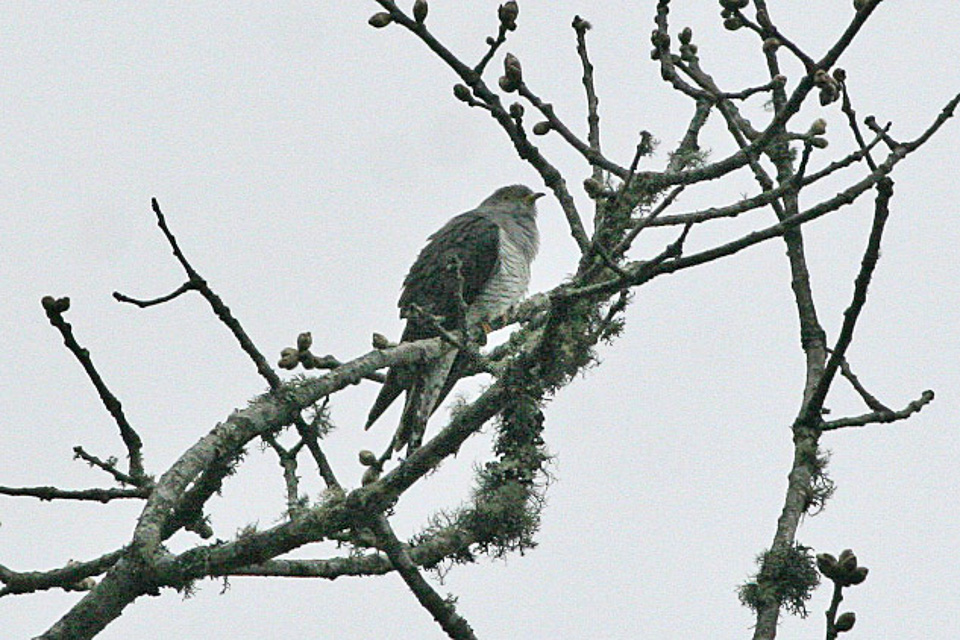 Lesser CuckooCuculus poliocephalus
-
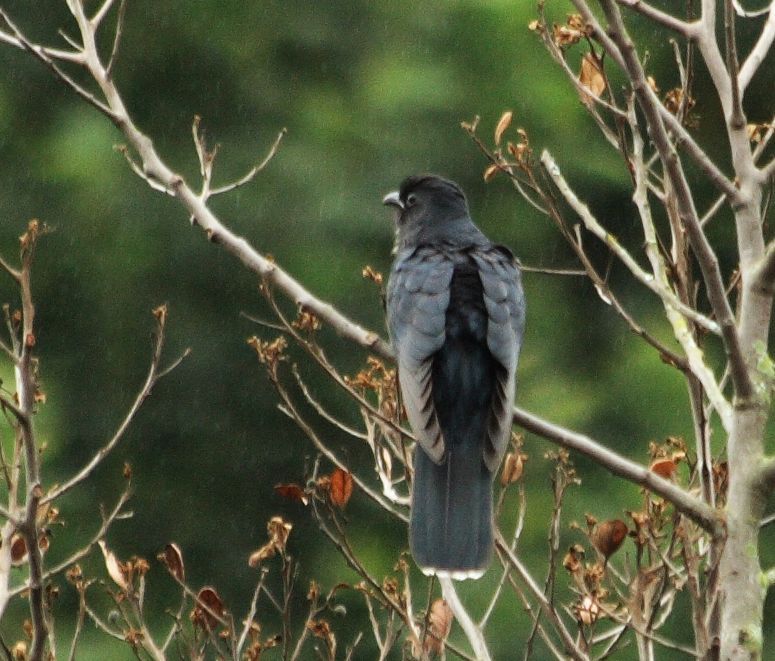 Black CuckooCuculus clamosus
-
 Oriental CuckooCuculus optatus
-
 Madagascar CuckooCuculus rochii
Compare
Questions and answers
What is the scientific name of the Himalayan Cuckoo?
The scientific name of the Himalayan Cuckoo is Cuculus saturatus. Written with its author, the full name is Cuculus saturatus Blyth, 1843.
Which family does the Himalayan Cuckoo belong to?
Cuculus saturatus belongs to the family Cuculidae, in the order Cuculiformes and the class Aves.
Where is the Himalayan Cuckoo found?
Checklists and occurrence records place Cuculus saturatus in 23 countries, including India, Taiwan, South Korea, China, Bhutan and Nepal.
What is the conservation status of the Himalayan Cuckoo?
The IUCN Red List category recorded for Cuculus saturatus is Least Concern (LC).
What other names does the Himalayan Cuckoo have?
Cuculus saturatus is also known in English as Oriental Cuckoo.
What food does a cuckoo eat?
The Himalayan Cuckoo feeds mainly on insects, particularly hairy and hairless caterpillars. It also eats grasshoppers, large beetles, spiders, stick-insects, crickets, mantids, flies, ants, certain fruits, pine shoots and pine needles. It occasionally eats eggs and nestlings of other birds.[17][18][20][21][22]
What are the habits of a cuckoo bird?
The Himalayan Cuckoo generally forages alone in trees but also searches for food on forest floors, grassy landscapes and lawns. It sometimes makes short aerial sallies to catch prey, while small groups gather at abundant food sources. Males frequently call at dawn and dusk.[23][24][25][27]
Sources
Passages the profile rests on
- The Himalayan Cuckoo differs from the Common Cuckoo in having broader and more widely spaced black wing bars. Source passage: “but has wings with much broader and widely spaced black bars.” — English Wikipedia
- Adult males have dark ashy-grey upperparts and a brown, almost black tail with white spots and tips. Source passage: “Adult male Himalayan cuckoos are dark ashy-grey above with a brown, almost black, tail that is whitely spotted and tipped.” — English Wikipedia
- Adult males have ash-grey throats and breasts, with white lower breasts and abdomens marked by black bars. Source passage: “The area from their chins to the breast is ash-grey, with their lower breast and abdomen being white with black bars” — English Wikipedia
- The legs and feet range in color from yellow to orange. Source passage: “Legs and feet range between yellow and orange.” — English Wikipedia
- The eye-ring is yellow, while the irises range from yellow to brown. Source passage: “The eye-ring is yellow with yellow to brown irises” — English Wikipedia
- The bill is black with an orange-yellow or green-yellow base. Source passage: “Bills are black with an orange-yellow or green-yellow base.” — English Wikipedia
- Females resemble males but may have a rufous tinge on the breast and sometimes on the rump and upper tail-coverts. Source passage: “Females are almost the same, but with rufous tinge to breast, and sometimes the rump and upper tail-coverts rufous with dark bars.” — English Wikipedia
- Juveniles have slate-grey upperparts with white edges and white-and-black barred underparts. Source passage: “Juveniles have brown irises and are slate grey above with white edges, barred white and black below” — English Wikipedia
- Both sexes occur in grey and hepatic plumage morphs. Source passage: “There are two plumage morphs in both sexes of which are grey and hepatic” — English Wikipedia
- The species measures approximately 30–35 cm in length. Source passage: “Their size approximately 30–35 cm and 70–140 g.” — English Wikipedia
- The species weighs approximately 70–140 g. Source passage: “Their size approximately 30–35 cm and 70–140 g.” — English Wikipedia
- During spring and summer, the species inhabits mixed coniferous and deciduous forests, thickets, birch habitats, mountain forests, wooded steppes and orchards. Source passage: “The species usually inhabits mixed coniferous and deciduous forests, thickets, birches and mountain forests or steppes with bushes and other wooded areas and orchards during the spring and summer seasons.” — English Wikipedia
- In Kashmir, Myanmar and Nepal, the species commonly occurs above the tree line at elevations of 1,500–3,300 m. Source passage: “Usually occurring above tree-lines of 1500m to 3300m in Kashmir, Myanmar and Nepal” — English Wikipedia
- In southwest China, the species has been recorded at elevations reaching 4,500 m. Source passage: “and even up to 4500m in southwest China.” — English Wikipedia
- During colder seasons, the species inhabits primary and secondary tropical forests, savannas, gardens, teak plantations and monsoon rainforests. Source passage: “For the colder seasons, it lives in primary and secondary tropical forests, savannas, gardens and teak on plantations, monsoon rainforests.” — English Wikipedia
- The species has also been recorded in swamps and mangroves. Source passage: “it is found in swamps, mangroves and plantations of Australia” — English Wikipedia
- The species feeds mainly on insects, particularly both hairy and hairless caterpillars. Source passage: “The diet of a Himalayan cuckoo consists mainly of insects—especially caterpillars, both hairless and hairy alike across several families” — English Wikipedia
- Recorded caterpillar prey families include Arctiidae, Lasiocampidae, Sphingidae, Saturnidae and Noctuidae. Source passage: “such as Arctiidae, Lasiocampidae, Sphingidae, Saturnidae, and Noctuidae.” — English Wikipedia
- Before eating caterpillars, the species removes their gut contents. Source passage: “Before consumption of the caterpillar, the cuckoo removes the gut content.” — English Wikipedia
- Other recorded animal foods include grasshoppers, large beetles, spiders, stick-insects, crickets, mantids, flies and ants. Source passage: “Apart from caterpillars, they eat grasshoppers, large beetles, spiders, stick-insects, crickets, mantids, flies, and ants.” — English Wikipedia
- The species also consumes certain fruits, pine shoots and pine needles. Source passage: “they have also been found to feed on certain fruits, pine shoots and needles” — English Wikipedia
- The species occasionally eats eggs and nestlings of other birds, including Asian Stubtails and Grey-cheeked Fulvettas. Source passage: “occasionally, eggs that have been removed from other birds' nests and the chicks within them, i.e. Asian Stubtail (Urosphena squameiceps) and the Grey-cheeked Fulvetta (Alcippe morrisonia).” — English Wikipedia
- The species generally forages in trees but also searches for food on forest floors, grassy landscapes and lawns. Source passage: “The species tends to generally forage arboreally, but has been known to forage on the grounds of forest floors and open areas like grassy landscapes and lawns.” — English Wikipedia
- Individuals generally forage alone and sometimes make short aerial sallies to catch prey. Source passage: “They prefer to seek food alone and may even perform short aerial sallies for prey” — English Wikipedia
- Small groups gather at abundant food sources and remain until the food is exhausted. Source passage: “small groups will form when the food source is abundant and will remain until the quantity is completely diminished.” — English Wikipedia
- At least 300 individuals were observed during a teak moth infestation in New Guinea. Source passage: “an infestation of teak moths (Hyblaea puera) in New Guinea that caught the attention of at least 300 individuals.” — English Wikipedia
- Males are frequently recorded calling at dawn and dusk from elevated lookouts or while flying. Source passage: “Males are notably recorded more during dawn and dusk from high lookouts or in flight.” — English Wikipedia
- Male calls consist of a high note followed by three lower, flat notes. Source passage: “Their call includes a high note followed by three lower flat notes” — English Wikipedia
- Females produce a bubbling call described as 'quick-quick-quick'. Source passage: “The females' call contains a bubbling "quick-quick-quick".” — English Wikipedia
- The species is a brood parasite that lays its eggs in the nests of other bird species. Source passage: “This species of cuckoo, like many others, is a brood parasite where the female lays her eggs in the nests of other bird species.” — English Wikipedia
- A female may lay approximately fifteen eggs in separate locations, placing them individually. Source passage: “She does this about fifteen times, placing her eggs in separate locations one by one.” — English Wikipedia
- Common host bird families include flycatchers, shrikes and white-eyes. Source passage: “The host families are usually flycatchers, shrikes or white-eyes.” — English Wikipedia
- The eggs are incubated and the chicks are raised by the host birds. Source passage: “In these new homes, the eggs are incubated and taken care of by the unsuspecting new parents.” — English Wikipedia
- Young cuckoos are fed insects and larvae by their host parents. Source passage: “it is fed insects and larvae alongside the others” — English Wikipedia
- A newly hatched cuckoo may push other eggs and chicks out of its host nest. Source passage: “Sometimes the young cuckoo chick will even push out some, if not all, the other eggs and chicks from the nest if it hatches early.” — English Wikipedia
- Egg coloration ranges from pale blue to white, with fine black, brown or red stippling. Source passage: “Their colors can be pale blue or white with fine black and brown or red stippling” — English Wikipedia
- Reported egg dimensions include 20–25 mm by 12–16 mm and 19–22 mm by 13–16 mm. Source passage: “with their sizing ranging from 20- 25mm by 12- 16mm to 19- 22mm by 13- 16mm.” — English Wikipedia
- Breeding in Kashmir generally occurs from May through June. Source passage: “usually during the months of May through June in Kashmir” — English Wikipedia
- Breeding in Nepal generally occurs from March through August. Source passage: “March through August in Nepal” — English Wikipedia
- Prinia flaviventris is the only recorded host species in Taiwan according to the document. Source passage: “Prinia flaviventris is the only recorded host to date in Taiwan” — English Wikipedia
- The breeding range extends from the Himalayas eastward to southern China and Taiwan. Source passage: “The species breeds from the Himalayas eastward to southern China and Taiwan.” — English Wikipedia
- The species migrates to Southeast Asia and the Greater Sunda Islands for winter. Source passage: “It migrates to southeast Asia and the Greater Sunda Islands for the winter.” — English Wikipedia
- The species occurs in northeast Pakistan and the northern Indian subcontinent during warm weather. Source passage: “The Himalayan cuckoo can be found throughout northeast Pakistan, the northern Indian subcontinent to southern China in warm weather” — English Wikipedia
- The species is recorded in Thailand, Taiwan, Nepal, Assam, Kashmir and Burma. Source passage: “spotted along Thailand, Taiwan, Nepal, Assam, Kashmir, and Burma.” — English Wikipedia
- Its recorded winter distribution includes Malaysia, the Philippines, Indonesia and New Guinea. Source passage: “including Malaysia, the Philippines, Indonesia and New Guinea in the months of October to May.” — English Wikipedia
- During the non-breeding season, the species occurs in Southeast Asia, the Greater Sundas and the Philippines. Source passage: “During the non-breeding season, it will be seen in southeast Asia, the Greater Sundas and the Philippines.” — English Wikipedia
- The species was formerly included under the name Oriental Cuckoo. Source passage: “It was formerly known as "Oriental cuckoo"” — English Wikipedia
- The species is classified as Least Concern and is not considered globally threatened. Source passage: “Cuculus saturatus is considered least concern as it is not globally threatened.” — English Wikipedia
- Population numbers depend on the condition of forest habitats. Source passage: “Naturally, the population numbers depend on how well the forest habitats are maintained.” — English Wikipedia
- The species is described as a common local bird that is widely dispersed throughout the Himalayas. Source passage: “It is a very common local species and is quite dispersed in the Himalayas.” — English Wikipedia
Data
- Catalogue of Life, 2026-10-16 XR cc by
- Global Biodiversity Information Facility CC BY 4.0
- Wikidata CC0
- GeoNames CC BY 4.0
- Wikimedia Commons per image; credit shown with each image
- Within the Catalogue of Life, this name comes from The Integrated Taxonomic Information System cc0
References
- Peters, & James Lee. (1940). Check-List of Birds of the World, Vol. 4.
- Banks, R. C., R. W. McDiarmid, and A. L. Gardner. (1987). Checklist of Vertebrates of the United States, the U.S. Territories, and Canada. Resource Publication, No. 166.
- Gill, Frank, & and Minturn Wright. (2006). Birds of the World: Recommended English Names.
- Dickinson, E. C., and J. V. Remsen Jr., eds. (2013). The Howard and Moore Complete Checklist of the Birds of the World, 4th Edition, Vol. 1 Non-Passerines.
This species in other databases
Page built on 27 November 2026. See how the catalog is made and all sources and licences.
Cite this page
ScientificNames.org. (2026). Cuculus saturatus (Himalayan Cuckoo). Retrieved November 27, 2026, from https://scientificnames.org/species/cuculus-saturatus
“Cuculus saturatus (Himalayan Cuckoo).” ScientificNames.org, 2026, scientificnames.org/species/cuculus-saturatus. Accessed 27 Nov. 2026.
ScientificNames.org. “Cuculus saturatus (Himalayan Cuckoo).” Accessed November 27, 2026. https://scientificnames.org/species/cuculus-saturatus.
@misc{scientificnames_cuculus_saturatus_himalayan_cuckoo,
  author = {{ScientificNames.org}},
  title = {Cuculus saturatus (Himalayan Cuckoo)},
  year = {2026},
  url = {https://scientificnames.org/species/cuculus-saturatus},
  note = {Accessed 2026-11-27}
}