Species · Birds
Comoros Blue Vanga Cyanolanius comorensis
The scientific name of the Comoros Blue Vanga is Cyanolanius comorensis. It is a species of bird in the family Vangidae (vangas), order Passeriformes. The name dates from 1894.
- Scientific name
- Cyanolanius comorensis (Shelley, 1894)
- Common name
- Comoros Blue Vanga
- Genus
- Cyanolanius
- Family
- Vangidae (Vangas)
- Order
- Passeriformes
- Class
- Aves
- Red List category
- NT Near Threatened
- Recorded in
- 1 country
- Name status
- accepted in the Catalogue of Life

Overview
Cyanolanius comorensis is endemic to the Comoros and occurs on the islands of Grand Comore and Mohéli. It is the only representative of its mainly Malagasy family found in the Comoros.
Written 27 November 2026 from the sources listed below. Each statement was checked against the passage it cites; statements that could not be supported were removed.
Habitat
The species inhabits subtropical or tropical dry forest and subtropical or tropical moist lowland forest.[1][2]
On Mohéli, the species is known to inhabit areas above 300 metres in elevation.[3]
On Grande Comore, it is mainly recorded in degraded forest patches associated with banana cultivation on Mount Karthala's slopes at elevations of 700–900 metres.[4]
Appearance
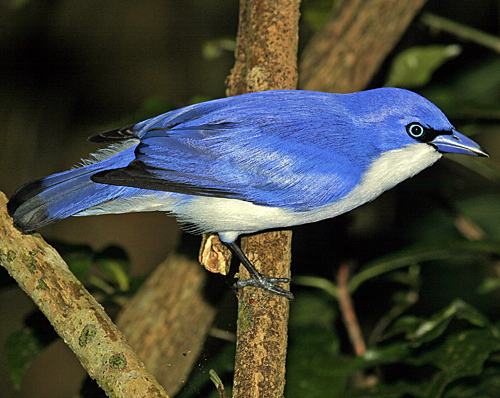
Adult males have an ultramarine-blue bill with a black tip, while adult females have an ultramarine-blue bill with a dark brown tip.[5][6]
Adults have pale-blue irises, black or dark-slate legs and feet, and blue-and-white plumage.[7][8][9]
The Mohéli subspecies comorensis tends to be larger than madagarensis and exhibits slight colour differences from it.[10][11]
Conservation
The species is threatened by its restricted geographical range, deforestation and habitat loss.[12][13]
Habitat degradation caused by invasive plants also threatens the species.[14]
Classification of the Comoros Blue Vanga
| Kingdom | Animalia |
|---|---|
| Phylum | Chordata |
| Subphylum | Vertebrata |
| Infraphylum | Gnathostomata |
| Parvphylum | Osteichthyes |
| Megaclass | Tetrapoda |
| Class | Aves (Bird) |
| Order | Passeriformes (Passerine) |
| Family | Vangidae (Vangas) |
| Genus | Cyanolanius (Blue Vangas) |
| Species | Cyanolanius comorensis (Shelley, 1894) |
Where the Comoros Blue Vanga is found
Checklists and occurrence records place Cyanolanius comorensis in 1 country across Africa. GBIF holds 36 georeferenced records of it.
Countries
Regions and cities with the most records
Range as the checklists state it
Africa
A number beside a place is its count of GBIF occurrence records. A place without a number comes from a checklist alone. Records show where a species has been observed or collected, which can include escapes and vagrants.
Common names
English
- Comoros Blue Vanga
- Comoro Blue Vanga
Names in 16 other languages
- Chinese
- 科摩罗蓝钩嘴鵙
- Croatian
- modra vanga
- Danish
- Comorer Blå Vanga
- Dutch
- Comorese Blauwe Vanga
- Esperanto
- komora vangao
- Estonian
- komoori vanga
- French
- Artamie des Comores, Cyanolane des Comores
- German
- Komoren-Blauvanga, Komorenvanga
- Italian
- Vanga blu delle Comore
- Norwegian
- koboltvanga
- Polish
- wanga komorska
- Portuguese
- vanga-azul-das-comores, vanga-comorense
- Slovak
- vanga komorská
- Spanish
- Vanga azul de las Comoras
- Swedish
- komorvanga
- Ukrainian
- ванга коморська
Synonyms
One other scientific name has been used for this species and is now treated as a synonym of Cyanolanius comorensis.
- Artamia comorensis Shelley, 1894
Subspecies and varieties
- Cyanolanius comorensis bensoni subspecies
- Cyanolanius comorensis comorensis subspecies
Related species
-
 Madagascar Blue VangaCyanolanius madagascarinus
-
 Helmet VangaEuryceros prevostii
-
 Common WoodshrikeTephrodornis pondicerianus
-
 Hook-billed VangaVanga curvirostris
-
 Bar-winged Flycatcher-shrikeHemipus picatus
-
 Sickle-billed VangaFalculea palliata
-
 Retz's HelmetshrikePrionops retzii
-
 Red-shouldered VangaCalicalicus rufocarpalis
Compare
Questions and answers
What is the scientific name of the Comoros Blue Vanga?
The scientific name of the Comoros Blue Vanga is Cyanolanius comorensis. Written with its author, the full name is Cyanolanius comorensis (Shelley, 1894).
Which family does the Comoros Blue Vanga belong to?
Cyanolanius comorensis belongs to the family Vangidae, in the order Passeriformes and the class Aves.
Where is the Comoros Blue Vanga found?
Checklists and occurrence records place Cyanolanius comorensis in 1 country: Comoros.
What is the conservation status of the Comoros Blue Vanga?
The IUCN Red List category recorded for Cyanolanius comorensis is Near Threatened (NT).
What other names does the Comoros Blue Vanga have?
Cyanolanius comorensis is also known in English as Comoro Blue Vanga.
Where does the Comoros Blue Vanga occur?
The species occurs on Grand Comore and Mohéli in the Comoros.[15][16]
What habitats does the Comoros Blue Vanga inhabit?
It inhabits subtropical or tropical dry forest and subtropical or tropical moist lowland forest.[1][2]
How do adult male and female bills differ?
Adult males have an ultramarine-blue bill with a black tip. Adult females have an ultramarine-blue bill with a dark brown tip.[5][6]
Sources
Passages the profile rests on
- The species inhabits subtropical or tropical dry forest. Source passage: “its natural habitats are subtropical or tropical dry forest” — English Wikipedia
- The species inhabits subtropical or tropical moist lowland forest. Source passage: “subtropical or tropical moist lowland forest.” — English Wikipedia
- On Mohéli, the species is known to inhabit areas above 300 metres in elevation. Source passage: “It is known to inhabits habitats above an elevation of 300 m (980 ft) on Mohéli.” — English Wikipedia
- On Grande Comore, the species is mainly recorded in degraded forest patches associated with banana cultivation on Mount Karthala's slopes at elevations of 700–900 metres. Source passage: “On Grand Comore, it is mainly known from degraded forest patches with banana cultivation on the slopes of Mount Karthala at an elevation of 700–900 m (2,300–3,000 ft).” — English Wikipedia
- Adult males have an ultramarine-blue bill with a black tip. Source passage: “It has a ultramarine blue beak with a black tip in males” — English Wikipedia
- Adult females have an ultramarine-blue bill with a dark brown tip. Source passage: “and a dark brown tip in females.” — English Wikipedia
- Adults have pale-blue irises. Source passage: “The iris is pale blue in adults” — English Wikipedia
- The species has black or dark-slate legs and feet. Source passage: “the legs and feet are black or dark slate in colour.” — English Wikipedia
- The species has blue-and-white plumage. Source passage: “Beautiful blue-and-white vanga” — ebird.org
- The Mohéli subspecies comorensis tends to be larger than the subspecies madagarensis. Source passage: “It tends to be larger than madagarensis” — English Wikipedia
- The Mohéli subspecies comorensis exhibits slight colour differences from madagarensis. Source passage: “and is also exhibits slight differences in colour.” — English Wikipedia
- The species is threatened by its restricted geographical range. Source passage: “is threatened by a limited range” — English Wikipedia
- Deforestation and habitat loss threaten the species. Source passage: “deforestation and habitat loss” — English Wikipedia
- Habitat degradation caused by invasive plants threatens the species. Source passage: “degradation of the habitat due to invasive plant species” — English Wikipedia
- The species occurs on the islands of Grand Comore and Mohéli in the Comoros. Source passage: “The species is found on the islands of Grand Comore and Mohéli in the Comoros Islands.” — English Wikipedia
- The species is reported from Mohéli in the Comoros. Source passage: “where it is found on the islands of Mohéli.” — datazone.birdlife.org
Data
- Catalogue of Life, 2026-10-16 XR cc by
- Global Biodiversity Information Facility CC BY 4.0
- Wikidata CC0
- GeoNames CC BY 4.0
- Wikimedia Commons per image; credit shown with each image
- Within the Catalogue of Life, this name comes from The Integrated Taxonomic Information System cc0
This species in other databases
Page built on 27 November 2026. See how the catalog is made and all sources and licences.
Cite this page
ScientificNames.org. (2026). Cyanolanius comorensis (Comoros Blue Vanga). Retrieved November 27, 2026, from https://scientificnames.org/species/cyanolanius-comorensis
“Cyanolanius comorensis (Comoros Blue Vanga).” ScientificNames.org, 2026, scientificnames.org/species/cyanolanius-comorensis. Accessed 27 Nov. 2026.
ScientificNames.org. “Cyanolanius comorensis (Comoros Blue Vanga).” Accessed November 27, 2026. https://scientificnames.org/species/cyanolanius-comorensis.
@misc{scientificnames_cyanolanius_comorensis_comoros_blue_vanga,
  author = {{ScientificNames.org}},
  title = {Cyanolanius comorensis (Comoros Blue Vanga)},
  year = {2026},
  url = {https://scientificnames.org/species/cyanolanius-comorensis},
  note = {Accessed 2026-11-27}
}