Species · Conifers and allies
Zamia Palm Cycas armstrongii
The scientific name of the Zamia Palm is Cycas armstrongii. It is a species of gymnosperm in the family Cycadaceae (cycads), order Cycadales.
- Scientific name
- Cycas armstrongii Miq.
- Common name
- Zamia Palm
- Genus
- Cycas
- Family
- Cycadaceae (Cycads)
- Order
- Cycadales
- Class
- Cycadopsida
- Red List category
- VU Vulnerable
- Recorded in
- 1 country
- Name status
- accepted in the Catalogue of Life

Overview
Cycas armstrongii is endemic to Australia's Northern Territory, where it occurs from Darwin to the Mary River. It has pinnate leaves with forward-angled leaflets, and its ripe seeds have a yellow outer fleshy coating.
Written 27 November 2026 from the sources listed below. Each statement was checked against the passage it cites; statements that could not be supported were removed.
Appearance
The species has pinnate leaves that are slightly keeled or flat. Young leaflets are densely covered with orange hairs before developing glossy bright green upper surfaces and light green undersides. The leaflets are angled forward at approximately 40 degrees.[1][2][3]
Each leaf contains between 100 and 220 leaflets, measuring 5.5–14 centimetres long and 4.5–8 millimetres wide. Mature plants typically have approximately 50 leaves in their crowns.[4][5][6]
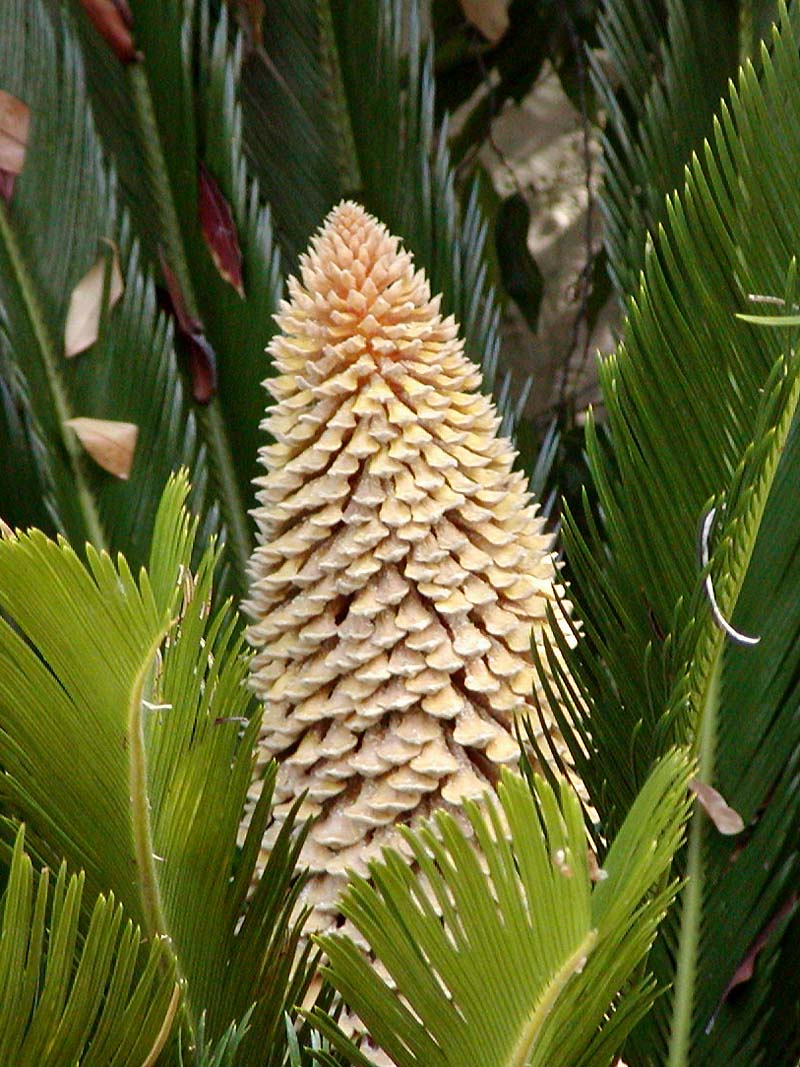
Ripe seeds have a yellow coating on their outer fleshy layer. Male cones are orange and ovoid, with their upper halves tapering to a point.[7][8]
The stems typically reach 3 metres in height and measure between 5 and 11 centimetres in diameter. They can rarely reach 6 metres.[9][10]
Male cones measure 11–20 centimetres long and 7.5–10 centimetres in diameter. Female sporophylls measure between 13 and 22 centimetres in length.[11][12]
Habitat
The species commonly grows in open forests and woodlands in Australia's Top End. It usually grows in well-drained sandy and lateritic soils.[13][14]
Behaviour
The leaves are deciduous during the dry season but persist in moister growing conditions. The species tolerates fire extremely well and produces abundant new leaf growth following early spring fires.[15][16]
Reproduction and life cycle
Female cones open to expose their sporophylls. Each female sporophyll bears between two and four ovules.[17][18]
The female sporophylls have lanceolate triangular laminas with an apical spine. The species produces fruit between March and September.[19][20]
Conservation
The species has a secure conservation status. Less than one percent of its living populations are located within conservation reserves.[21][22]
The estimated global population exceeds ten million individuals.[23]
Similar species
Cycas armstrongii can be easily confused with Cycas maconochiei.[24]
Classification of the Zamia Palm
| Kingdom | Plantae |
|---|---|
| Subkingdom | Pteridobiotina |
| Phylum | Tracheophyta |
| Class | Cycadopsida |
| Order | Cycadales |
| Family | Cycadaceae (Cycads) |
| Genus | Cycas (Cycad) |
| Species | Cycas armstrongii Miq. |
Origin of the name. Honoring John Armstrong (1820–1902), collector for Kew Gardens and appointed in 1838 to establish a government garden at Port Essington, Australia.
Where the Zamia Palm is found
Checklists and occurrence records place Cycas armstrongii in 1 country across Oceania. GBIF holds 2,284 georeferenced records of it.
Countries
Regions and cities with the most records
- Northern Territory, Australia 2,182
- Palmerston, Australia 841
- Darwin, Australia 596
- Queensland, Australia 7
- Western Australia, Australia 3
Range as the checklists state it
Australia (Northern Territory)
A number beside a place is its count of GBIF occurrence records. A place without a number comes from a checklist alone. Records show where a species has been observed or collected, which can include escapes and vagrants.
Common names
English
- Zamia Palm
Names in 4 other languages
- Chinese
- 北領地蘇鐵, 阿姆斯特朗苏铁
- Lithuanian
- Adelaidinis cikas
- Russian
- Саговник Армстронга
- Ukrainian
- Цикас армстронга или Саговник Армстронга
Related species
-
 Sago PalmCycas revoluta
-
 Queen SagoCycas circinalis
-
 Queen SagoCycas rumphii
-
 Micronesian CycadCycas micronesica
-
 Madagascar CycadCycas thouarsii
-
 Beddome’s CycasCycas beddomei
-
 Arayat PitogoCycas riuminiana
-
 Australian Nut PalmCycas media
Compare
Questions and answers
What is the scientific name of the Zamia Palm?
The scientific name of the Zamia Palm is Cycas armstrongii. Written with its author, the full name is Cycas armstrongii Miq..
Which family does the Zamia Palm belong to?
Cycas armstrongii belongs to the family Cycadaceae, in the order Cycadales and the class Cycadopsida.
Where is the Zamia Palm found?
Checklists and occurrence records place Cycas armstrongii in 1 country: Australia.
What is the conservation status of the Zamia Palm?
The IUCN Red List category recorded for Cycas armstrongii is Vulnerable (VU).
Sources
Passages the profile rests on
- The species has pinnate leaves that are slightly keeled or flat. Source passage: “The leaves are (very unusually for a cycad) deciduous in the dry season (though persistent if grown in moister situations), 55–90 cm long, slightly keeled or flat, pinnate with 100-220 leaflets” — English Wikipedia
- Young leaflets are densely covered with orange hairs before becoming glossy bright green on their upper surfaces and light green underneath. Source passage: “the leaflets densely orange-pubescent at first, then glossy bright green above, light green below” — English Wikipedia
- The leaflets are angled forward at approximately 40 degrees. Source passage: “angled forward at 40 degrees.” — English Wikipedia
- Each leaf contains between 100 and 220 leaflets. Source passage: “pinnate with 100-220 leaflets” — English Wikipedia
- The leaflets measure 5.5–14 centimetres long and 4.5–8 millimetres wide. Source passage: “5.5–14 cm long and 4.5–8 mm wide” — English Wikipedia
- Mature plants typically have approximately 50 leaves in their crowns. Source passage: “Mature plants have around 50 leaves in the crown.” — English Wikipedia
- Ripe seeds have a yellow coating on their outer fleshy layer. Source passage: “The sarcotesta has a yellow coating when ripe.” — English Wikipedia
- Male cones are orange and ovoid, with their upper halves tapering to a point. Source passage: “The male cones are ovoid, orange, 11–20 cm long and 7.5–10 cm diameter, with upper half of cone drawn to a point.” — English Wikipedia
- The stems typically reach 3 metres in height, although they can rarely reach 6 metres. Source passage: “The stems reach 3 m (rarely 6 m) tall” — English Wikipedia
- The stems measure between 5 and 11 centimetres in diameter. Source passage: “with a diameter of 5–11 cm.” — English Wikipedia
- Male cones measure 11–20 centimetres long and 7.5–10 centimetres in diameter. Source passage: “11–20 cm long and 7.5–10 cm diameter” — English Wikipedia
- Female sporophylls measure between 13 and 22 centimetres in length. Source passage: “with 13–22 cm long sporophylls” — English Wikipedia
- The species commonly grows in open forests and woodlands in Australia's Top End. Source passage: “This cycad is common in open forest and woodland around the Top End” — English Wikipedia
- The species usually grows in well-drained sandy and lateritic soils. Source passage: “It usually grows on well-drained sandy and lateritic soils.” — English Wikipedia
- The leaves are deciduous during the dry season, although they persist in moister growing conditions. Source passage: “The leaves are (very unusually for a cycad) deciduous in the dry season (though persistent if grown in moister situations)” — English Wikipedia
- The species tolerates fire extremely well and produces abundant new leaf growth following early spring fires. Source passage: “The species is extremely fire tolerant, and the usually early spring fires initiate a profusion of new leaf growth in the plants” — English Wikipedia
- Female cones open to expose their sporophylls. Source passage: “The female cones open, with 13–22 cm long sporophylls” — English Wikipedia
- Each female sporophyll bears between two and four ovules. Source passage: “with 2-4 ovules per sporophyll” — English Wikipedia
- The female sporophylls have lanceolate triangular laminas with an apical spine. Source passage: “on a lanceolate triangular lamina with an apical spine.” — English Wikipedia
- The species produces fruit between March and September. Source passage: “Fruiting: March to September.” — English Wikipedia
- The species has a secure conservation status. Source passage: “The conservation status is secure.” — English Wikipedia
- Less than one percent of the species' living populations are located within conservation reserves. Source passage: “While locally abundant, less than 1% of these living fossils are located within conservation reserves.” — English Wikipedia
- The species has an estimated global population exceeding ten million individuals. Source passage: “It is one of the most abundant cycads in the world, with a population estimate of over ten million.” — English Wikipedia
- Cycas armstrongii can be easily confused with Cycas maconochiei. Source passage: “can be easily confused with Cycas maconochiei.” — English Wikipedia
Data
- Catalogue of Life, 2026-10-16 XR cc by
- Global Biodiversity Information Facility CC BY 4.0
- Wikidata CC0
- GeoNames CC BY 4.0
- Wikimedia Commons per image; credit shown with each image
- Within the Catalogue of Life, this name comes from The World List of Cycads, online edition cc by
References
- Miq. (1868). In: Arch. Néerl. Sci. Exact. Nat. 3: 235-236 Link where the name was published
This species in other databases
- Catalogue of Life 32RZS
- Wikidata Q159799
- iNaturalist 136182
- World Flora Online wfo-0000631492
- IPNI 296976-1
- Tropicos 9600261
- GRIN 312695
Page built on 28 November 2026. See how the catalog is made and all sources and licences.
Cite this page
ScientificNames.org. (2026). Cycas armstrongii (Zamia Palm). Retrieved November 28, 2026, from https://scientificnames.org/species/cycas-armstrongii
“Cycas armstrongii (Zamia Palm).” ScientificNames.org, 2026, scientificnames.org/species/cycas-armstrongii. Accessed 28 Nov. 2026.
ScientificNames.org. “Cycas armstrongii (Zamia Palm).” Accessed November 28, 2026. https://scientificnames.org/species/cycas-armstrongii.
@misc{scientificnames_cycas_armstrongii_zamia_palm,
  author = {{ScientificNames.org}},
  title = {Cycas armstrongii (Zamia Palm)},
  year = {2026},
  url = {https://scientificnames.org/species/cycas-armstrongii},
  note = {Accessed 2026-11-28}
}