Species · Conifers and allies
Cycas arnhemica
Cycas arnhemica has no English name on record in the checklists used here. It is a species of gymnosperm in the family Cycadaceae (cycads), order Cycadales.
- Scientific name
- Cycas arnhemica K.D.Hill
- Genus
- Cycas
- Family
- Cycadaceae (Cycads)
- Order
- Cycadales
- Class
- Cycadopsida
- Red List category
- LC Least Concern
- Recorded in
- 1 country
- Name status
- accepted in the Catalogue of Life

Overview
Cycas arnhemica is native to northwestern Northern Territory in Arnhem Land, Australia, with a recorded distribution around the Goyder River and lower Blyth River. It has erect stems, numerous pinnate leaves, and female and male cones distinguished by orange hairs.
Written 27 November 2026 from the sources listed below. Each statement was checked against the passage it cites; statements that could not be supported were removed.
Appearance
Young leaves initially have dense white tomentum before becoming bright to dark green. The leaf undersides often retain their downy covering.[1][2]
The female sporophylls are grey and bear orange hairs. They have toothed triangular laminae ending in an apical spine.[3][4]
The ripe seeds develop an orange sarcotesta. They measure 28–32 millimetres in length and 25–29 millimetres in breadth.[5][6]
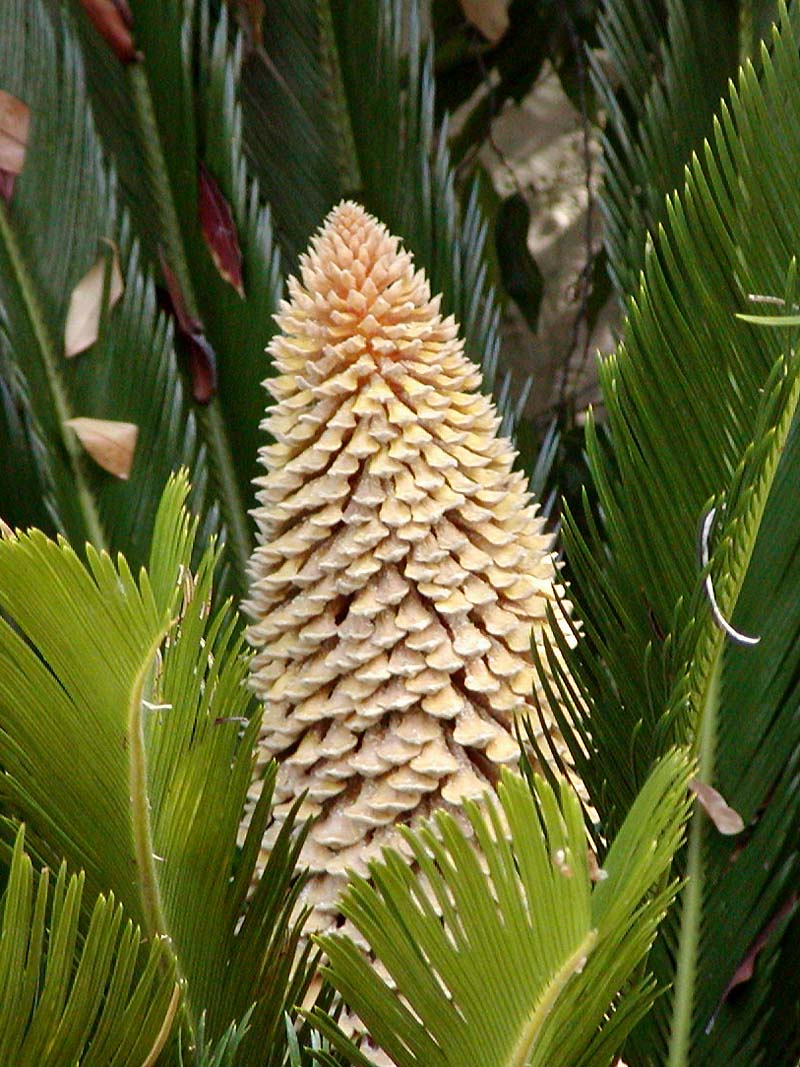
The male cones are covered with orange hairs.[7]
Reproduction and life cycle
The female cones are open and measure 15–24 centimetres in length. Each sporophyll bears two to six ovules.[8][9]
The male cones grow singly rather than in clusters. They measure 18–36 centimetres in length and 6.5–12 centimetres in diameter.[10][11]
Habitat
Cycas arnhemica is native to northwestern Northern Territory in Arnhem Land, Australia. Its recorded distribution is restricted to areas around the Goyder River and lower Blyth River in Arnhem Land.[12][13]
The species commonly occurs in Eucalyptus woodlands and savanna grasslands.[14]
Conservation
Grass fires can kill seeds and seedlings of Cycas arnhemica. Despite fire-related damage, its conservation status is considered stable.[15][16]
Its inhospitable habitat and healthy number of individuals are cited as factors associated with its stable conservation status.[17]
Similar species
Cycas maconochiei is identified as the species most closely related to Cycas arnhemica.[18]
Classification of Cycas arnhemica
| Kingdom | Plantae |
|---|---|
| Subkingdom | Pteridobiotina |
| Phylum | Tracheophyta |
| Class | Cycadopsida |
| Order | Cycadales |
| Family | Cycadaceae (Cycads) |
| Genus | Cycas (Cycad) |
| Species | Cycas arnhemica K.D.Hill |
Origin of the name. Referring to its occurrence in central Arnhem Land, Australia.
Where Cycas arnhemica is found
Checklists and occurrence records place Cycas arnhemica in 1 country across Oceania. GBIF holds 574 georeferenced records of it.
Countries
Regions and cities with the most records
Range as the checklists state it
Australia (Northern Territory)
A number beside a place is its count of GBIF occurrence records. A place without a number comes from a checklist alone. Records show where a species has been observed or collected, which can include escapes and vagrants.
Common names
Names in 2 other languages
- Chinese
- 阿納姆蘇鐵
- Lithuanian
- Plokščiasėklis cikas
Synonyms
3 other scientific names have been used for this species and are now treated as synonyms of Cycas arnhemica.
- Cycas arnhemica subsp. arnhemica
- Cycas arnhemica subsp. muninga Chirgwin & K.D.Hill
- Cycas arnhemica subsp. natja K.D.Hill
Related species
-
 Sago PalmCycas revoluta
-
 Queen SagoCycas circinalis
-
 Queen SagoCycas rumphii
-
 Micronesian CycadCycas micronesica
-
 Madagascar CycadCycas thouarsii
-
 Beddome’s CycasCycas beddomei
-
 Arayat PitogoCycas riuminiana
-
 Australian Nut PalmCycas media
Compare
Sources
Passages the profile rests on
- Young leaves initially have dense white tomentum before becoming bright to dark green. Source passage: “the new young leaves are deep white tomentose at first, becoming bright to dark green” — English Wikipedia
- The leaf undersides often retain their downy covering. Source passage: “the down often persisting on the underside.” — English Wikipedia
- The female cones have grey sporophylls bearing orange hairs. Source passage: “with grey sporophylls and orange hairs” — English Wikipedia
- The female sporophylls have toothed triangular laminae ending in an apical spine. Source passage: “Triangular lamina, toothed, with an apical spine.” — English Wikipedia
- The seeds measure 28–32 millimetres in length and 25–29 millimetres in breadth. Source passage: “The seeds are 28–32 mm long and 25–29 mm broad” — English Wikipedia
- The ripe seeds develop an orange sarcotesta. Source passage: “with an orange sarcotesta when ripe.” — English Wikipedia
- The male cones are covered with orange hairs. Source passage: “also covered in orange hairs.” — English Wikipedia
- The female cones are open and measure 15–24 centimetres in length. Source passage: “The female cones are open, 15–24 cm long” — English Wikipedia
- Each sporophyll of the female cones bears two to six ovules. Source passage: “with two to six ovules per sporophyll.” — English Wikipedia
- The male cones grow singly rather than in clusters. Source passage: “The male cones solitary” — English Wikipedia
- The male cones measure 18–36 centimetres in length and 6.5–12 centimetres in diameter. Source passage: “18–36 cm long and 6.5–12 cm diameter” — English Wikipedia
- Cycas arnhemica is native to northwestern Northern Territory in Arnhem Land, Australia. Source passage: “native to Australia, in the northwest of Northern Territory in Arnhem Land” — English Wikipedia
- Its recorded distribution is restricted to areas around the Goyder River and lower Blyth River in Arnhem Land. Source passage: “Found only around the Goyder River and the lower Blyth River in Arnhem land” — English Wikipedia
- The species commonly occurs in Eucalyptus woodlands and savanna grasslands. Source passage: “common amongst the Eucalyptus woodlands and savanna grasslands.” — English Wikipedia
- Grass fires can kill seeds and seedlings of Cycas arnhemica. Source passage: “many seeds are easily killed off, as are seedlings in these ever more common events.” — English Wikipedia
- Despite fire-related damage, the conservation status of Cycas arnhemica is considered stable. Source passage: “However, the conservation status is considered stable” — English Wikipedia
- The species' inhospitable habitat and healthy number of individuals are cited as factors associated with its stable conservation status. Source passage: “due to its inhospitable habitat and healthy number of individuals.” — English Wikipedia
- Cycas maconochiei is identified as the species most closely related to Cycas arnhemica. Source passage: “it is most closely related to Cycas maconochiei.” — English Wikipedia
Data
- Catalogue of Life, 2026-10-16 XR cc by
- Global Biodiversity Information Facility CC BY 4.0
- Wikidata CC0
- GeoNames CC BY 4.0
- Wikimedia Commons per image; credit shown with each image
- Within the Catalogue of Life, this name comes from The World List of Cycads, online edition cc by
References
- K.D.Hill (1994). In: Telopea 5(4): 693-696, fig. 1 Link where the name was published
This species in other databases
- Catalogue of Life 32RZT
- Wikidata Q5197916
- iNaturalist 136185
- World Flora Online wfo-0000631493
- IPNI 976797-1
- Tropicos 50140313
- GRIN 444272
Page built on 28 November 2026. See how the catalog is made and all sources and licences.
Cite this page
ScientificNames.org. (2026). Cycas arnhemica. Retrieved November 28, 2026, from https://scientificnames.org/species/cycas-arnhemica
“Cycas arnhemica.” ScientificNames.org, 2026, scientificnames.org/species/cycas-arnhemica. Accessed 28 Nov. 2026.
ScientificNames.org. “Cycas arnhemica.” Accessed November 28, 2026. https://scientificnames.org/species/cycas-arnhemica.
@misc{scientificnames_cycas_arnhemica,
  author = {{ScientificNames.org}},
  title = {Cycas arnhemica},
  year = {2026},
  url = {https://scientificnames.org/species/cycas-arnhemica},
  note = {Accessed 2026-11-28}
}