Species · Conifers and allies
Cycas brachycantha
Cycas brachycantha has no English name on record in the checklists used here. It is a species of gymnosperm in the family Cycadaceae (cycads), order Cycadales.
- Scientific name
- Cycas brachycantha K.D.Hill, T.H.Nguyên & P.K.Lôc
- Genus
- Cycas
- Family
- Cycadaceae (Cycads)
- Order
- Cycadales
- Class
- Cycadopsida
- Red List category
- VU Vulnerable
- Recorded in
- 1 country
- Name status
- accepted in the Catalogue of Life

Overview
The species is endemic to Bắc Kạn Province in northern Vietnam and occurs in Ba Bể National Park. It has a short, often subterranean stem and glossy dark-green leaves with 100–210 forward-angled leaflets.
Written 27 November 2026 from the sources listed below. Each statement was checked against the passage it cites; statements that could not be supported were removed.
Habitat
Cycas brachycantha grows in cracks and crevices of limestone crests and ridges, often where soil is absent. It occurs beneath the canopy of evergreen forests.[1][2]
Appearance
The species has a short stem that is often subterranean. Its above-ground stem can reach 1 m in height.[3][4]
The leaves measure 1.4–2.5 m in length and are slightly keeled to flat, with a very glossy dark-green surface. They have a pinnate structure with 100–210 leaflets, each measuring 20–25 cm long and 10–14 mm wide.[5][6][7][8]
The leaflets are angled forward at 70–85 degrees. The leaf apex bears a pair of leaflets and lacks a spine.[9][10]
Emerging young leaves are covered in white tomentose hairs before becoming glabrous. The petioles are spiny and glabrous.[11][12]
The sarcotesta is yellow, and the sclerotesta is rough and ovoid.[13][14]
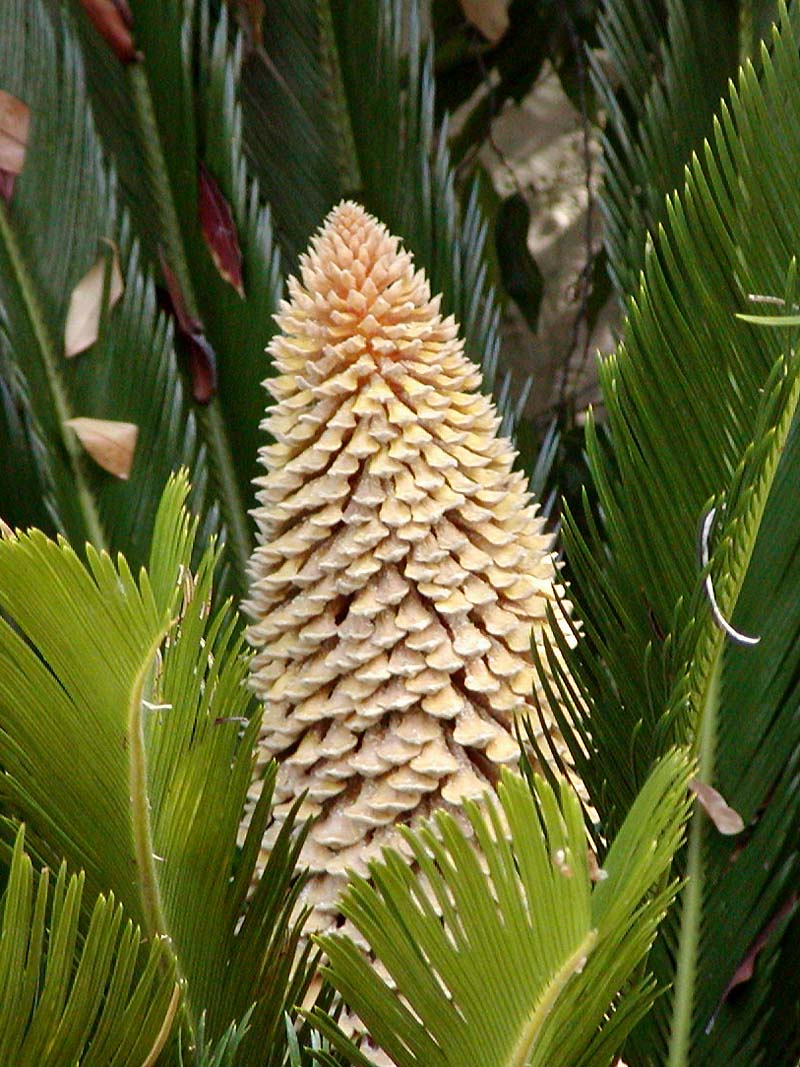
The male cones are yellow, spindle-shaped and occur singly. They measure 12–14 cm in length and 3–4 cm in diameter.[15][16][17]
Reproduction and life cycle
The female cones have a closed structure. Their sporophylls measure 8–12 cm in length and are densely covered with brown tomentose hairs.[18][19][20]
The female cone sporophylls bear two to four glabrous ovules. Their laminae have soft lateral spines but no apical spine.[21][22]
Classification of Cycas brachycantha
| Kingdom | Plantae |
|---|---|
| Subkingdom | Pteridobiotina |
| Phylum | Tracheophyta |
| Class | Cycadopsida |
| Order | Cycadales |
| Family | Cycadaceae (Cycads) |
| Genus | Cycas (Cycad) |
| Species | Cycas brachycantha K.D.Hill, T.H.Nguyên & P.K.Lôc |
Origin of the name. From the Greek brachys (‘short’) and acanthos (‘spine’), referring to the characteristically short petiolar spines.
Where Cycas brachycantha is found
Checklists and occurrence records place Cycas brachycantha in 1 country across Asia. GBIF holds 8 georeferenced records of it.
Countries
Range as the checklists state it
Vietnam (Bac Kan)
A number beside a place is its count of GBIF occurrence records. A place without a number comes from a checklist alone. Records show where a species has been observed or collected, which can include escapes and vagrants.
Common names
Names in 2 other languages
- Chinese
- 短刺蘇鐵
- Lithuanian
- Trumpadyglis cikas
Related species
-
 Sago PalmCycas revoluta
-
 Queen SagoCycas circinalis
-
 Queen SagoCycas rumphii
-
 Micronesian CycadCycas micronesica
-
 Madagascar CycadCycas thouarsii
-
 Beddome’s CycasCycas beddomei
-
 Arayat PitogoCycas riuminiana
-
 Australian Nut PalmCycas media
Compare
Questions and answers
Sources
Passages the profile rests on
- The species grows in cracks and crevices of limestone crests and ridges, often where soil is absent. Source passage: “It grows in often soil-free cracks and crevices of limestone crests and ridges” — English Wikipedia
- The species occurs beneath the canopy of evergreen forests. Source passage: “under the canopy of evergreen forests.” — English Wikipedia
- The species has a short stem that is often subterranean. Source passage: “It has a short stem 9–10 cm diameter, often subterranean” — English Wikipedia
- The above-ground stem can reach 1 m in height. Source passage: “or up to 1 m tall above ground” — English Wikipedia
- The leaves measure 1.4–2.5 m in length. Source passage: “The leaves are 1.4-2.5 m long” — English Wikipedia
- The leaves are slightly keeled to flat and have a very glossy dark-green surface. Source passage: “slightly keeled to flat, very glossy dark green” — English Wikipedia
- The leaves have a pinnate structure with 100–210 leaflets. Source passage: “pinnate, with 100-210 leaflets” — English Wikipedia
- Individual leaflets measure 20–25 cm long and 10–14 mm wide. Source passage: “each leaflet 20–25 cm long and 10–14 mm wide” — English Wikipedia
- The leaflets are angled forward at 70–85 degrees. Source passage: “angled forward at 70-85°” — English Wikipedia
- The leaf apex bears a pair of leaflets and lacks a spine. Source passage: “the leaf apex has a pair of leaflets but no spine.” — English Wikipedia
- Emerging young leaves are covered in white tomentose hairs before becoming glabrous. Source passage: “The emerging young leaves are white tomentose, soon becoming glabrous.” — English Wikipedia
- The petioles are both spiny and glabrous. Source passage: “The petioles are spiny and glabrous.” — English Wikipedia
- The sarcotesta is yellow. Source passage: “The sarcotesta is yellow” — English Wikipedia
- The sclerotesta is rough and ovoid. Source passage: “the sclerotesta rough, ovoid.” — English Wikipedia
- The male cones occur singly and have a spindle-shaped form. Source passage: “The male cones solitary and spindle shaped” — English Wikipedia
- The male cones are yellow. Source passage: “yellow, 12–14 cm long” — English Wikipedia
- The male cones measure 12–14 cm in length and 3–4 cm in diameter. Source passage: “12–14 cm long and 3–4 cm diameter.” — English Wikipedia
- The female cones have a closed structure. Source passage: “The female cones are closed type” — English Wikipedia
- The female cone sporophylls measure 8–12 cm in length. Source passage: “the sporophylls 8–12 cm long” — English Wikipedia
- The female cone sporophylls are densely covered with brown tomentose hairs. Source passage: “dense brown tomentose” — English Wikipedia
- The female cone sporophylls bear two to four glabrous ovules. Source passage: “with two to four glabrous ovules” — English Wikipedia
- The female cone sporophyll laminae have soft lateral spines but no apical spine. Source passage: “soft lateral spines on the lamina, with no apical spine.” — English Wikipedia
Data
- Catalogue of Life, 2026-10-16 XR cc by
- Global Biodiversity Information Facility CC BY 4.0
- Wikidata CC0
- GeoNames CC BY 4.0
- Wikimedia Commons per image; credit shown with each image
- Within the Catalogue of Life, this name comes from The World List of Cycads, online edition cc by
References
- K.D.Hill, T.H.Nguyên & P.K.Lôc (2004). In: Bot. Rev. (Lancaster) 70(2): 155-157, fig. 6 Link where the name was published
This species in other databases
- Catalogue of Life 32S24
- Wikidata Q5197920
- iNaturalist 136215
- World Flora Online wfo-0000631505
- IPNI 60436309-2
- Tropicos 100318822
- GRIN 444300
Page built on 28 November 2026. See how the catalog is made and all sources and licences.
Cite this page
ScientificNames.org. (2026). Cycas brachycantha. Retrieved November 28, 2026, from https://scientificnames.org/species/cycas-brachycantha
“Cycas brachycantha.” ScientificNames.org, 2026, scientificnames.org/species/cycas-brachycantha. Accessed 28 Nov. 2026.
ScientificNames.org. “Cycas brachycantha.” Accessed November 28, 2026. https://scientificnames.org/species/cycas-brachycantha.
@misc{scientificnames_cycas_brachycantha,
  author = {{ScientificNames.org}},
  title = {Cycas brachycantha},
  year = {2026},
  url = {https://scientificnames.org/species/cycas-brachycantha},
  note = {Accessed 2026-11-28}
}