Species · Conifers and allies
Cycas brunnea
Cycas brunnea has no English name on record in the checklists used here. It is a species of gymnosperm in the family Cycadaceae (cycads), order Cycadales.
- Scientific name
- Cycas brunnea K.D.Hill
- Genus
- Cycas
- Family
- Cycadaceae (Cycads)
- Order
- Cycadales
- Class
- Cycadopsida
- Red List category
- NT Near Threatened
- Recorded in
- 1 country
- Name status
- accepted in the Catalogue of Life
Overview
Cycas brunnea occurs in northwest Queensland and northeast Northern Territory near the border between the two regions.
Written 27 November 2026 from the sources listed below. Each statement was checked against the passage it cites; statements that could not be supported were removed.
Habitat
Cycas brunnea grows on exposed sites in savanna and creek valleys on soils derived from sandstone and limestone. It occurs in areas receiving moderate seasonal rainfall.[1][2]
The species occurs among restricted plant species in adjacent woodlands.[3]
Appearance
The stems reach heights of 2–5 metres and develop crowns containing numerous leaves. The leaves measure 1.2–1.7 metres in length and are mature, glabrous and pinnate.[4][5][6][7]
Each leaf contains between 160 and 240 leaflets, measuring 17–27 centimetres long and 6–7.5 millimetres wide. The leaf stalks are covered with brown tomentum and bear sharp spines.[8][9][10][11]
The emergent leaves are covered in brown tomentum.[12]
The female cones have an open structure and an orange tomentose covering. Their sporophylls measure 28–32 centimetres in length, and their laminae have serrated margins.[13][14][15][16]
The sarcotesta is orange and glaucous. The sclerotesta has an ovoid and flattened shape.[17][18]
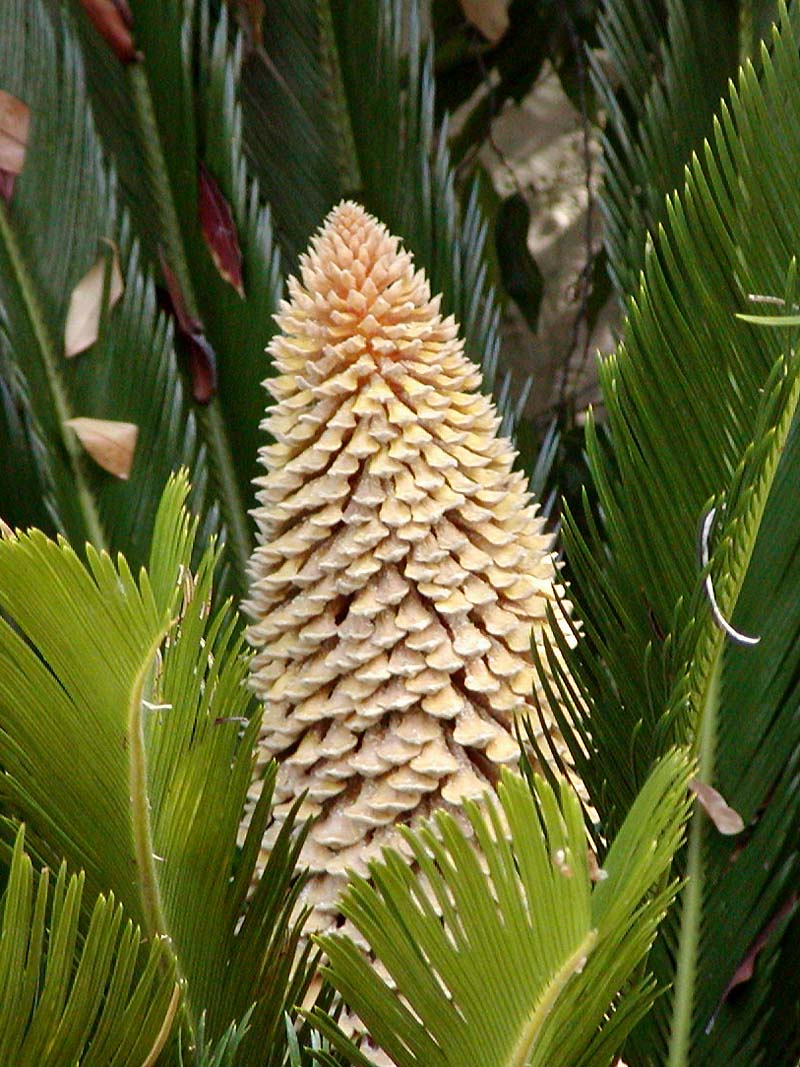
The male cones occur singly and measure approximately 21 centimetres long and 13 centimetres in diameter. They possess an upturned apical spine.[19][20][21]
Conservation
Cycas brunnea is classified as near-threatened because of its restricted geographic range. It occurs in some protected areas, including Boodjamulla National Park.[22][23]
Similar species
Cycas brunnea is similar in appearance to Cycas angulata.[24]
Classification of Cycas brunnea
| Kingdom | Plantae |
|---|---|
| Subkingdom | Pteridobiotina |
| Phylum | Tracheophyta |
| Class | Cycadopsida |
| Order | Cycadales |
| Family | Cycadaceae (Cycads) |
| Genus | Cycas (Cycad) |
| Species | Cycas brunnea K.D.Hill |
Origin of the name. From the late Latin brunneus (‘brown’), referring to the brown trichomes on new growth that distinguish it from related taxa.
Where Cycas brunnea is found
Checklists and occurrence records place Cycas brunnea in 1 country across Oceania. GBIF holds 40 georeferenced records of it.
Countries
Regions and cities with the most records
Range as the checklists state it
Australia (Queensland)
A number beside a place is its count of GBIF occurrence records. A place without a number comes from a checklist alone. Records show where a species has been observed or collected, which can include escapes and vagrants.
Common names
Names in 2 other languages
- Chinese
- 棕絨蘇鐵
- Lithuanian
- Rudaplaukis cikas
Related species
-
 Sago PalmCycas revoluta
-
 Queen SagoCycas circinalis
-
 Queen SagoCycas rumphii
-
 Micronesian CycadCycas micronesica
-
 Madagascar CycadCycas thouarsii
-
 Beddome’s CycasCycas beddomei
-
 Arayat PitogoCycas riuminiana
-
 Australian Nut PalmCycas media
Compare
Sources
Passages the profile rests on
- The species grows on exposed sites in savanna and creek valleys on soils derived from sandstone and limestone. Source passage: “It occurs on exposed sites in savanna and creek valleys on sandstone and limestone derived soils, with moderate seasonal rainfall.” — English Wikipedia
- The species occurs in areas receiving moderate seasonal rainfall. Source passage: “with moderate seasonal rainfall.” — English Wikipedia
- Cycas brunnea occurs among restricted plant species in adjacent woodlands. Source passage: “as well as restricted plants in the adjacent woodlands such as Cycas brunnea.” — dcceew.gov.au
- The stems of Cycas brunnea reach heights of 2–5 metres. Source passage: “The stems grow to 2–5 m tall” — English Wikipedia
- The species develops crowns containing numerous leaves. Source passage: “with numerous leaves in the crown.” — English Wikipedia
- The leaves measure 1.2–1.7 metres in length. Source passage: “The leaves are 1.2-1.7 m long” — English Wikipedia
- The mature leaves are glabrous and pinnate. Source passage: “glabrous with age, pinnate” — English Wikipedia
- Each leaf contains between 160 and 240 leaflets. Source passage: “with 160-240 leaflets” — English Wikipedia
- The leaflets measure 17–27 centimetres long and 6–7.5 millimetres wide. Source passage: “the leaflets 17–27 cm long and 6–7.5 mm wide.” — English Wikipedia
- The leaf stalks are covered with brown tomentum. Source passage: “The petioles are covered in brown tomentum” — English Wikipedia
- The leaf stalks bear sharp spines. Source passage: “and armed with sharp spines.” — English Wikipedia
- The emergent leaves are covered in brown tomentum. Source passage: “as the emergent leaves are brown tomentose.” — English Wikipedia
- The female cones have an open structure. Source passage: “The female cones are open” — English Wikipedia
- The female cone sporophylls measure 28–32 centimetres in length. Source passage: “with sporophylls 28–32 cm long.” — English Wikipedia
- The female cones have an orange tomentose covering. Source passage: “Orange tomentose covering cone” — English Wikipedia
- The female cone laminae have serrated margins. Source passage: “with serrations along margins of the lamina.” — English Wikipedia
- The sarcotesta is orange and glaucous. Source passage: “The sarcotesta is orange and glaucous” — English Wikipedia
- The sclerotesta has an ovoid and flattened shape. Source passage: “the sclerotesta ovoid and flattened.” — English Wikipedia
- The male cones occur singly. Source passage: “The male cones are solitary” — English Wikipedia
- The male cones measure approximately 21 centimetres long and 13 centimetres in diameter. Source passage: “21 cm long and 13 cm diameter” — English Wikipedia
- The male cones possess an upturned apical spine. Source passage: “and with an upturned apical spine.” — English Wikipedia
- Cycas brunnea is classified as near-threatened because of its restricted geographic range. Source passage: “It is considered near-threatened due to its restricted range” — English Wikipedia
- The species occurs in some protected areas, including Boodjamulla National Park. Source passage: “though it occurs in some protected areas including Boodjamulla National Park.” — English Wikipedia
- Cycas brunnea is similar in appearance to Cycas angulata. Source passage: “and is similar in appearance to Cycas angulata.” — English Wikipedia
Data
- Catalogue of Life, 2026-10-16 XR cc by
- Global Biodiversity Information Facility CC BY 4.0
- Wikidata CC0
- GeoNames CC BY 4.0
- Within the Catalogue of Life, this name comes from The World List of Cycads, online edition cc by
References
- K.D.Hill (1992). In: Telopea 5(1): 200-201, fig. 15 where the name was published
This species in other databases
- Catalogue of Life 32S26
- Wikidata Q5197923
- iNaturalist 136179
- World Flora Online wfo-0000631507
- IPNI 968181-1
- Tropicos 100318823
- GRIN 444193
Page built on 29 November 2026. See how the catalog is made and all sources and licences.
Cite this page
ScientificNames.org. (2026). Cycas brunnea. Retrieved November 29, 2026, from https://scientificnames.org/species/cycas-brunnea
“Cycas brunnea.” ScientificNames.org, 2026, scientificnames.org/species/cycas-brunnea. Accessed 29 Nov. 2026.
ScientificNames.org. “Cycas brunnea.” Accessed November 29, 2026. https://scientificnames.org/species/cycas-brunnea.
@misc{scientificnames_cycas_brunnea,
  author = {{ScientificNames.org}},
  title = {Cycas brunnea},
  year = {2026},
  url = {https://scientificnames.org/species/cycas-brunnea},
  note = {Accessed 2026-11-29}
}