Species · Conifers and allies
Chamao Hill Cycad Cycas chamaoensis
The scientific name of the Chamao Hill Cycad is Cycas chamaoensis. It is a species of gymnosperm in the family Cycadaceae (cycads), order Cycadales.
- Scientific name
- Cycas chamaoensis K.D.Hill
- Common name
- Chamao Hill Cycad
- Genus
- Cycas
- Family
- Cycadaceae (Cycads)
- Order
- Cycadales
- Class
- Cycadopsida
- Red List category
- CR Critically Endangered
- Recorded in
- 1 country
- Name status
- accepted in the Catalogue of Life
Overview
Cycas chamaoensis grows on and around Mount Khao Chamao in eastern central Thailand. It has tree-like stems, crowns bearing more than 60 leaves and distinctive male and female cones.
Written 27 November 2026 from the sources listed below. Each statement was checked against the passage it cites; statements that could not be supported were removed.
Appearance
The stems are tree-like and grow either upright or lying partly along the ground. Each crown bears more than 60 leaves, measuring between 1.2 and 2.5 metres long, which terminate in a spine.[1][2][3][4]
The petioles are hairless and partly spiny. Each leaf has between 85 and 155 pairs of lance-shaped leaflets, which are hairless and angled forward at 60–70 degrees.[5][6][7]
The female cones are of the closed type. Their sporophylls measure between 13 and 18 centimetres long and have a yellow to grey woolly covering.[8][9][10]
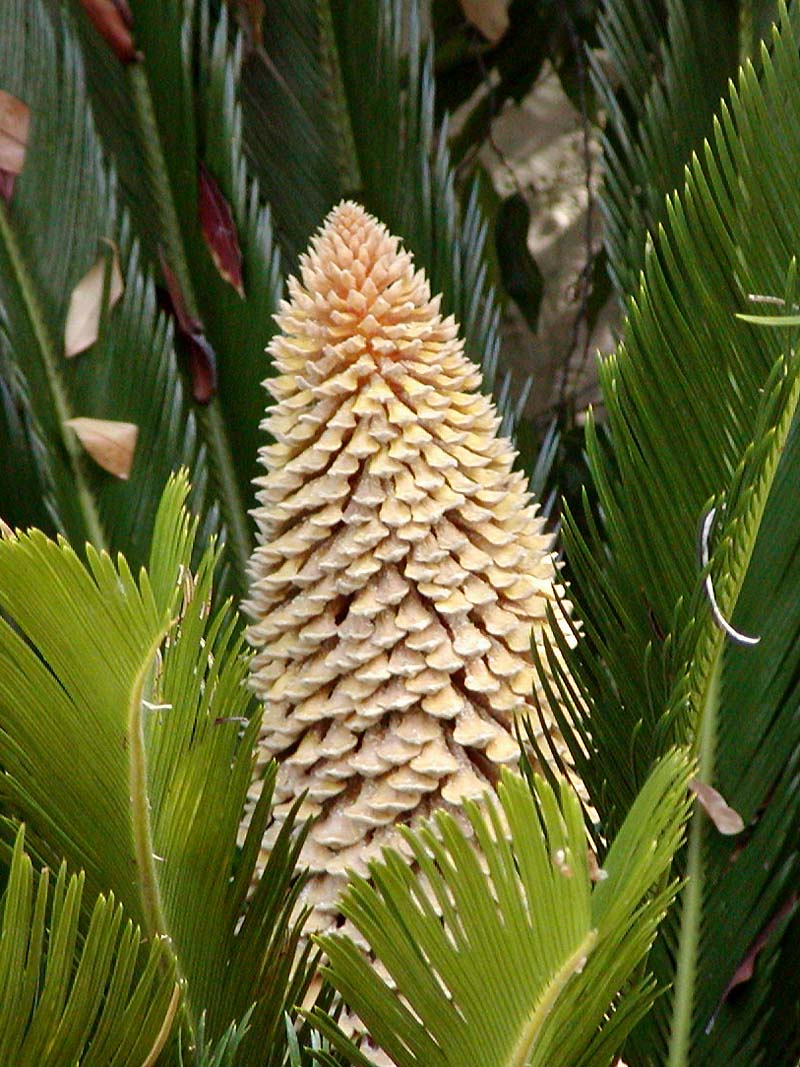
The female cone sporophyll lamina is elongated and almost circular, with numerous lateral spines. The male cones grow singly and upright, have a spindle-shaped to narrowly ovoid form, measure between 12 and 13 centimetres in diameter and have a prominent spine at their apex.[11][12][13][14][15][16]
The sarcotesta is approximately 3 millimetres thick, and the sclerotesta has a smooth surface.[17][18]
Habitat
The species grows on and around Mount Khao Chamao in eastern central Thailand. Its habitat includes exposed granite outcrops.[19][20]
The species name refers to its association with Khao Chamao mountain in Thailand, its only known habitat.[21][22]
Reproduction and life cycle
Each female cone sporophyll bears between two and four ovules.[23]
Conservation
The species has an insecure conservation status. Its restricted distribution on a single mountain is identified as a conservation concern.[24][25][26]
Uses
Local inhabitants value the species for gardening.[27]
Similar species
Cycas chamaoensis is closely related to Cycas pectinata.[28]
Classification of the Chamao Hill Cycad
| Kingdom | Plantae |
|---|---|
| Subkingdom | Pteridobiotina |
| Phylum | Tracheophyta |
| Class | Cycadopsida |
| Order | Cycadales |
| Family | Cycadaceae (Cycads) |
| Genus | Cycas (Cycad) |
| Species | Cycas chamaoensis K.D.Hill |
Origin of the name. Referring to Khao Chamao mountain, Rayong Province, Thailand, its type locality and only known habitat.
Where the Chamao Hill Cycad is found
Checklists and occurrence records place Cycas chamaoensis in 1 country across Asia.
Countries
Range as the checklists state it
Thailand (Chantaburi)
A number beside a place is its count of GBIF occurrence records. A place without a number comes from a checklist alone. Records show where a species has been observed or collected, which can include escapes and vagrants.
Common names
English
- Chamao Hill Cycad
- Cycad
Names in 4 other languages
- Chinese
- 尖竹汶蘇鐵
- Lithuanian
- Tailandinis cikas
- Thai
- Prong, ปรงเขาชะเมา
- Turkish
- Çamao Sikadı
Related species
-
 Sago PalmCycas revoluta
-
 Queen SagoCycas circinalis
-
 Queen SagoCycas rumphii
-
 Micronesian CycadCycas micronesica
-
 Madagascar CycadCycas thouarsii
-
 Beddome’s CycasCycas beddomei
-
 Arayat PitogoCycas riuminiana
-
 Australian Nut PalmCycas media
Compare
Questions and answers
What is the scientific name of the Chamao Hill Cycad?
The scientific name of the Chamao Hill Cycad is Cycas chamaoensis. Written with its author, the full name is Cycas chamaoensis K.D.Hill.
Which family does the Chamao Hill Cycad belong to?
Cycas chamaoensis belongs to the family Cycadaceae, in the order Cycadales and the class Cycadopsida.
Where is the Chamao Hill Cycad found?
Checklists and occurrence records place Cycas chamaoensis in 1 country: Thailand.
What is the conservation status of the Chamao Hill Cycad?
The IUCN Red List category recorded for Cycas chamaoensis is Critically Endangered (CR).
What other names does the Chamao Hill Cycad have?
Cycas chamaoensis is also known in English as Cycad.
Sources
Passages the profile rests on
- The species has tree-like stems that grow either upright or lying partly along the ground. Source passage: “Stems are arborescent, either erect or decumbent.” — English Wikipedia
- Each crown bears more than 60 leaves. Source passage: “Leaves numerous, exceeding 60 per crown” — English Wikipedia
- The leaves measure between 1.2 and 2.5 metres long. Source passage: “1.2-2.5 meters in length” — English Wikipedia
- The leaves terminate in a spine. Source passage: “ending in terminal spine.” — English Wikipedia
- The petioles are hairless and partly spiny. Source passage: “glabrous and partially spiny.” — English Wikipedia
- The leaves have between 85 and 155 pairs of lance-shaped leaflets. Source passage: “Leaflets in 85-155 pairs, and lanceolate” — English Wikipedia
- The leaflets are hairless and angled forward at 60–70 degrees. Source passage: “glabrous and angled forward at 60-70 degrees.” — English Wikipedia
- The female cones are of the closed type. Source passage: “Female cones closed type” — English Wikipedia
- The female cone sporophylls measure between 13 and 18 centimetres long. Source passage: “sporophylls 13–18 cm long” — English Wikipedia
- The female cone sporophylls have yellow to grey woolly covering. Source passage: “with yellow to gray tomentose.” — English Wikipedia
- The female cone sporophyll lamina is elongated and almost circular. Source passage: “Lamina is long, almost circular” — English Wikipedia
- The female cone sporophyll lamina bears numerous lateral spines. Source passage: “with numerous lateral spines.” — English Wikipedia
- The male cones grow singly and upright. Source passage: “Male cones solitary and erect” — English Wikipedia
- The male cones have a spindle-shaped to narrowly ovoid form. Source passage: “spindle shaped to narrow ovoid” — English Wikipedia
- The male cones measure between 12 and 13 centimetres in diameter. Source passage: “12–13 cm in diameter” — English Wikipedia
- The male cones have a prominent spine at their apex. Source passage: “Prominent apical spine present.” — English Wikipedia
- The sarcotesta is approximately 3 millimetres thick. Source passage: “Sarcotesta 3 mm thick” — English Wikipedia
- The sclerotesta has a smooth surface. Source passage: “with smooth sclerotesta.” — English Wikipedia
- The species grows on and around Mount Khao Chamao in eastern central Thailand. Source passage: “This cycad is native to eastern central Thailand, on Mount Khao Chamao northeast of Klaeng and southeast of Bangkok.” — English Wikipedia
- The species grows on exposed granite outcrops. Source passage: “This cycad grows from bare granite outcroppings, in full sun.” — English Wikipedia
- The species name refers to Khao Chamao mountain, the only known habitat associated with the species. Source passage: “Cycas chamaoensis is named after the only known habitat of this species, on and near Khao Chamao mountain in Khao Chamao District, Thailand.” — English Wikipedia
- The species name derives from its association with Khao Chamao mountain in Thailand. Source passage: “Cycas chamaoensis is named after the only known habitat of this species, on and near Khao Chamao mountain in Khao Chamao District, Thailand.” — inaturalist.org
- Each female cone sporophyll bears between two and four ovules. Source passage: “2-4 ovules per sporophyll.” — English Wikipedia
- The species is restricted to Mount Khao Chamao in Thailand. Source passage: “on Mount Khao Chamao northeast of Klaeng and southeast of Bangkok.” — English Wikipedia
- The species has an insecure conservation status. Source passage: “The conservation status is insecure” — English Wikipedia
- The species' restricted distribution on a single mountain is identified as a conservation concern. Source passage: “the plant's range is restricted to only 1 mountain.” — English Wikipedia
- Local inhabitants value the species for gardening. Source passage: “local inhabitants treasure the plant for gardening purposes” — English Wikipedia
- Cycas chamaoensis is closely related to Cycas pectinata. Source passage: “It is closely related to Cycas pectinata.” — English Wikipedia
Data
- Catalogue of Life, 2026-10-16 XR cc by
- Wikidata CC0
- GeoNames CC BY 4.0
- Within the Catalogue of Life, this name comes from The World List of Cycads, online edition cc by
References
- K.D.Hill (1999). In: Brittonia 51(1): 58, fig. 6 Link where the name was published
This species in other databases
- Catalogue of Life 32S2F
- Wikidata Q5197927
- iNaturalist 136198
- World Flora Online wfo-0000631517
- IPNI 1007288-1
- Tropicos 100318829
- GRIN 444301
Page built on 29 November 2026. See how the catalog is made and all sources and licences.
Cite this page
ScientificNames.org. (2026). Cycas chamaoensis (Chamao Hill Cycad). Retrieved November 29, 2026, from https://scientificnames.org/species/cycas-chamaoensis
“Cycas chamaoensis (Chamao Hill Cycad).” ScientificNames.org, 2026, scientificnames.org/species/cycas-chamaoensis. Accessed 29 Nov. 2026.
ScientificNames.org. “Cycas chamaoensis (Chamao Hill Cycad).” Accessed November 29, 2026. https://scientificnames.org/species/cycas-chamaoensis.
@misc{scientificnames_cycas_chamaoensis_chamao_hill_cycad,
  author = {{ScientificNames.org}},
  title = {Cycas chamaoensis (Chamao Hill Cycad)},
  year = {2026},
  url = {https://scientificnames.org/species/cycas-chamaoensis},
  note = {Accessed 2026-11-29}
}