Species · Conifers and allies
Cycad Cycas platyphylla
The scientific name of the Cycad is Cycas platyphylla. It is a species of gymnosperm in the family Cycadaceae (cycads), order Cycadales.
- Scientific name
- Cycas platyphylla K.D.Hill
- Common name
- Cycad
- Genus
- Cycas
- Family
- Cycadaceae (Cycads)
- Order
- Cycadales
- Class
- Cycadopsida
- Red List category
- EN Endangered
- Recorded in
- 1 country
- Name status
- accepted in the Catalogue of Life

Overview
Cycas platyphylla is native to Queensland, Australia, and primarily grows west of the Atherton Tableland in north-east Queensland. It has pinnate, keeled leaves, orange-covered megasporophylls and developing seeds with an intensely glaucous sarcotesta.
Written 27 November 2026 from the sources listed below. Each statement was checked against the passage it cites; statements that could not be supported were removed.
Appearance
The stems are erect or decumbent and can reach 1.5 metres in height, although they are usually shorter than one metre. The leaves are pinnate and keeled, measuring 60–100 centimetres in length.[1][2][3][4]
New fronds initially have a glaucous blue colour before turning dark yellow-green. Mature fronds have moderate glossiness on their upper surfaces.[5][6]
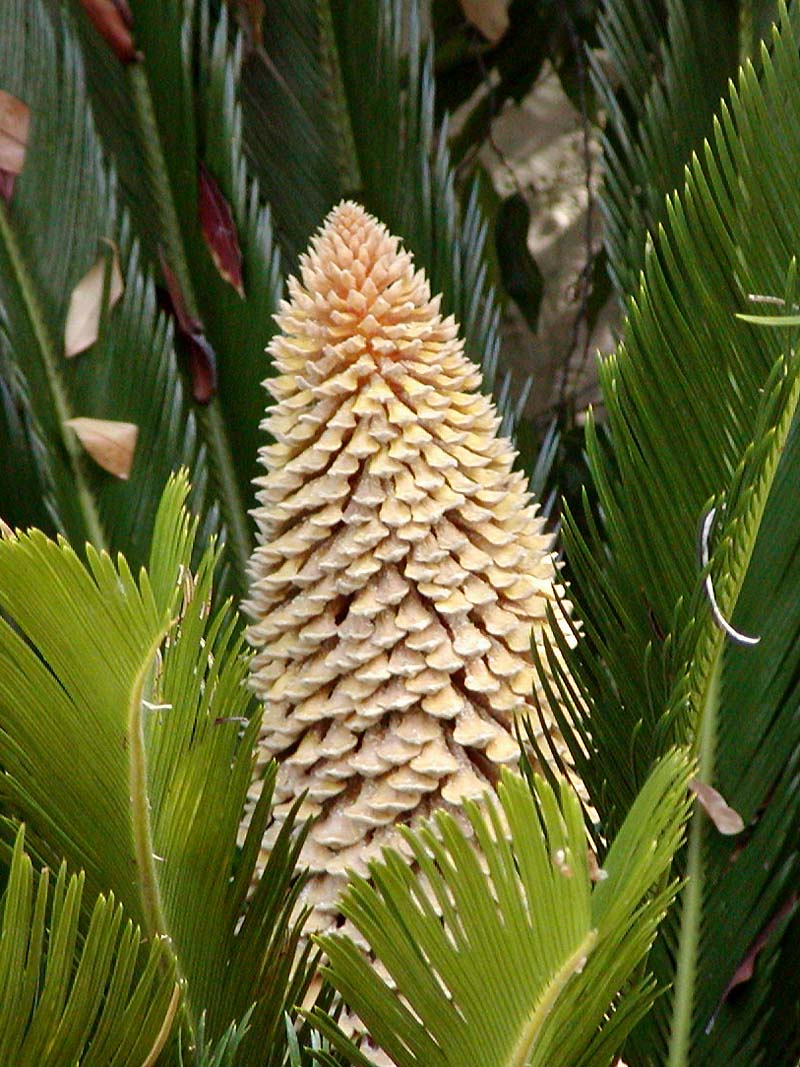
The megasporophylls are densely covered with orange indumentum. Developing seeds have an intensely glaucous sarcotesta.[7][8]
Habitat
The species primarily grows in sparse Eucalyptus savanna on skeletal soils over rhyolite or basalt outcrops. Its main habitat is west of the Atherton Tableland in north-east Queensland.[9][10]
The species grows abundantly in cool habitats.[11]
Behaviour
The species tolerates fire.[12]
Classification of the Cycad
| Kingdom | Plantae |
|---|---|
| Subkingdom | Pteridobiotina |
| Phylum | Tracheophyta |
| Class | Cycadopsida |
| Order | Cycadales |
| Family | Cycadaceae (Cycads) |
| Genus | Cycas (Cycad) |
| Species | Cycas platyphylla K.D.Hill |
Origin of the name. From the Greek platys (‘broad’) and phyllon (‘leaf’), referring to the broad, sterile tip of the megasporophylls (which are modified leaves).
Where the Cycad is found
Checklists and occurrence records place Cycas platyphylla in 1 country across Oceania. GBIF holds 187 georeferenced records of it.
Countries
Regions and cities with the most records
Range as the checklists state it
Australia (Queensland)
A number beside a place is its count of GBIF occurrence records. A place without a number comes from a checklist alone. Records show where a species has been observed or collected, which can include escapes and vagrants.
Common names
English
- Cycad
Names in 3 other languages
- Chinese
- 闊葉蘇鐵
- Lithuanian
- Plačialapis cikas
- Slovak
- cykas širokolistý
Related species
-
 Sago PalmCycas revoluta
-
 Queen SagoCycas circinalis
-
 Queen SagoCycas rumphii
-
 Micronesian CycadCycas micronesica
-
 Madagascar CycadCycas thouarsii
-
 Beddome’s CycasCycas beddomei
-
 Arayat PitogoCycas riuminiana
-
 Australian Nut PalmCycas media
Compare
Questions and answers
What is the scientific name of the Cycad?
The scientific name of the Cycad is Cycas platyphylla. Written with its author, the full name is Cycas platyphylla K.D.Hill.
Which family does the Cycad belong to?
Cycas platyphylla belongs to the family Cycadaceae, in the order Cycadales and the class Cycadopsida.
Where is the Cycad found?
Checklists and occurrence records place Cycas platyphylla in 1 country: Australia.
What is the conservation status of the Cycad?
The IUCN Red List category recorded for Cycas platyphylla is Endangered (EN).
Sources
Passages the profile rests on
- The species has erect or decumbent stems. Source passage: “The stems are erect or decumbent” — English Wikipedia
- The stems can reach 1.5 metres in height, although they are usually shorter than one metre. Source passage: “growing to 1.5 m tall but most often less than a metre.” — English Wikipedia
- The leaves are pinnate and keeled. Source passage: “The leaves are pinnate, keeled, 60–100 cm long.” — English Wikipedia
- The leaves measure 60–100 centimetres in length. Source passage: “The leaves are pinnate, keeled, 60–100 cm long.” — English Wikipedia
- New fronds initially have a glaucous blue colour before turning dark yellow-green. Source passage: “New fronds are glaucous blue at first, becoming dark yellow-green” — English Wikipedia
- The mature fronds have moderate glossiness on their upper surfaces. Source passage: “moderately glossy above.” — English Wikipedia
- The megasporophylls are densely covered with orange indumentum. Source passage: “Megasporophylls are thickly covered in orange indumentum” — English Wikipedia
- Developing seeds have an intensely glaucous sarcotesta. Source passage: “the developing seeds have an intensely glaucous sarcotesta.” — English Wikipedia
- The species primarily grows in sparse Eucalyptus savanna on skeletal soils over rhyolite or basalt outcrops. Source passage: “sparse Eucalyptus savanna on skeletal soils over outcrops of rhyolite or basalt” — English Wikipedia
- The species' main habitat is west of the Atherton Tableland in north-east Queensland. Source passage: “west of the Atherton Tableland in north-east Queensland.” — English Wikipedia
- The species grows abundantly in cool habitats. Source passage: “It grows abundantly in cool habitat” — English Wikipedia
- The species tolerates fire. Source passage: “This species is fire tolerant.” — English Wikipedia
Data
- Catalogue of Life, 2026-10-16 XR cc by
- Global Biodiversity Information Facility CC BY 4.0
- Wikidata CC0
- GeoNames CC BY 4.0
- Wikimedia Commons per image; credit shown with each image
- Within the Catalogue of Life, this name comes from The World List of Cycads, online edition cc by
References
- K.D.Hill (1992). In: Telopea 5(1): 193-194, fig. 9 where the name was published
This species in other databases
- Catalogue of Life 32S4W
- Wikidata Q3008231
- iNaturalist 136026
- World Flora Online wfo-0000631635
- IPNI 968179-1
- Tropicos 100318886
- GRIN 444212
Page built on 28 November 2026. See how the catalog is made and all sources and licences.
Cite this page
ScientificNames.org. (2026). Cycas platyphylla (Cycad). Retrieved November 28, 2026, from https://scientificnames.org/species/cycas-platyphylla
“Cycas platyphylla (Cycad).” ScientificNames.org, 2026, scientificnames.org/species/cycas-platyphylla. Accessed 28 Nov. 2026.
ScientificNames.org. “Cycas platyphylla (Cycad).” Accessed November 28, 2026. https://scientificnames.org/species/cycas-platyphylla.
@misc{scientificnames_cycas_platyphylla_cycad,
  author = {{ScientificNames.org}},
  title = {Cycas platyphylla (Cycad)},
  year = {2026},
  url = {https://scientificnames.org/species/cycas-platyphylla},
  note = {Accessed 2026-11-28}
}