Species · Other invertebrates
Button Coral Cynarina lacrymalis
The scientific name of the Button Coral is Cynarina lacrymalis. It is a species of animal in the family Lobophylliidae, order Scleractinia. The name dates from 1849.
- Scientific name
- Cynarina lacrymalis (Milne Edwards & Haime, 1849)
- Common name
- Button Coral
- Genus
- Cynarina
- Family
- Lobophylliidae
- Order
- Scleractinia
- Class
- Anthozoa
- Red List category
- LC Least Concern
- Environment
- marine
- Recorded in
- 17 countries
- Name status
- accepted in the Catalogue of Life

Overview
Button Coral is a solitary coral consisting of a single polyp housed within a secreted stony corallite. It occurs on shallow reefs and sandy seabeds in the Red Sea, Gulf of Aden, east coast of Africa, Seychelles, Japan, Indonesia, and northern and eastern Australia, at depths of up to 40 metres. Its transparent fleshy mantle allows its 96 septa to remain visible, and its tissues swell during daylight.
Written 27 November 2026 from the sources listed below. Each statement was checked against the passage it cites; statements that could not be supported were removed.
Appearance
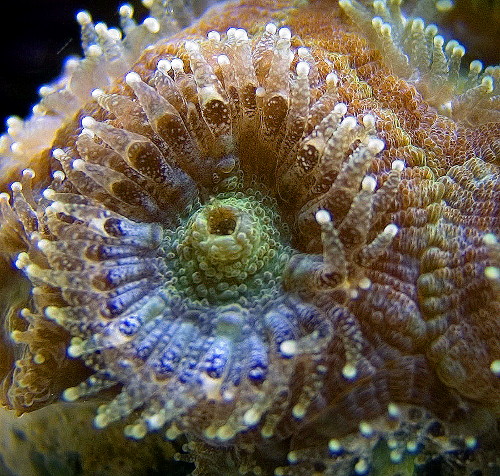
The coral is solitary and consists of a single polyp housed within a secreted stony corallite. Its body is cylindrical, with a round or oval upper surface, and it can reach a diameter of 10 cm and a height of 8 cm.[1][2][3]
Its corallite has twelve broad white radial septa and secondary septa, totaling 96 septa. The costae have alternating thick and thin sections with large rounded lobes, while the columella is short and broad.[4][5][6]
Its transparent fleshy mantle allows the septa to remain visible. Its usual coloration is pale brown or green, although pinkish and bluish forms also occur, and its coloration depends on the species of zooxanthellae living in its tissues.[7][8][9]
The coral can change its surface appearance between glossy and dull.[10]
Habitat
Button Coral occurs on shallow reefs and sandy seabeds with moderate water flow. The species occurs at depths of up to 40 metres.[11][12]
Its distribution includes the Red Sea and Gulf of Aden, the east coast of Africa, and the Seychelles. It is also found in Japan, Indonesia, and northern and eastern Australia.[13][14][15]
Diet
Symbiotic zooxanthellae use sunlight to produce organic compounds that supply most of the coral's energy. At night, the coral extends its tentacles to capture planktonic particles from the surrounding water.[16][17]
In captivity, the coral can receive supplemental meaty foods such as brine shrimp, krill, and fish chunks.[18]
Behaviour
The coral orients its cup surface parallel to the surface supporting it and sways with the movement of the water. Its mantle tissues absorb water and swell during daylight, potentially increasing its diameter to twice its original size.[19][20][21][22]
At night, its extended tentacles make the coral resemble a sea anemone. The species is not aggressive toward other corals, but it should be kept away from them because it could be overtaken.[23][24][25]
Reproduction and life cycle
The species is hermaphroditic and reproduces by releasing eggs and sperm into the water for fertilisation. Sex cell development begins around August, and spawning occurs in April.[26][27]
Its gonads are located in the mesentery and are not kept separate. Each polyp produces more oocytes than those of other species inhabiting the same habitats.[28][29]
Its planula larvae are planktonic before settling on the seabed and developing into juvenile polyps. Under low-light conditions, the coral can also reproduce asexually when part of its disc detaches and develops into a new individual.[30][31]
Uses
The species is kept in reef aquaria and has been propagated in captivity. It grows slowly in captivity and is described as relatively easy to care for.[32][33][34][35]
Captive specimens require moderate light.[36]
Classification of the Button Coral
| Kingdom | Animalia |
|---|---|
| Phylum | Cnidaria |
| Class | Anthozoa |
| Subclass | Hexacorallia |
| Order | Scleractinia |
| Suborder | Vacatina |
| Family | Lobophylliidae |
| Genus | Cynarina (Scolymia) |
| Species | Cynarina lacrymalis (Milne Edwards & Haime, 1849) |
Where the Button Coral is found
Checklists and occurrence records place Cynarina lacrymalis in 17 countries. GBIF holds 555 georeferenced records of it.
Countries
- Australia 214
- Egypt 13
- Indonesia 58
- Israel 3
- Japan 81
- Kenya 4
- Malaysia 17
- Maldives 9
- Mayotte 16
- New Caledonia 60
- Palau 3
- Papua New Guinea 11
- Philippines 42
- Reunion 7
- Seychelles 6
- Solomon Islands 7
- Vanuatu 4
Regions and cities with the most records
- Queensland, Australia 29
- Mont-Dore, New Caledonia 24
- Gushikawa, Japan 19
- Ishikawa, Japan 19
- Katsuren-haebaru, Japan 19
- Nouméa, New Caledonia 19
- Uruma, Japan 19
- Yomitan, Japan 19
- Okinawa, Japan 18
- Nago, Japan 17
- Dumbéa, New Caledonia 12
- Kaouéni, Mayotte 8
- Koungou, Mayotte 8
- Kushimoto, Japan 8
- Mamoudzou, Mayotte 8
- Dzaoudzi, Mayotte 7
- Labattoir, Mayotte 7
- El Nido, Philippines 6
- Ambon, Indonesia 5
- Okinawa, Japan 5
- Ushibukamachi, Japan 5
- Amlapura, Indonesia 4
- Amlapura city, Indonesia 4
- Bedugul, Indonesia 4
- Kani-Kéli, Mayotte 4
- Nagasaki, Japan 4
- Ouangani, Mayotte 4
- Serang, Indonesia 4
- Victoria, Seychelles 4
- Aqaba, Jordan 3
- Asso, Japan 3
- Banten, Indonesia 3
- Bauan, Philippines 3
- Daanbantayan, Philippines 3
- Eilat, Israel 3
- Ginowan, Japan 3
A number beside a place is its count of GBIF occurrence records. A place without a number comes from a checklist alone. Records show where a species has been observed or collected, which can include escapes and vagrants.
Common names
English
- Button Coral
- Solitary Cup Coral
Names in 5 other languages
- Chinese
- 圓冠珊瑚
- Czech
- rifovník žebrovitý
- French
- Corail à larmes
- Japanese
- コハナガタサンゴ
- Thai
- ปะการังถ้วยหนาม
Synonyms
17 other scientific names have been used for this species and are now treated as synonyms of Cynarina lacrymalis.
- Antillia grandiflora Gerth, 1921
- Antillia japonica Yabe & Sugiyama, 1931
- Antillia nomaensis Yabe & Sugiyama, 1931
- Caryophyllia carduus Audouin, 1826
- Caryophyllia lacrymalis Milne Edwards & Haime, 1849
- Cynarina lacrimalis (Milne Edwards & Haime, 1848)
- Cynarina savignyi Brüggemann, 1877
- Lithophyllia lacrymalis (Milne Edwards & Haime, 1849)
- Lithophyllia palata Gardiner, 1899
- Lithophyllia verbeeki Gerth, 1921
- Lobophyllia japonica (Yabe & Sugiyama, 1931)
- Mussa (Lithophyllia) lacrymalis (Milne Edwards & Haime, 1849)
- Protolobophyllia japonica (Yabe & Sugiyama, 1931)
- Protolobophyllia nomaensis (Yabe & Sugiyama, 1931)
- Protolobophyllia sinica Ma, 1959
- Rhodocyathus ceylonensis Bourne, 1905
- Scolymia lacrymalis (Milne Edwards & Haime, 1849)
Related species
- Cynarina macassarensis
-
 Starry Cup CoralAcanthastrea echinata
-
 Lord CoralMicromussa lordhowensis
-
 Lobed Cactus CoralLobophyllia hemprichii
-
 Flat Lettuce CoralEchinophyllia aspera
-
 Lobed Cactus CoralLobophyllia corymbosa
- Bowerbank's Cup CoralHomophyllia bowerbanki
-
 Lobed Cactus CoralLobophyllia costata
Compare
Questions and answers
What is the scientific name of the Button Coral?
The scientific name of the Button Coral is Cynarina lacrymalis. Written with its author, the full name is Cynarina lacrymalis (Milne Edwards & Haime, 1849).
Which family does the Button Coral belong to?
Cynarina lacrymalis belongs to the family Lobophylliidae, in the order Scleractinia and the class Anthozoa.
Where is the Button Coral found?
Checklists and occurrence records place Cynarina lacrymalis in 17 countries, including Australia, Japan, New Caledonia, Indonesia, Philippines and Malaysia.
What is the conservation status of the Button Coral?
The IUCN Red List category recorded for Cynarina lacrymalis is Least Concern (LC).
What other names does the Button Coral have?
Cynarina lacrymalis is also known in English as Solitary Cup Coral.
Sources
Passages the profile rests on
- The coral is solitary and consists of a single polyp housed within a secreted stony corallite. Source passage: “Cynarina lacrymalis is a large, solitary coral with a single polyp nestling in a corallite, the stony cup it has secreted.” — English Wikipedia
- The coral can reach a diameter of 10 cm and a height of 8 cm. Source passage: “It can grow to a diameter of 10 cm (3.9 in) and a height of 8 cm (3.1 in).” — English Wikipedia
- Its body is cylindrical and has a round or oval upper surface. Source passage: “It is cylindrical with a round or oval upper surface.” — English Wikipedia
- Its corallite has twelve broad white radial septa and secondary septa, totaling 96 septa. Source passage: “There are twelve broad white radially arranged septa (ridges) joined to the corallite wall, with secondary septa between for a total of 96 septa.” — English Wikipedia
- Its costae have alternating thick and thin sections and large rounded lobes. Source passage: “The coral's costae (continuations of the septa) alternate between thick and thin depending on the septa they are an extension of. They have large, rounded lobes” — English Wikipedia
- The columella in its corallite is short and broad. Source passage: “the central axial structure (columella) in the corallite is short and broad.” — English Wikipedia
- Its transparent fleshy mantle allows the septa to remain visible. Source passage: “The septa can be seen through the transparent, fleshy mantle” — English Wikipedia
- Its usual coloration is pale brown or green, although pinkish and bluish forms also occur. Source passage: “This is usually pale brown or green, sometimes with a contrasting oral disc, but also sometimes pinkish or bluish.” — English Wikipedia
- Its coloration depends on the species of zooxanthellae living in its tissues. Source passage: “The colour depends on which species of zooxanthella take up residence.” — English Wikipedia
- The coral can change its surface appearance between glossy and dull. Source passage: “The coral has the ability to change its surface from glossy to dull” — English Wikipedia
- The coral occurs on shallow reefs and sandy seabeds with moderate water flow. Source passage: “It is found on shallow reefs and sandy seabeds with moderate water flow” — English Wikipedia
- The species occurs at depths of up to 40 metres. Source passage: “down to depths of 40 metres (130 ft).” — English Wikipedia
- The species occurs in the Red Sea and Gulf of Aden. Source passage: “Cynarina lacrymalis is found in the Red Sea and Gulf of Aden” — English Wikipedia
- Its distribution includes the east coast of Africa and the Seychelles. Source passage: “the east coast of Africa and the Seychelles.” — English Wikipedia
- The species is also found in Japan, Indonesia, and northern and eastern Australia. Source passage: “It is also found in Japan, Indonesia and northern and eastern Australia.” — English Wikipedia
- Symbiotic zooxanthellae use sunlight to produce organic compounds that supply most of the coral's energy. Source passage: “The zooxanthellae are photosynthetic and use sunlight to create organic compounds. These provide most of the coral's energy needs.” — English Wikipedia
- At night, the coral extends its tentacles to capture planktonic particles from the surrounding water. Source passage: “during the night, the tentacles of the polyp are extended to trap planktonic particles floating past” — English Wikipedia
- In captivity, the coral can receive supplemental meaty foods such as brine shrimp, krill, and fish chunks. Source passage: “can be supplementally fed with meaty foods like brine shrimp, krill, or chunks of fish.” — English Wikipedia
- The coral orients its cup surface parallel to the surface supporting it. Source passage: “Cynarina lacrymalis orientates itself so that its cup surface is parallel to the surface to which it is fastened” — English Wikipedia
- The coral sways with the movement of the water. Source passage: “and sways with the water's flow.” — English Wikipedia
- Its mantle tissues absorb water and swell during daylight. Source passage: “During the day, the mantle tissues absorb water and swell up.” — English Wikipedia
- Daytime swelling may increase the coral's diameter to twice its original size. Source passage: “This increases the area exposed to the light and may double the coral's diameter.” — English Wikipedia
- At night, its extended tentacles make the coral resemble a sea anemone. Source passage: “At night, when the polyp extends its many tentacles to feed, the coral resembles a sea anemone.” — English Wikipedia
- The species is not aggressive toward other corals. Source passage: “The species is not aggressive” — English Wikipedia
- The coral should be kept away from other corals because it could be overtaken. Source passage: “but should be kept away from other corals as it could be overtaken.” — English Wikipedia
- The species is hermaphroditic and reproduces by releasing eggs and sperm into the water for fertilisation. Source passage: “This coral is a hermaphrodite and reproduces by releasing eggs and sperm into the water where fertilisation takes place.” — English Wikipedia
- Sex cell development begins around August, and spawning occurs in April. Source passage: “begins sex cell development in late summer, around August, and spawns in April.” — English Wikipedia
- The species' gonads are located in the mesentery and are not kept separate. Source passage: “The coral's gonads are contained in the mesentery, but not kept separate.” — English Wikipedia
- Each polyp produces more oocytes than those of other species inhabiting the same habitats. Source passage: “The species produces a large amount of oocytes per polyp compared to others in the same habitats.” — English Wikipedia
- Its planula larvae are planktonic before settling on the seabed and developing into juvenile polyps. Source passage: “The planula larvae which emerge from the eggs are planktonic and eventually settle on the seabed to undergo metamorphosis into juvenile polyps.” — English Wikipedia
- Under low-light conditions, the coral can reproduce asexually when part of its disc detaches and develops into a new individual. Source passage: “Under conditions of poor light, the coral sometimes reproduces asexually, part of the disc becoming detached and growing into a new individual.” — English Wikipedia
- The species is kept in reef aquaria. Source passage: “and is sometimes kept in reef aquaria.” — English Wikipedia
- The coral has been propagated in captivity. Source passage: “It has been propagated in captivity” — English Wikipedia
- The species grows slowly in captivity. Source passage: “its slow growth rate makes it a niche species” — English Wikipedia
- The species is described as relatively easy to care for in captivity. Source passage: “is relatively easy to care for” — English Wikipedia
- Captive specimens require moderate light. Source passage: “In captivity, the species needs moderate light” — English Wikipedia
Data
- Catalogue of Life, 2026-10-16 XR cc by
- Global Biodiversity Information Facility CC BY 4.0
- Wikidata CC0
- GeoNames CC BY 4.0
- Wikimedia Commons per image; credit shown with each image
- Within the Catalogue of Life, this name comes from World List of Scleractinia cc by
This species in other databases
- Catalogue of Life 92XYJ
- Wikidata Q309881
- iNaturalist 503588
- WoRMS urn:lsid:marinespecies.org:taxname:287961
- ITIS 53500
Page built on 28 November 2026. See how the catalog is made and all sources and licences.
Cite this page
ScientificNames.org. (2026). Cynarina lacrymalis (Button Coral). Retrieved November 28, 2026, from https://scientificnames.org/species/cynarina-lacrymalis
“Cynarina lacrymalis (Button Coral).” ScientificNames.org, 2026, scientificnames.org/species/cynarina-lacrymalis. Accessed 28 Nov. 2026.
ScientificNames.org. “Cynarina lacrymalis (Button Coral).” Accessed November 28, 2026. https://scientificnames.org/species/cynarina-lacrymalis.
@misc{scientificnames_cynarina_lacrymalis_button_coral,
  author = {{ScientificNames.org}},
  title = {Cynarina lacrymalis (Button Coral)},
  year = {2026},
  url = {https://scientificnames.org/species/cynarina-lacrymalis},
  note = {Accessed 2026-11-28}
}