Species · Fishes
Queen Weakfish Cynoscion albus
The scientific name of the Queen Weakfish is Cynoscion albus. It is a species of fish in the family Sciaenidae (drums), order Perciformes. The name dates from 1864.
- Scientific name
- Cynoscion albus (Günther, 1864)
- Common name
- Queen Weakfish
- Genus
- Cynoscion
- Family
- Sciaenidae (Drums)
- Order
- Perciformes
- Class
- Teleostei
- Red List category
- DD Data Deficient
- Environment
- brackish, marine
- Recorded in
- 5 countries
- Name status
- accepted in the Catalogue of Life
Overview
Cynoscion albus inhabits coastal waters, including estuaries and river mouths. It is mainly silvery, with a bluish-grey upper surface, a black opercle lining and a black lower-jaw tip.
Written 28 November 2026 from the sources listed below. Each statement was checked against the passage it cites; statements that could not be supported were removed.
Appearance
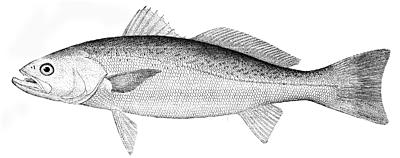
Queen weakfish has an elongated, fusiform, compressed body with an oval cross-section. Its head is low and pointed, without a spongy upper surface, and its moderately sized eye is set above a large oblique mouth with the lower jaw projecting beyond the upper jaw.[1][2][3]
The front of its upper jaws bears one pair of large pointed canine teeth. It has no chin barbels or pores, and its gill rakers are long and slender, with 8–9 lower rakers.[4][5][6]
Its dorsal fin has a long base and a deep notch, with a formula of IX–X + I spines and 19–22 rays. Its anal fin has two small, weak spines and 8–9 rays, while its relatively long pectoral fins have 17–18 rays and reach halfway to the anus.[7][8][9]
The rear edge of its tail has either a blunt point or an S-shaped outline. Its body scales are large and rough, whereas its head scales are smooth, and its soft dorsal and anal fins have basal sheaths three scales wide.[10][11][12]
Its lateral line arches anteriorly and becomes straight well before reaching the level of the anus. It has 54–58 pored lateral-line scales, which are smaller than adjacent scales and have small accessory scales.[13][14][15]
Its coloration is mainly silvery, with a bluish-grey upper surface and black opercle lining. Its fins are clear or whitish, and the tip of its lower jaw is black.[16][17][18]
Habitat
Queen weakfish inhabits coastal waters, including estuaries and river mouths.[19]
Diet
Its recorded prey includes octopuses, squids and cuttlefish. It also feeds on mobile benthic crustaceans such as shrimps and crabs.[20][21]
Classification of the Queen Weakfish
| Kingdom | Animalia |
|---|---|
| Phylum | Chordata |
| Subphylum | Vertebrata |
| Infraphylum | Gnathostomata |
| Parvphylum | Osteichthyes |
| Gigaclass | Actinopterygii |
| Superclass | Actinopteri |
| Class | Teleostei (Teleost) |
| Order | Perciformes |
| Suborder | Percoidei |
| Family | Sciaenidae (Drums) |
| Genus | Cynoscion (Sea Trout) |
| Species | Cynoscion albus (Günther, 1864) |
Where the Queen Weakfish is found
Checklists and occurrence records place Cynoscion albus in 5 countries. GBIF holds 84 georeferenced records of it.
Countries
Regions and cities with the most records
A number beside a place is its count of GBIF occurrence records. A place without a number comes from a checklist alone. Records show where a species has been observed or collected, which can include escapes and vagrants.
Common names
English
- Queen Weakfish
- Whitefin Weakfish
- Queen Corvina
- White Corvina
Names in 4 other languages
- Czech
- smuha ekvádorská
- French
- Acoupa Reine
- Portuguese
- Corvina-lança
- Spanish
- Corvina Alba, Corvinata Reina, corvina chiapaneca, corvina reina
Synonyms
One other scientific name has been used for this species and is now treated as a synonym of Cynoscion albus.
- Otolithus albus Günther, 1864
Related species
-
 Spotted SeatroutCynoscion nebulosus
-
 WeakfishCynoscion regalis
-
 Sand SeatroutCynoscion arenarius
-
 Acoupa WeakfishCynoscion acoupa
-
 Silver SeatroutCynoscion nothus
-
 Striped WeakfishCynoscion striatus
- Jamaica WeakfishCynoscion jamaicensis
- Smallscale WeakfishCynoscion microlepidotus
Compare
Questions and answers
What is the scientific name of the Queen Weakfish?
The scientific name of the Queen Weakfish is Cynoscion albus. Written with its author, the full name is Cynoscion albus (Günther, 1864).
Which family does the Queen Weakfish belong to?
Cynoscion albus belongs to the family Sciaenidae, in the order Perciformes and the class Teleostei.
Where is the Queen Weakfish found?
Checklists and occurrence records place Cynoscion albus in 5 countries: Mexico, Colombia, Panama, Ecuador and Nicaragua.
What is the conservation status of the Queen Weakfish?
The IUCN Red List category recorded for Cynoscion albus is Data Deficient (DD).
What other names does the Queen Weakfish have?
Cynoscion albus is also known in English as Whitefin Weakfish, Queen Corvina and White Corvina.
Sources
Passages the profile rests on
- The species has an elongated, fusiform, compressed body with an oval cross-section. Source passage: “Elongate, fusiform, compressed, oval cross-section” — biogeodb.stri.si.edu
- Its head is low and pointed, without a spongy upper surface. Source passage: “head low, pointed, not spongy on top” — biogeodb.stri.si.edu
- It has a moderately sized eye and a large oblique mouth with the lower jaw projecting beyond the upper jaw. Source passage: “eye moderate; mouth large, oblique, lower jaw projecting beyond upper jaw” — biogeodb.stri.si.edu
- The front of its upper jaws bears one pair of large pointed canine teeth. Source passage: “front of top jaws with 1 pair of large pointed canines” — biogeodb.stri.si.edu
- The species has no chin barbels or pores. Source passage: “no barbels or pores on chin” — biogeodb.stri.si.edu
- Its gill rakers are long and slender, with 8–9 lower rakers. Source passage: “gill rakers long and slender, 8-9 lower rakers” — biogeodb.stri.si.edu
- Its dorsal fin has a long base and a deep notch, with a formula of IX–X + I spines and 19–22 rays. Source passage: “dorsal with long base, deep notch, X (IX-X) + I, 19-22” — biogeodb.stri.si.edu
- Its anal fin has two small, weak spines and 8–9 rays. Source passage: “anal fin with II small (< ½ length of 1st ray) weak spines, 8-9 rays” — biogeodb.stri.si.edu
- Its pectoral fins have 17–18 rays and are relatively long, reaching halfway to the anus. Source passage: “pectoral fins 17-18, relatively long, reaching half way to anus” — biogeodb.stri.si.edu
- The rear edge of its tail has either a blunt point or an S-shaped outline. Source passage: “rear margin of tail with blunt point or S shaped” — biogeodb.stri.si.edu
- Its body scales are large and rough, whereas its head scales are smooth. Source passage: “scales large, rough on body, smooth on head” — biogeodb.stri.si.edu
- Its soft dorsal and anal fins have basal sheaths three scales wide. Source passage: “soft dorsal and anal fins with a basal sheath 3 scales wide” — biogeodb.stri.si.edu
- Its lateral line arches anteriorly and becomes straight well before reaching the level of the anus. Source passage: “lateral line arched anteriorly and straight well before level of anus” — biogeodb.stri.si.edu
- It has 54–58 pored lateral-line scales. Source passage: “pored lateral-line scales 54-58” — biogeodb.stri.si.edu
- Its lateral-line scales are smaller than adjacent scales and have small accessory scales. Source passage: “lateral line scales smaller than adjacent scales, and with small accessory scales.” — biogeodb.stri.si.edu
- Its coloration is mainly silvery, with a bluish-grey upper surface and black opercle lining. Source passage: “Color mainly silvery, bluish-grey above with black opercle lining” — biogeodb.stri.si.edu
- Its fins are clear or whitish. Source passage: “fins clear or whitish” — biogeodb.stri.si.edu
- The tip of its lower jaw is black. Source passage: “tip of lower jaw black” — biogeodb.stri.si.edu
- The species inhabits coastal waters, including estuaries and river mouths. Source passage: “Inhabits coastal waters, including estuaries and river mouths.” — biogeodb.stri.si.edu
- Its recorded prey categories include octopuses, squids, and cuttlefish. Source passage: “Octopus/squid/cuttlefish” — biogeodb.stri.si.edu
- Its recorded prey includes mobile benthic crustaceans such as shrimps and crabs. Source passage: “Mobile benthic crustacea (shrimps/crabs)” — biogeodb.stri.si.edu
Data
- Catalogue of Life, 2026-10-16 XR cc by
- Global Biodiversity Information Facility CC BY 4.0
- Wikidata CC0
- GeoNames CC BY 4.0
- Within the Catalogue of Life, this name comes from World Register of Marine Species cc by
This species in other databases
- Catalogue of Life 6BVLF
- Wikidata Q585172
- iNaturalist 98862
- WoRMS urn:lsid:marinespecies.org:taxname:276075
- ITIS 169254
Page built on 29 November 2026. See how the catalog is made and all sources and licences.
Cite this page
ScientificNames.org. (2026). Cynoscion albus (Queen Weakfish). Retrieved November 29, 2026, from https://scientificnames.org/species/cynoscion-albus
“Cynoscion albus (Queen Weakfish).” ScientificNames.org, 2026, scientificnames.org/species/cynoscion-albus. Accessed 29 Nov. 2026.
ScientificNames.org. “Cynoscion albus (Queen Weakfish).” Accessed November 29, 2026. https://scientificnames.org/species/cynoscion-albus.
@misc{scientificnames_cynoscion_albus_queen_weakfish,
  author = {{ScientificNames.org}},
  title = {Cynoscion albus (Queen Weakfish)},
  year = {2026},
  url = {https://scientificnames.org/species/cynoscion-albus},
  note = {Accessed 2026-11-29}
}